
Writing messaging pillars that influence decisions is not about clever wording or internal alignment alone. Instead, it is about shaping perception, guiding belief, and reducing friction at the moment a choice is made. When messaging pillars are grounded in clarity, relevance, and emotional context, they function as strategic tools rather than static brand assets—an applied expression of Brand strategy at the moment decisions are made. Over time, this clarity helps audiences move from awareness to confidence. As a result, messaging becomes a driver of action, not just communication. These principles reflect a broader approach to brand clarity and decision-driven messaging explored throughout Brand Quarterly, where strategy, perception, and communication intersect.
The real problem is not that brands lack messaging pillars. Rather, most messaging pillars fail to influence anyone in a meaningful way. They often describe what a brand wants to say instead of addressing what an audience needs to hear in order to believe, choose, and commit. Consequently, the message feels disconnected from real decision-making. This disconnect weakens trust and slows momentum.
To write messaging pillars that actually influence decisions, brands must move beyond abstraction and into strategic clarity. That clarity emerges when language aligns with psychology, context, and real-world behavior. At that point, messaging supports how decisions are actually made
How Messaging Pillars That Influence Decisions Are Built
Messaging pillars that influence decisions are built through deliberate structure, not creative instinct alone. First, they begin with a clear understanding of the audience’s mindset at the moment of choice. From there, that insight is translated into language that reduces uncertainty and reinforces confidence. Rather than listing brand attributes, effective pillars focus on what the audience needs to believe in order to move forward. As a result, messaging becomes both intentional and usable.This process is often supported by structured brand strategy services that align messaging with real decision-making behavior.
When developed correctly, each pillar connects strategic intent with emotional relevance. At the same time, it ensures consistency across touchpoints while remaining flexible enough to adapt to context. This balance allows brands to communicate clearly without becoming rigid. Over time, messaging pillars stop functioning as internal guidelines. Instead, they actively shape perception, trust, and decision-making.
What Messaging Pillars Really Are (And Why Most Fail)
At their core, messaging pillars are the foundational themes that support everything a brand communicates. They guide how value, differentiation, and relevance are expressed across channels, campaigns, and conversations. Ideally, they create coherence over time. However, many brands misunderstand their purpose.
Most messaging pillars fail for three clear reasons:
- They are written from an internal perspective rather than an audience lens
- They rely on vague or overused language that lacks meaning
- They fail to connect clearly to moments of decision-making
Words like innovative, customer-first, or future-ready may sound impressive. However, they rarely move anyone closer to action. Influence requires specificity, relevance, and emotional clarity. Without those elements, messaging remains aspirational instead of persuasive. This challenge becomes even more visible during periods of change, as highlighted in Brand Quarterly rebranding insights on maintaining trust while evolving a brand.
Effective messaging pillars do not explain what a brand is. Instead, they articulate why a brand matters when a decision is being made.
Start With the Decision, Not the Brand
The most influential messaging pillars are built backward, starting with the decision your audience is trying to make. Before writing a single line of messaging, it is essential to understand that decision context. Otherwise, messaging risks becoming disconnected from reality. Clarity always starts with intent.
Begin by asking:
- What decision is the audience facing?
- What uncertainty do they perceive?
- What outcome are they hoping to achieve?
- What might cause hesitation or accelerate commitment?
These questions reveal where confidence is fragile. Messaging pillars should exist to strengthen that confidence. People do not make decisions based on brand descriptors alone. Instead, they decide based on clarity, trust, and perceived alignment with their needs or identity. If a pillar does not reduce doubt or reinforce belief, it is not doing its job.
The Difference Between Messaging Pillars and Value Propositions
One of the most common mistakes brands make is confusing messaging pillars with value propositions. Although related, they serve different purposes. Value propositions explain what you offer and why it is valuable. Messaging pillars, on the other hand, reinforce what you consistently communicate to shape perception over time.
Key differences include:
- Value propositions focus on offer and benefit
- Messaging pillars focus on belief and perception
- Value propositions answer what you provide
- Messaging pillars answer why your audience should care
Messaging pillars are not transactional. Instead, they are cumulative and narrative-driven. Each interaction reinforces understanding long before a buying moment occurs. Over time, this repetition shapes belief and accelerates decision-making.
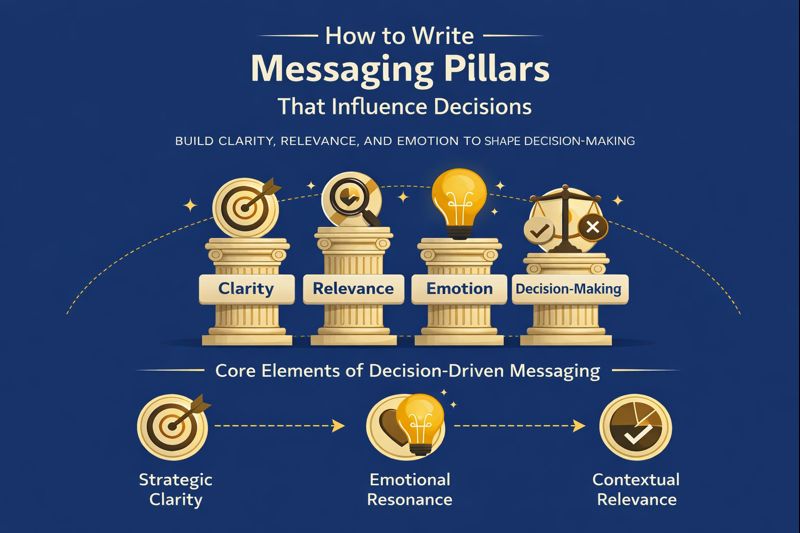
The Three Elements of Decision-Influencing Messaging Pillars
To influence decisions, each messaging pillar must balance logic, emotion, and relevance.
1. Strategic Clarity
A messaging pillar should be immediately understandable. If it requires explanation, it’s too complex or too internal.
Clarity means:
- One clear idea per pillar
- No jargon or abstract phrasing
- Language that reflects how your audience actually speaks and thinks
Clarity builds trust. Confusion creates friction.
2. Emotional Resonance
People justify decisions rationally, but they make them emotionally. Messaging pillars must tap into what the audience cares about, fears, or aspires toward.
This doesn’t mean being sentimental. It means acknowledging:
- Identity (“This brand understands me.”)
- Belonging (“This brand aligns with how I see myself.”)
- Assurance (“Choosing this brand feels safe and smart.”)
Emotion is the bridge between attention and action.
3. Contextual Relevance
A pillar must be relevant to the current reality of your audience. Messaging that worked two years ago may no longer resonate if priorities, pressures, or expectations have shifted.
Relevance comes from:
- Audience research
- Market awareness
- Cultural and industry context
If your messaging pillars don’t reflect the world your audience is navigating, they will feel disconnected, no matter how well written they are.
How Many Messaging Pillars Should You Have?
More messaging pillars do not create more impact. In most cases, three to five pillars is the ideal range. Fewer than three limits nuance and clarity. More than five dilutes focus and weakens consistency.
Each pillar should:
- Support the overall brand narrative
- Address a distinct dimension of decision-making
- Be strong enough to stand on its own
Think of messaging pillars as structural supports. Balance is essential for strength rather than volume.
Writing Messaging Pillars That Are Actually Usable
A messaging pillar only works if it can be used consistently by everyone who represents the brand. That includes marketing teams, leadership, sales, and content creators. If a pillar cannot be applied easily, it will be ignored. Usability matters as much as strategy.
Each pillar should include:
- A clear and concise headline
- A brief explanation of intent and relevance
- Proof points or behaviors that reinforce credibility
This structure keeps messaging practical rather than theoretical.
Common Messaging Pillar Mistakes (And How to Avoid Them)
Even strong brands fall into predictable traps when developing messaging pillars. Often, these mistakes come from prioritizing internal alignment over audience impact. As a result, messaging sounds polished but fails to influence real decisions. Over time, this gap weakens trust and reduces effectiveness.
Common mistakes include:
- Writing only for internal audiences
- Using generic language that lacks differentiation
- Overloading pillars with multiple ideas
- Ignoring the competitive landscape
- Treating pillars as static rather than evolving
Effective messaging becomes memorable. Ineffective messaging fades.
Mistake 1: Writing for Internal Alignment Only
Many messaging pillars are written to satisfy leadership teams rather than the people they are meant to influence. While internal clarity matters, it should never come at the expense of audience understanding.
Fix: Write for audience comprehension first, internal clarity second. If a pillar doesn’t immediately make sense to someone outside your organization, it won’t guide belief or behavior.
Mistake 2: Using Generic Language
Words like innovative, trusted, or customer-first are so widely used they no longer differentiate. Generic language feels safe, but safety rarely influences decisions.
Fix: Replace broad claims with specific outcomes, beliefs, or implications. Precision builds credibility — and credibility drives choice.
Mistake 3: Overloading Pillars With Too Many Ideas
When a single pillar tries to communicate multiple messages, none of them land clearly. Overloaded pillars create confusion rather than confidence.
Fix: Commit to one core idea per pillar. Ruthless prioritization sharpens focus and makes messaging easier to apply consistently across teams and channels.
Mistake 4: Ignoring the Competitive Landscape
Messaging that sounds good in isolation may fall flat when placed next to competitors saying the same thing. Without contrast, differentiation disappears. This is where structured competitor mapping helps clarify contrast and prevents brands from sounding interchangeable.
Fix: Ensure each pillar clearly distinguishes your brand from others in the category. A strong pillar doesn’t just describe who you are — it signals why choosing you feels different and more aligned.
Mistake 5: Treating Pillars as Static
Markets evolve, expectations shift, and language changes. Messaging pillars that never adapt slowly lose relevance, even if they were once effective.
Fix: Review and refine your messaging pillars regularly. Relevance is not maintained through consistency alone — it requires awareness and adjustment.
Testing Whether Your Messaging Pillars Influence Decisions
You do not need a large campaign to test effectiveness. Instead, observation and intent reveal the truth. Messaging that influences decisions shows up in behavior, not just feedback. Patterns matter more than opinions.
Look for:
- Consistent usage across channels
- Natural adoption in sales conversations
- Audience reference or repetition
- Reduced friction in the decision journey
Effective messaging becomes memorable. Ineffective messaging fades.
Messaging Pillars as a Strategic Advantage
When written with discipline and insight, messaging pillars become more than a framework. They become a competitive advantage. Over time, they create consistency without rigidity and enable faster, clearer communication.
Strong messaging pillars help:
- Build trust gradually
- Influence decisions before they are conscious
- Shorten the path from interest to action
- Increase strategic alignment across teams
Ultimately, the strongest brands do not speak louder. They speak more clearly and with purpose.
Conclusion: Influence Comes From Clarity, Not Volume
Messaging pillars that influence decisions are not about saying more. They are about saying the right things in the right way for the right reasons. Clarity always outperforms noise. Precision outperforms volume.
When done well, messaging pillars respect audience intelligence and reflect how decisions are made. In a crowded market, clarity becomes power. And messaging pillars, when built correctly, shape belief, earn trust, and influence choice.
