
Brand positioning is one of the most fundamental concepts in brand strategy, yet it remains widely misunderstood and poorly executed. Many brands invest heavily in visual identity, advertising, and digital marketing without clearly defining what they stand for or why they should be chosen. As a result, they struggle to differentiate, compete on value, or sustain long-term growth.
At its essence, brand positioning defines the unique place a brand occupies in the minds of its target audience relative to competitors. It clarifies meaning, relevance, and perceived value. When positioning is clear and consistently reinforced, it becomes a powerful driver of preference, loyalty, and brand equity. When it is vague or inconsistent, even well-funded brands fail to gain traction.
This article provides a comprehensive and technical guide to brand positioning, covering its definition, strategic importance, core components, positioning strategies, frameworks, real-world examples, common mistakes, and its role in the digital era.
What Is Brand Positioning?
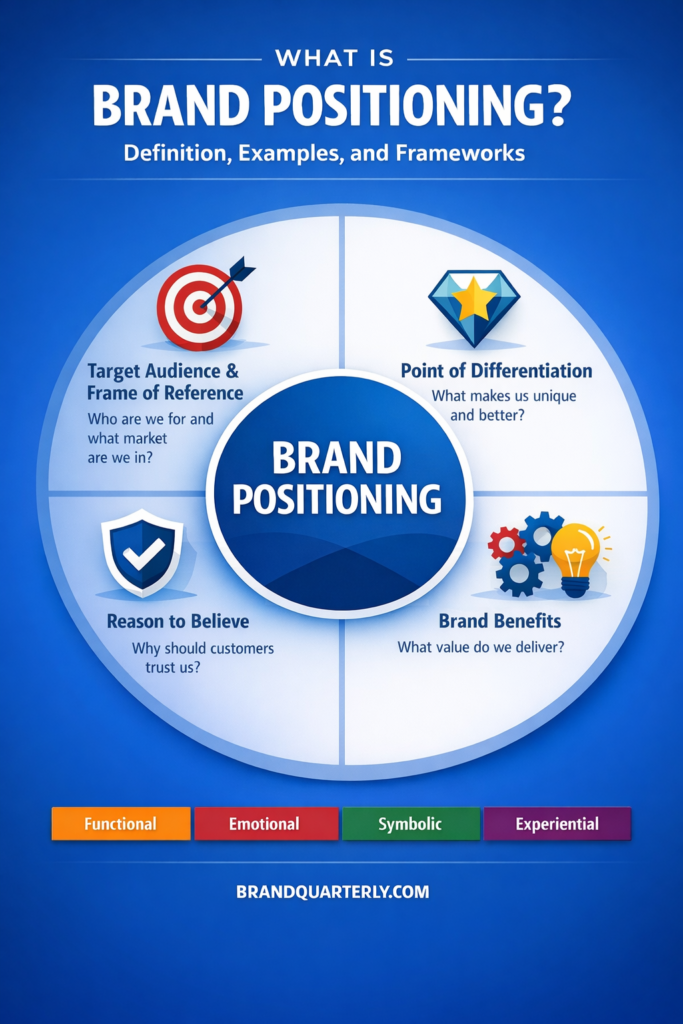
Brand positioning is the strategic process of defining how a brand is intended to be perceived in the minds of a specific target audience, relative to competing alternatives. It establishes the brand’s point of difference, frame of reference, and reason for being chosen.
At a strategic level, brand positioning answers four essential questions:
- Who is the brand for?
- What category does it compete in?
- What makes it meaningfully different?
- Why should customers believe this difference?
Brand positioning is not a slogan or a campaign message. It is an internal strategic foundation that informs marketing, product development, pricing, customer experience, and organizational behavior. When positioning is strong, every brand action reinforces the same core idea.
Brand Positioning vs. Brand Identity
A brand can have a visually polished and professionally designed identity yet still fail in the market if its positioning is weak. Brand identity refers to how a brand looks and sounds—logos, colors, typography, and tone of voice. Brand positioning defines what the brand means and why it matters.
Visual identity can attract attention, but it does not explain relevance or value. Without positioning, identity becomes aesthetic rather than strategic. Over time, this leads to high awareness but low preference. Strong brands always define positioning before identity. Identity should express positioning, not compensate for its absence.
Brand Positioning vs. Brand Image
Brand positioning represents the intended strategic perception a brand seeks to establish. In contrast, brand image reflects the perception actually held by customers, shaped through experiences, interactions, and reputation.
While positioning is controlled internally, image is formed externally. A gap between the two indicates a strategic or operational problem rather than a creative one. Successful brands continuously measure perception and adjust behavior to ensure alignment. When positioning and image reinforce each other, trust and credibility increase. Positioning sets direction; image confirms effectiveness.
Why Brand Positioning Matters
1. Differentiation in Competitive Markets
In most categories, functional differences between products are minimal or easily copied. However, brand positioning allows companies to stand out in the minds of customers by emphasizing meaning rather than just features or price. As a result, customers can recognize why one brand matters more than another, even when products seem similar. This type of differentiation simplifies decision-making and builds preference over time. Ultimately, perceptual differentiation becomes a key source of competitive advantage. This how customers perceive differences shapes how customers evaluate options before rational comparison even begins. When a brand owns a clear position, it reduces mental effort and simplifies decision-making. Over time, this mental shortcut becomes a source of competitive advantage. Brands without differentiation are forced into feature wars or price competition. Strong positioning elevates brands above transactional choice.
2. Strategic Consistency
Clear brand positioning aligns teams across marketing, product, sales, and leadership. It provides a shared strategic lens for decision-making. When positioning is defined, teams evaluate initiatives based on alignment rather than opinion. This reduces internal friction and accelerates execution. Consistency across touchpoints reinforces brand meaning externally. Internally, it creates focus and discipline. Over time, consistency strengthens recognition and trust. Fragmented positioning leads to fragmented perception.
3. Pricing Power
Well-positioned brands experience lower price sensitivity. As a result, when customers understand and value a brand’s unique positioning, they are more willing to pay a premium. Consequently, price becomes a signal of meaning rather than a barrier. Positioning reframes value beyond functional utility. As a result, brands rely less on discounts to drive demand. Strong positioning also protects margins during competitive pressure. Brands with weak positioning are far more vulnerable to price erosion.
4. Long-Term Brand Equity
Brand positioning is built over time. As a result, consistent reinforcement over time builds strong memory structures that increase brand salience, preference, and loyalty. Furthermore, these structures strengthen customer trust and long-term engagement. Each aligned interaction strengthens mental associations in the customer’s mind. These associations reduce perceived risk and increase confidence in choice. As familiarity grows, switching costs increase. This compounding effect transforms positioning into durable brand equity. Equity enables growth, resilience, and long-term profitability. It cannot be built through short-term campaigns alone.
Core Components of Brand Positioning
A robust brand positioning strategy consists of several interrelated components that must work together coherently. Weakness in one component undermines the entire positioning system. Strategic clarity emerges from alignment, not isolated decisions. Effective positioning is both focused and defensible. Each component plays a distinct role in shaping perception. Together, they create a unified brand meaning. Brands that treat components separately often struggle with inconsistency.
Target Audience
Effective brand positioning begins with a clearly defined target audience. This involves demographics, psychographics, motivations, unmet needs, and decision contexts. Without clarity, positioning becomes vague and loses impact. By contrast, precise targeting makes the brand more relevant and memorable. In addition, understanding audience behavior guides better messaging and product decisions. Understanding why customers choose is more important than knowing who they are. Precision allows brands to be relevant rather than generic. Vague audiences lead to vague positioning. Broad targeting dilutes differentiation. Focus increases memorability and preference.
Frame of Reference
The frame of reference defines the category or competitive set in which the brand operates. It answers the question: What type of brand is this?
Examples include:
- Luxury fashion
- Enterprise software
- Sustainable consumer goods
- Performance sportswear
Choosing the right frame of reference is strategic because it shapes customer expectations and competitive comparisons. A narrow frame may limit growth, while a broad frame may invite stronger competitors. Clear categorization reduces confusion. Customers must understand what the brand is before appreciating how it is different.
Point of Differentiation
The point of differentiation is the primary reason the brand is meaningfully different and superior in the eyes of the target audience. It defines why the brand is chosen over alternatives.
Effective differentiation must be:
- Relevant to customer needs
- Distinctive relative to competitors
- Hard for competitors to copy
Superficial or generic differentiation rarely sustains advantage. True differentiation is rooted in capabilities, culture, or systems. It must be consistently visible across touchpoints. When executed well, differentiation simplifies choice. Ownership—not novelty—is the goal.
Reason to Believe
Positioning claims must be credible. Reasons to believe provide proof that supports the brand’s differentiation. They reduce skepticism and build trust.
These may include:
- Product features or performance
- Intellectual property or patents
- Expertise or heritage
- Social proof or endorsements
- Cultural authority or leadership
Without credibility, positioning becomes empty messaging. Over time, consistent proof reinforces belief. Trust is earned through behavior, not declarations.
Types of Brand Positioning Strategies
Brands can adopt different positioning approaches depending on market dynamics and organizational strengths. No single strategy is universally superior. Effectiveness depends on alignment with customer motivation and category context. Strong brands often blend multiple approaches with a clear primary focus. Strategic choice matters more than creativity. The wrong positioning type weakens relevance. Clarity determines success.
Functional Positioning
Functional positioning emphasizes practical benefits such as performance, efficiency, or quality. It works best in utility-driven categories.
Example: A software platform positioned as the fastest or most secure solution.
Emotional Positioning
Emotional positioning focuses on how the brand makes customers feel. It builds attachment beyond rational evaluation.
Example: Brands associated with confidence, freedom, belonging, or nostalgia.
Symbolic Positioning
Symbolic positioning connects the brand to identity, status, or self-expression.
Example: Luxury brands that signal prestige and social distinction.
Experiential Positioning
Experiential positioning emphasizes the holistic experience across touchpoints.
Example: Hospitality or lifestyle brands focused on atmosphere, service design, and community.
Brand Positioning Frameworks
Strategists use frameworks to structure, articulate, and validate brand positioning decisions. Frameworks provide discipline and shared language. They prevent vague or generic positioning. While no framework is universal, each offers a useful lens. The value lies in strategic thinking, not rigid templates. Frameworks support clarity and alignment. Strategy must serve the brand, not the model.
1. The Classic Positioning Statement
A traditional positioning statement follows this format:
For [target audience], [brand] is the [category] that [point of differentiation] because [reason to believe].
Although not consumer-facing, this statement ensures strategic clarity and internal alignment. It acts as a filter for decision-making. If an initiative does not align, it should be questioned. Simplicity is its strength. Discipline keeps it effective.
2. The Brand Key Model
Popularized by Unilever, the Brand Key model includes:
- Root strength
- Competitive environment
- Target
- Insight
- Benefits
- Values and personality
- Reasons to believe
- Discriminator
- Brand essence
This framework integrates positioning into a broader brand system. It links functional benefits to emotional meaning. It is particularly useful for large or complex brand portfolios. Depth distinguishes it from simpler models.
3. Jobs-to-Be-Done (JTBD)
The JTBD framework positions brands around the underlying “job” customers hire them to do, rather than demographic traits. It focuses on progress rather than people.
Example: A ride-sharing service positioned around convenience rather than transportation.
This approach uncovers hidden motivations. It is especially effective for innovation and category disruption. Clarity is essential to avoid abstraction. Insight drives effectiveness.
4. Perceptual Mapping
Perceptual maps visualize how brands are perceived across key dimensions such as price and quality. They reveal competitive clusters and white space. These maps reflect perception, not objective reality. Their value depends on selecting meaningful dimensions. When used correctly, they guide differentiation decisions. They also help track positioning shifts over time. Visualization enhances strategic discussion.
Common Brand Positioning Mistakes
- Trying to appeal to everyone
- Copying competitor positioning
- Relying on generic claims such as “quality” or “innovation”
- Failing to align internal culture with external positioning
- Treating positioning as a campaign rather than a long-term strategy
Positioning is not what a brand wants to be known for—it is what it can credibly own. Commitment determines success.
Brand Positioning in the Digital Era
Digital platforms have increased transparency, competition, and speed. As a result:
- Positioning must be reinforced across many micro-touchpoints
- Consistency matters more than frequency
- Community and culture play a larger role in perception
Every interaction reinforces or erodes positioning. Micro-moments accumulate into brand meaning. Strong positioning provides coherence amid fragmentation. It enables adaptation without dilution. Strategy remains the anchor in constant change.
Conclusion
Brand positioning is the strategic backbone of every successful brand. It defines how a brand is understood, remembered, and chosen in competitive markets. Without clear positioning, even well-designed and well-marketed brands struggle to sustain relevance and preference.
Effective brand positioning aligns internal teams, enables differentiation, and builds long-term brand equity through consistent reinforcement. In an increasingly complex and transparent marketplace, positioning provides clarity and focus.
Ultimately, brand positioning is not about what a brand claims—it is about what it can consistently and credibly own over time.
