
In today’s competitive business environment, a brand is much more than a logo, slogan, or product. Successful brands have a clear brand purpose, a guiding principle that explains why they exist beyond making profits. This purpose is the foundation that informs every decision, shapes customer perception, and drives loyalty. Consumers today, especially Millennials and Gen Z, increasingly gravitate toward brands that align with their values and demonstrate a meaningful “why.”
Understanding your brand purpose is no longer optional—it’s essential for long-term growth and relevance. It not only differentiates your brand but also provides employees and stakeholders with a sense of direction and shared mission. In this article, we will break down how to define your brand purpose, explore its benefits, and offer actionable steps to integrate it into your marketing strategy.
What Is Brand Purpose?
Brand purpose is the reason your brand exists beyond profit-making. While many companies focus solely on revenue or market share, purpose-driven brands operate with a higher goal that resonates emotionally with their audience. A strong brand purpose reflects your values, mission, and the impact you want to create in the world.
For example, brands like Patagonia and TOMS have built entire identities around their purpose. Patagonia’s commitment to environmental sustainability and TOMS’ social mission of providing shoes for children in need go far beyond selling products—they create an emotional connection that inspires loyalty. A clear brand purpose communicates authenticity, making your brand relatable and trustworthy.
Defining brand purpose isn’t just a marketing exercise; it influences culture, strategy, and customer relationships. Companies with a clear purpose tend to outperform competitors because they inspire both employees and consumers. Therefore, understanding the concept and embedding it in your organization is critical for long-term success.
Why Brand Purpose Matters
Defining your brand purpose has tangible and intangible benefits for your business. First, it provides clarity and direction. When every team member understands why the brand exists, decisions across marketing, product development, and customer service become more aligned.
Second, brand purpose strengthens customer loyalty. Consumers are more likely to support a brand whose values reflect their own. A purpose-driven brand encourages repeat purchases, positive word-of-mouth, and advocacy because it connects on a deeper emotional level.
Third, it attracts top talent. Employees today seek meaningful work, and organizations with clear values and purpose are more likely to attract and retain motivated individuals. Finally, brands with a strong purpose often enjoy resilience during crises, as customers and stakeholders perceive them as authentic and committed rather than opportunistic.
How to Identify Your Brand Purpose
Defining your brand purpose is a reflective and strategic process. It requires an honest assessment of your brand’s mission, values, and unique contribution to the world. Here are practical steps to help identify your brand purpose:
1. Start With Why
Ask yourself: why does your brand exist beyond selling products or services? The “why” should capture your brand’s deeper mission and the positive impact it seeks to create. Simon Sinek’s famous framework, Start With Why, emphasizes that clarity of purpose drives loyalty and inspiration more than features or benefits.
Your brand’s “why” should be clear, concise, and emotionally resonant. Avoid generic statements like “we want to be the best in our industry.” Instead, focus on a purpose that communicates contribution, change, or transformation. For example, Airbnb’s purpose is to “create a world where anyone can belong anywhere.” This goes far beyond simply providing short-term accommodations.
2. Reflect on Your Values
Brand purpose and values are deeply interconnected. Values act as guiding principles that shape how your brand operates internally and externally. Consider what principles your brand refuses to compromise on. Are you committed to sustainability, social responsibility, innovation, or customer-centricity?
By aligning purpose with values, you create a coherent identity that feels authentic. Values also guide decision-making and culture within your organization. For instance, Ben & Jerry’s purpose of promoting social justice is reflected in their values, actions, and even product campaigns. This consistency strengthens credibility and reinforces your brand purpose.
3. Understand Your Audience
Your brand purpose should resonate not only internally but also with your target audience. Conduct research to understand their needs, values, and aspirations. Ask: what problems do they care about? What motivates their purchasing decisions?
A purpose that aligns with your audience creates meaningful engagement. Consumers today want brands to take a stand on social, environmental, and ethical issues. By understanding your audience’s values, you can craft a purpose that inspires loyalty, advocacy, and trust. Remember, a purpose irrelevant to your audience will fail to create emotional connection, no matter how noble it may seem.
4. Analyze Your Market and Competitors
While purpose should be unique, it’s important to understand the broader market context. Look at your competitors: what is their purpose? How do they communicate it? Identifying gaps and opportunities can help differentiate your brand.
Your goal is to create a purpose that is authentic, unique, and defensible. Differentiation ensures your brand stands out in a crowded market. It also prevents your purpose from sounding like generic marketing rhetoric, which savvy consumers quickly recognize. A well-defined purpose gives your brand a distinct identity that cannot easily be replicated.
5. Translate Purpose Into Action
A brand purpose is only meaningful if it drives real-world action. Consider how your purpose can be embedded in your products, services, marketing campaigns, and corporate culture. Consumers expect brands to “walk the talk.”
For example, a company focused on sustainability should implement environmentally friendly practices in sourcing, production, and packaging. Similarly, a purpose-driven brand in the tech sector might support digital literacy programs or ethical AI research. Translating purpose into measurable action creates credibility and reinforces your commitment to making a difference.
Examples of Strong Brand Purpose
Looking at successful brands can provide clarity on how purpose works in practice. Here are a few examples:
- Patagonia: Purpose—“We’re in business to save our home planet.” Patagonia’s environmental activism drives product innovation, marketing campaigns, and corporate culture, making sustainability the brand’s core identity.
- TOMS: Purpose—“We improve lives through business.” TOMS pioneered the one-for-one model, linking every purchase to social impact and creating a loyal community around purpose.
- Warby Parker: Purpose—“To offer designer eyewear at a revolutionary price while leading the way for socially conscious businesses.” Their model includes donating glasses to those in need, aligning profit with purpose.
These brands prove that purpose resonates when it is authentic, actionable, and consistently communicated.
How to Communicate Your Brand Purpose
Defining your brand purpose is only half the battle; communicating it effectively is equally important. Your audience should easily understand what you stand for and why it matters.
1. Embed Purpose in Your Storytelling
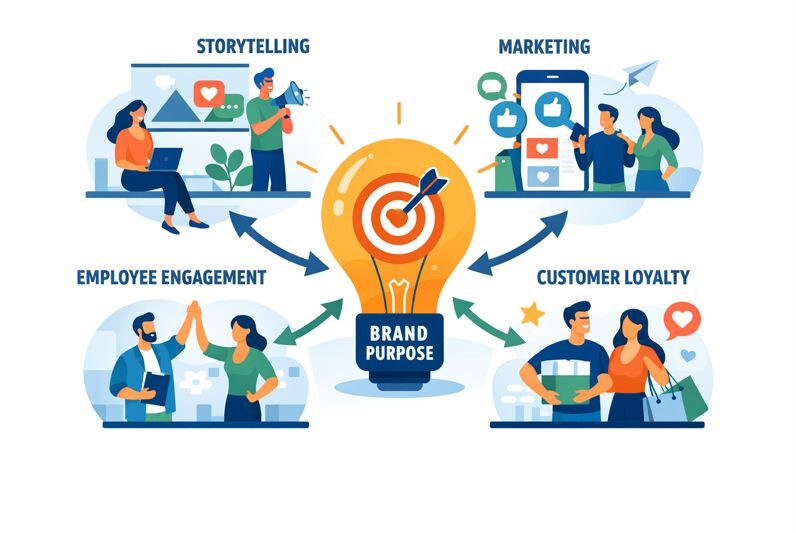
Storytelling is one of the most powerful tools for communicating purpose. Use narratives to show how your brand solves problems, creates impact, and lives its values. Authentic stories resonate emotionally, making your purpose memorable and relatable. Share real-life examples, customer experiences, or behind-the-scenes stories that illustrate your brand’s commitment to its purpose. The more personal and tangible the story, the easier it is for your audience to connect and see your brand as authentic. Over time, consistent storytelling builds a narrative that reinforces your purpose and strengthens brand loyalty.
2. Align Marketing Channels
Purpose should be visible across all touchpoints: website, social media, advertising, packaging, and customer interactions. Consistency reinforces credibility and trust. For example, Nike consistently integrates purpose-driven storytelling in its campaigns, such as empowering athletes and promoting inclusivity. Aligning your brand purpose with a comprehensive brand strategy ensures that every touchpoint works together to reinforce your identity. By integrating purpose into your overall strategy, you create a cohesive experience that strengthens customer trust, loyalty, and recognition across all channels. Beyond messaging, consider how your purpose informs design, tone of voice, and customer experience at every channel. Whether it’s a social media post, an email newsletter, or product packaging, your purpose should be recognizable and coherent. This unified approach ensures that your audience experiences your brand purpose no matter where they interact with your brand.
3. Leverage Employee Advocacy
Employees are ambassadors of your brand purpose. Internal alignment ensures that your purpose is reflected in every interaction, from customer service to corporate decision-making. Encourage employees to share their experiences and engage in purpose-driven initiatives, creating authenticity that resonates externally. Employee advocacy can also amplify your message on social media, helping reach new audiences and reinforce credibility. Providing training and resources so employees understand and embody the brand purpose ensures that the culture and messaging remain consistent. When employees are genuinely inspired by the purpose, it becomes a self-sustaining force that strengthens both internal culture and external perception.
Measuring the Impact of Brand Purpose
Brand purpose is more than a feel-good concept; it has measurable outcomes. You can evaluate the impact of your purpose through both qualitative and quantitative metrics.
- Customer Loyalty: Track repeat purchase rates, Net Promoter Score (NPS), and social engagement to gauge emotional connection.
- Brand Equity: Monitor perception surveys, online mentions, and sentiment analysis to see how purpose influences reputation.
- Employee Engagement: Measure retention, satisfaction, and participation in purpose-driven initiatives to understand internal alignment.
- Financial Performance: While purpose is not only about profits, studies show that purpose-driven companies often outperform competitors in long-term growth.
By measuring these outcomes, you can refine and strengthen your purpose over time, ensuring it continues to drive value.
Common Mistakes to Avoid
While defining a brand purpose is powerful, many brands fail to leverage it effectively. Common mistakes include:
- Being Generic: Avoid vague statements that could apply to any brand. Your purpose should be distinctive and specific.
- Lack of Action: Purpose without action appears inauthentic. Consumers expect brands to demonstrate commitment.
- Ignoring Audience Needs: A purpose that doesn’t resonate with your audience won’t create loyalty or engagement.
- Inconsistent Communication: Purpose should permeate every touchpoint, or it risks being seen as marketing fluff.
Awareness of these pitfalls ensures your brand purpose is authentic, actionable, and impactful.
Conclusion
Defining your brand purpose is not a marketing trend—it’s a strategic imperative for modern businesses. A clear purpose inspires loyalty, drives differentiation, aligns employees, and enhances long-term growth. By understanding your “why,” reflecting your values, connecting with your audience, and translating purpose into action, your brand can achieve both business success and meaningful societal impact.
Brands that succeed in defining and living their purpose create deep emotional connections that endure beyond products and promotions. Your brand purpose is your North Star—a guiding principle that shapes every decision, story, and interaction. Start today, and build a brand that doesn’t just exist but truly matters.
