
Understanding qualitative vs quantitative methods is essential for anyone working with data, research, or business intelligence. These two intelligence approaches shape how organizations collect insights, interpret information, and make strategic decisions related to brand positioning. While some rely on numbers and measurable data, others focus on human behavior and context. Knowing when to use each method can significantly improve the quality of your decisions. In this guide, we break down how qualitative and quantitative intelligence methods differ and how they work together.
Instead of viewing these approaches as competing frameworks, forward-thinking organizations treat them as complementary lenses. One reveals patterns at scale, while the other explains the meaning behind those patterns. If you rely only on numbers, you risk missing context. If you depend solely on opinions, you may lack proof.
This article breaks down both methods in a practical, real-world way. You will learn not just what they are, but when they work best, where they fall short, and how to combine them for stronger decision-making. Whether you’re running a business, managing data, or building a strategy, mastering both approaches is no longer optional—it’s essential. Understanding both approaches is a key part of effective brand strategy, where decisions must balance data and human insight.
What Intelligence Methods Really Mean in Practice
In simple terms, intelligence methods are structured ways of turning raw information into something useful. However, in practice, they go far beyond data collection. They involve filtering noise, identifying relevance, and translating findings into action.
Organizations today are flooded with data, but without the right method, that data becomes overwhelming rather than helpful. Intelligence methods provide the framework needed to interpret what matters and what doesn’t.
There are two dominant approaches. One relies on measurable evidence, often expressed through numbers, percentages, and statistical outputs. The other focuses on meaning, interpretation, and human insight. Both aim to answer questions, but they do so in very different ways. This is why understanding qualitative vs quantitative methods is critical for choosing the right approach.
Understanding this distinction helps avoid a common mistake: choosing a method based on convenience rather than suitability. The right method depends on the problem you are trying to solve, not just the data you already have.
Qualitative vs Quantitative Methods: Qualitative Intelligence Explained
Qualitative intelligence methods are all about understanding depth rather than scale. Instead of asking “how many,” they ask “why” and “how.” These methods are designed to uncover motivations, perceptions, and underlying reasons behind behavior especially when defining a target audience.
For example, if a company notices declining sales, quantitative data might show the drop, but qualitative methods help explain why it is happening. Customer interviews, feedback sessions, and observational studies provide insight into emotions, expectations, and frustrations.
One of the defining features of qualitative intelligence is its flexibility. Researchers are not locked into rigid formats. They can adapt questions, explore unexpected directions, and follow insights as they emerge. This makes qualitative methods especially useful in uncertain or evolving environments.
Another important aspect is context. Qualitative data does not exist in isolation. It is tied to real-world situations, cultural influences, and human experiences. This makes the insights richer, but also more complex to interpret.
Ultimately, qualitative intelligence is less about proving something and more about understanding it deeply. In the broader discussion of qualitative vs quantitative methods, this depth is what makes qualitative insights so valuable.
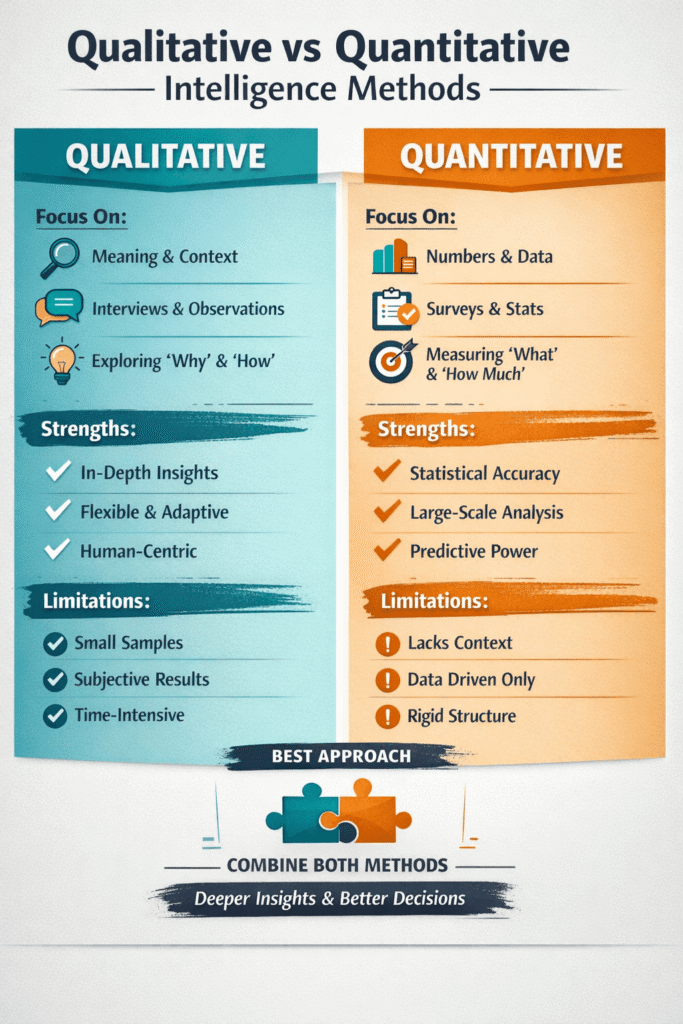
Core Traits of Qualitative Approaches
Qualitative methods stand out because they prioritize meaning over measurement. Instead of large datasets, they work with smaller, carefully selected samples that provide detailed perspectives. This approach is often used in customer segmentation, where deeper insights into specific groups are more valuable than broad generalizations.
Another defining trait is open-ended interaction. Participants are not restricted to predefined answers, which often leads to unexpected insights. These unstructured responses can reveal patterns that would never appear in a spreadsheet.
However, this flexibility comes with a trade-off. Since the process is less standardized, results can vary depending on how the research is conducted. Interpretation also plays a major role, meaning the analyst’s perspective can influence conclusions.
Despite this, qualitative methods are incredibly valuable when dealing with complex or sensitive topics. They capture nuances that numbers simply cannot represent. In many cases, they provide the missing layer that turns data into actionable intelligence.
This is why industries focused on human behavior—like marketing, design, and leadership—rely heavily on qualitative insights.
Strengths of Qualitative Intelligence
One of the biggest advantages of qualitative intelligence is its ability to reveal hidden drivers behind decisions. It goes beyond surface-level observations and digs into motivations, beliefs, and emotional triggers. This is something numbers alone cannot achieve.
Another strength is adaptability. Researchers can adjust their approach in real time, allowing them to explore new angles as they emerge. This makes qualitative methods particularly effective in exploratory research where the problem is not fully defined.
Qualitative insights also tend to be more relatable. Because they are rooted in real human experiences, they are easier for decision-makers to understand and connect with. This often leads to more intuitive and empathetic strategies.
Additionally, these methods are excellent for innovation. Many breakthrough ideas come from understanding unmet needs rather than analyzing existing data. Qualitative research helps uncover those opportunities.
However, the true power of qualitative intelligence lies in its ability to provide meaning, not just information.
Limitations of Qualitative Intelligence
Despite its depth, qualitative intelligence has clear limitations that must be acknowledged. One of the most significant is scalability. Because it relies on smaller samples, it cannot easily represent large populations.
Another challenge is subjectivity. Since interpretation plays a key role, different researchers may draw different conclusions from the same data. This can create inconsistencies if not carefully managed.
Time is also a factor. Conducting interviews, analyzing responses, and identifying themes requires significant effort. Compared to automated data analysis, qualitative research is often slower and more resource-intensive.
There is also the issue of validation. Unlike quantitative data, qualitative findings are harder to verify through replication. This makes them less suitable for decisions that require high levels of certainty.
For these reasons, qualitative methods are most effective when used alongside quantitative data rather than on their own.
Qualitative vs Quantitative Methods: Quantitative Intelligence Explained
Quantitative intelligence methods take a completely different approach. Instead of focusing on meaning, they focus on measurement. The goal is to produce clear, objective results that can be tested and validated.
These methods rely on structured data collection techniques such as surveys, experiments, and analytics tools. The data is then analyzed using statistical models to identify patterns and relationships.
For example, a business might use quantitative methods to track sales performance, measure customer retention, or forecast future demand. Businesses often apply quantitative methods in areas like competitive analysis to measure performance, benchmark against rivals, and track market trends.
These insights are expressed in numbers, making them easy to compare and evaluate.
One of the key advantages of quantitative intelligence is its ability to handle large datasets. With the right tools, organizations can analyze massive amounts of information quickly and efficiently.
This makes quantitative methods essential for data-driven decision-making in today’s digital environment.
Core Traits of Quantitative Approaches
Quantitative methods are defined by structure and consistency. Every step of the process—from data collection to analysis—is standardized to ensure reliability. This allows results to be replicated and verified.
Another key trait is objectivity. By relying on numerical data, quantitative methods minimize personal bias. This makes the findings more credible, especially in high-stakes decision-making scenarios.
Large sample sizes are also a defining feature. The more data collected, the more accurate and generalizable the results become. This is particularly important for identifying trends and making predictions.
However, this structure also limits flexibility. Researchers must define variables in advance, which can restrict the scope of analysis. Unexpected insights are less likely to emerge compared to qualitative methods.
Even so, quantitative intelligence remains the backbone of modern analytics and performance measurement.
Strengths of Quantitative Intelligence
Quantitative intelligence excels in providing clarity and precision. It transforms complex data into clear metrics that can be easily interpreted and compared. This makes it highly effective for tracking performance and measuring success.
Another major strength is scalability. Large datasets can be analyzed quickly using advanced tools, allowing organizations to operate at a much larger scale. This is particularly valuable in industries like finance, e-commerce, and technology.
Quantitative methods are also ideal for testing hypotheses. By using statistical analysis, researchers can determine whether a relationship exists between variables and how strong that relationship is.
Additionally, the results are highly reliable when the data is accurate. This makes quantitative intelligence a trusted foundation for strategic decisions.
However, while it provides strong evidence, it does not always explain the reasons behind the numbers.
Limitations of Quantitative Intelligence
The biggest limitation of quantitative intelligence is its lack of context. Numbers can show what is happening, but they rarely explain why. This can lead to incomplete or misleading conclusions if used in isolation.
Another issue is dependency on data quality. If the data is flawed, outdated, or incomplete, the results will also be unreliable. This makes data validation a critical step in the process.
Quantitative methods also struggle with complexity. Human behavior, emotions, and cultural factors are difficult to capture in numerical form. As a result, important insights may be overlooked.
There is also a risk of over-reliance on metrics. Organizations may focus too much on measurable outcomes and ignore qualitative factors that are equally important.
For these reasons, quantitative intelligence should always be interpreted within a broader context.
Qualitative vs Quantitative Methods: Depth vs Scale
At its core, the difference between qualitative and quantitative intelligence comes down to depth versus scale. Qualitative methods go deep into specific issues, while quantitative methods cover a broader range of data.
Qualitative intelligence provides meaning, context, and explanation. Quantitative intelligence provides measurement, comparison, and validation. Both are valuable, but they serve different purposes.
Another key difference is how insights are generated. Qualitative methods are exploratory and flexible, while quantitative methods are structured and confirmatory. This affects how each method is used in the decision-making process.
Instead of choosing one over the other, the most effective approach is to use both strategically. Each method fills gaps left by the other, creating a more complete picture.
This balanced approach is what separates data-driven organizations from truly intelligent ones.
When to Use Qualitative vs Quantitative Methods
Choosing the right method depends on the question you are trying to answer. If you need to understand motivations, perceptions, or experiences, qualitative methods are the better choice.
On the other hand, if you need measurable results, trend analysis, or statistical validation, quantitative methods are more appropriate.
In many cases, the best approach is sequential. Start with qualitative research to explore the problem, then use quantitative methods to test and validate findings.
This combination allows organizations to move from insight to evidence in a structured way. It reduces risk and improves decision quality.
Ultimately, the goal is not to choose a method, but to choose the right method at the right time.
Why Combining Both Methods Is the Smartest Strategy
The most successful organizations do not rely on a single approach. They integrate qualitative and quantitative intelligence to create a more complete understanding of their environment.
For example, a company might analyze customer data to identify a trend, then conduct interviews to understand the reasons behind it. This combination provides both evidence and explanation.
Mixed-method approaches also improve accuracy. When findings from one method align with the other, confidence in the results increases significantly.
Additionally, combining methods allows for more innovative thinking. It encourages teams to look beyond numbers and consider the human side of data.
In a world where data is abundant but insight is scarce, this balanced approach is a major competitive advantage.
Conclusion
Qualitative and quantitative intelligence methods are not rivals—they are partners in effective decision-making. Each brings unique strengths and addresses different aspects of a problem.
Qualitative methods provide depth, context, and human understanding. Quantitative methods deliver precision, scale, and measurable evidence. Together, they create a powerful framework for analyzing complex challenges.
Organizations that understand how to use both methods effectively are better equipped to adapt, innovate, and grow. They do not just collect data—they understand it.
In the end, the true value of intelligence lies not in the method itself, but in how it is applied. By combining both approaches, you move closer to decisions that are not only informed but truly intelligent.
