
In the modern digital marketplace, brands are constantly being discussed across countless online platforms. Social media networks, news outlets, blogs, review sites, and online communities generate massive volumes of conversations every minute. For businesses, keeping track of these discussions is critical because public perception can shape purchasing decisions, influence reputation, and impact long-term growth. However, monitoring these conversations manually is unrealistic due to the scale and speed of digital communication.
Automation tools for brand monitoring are crucial for businesses that want to stay on top of online conversations, track brand mentions, and manage their reputation effectively. These platforms help organizations analyze audience sentiment, identify emerging trends, and respond to discussions in real time across social media, blogs, news sites, and forums. By leveraging automation tools for brand monitoring, companies gain a clear understanding of how customers and the wider public perceive their brand. Using these systems not only improves responsiveness but also provides actionable insights that guide marketing strategies and strengthen brand credibility.
Brand monitoring automation also enables marketing teams to shift their focus from manual data collection to strategic decision-making. Instead of spending hours searching for brand mentions, businesses can rely on intelligent dashboards and automated reports that highlight meaningful insights. This data-driven approach helps companies respond quickly to customer feedback and manage their reputation more effectively.
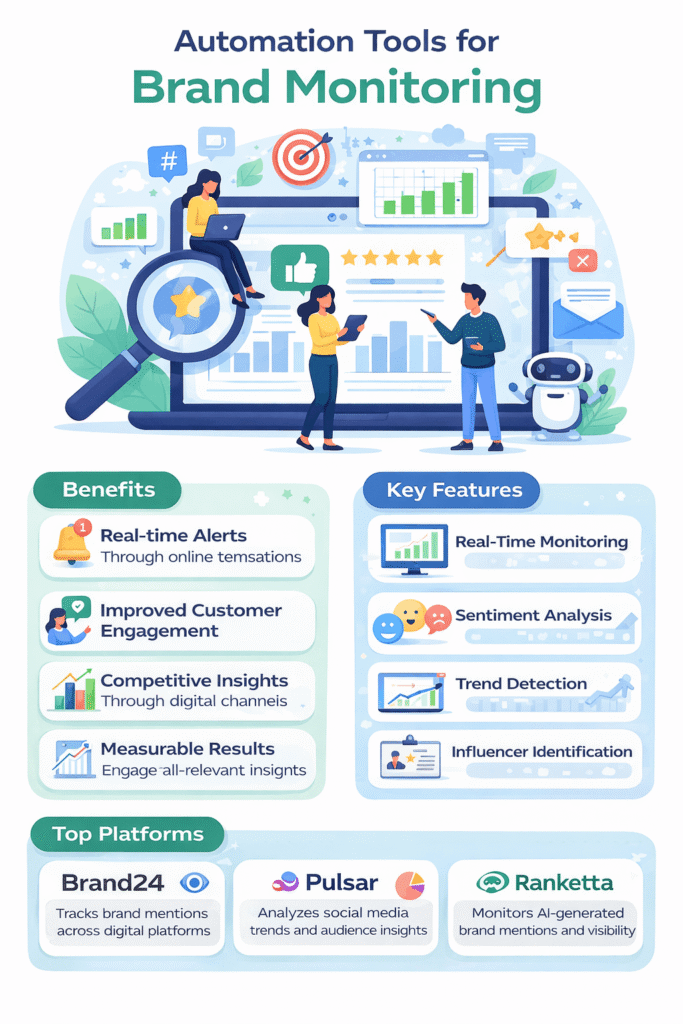
In this article, we will explore the role of automation in brand monitoring, explain why it has become essential for modern businesses, and discuss the features that define effective monitoring tools. We will also examine three platforms—Brand24, Pulsar, and Ranketta—that help organizations automate brand tracking and gain deeper insights into online conversations.
Understanding Brand Monitoring
Brand monitoring refers to the practice of tracking and analyzing online discussions related to a specific brand, product, service, or organization. These discussions can occur on a wide range of digital platforms, including social media, blogs, news sites, forums, review platforms, and video channels. Monitoring these conversations helps companies understand how their brand is perceived by customers and the broader market.
The goal of brand monitoring is not only to track mentions but also to interpret what those mentions mean. Businesses want to know whether people are speaking positively or negatively about their products, what concerns customers may have, and what trends are emerging in their industry. This information provides valuable feedback that can guide marketing strategies, product improvements, and customer service initiatives.
In the past, companies attempted to monitor brand discussions manually by searching for keywords or reviewing social media posts individually. While this approach could work on a small scale, it quickly became impractical as digital communication expanded. Today, millions of pieces of content are published every day, making manual monitoring inefficient and unreliable.
Automated brand monitoring tools address this challenge by scanning thousands of online sources simultaneously. These tools collect and organize data from multiple channels, allowing businesses to view all relevant conversations in one centralized platform. This makes it easier to identify important discussions and respond quickly to customer feedback.
Another important aspect of brand monitoring is competitive intelligence. Companies can track mentions of competing brands and analyze how those brands are perceived in the market. By comparing these insights with their own brand data, organizations can identify opportunities to improve their positioning and differentiate themselves from competitors.
The Importance of Automation in Brand Monitoring
Automation has transformed brand monitoring from a manual task into a highly efficient and scalable process. The primary advantage of automation is its ability to process vast amounts of information quickly and continuously. Automated tools can monitor digital channels around the clock, ensuring that businesses never miss important conversations about their brand.
Real-time monitoring is one of the most valuable benefits of automation. When a brand is mentioned online, automated tools can immediately notify the relevant team through alerts or dashboards. This allows organizations to respond quickly to customer concerns, engage with positive feedback, or address potential reputation risks before they escalate.
Another critical advantage of automation is advanced sentiment analysis. Modern monitoring platforms use artificial intelligence and natural language processing to evaluate the tone of online conversations. By categorizing mentions as positive, negative, or neutral, businesses can quickly assess the overall perception of their brand.
Automation also allows companies to monitor a larger number of keywords and topics simultaneously. This scalability is especially important for organizations that operate across multiple markets or offer a wide range of products. Automated systems can track thousands of keywords and phrases at once, ensuring comprehensive monitoring coverage.
Finally, automation significantly improves productivity within marketing teams. By automating data collection and analysis, businesses can spend more time interpreting insights and developing strategies. This enables teams to focus on improving brand engagement rather than simply gathering information.
Key Features of Automation Tools for Brand Monitoring
Automation tools for brand monitoring typically offer a variety of features designed to help businesses track, analyze, and respond to online conversations. Understanding these features can help organizations choose the most suitable platform for their needs.
One of the most important capabilities is real-time mention tracking. Monitoring tools continuously scan the internet for brand mentions across social media platforms, blogs, forums, and news websites. When a relevant mention is detected, the system records it and often sends an alert to the user. This ensures that businesses remain aware of conversations happening around their brand.
Sentiment analysis is another key feature of modern monitoring tools. By using artificial intelligence to interpret language patterns, these platforms can determine whether a conversation expresses positive, negative, or neutral sentiment. This allows companies to measure public opinion and track changes in brand perception over time.
Data visualization and reporting features also play an essential role. Most monitoring tools provide dashboards that display metrics such as mention volume, audience reach, engagement levels, and sentiment trends. These visual insights make it easier for marketing teams to analyze data and present findings to stakeholders.
Influencer identification is another valuable feature offered by many monitoring platforms. These tools can identify individuals or accounts that have significant influence within conversations related to a brand. Engaging with these influencers can help companies expand their reach and strengthen brand awareness.
Finally, advanced monitoring tools include trend detection capabilities. By analyzing large datasets of conversations, these platforms can identify emerging topics or patterns that may affect a brand’s reputation or market position.
Brand Monitoring Tool Example:
1. Brand24
One well-known platform for automated brand monitoring is Brand24. This platform focuses on tracking online mentions across social media, news websites, blogs, forums, and other digital channels. It provides businesses with real-time insights into how their brand is discussed online.
Brand24 collects large volumes of data and organizes them into a user-friendly dashboard that allows businesses to track conversation trends and audience sentiment. By analyzing this data, companies can understand how people react to their marketing campaigns, product launches, or customer service interactions.
Another notable feature of Brand24 is its sentiment analysis capability. The platform uses artificial intelligence to classify mentions according to their emotional tone. This helps organizations identify whether discussions about their brand are generally positive or if there are emerging concerns that need attention.
The tool also includes influencer identification features that highlight users with significant reach or authority within online conversations. By engaging with these individuals, companies can strengthen their marketing efforts and increase visibility within relevant communities.
Additionally, Brand24 provides customizable alerts that notify users whenever new brand mentions appear online. These alerts help organizations respond quickly to feedback and stay informed about conversations that may affect their reputation.
2. Pulsar
Another advanced platform for brand monitoring is Pulsar. This platform specializes in social listening and audience intelligence, enabling organizations to analyze how conversations develop across digital channels.
Pulsar collects and analyzes data from social networks, blogs, forums, and news websites. By combining these data sources, the platform provides a comprehensive view of how audiences interact with brands and discuss industry topics.
One of Pulsar’s distinguishing features is narrative analysis. This capability helps organizations understand how certain stories or themes evolve within online discussions. By identifying emerging narratives, companies can anticipate shifts in public opinion and adjust their communication strategies accordingly.
The platform also offers audience segmentation tools that categorize users based on demographics, interests, and behavior patterns. This helps businesses better understand who is participating in brand-related discussions and how different audience groups perceive their brand.
Pulsar also integrates artificial intelligence technologies that automate data analysis and trend detection. These AI-powered insights enable organizations to make more informed marketing decisions and respond proactively to changes in public sentiment.
3. Ranketta
As artificial intelligence continues to reshape the way people search for information, brand monitoring is expanding into new areas. One platform designed for this evolving environment is Ranketta.
Ranketta focuses on monitoring how brands appear within responses generated by artificial intelligence systems. As more users rely on AI-powered search tools and chatbots for information, it has become increasingly important for businesses to understand how their brand is represented in these environments.
The platform analyzes AI-generated responses to determine which brands or products are recommended and how frequently they appear. This allows companies to measure their visibility within AI-driven search ecosystems.
Ranketta also identifies the sources that influence AI-generated recommendations. By understanding which websites, articles, or reviews contribute to these responses, businesses can improve their content strategies and strengthen their presence in AI search results.
Another important feature of Ranketta is product-level monitoring. Instead of focusing only on overall brand visibility, the platform can analyze how individual products appear in AI-generated recommendations. This provides companies with more detailed insights into how their offerings are perceived.
As generative AI becomes more integrated into online search and discovery, tools like Ranketta are expected to play an increasingly important role in brand monitoring strategies.
Advantages of Using Automated Monitoring Tools
Automated brand monitoring tools provide numerous benefits that help businesses manage their reputation and improve their marketing strategies. One of the most significant advantages is the ability to track conversations in real time. This ensures that companies are immediately aware of discussions that may impact their brand image.
Another major benefit is improved customer engagement. By identifying customer questions, complaints, or compliments quickly, businesses can respond promptly and demonstrate their commitment to customer satisfaction. This responsiveness often strengthens trust and loyalty among customers.
Automated monitoring tools also help organizations identify trends and patterns within large datasets. These insights allow businesses to recognize emerging topics or concerns that may influence consumer behavior. Marketing teams can then use this information to refine campaigns or adjust messaging.
Competitive analysis is another valuable benefit. Monitoring tools allow companies to track discussions related to competing brands, giving them insight into competitor strengths and weaknesses. These insights can inform strategic decisions and help businesses position themselves more effectively within the market.
Finally, automated monitoring provides measurable performance data. Businesses can analyze metrics such as engagement levels, sentiment trends, and conversation volume to evaluate the success of their marketing efforts.
Best Practices for Implementing Brand Monitoring Automation
To maximize the value of automated brand monitoring tools, businesses should adopt a strategic approach to implementation. The first step is to define clear objectives for monitoring activities. Organizations should determine whether they want to focus primarily on reputation management, customer feedback analysis, competitive intelligence, or trend detection.
Selecting the right keywords is another crucial step. Monitoring tools rely on keyword tracking to identify relevant conversations. Businesses should include variations of their brand name, product names, common misspellings, industry terms, and competitor names.
Organizations should also establish clear response protocols for different types of mentions. Positive feedback may require engagement and appreciation, while negative comments may require prompt resolution or clarification. Having a defined response strategy ensures consistent communication.
Regular analysis of monitoring data is also essential. Businesses should review reports frequently to identify patterns, evaluate sentiment changes, and detect emerging topics that may require attention.
Finally, integrating monitoring tools with marketing and customer service systems can improve collaboration between teams. When insights from brand monitoring are shared across departments, organizations can respond more effectively to customer needs and market trends.
The Future of Automated Brand Monitoring
The future of brand monitoring is likely to be shaped by continued advancements in artificial intelligence and data analytics. As digital communication continues to evolve, monitoring tools will become more sophisticated and capable of analyzing increasingly diverse types of content.
Predictive analytics is one area expected to grow significantly. Instead of simply analyzing past conversations, future monitoring platforms may be able to forecast potential reputation risks based on emerging patterns in online discussions.
Another important development is the monitoring of AI-generated content. As AI-powered search engines and chatbots become more common, businesses will need tools that track how their brand appears in automated responses and recommendations.
Multimedia monitoring is also expected to expand. Future tools may analyze images, videos, and audio content to identify brand references that traditional text-based monitoring might miss.
Ultimately, automated brand monitoring will continue to evolve as technology advances. Businesses that adopt these tools early will be better prepared to understand audience perceptions and maintain a strong digital reputation.
Conclusion
Automation tools have fundamentally changed the way organizations monitor and manage their brand reputation online. By using automated systems, businesses can track conversations across the internet, analyze sentiment, and identify emerging trends in real time.
Platforms such as Brand24, Pulsar, and Ranketta demonstrate how advanced technology can transform brand monitoring into a strategic advantage. These tools allow organizations to gain deeper insights into audience behavior and respond quickly to changing market conditions.
As digital communication continues to expand and artificial intelligence becomes more integrated into online experiences, automated monitoring tools will play an increasingly important role in brand management. Companies that invest in these technologies will be better equipped to protect their reputation, strengthen customer relationships, and remain competitive in the digital marketplace.
