
In today’s competitive markets, products alone rarely differentiate brands. Consumers increasingly make decisions based on how they feel about a company — its values, voice, behavior, and personality. This emotional layer of branding is shaped by brand personality frameworks, which provide structured approaches to define how a brand thinks, speaks, and behaves across every touchpoint. These frameworks ensure that a brand’s messaging is consistent, human, and memorable.
Brand personality frameworks are essential for translating abstract brand ideas into actionable strategies. They guide everything from marketing campaigns and customer service to product experiences and internal culture. By using frameworks, brands can create a strong identity that resonates emotionally, builds trust, and fosters loyalty. Whether through archetypes, personality spectrums, or tone systems, these frameworks provide clarity for teams and consistency for customers.
Before diving into specific frameworks, it’s important to understand the foundation that informs them, such as brand values and brand purpose. These core elements clarify why a brand exists, what it stands for, and how it intends to make an impact. Frameworks build on these foundations to ensure every interaction reflects the brand’s identity and mission.
What Is Brand Personality?
Brand personality refers to the set of human traits associated with a brand — how it behaves, speaks, reacts, and emotionally connects with its audience. Rather than being a static design element, personality influences everything from customer service tone and advertising voice to product naming and social media interactions. When done well, it makes brands feel relatable, trustworthy, and distinctive.
Psychologically, humans are wired to connect with personalities more easily than corporations. Assigning human characteristics to brands helps customers understand them faster, remember them longer, and emotionally bond with them more deeply. This emotional attachment plays a critical role in brand loyalty, advocacy, and long-term customer relationships.
However, without structure, brand personality often becomes inconsistent across departments, campaigns, and platforms. One team may write humorously, another formally, while product messaging may feel sterile or confusing. This disconnect erodes trust and weakens brand equity over time, making strategic alignment essential.
That’s where brand personality frameworks come in — providing clear systems that translate abstract identity concepts into actionable communication standards. These frameworks ensure consistency while still allowing creative flexibility, making them indispensable for modern brand strategy.
Why Brand Personality Frameworks Matter
Brand personality frameworks matter because consistency builds credibility, and credibility builds trust. When a brand behaves predictably and authentically across every channel, customers develop confidence in what it stands for and what it delivers. This reliability strengthens brand memory, emotional attachment, and competitive differentiation.
Frameworks also enable internal alignment across departments, agencies, and partners. Marketing, customer support, product teams, and leadership can operate from the same personality playbook, reducing friction and misinterpretation. This shared understanding creates a unified brand experience regardless of who communicates with the audience.
From a strategic perspective, frameworks make brand identity scalable. As companies grow into new markets, products, or platforms, personality frameworks ensure the brand evolves without losing coherence. They provide guardrails that preserve character while enabling adaptation.
Most importantly, brand personality frameworks transform branding from subjective taste-based decisions into structured strategic systems. This shift empowers brands to build emotional equity intentionally rather than accidentally, increasing both marketing effectiveness and customer loyalty.
Overview of Brand Personality Frameworks
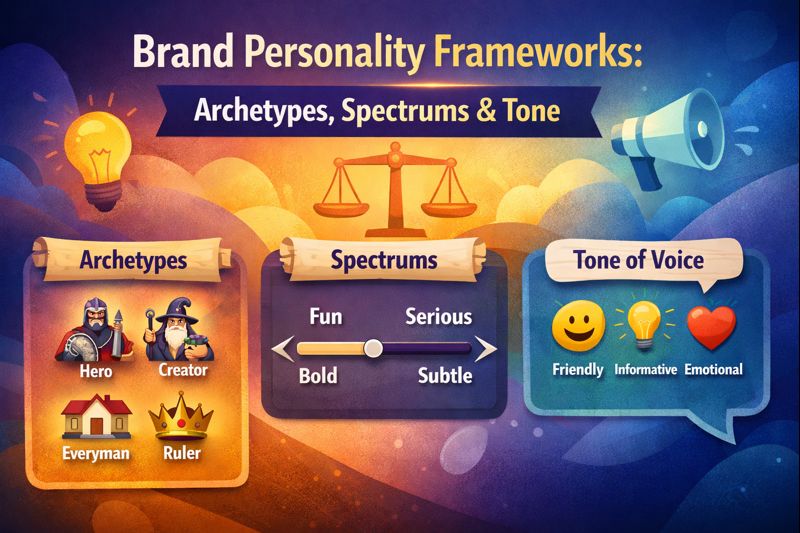
There are three dominant categories of brand personality frameworks used in modern branding:
- Brand Archetypes – Narrative-based identities rooted in psychology and mythology
- Brand Personality Spectrums – Trait-based positioning systems across behavioral dimensions
- Brand Tone Systems – Linguistic and emotional voice guidelines across contexts
Each framework offers a different lens for shaping brand character, and the strongest brand strategies often integrate all three. Archetypes define the brand’s emotional role in the customer’s life, spectrums clarify behavioral boundaries, and tone systems guide how the brand speaks in real-world situations.
Understanding how these frameworks complement one another allows brands to move from conceptual identity into practical expression. Together, they ensure that a brand not only knows who it is but also sounds like itself consistently across every interaction.
Let’s explore each framework in depth — starting with archetypes.
Brand Archetypes Framework
What Are Brand Archetypes?
Brand archetypes are symbolic models based on universal human narratives. They draw from psychology and mythology to define characters that audiences instinctively recognize. Common archetypes include the Creator, Explorer, Everyman, and Sage. Aligning a brand with a specific archetype allows it to communicate emotionally, creating instant familiarity and trust.
Archetypes also support brand architecture decisions by defining how sub-brands, products, and services align with the parent brand’s emotional narrative. When implemented correctly, archetypes provide a storytelling blueprint that informs marketing campaigns, product messaging, and customer experience.
The 12 Core Brand Archetypes Explained
Most brand archetype frameworks organize identities into twelve core types, each reflecting a unique emotional motivation:
- The Innocent – Optimistic, pure, honest, and trustworthy
- The Everyman – Relatable, humble, friendly, and inclusive
- The Hero – Courageous, determined, and performance-driven
- The Caregiver – Compassionate, nurturing, and service-oriented
- The Explorer – Adventurous, independent, and discovery-driven
- The Rebel – Disruptive, bold, and anti-establishment
- The Lover – Passionate, intimate, and emotionally expressive
- The Creator – Imaginative, innovative, and visionary
- The Jester – Playful, humorous, and entertaining
- The Sage – Wise, knowledgeable, and truth-seeking
- The Magician – Transformational, visionary, and future-focused
- The Ruler – Authoritative, confident, and leadership-driven
Each archetype offers brands a psychological blueprint for emotional connection. For example, Nike embodies the Hero archetype by inspiring courage and achievement, while Dove leans into the Caregiver archetype by promoting self-acceptance and empathy. Harley-Davidson, on the other hand, expresses the Rebel archetype through freedom, defiance, and nonconformity.
Choosing the right archetype helps brands differentiate in crowded markets by claiming emotional territory rather than functional features alone. This emotional positioning builds stronger loyalty, advocacy, and storytelling coherence.
How Archetypes Shape Brand Strategy
Archetypes influence far more than marketing copy — they shape the entire brand ecosystem. From visual design and customer experience to partnerships and innovation strategy, archetypes define what feels “on-brand” and what doesn’t. This consistency builds familiarity and emotional trust over time.
In communication, archetypes determine vocabulary, storytelling themes, tone of voice, humor level, and emotional framing. A Sage brand educates and explains; a Jester brand entertains and surprises; a Hero brand motivates and challenges. These differences fundamentally shape how audiences perceive and interact with the brand.
Operationally, archetypes guide behavior. A Caregiver brand prioritizes customer support excellence, community impact, and empathy-driven design, while a Ruler brand emphasizes authority, leadership, and premium service structures. These behaviors reinforce brand promises through action, not just messaging.
Strategically, archetypes help brands avoid identity drift. When growth pressures push companies into new markets or products, archetypes serve as anchors, ensuring expansion remains emotionally coherent rather than confusing or diluted.
Advantages of Archetype Frameworks
One of the greatest strengths of archetypes is their universality. Because archetypes reflect timeless human narratives, they resonate across cultures, industries, and generations. This makes them especially valuable for global brands seeking emotional consistency across diverse markets.
Archetypes also simplify complex identity discussions. Rather than debating abstract brand adjectives endlessly, teams can rally around a shared narrative role, accelerating alignment and creative direction. This clarity improves decision-making across marketing, design, and experience development.
Another advantage is emotional depth. Archetypes operate at the subconscious level, triggering instinctive recognition and emotional connection. This psychological grounding makes brands feel meaningful rather than transactional, fostering long-term loyalty rather than short-term engagement.
Finally, archetypes integrate naturally with storytelling, enabling brands to craft campaigns, narratives, and brand worlds that feel cohesive and memorable. This narrative consistency amplifies brand recall and emotional impact.
Limitations of Archetypes
Despite their strengths, archetypes also have limitations when used in isolation. Many industries gravitate toward the same archetypes — tech brands often choose Creator or Magician, finance brands favor Sage or Ruler — which can lead to category sameness and diminished differentiation.
Archetypes can also oversimplify complex brand personalities. Most brands embody multiple traits and behaviors, and forcing them into a single archetype can restrict nuance or authenticity. Without careful calibration, archetypes may feel artificial rather than organic.
Additionally, archetypes focus more on emotional identity than practical communication behaviors. They define who the brand is but not necessarily how it should speak in specific contexts, such as crisis communication, customer support, or technical documentation.
For these reasons, archetypes work best when combined with behavioral frameworks — such as personality spectrums and tonal systems — which we’ll explore next.
Brand Personality Spectrum Frameworks
What Is a Brand Personality Spectrum?
Brand personality spectrums define brand character using opposing trait dimensions rather than fixed archetypes. Instead of selecting one identity type, brands position themselves along continua such as formal–casual, serious–playful, bold–reserved, innovative–traditional, or authoritative–friendly.
This approach allows for greater nuance and flexibility, enabling brands to express multidimensional personalities without being constrained by narrative labels. Rather than asking, “Which archetype are we?” spectrum models ask, “Where do we sit along key behavioral dimensions?”
Spectrums are particularly valuable for organizations that operate across diverse contexts, audiences, or product lines. They allow brands to calibrate expression dynamically while maintaining consistency within defined boundaries. This adaptability makes spectrum frameworks ideal for complex ecosystems such as enterprise brands, SaaS platforms, and global corporations.
By visualizing personality as coordinates rather than categories, spectrums create clearer guardrails for tone, messaging, and behavior — especially in operational environments.
Common Brand Personality Dimensions
Most spectrum-based frameworks include multiple trait dimensions, typically between four and six, that together define brand personality. Common dimensions include:
- Formal ↔ Casual – How structured and professional versus relaxed and conversational the brand sounds
- Serious ↔ Playful – How emotionally weighty or lighthearted the brand’s communication feels
- Bold ↔ Reserved – How assertive, daring, or confident versus cautious and understated the brand behaves
- Traditional ↔ Innovative – How rooted in heritage versus future-focused and experimental the brand appears
- Emotional ↔ Rational – How heart-driven versus logic-driven the brand’s messaging approach feels
- Exclusive ↔ Inclusive – How aspirational and elite versus accessible and community-driven the brand positions itself
Each dimension functions independently, allowing brands to create distinctive personality blends. For example, a brand might be casual but serious, innovative but emotionally restrained, or bold but inclusive — combinations that archetypes alone cannot fully capture.
Mapping these dimensions visually creates a personality blueprint that guides voice, tone, visuals, behavior, and experience design consistently across teams and channels.
How Spectrum Models Shape Brand Behavior
Spectrum frameworks translate directly into actionable communication guidelines. When a brand defines itself as moderately playful, highly inclusive, emotionally expressive, and casually confident, teams immediately understand how to write, design, and interact with audiences.
These dimensions influence word choice, sentence structure, pacing, humor usage, emoji adoption, storytelling tone, and even customer service protocols. They shape not just marketing copy but also onboarding emails, support scripts, in-app messaging, investor communications, and executive thought leadership.
Operationally, spectrum models reduce subjectivity. Instead of debating whether something “feels on-brand,” teams can assess whether it aligns with defined personality coordinates. This objectivity speeds approvals, improves consistency, and minimizes internal friction.
Strategically, spectrum models support scalable governance. As brands expand into new regions, languages, and platforms, these frameworks provide adaptable guidance without forcing rigid templates or tone uniformity.
Advantages of Spectrum-Based Frameworks
One major advantage of spectrum frameworks is flexibility. Unlike archetypes, which often lock brands into specific narratives, spectrums allow nuanced positioning that adapts to context without sacrificing consistency. This adaptability makes them especially useful for omnichannel and global brands.
Another strength is operational clarity. Spectrum dimensions translate easily into writing guidelines, UX voice systems, and behavioral rules. They are easier for teams to implement than abstract archetype metaphors, especially in regulated or enterprise environments.
Spectrum frameworks also reduce creative bottlenecks. Because boundaries are clearly defined, teams can innovate confidently without fear of going off-brand. This empowerment accelerates production cycles while maintaining brand coherence.
Finally, spectrum models integrate seamlessly with tone systems and content design frameworks, making them ideal foundations for scalable brand governance.
Limitations of Spectrum Frameworks
Despite their strengths, spectrum models can lack emotional storytelling power. While they define how a brand behaves, they don’t necessarily communicate why the brand exists emotionally or what role it plays in customers’ lives. This makes them less effective for narrative-driven branding without complementary frameworks.
Spectrum dimensions can also become overly technical or abstract if not grounded in real examples. Without concrete language samples and behavioral demonstrations, teams may struggle to translate trait coordinates into consistent expression.
Additionally, spectrums can blur emotional distinctiveness if brands cluster near category norms. Many organizations choose “moderately friendly, moderately innovative, moderately bold,” resulting in safe but forgettable personalities that fail to stand out.
For maximum impact, spectrum models should be paired with emotional storytelling frameworks such as archetypes and practical expression systems like tone guidelines.
Brand Tone Frameworks
What Is Brand Tone?
Brand tone refers to how a brand expresses its voice emotionally across different contexts. While brand voice defines consistent personality traits, tone adjusts based on audience needs, emotional situations, communication channels, and business objectives. It governs not what you say — but how you say it.
For example, a brand may maintain a friendly voice but adopt a more empathetic tone during customer support interactions and a more energetic tone in marketing campaigns. Tone systems ensure that emotional expression adapts appropriately without sacrificing brand identity consistency.
Tone frameworks translate abstract personality principles into actionable communication standards. They guide sentence structure, emotional intensity, formality level, vocabulary selection, and rhetorical style across use cases such as onboarding, marketing, sales, product UX, and crisis communication.
Without tone systems, brands risk sounding robotic, inconsistent, or emotionally misaligned — especially in high-stakes or sensitive situations.
Core Components of Brand Tone Frameworks
Effective tone frameworks typically include four core elements:
- Tone Dimensions – Emotional axes such as warm–neutral, confident–humble, energetic–calm, empathetic–direct
- Contextual Modulation Rules – Guidelines for adjusting tone across scenarios such as marketing, onboarding, support, errors, crises, and celebration
- Language Principles – Vocabulary standards, sentence complexity preferences, humor usage boundaries, and emotional framing rules
- Do/Don’t Examples – Concrete examples illustrating correct and incorrect tone execution
Together, these components transform personality concepts into operational communication systems. They ensure that tone remains intentional rather than reactive, emotional rather than mechanical, and human rather than corporate.
Tone frameworks also support localization and translation by preserving emotional intent across languages and cultures, reducing tone distortion in global brand ecosystems.
How Tone Systems Shape Customer Experience
Tone frameworks directly influence how customers perceive a brand at emotional moments of truth — onboarding, problem resolution, errors, feedback, cancellations, renewals, and crises. In these moments, tone matters more than messaging content itself, shaping trust, loyalty, and satisfaction outcomes.
For example, a cold or robotic tone during a service outage erodes confidence, while a warm, transparent, and empathetic tone builds goodwill even amid inconvenience. Tone determines whether customers feel respected, understood, and valued — or ignored, dismissed, and frustrated.
Tone frameworks also influence brand memorability. Emotionally distinctive voices — whether playful, poetic, bold, or comforting — stand out in crowded content environments. These tonal signatures become part of brand recognition as strongly as logos or taglines.
From a business perspective, consistent tone reduces friction, improves conversion rates, strengthens retention, and enhances advocacy — making tone governance a strategic growth lever rather than a stylistic afterthought.
Advantages of Tone-Based Frameworks
Tone frameworks excel at operational clarity. They provide actionable guidance for writers, designers, marketers, support teams, and product managers — translating brand identity into daily communication behaviors across hundreds of touchpoints.
Another advantage is emotional intelligence. Tone systems ensure brands respond appropriately to human emotions across contexts, preventing tone-deaf messaging that damages trust or credibility. This adaptability is critical in sensitive domains such as healthcare, finance, education, and crisis communication.
Tone frameworks also improve scalability. As brands grow into new markets, platforms, and channels, tone systems ensure consistent emotional expression without requiring centralized copywriting control.
Finally, tone frameworks integrate seamlessly with content design systems, UX writing standards, customer support playbooks, and brand governance documentation — strengthening organizational alignment.
Limitations of Tone Frameworks
Tone systems alone cannot define a brand’s emotional identity. They describe how a brand speaks, but not necessarily who the brand is or what emotional role it plays in customers’ lives. Without archetypes or personality positioning, tone guidelines risk becoming stylistic rather than strategic.
Tone frameworks can also become overly prescriptive if implemented rigidly, stifling creativity or authenticity. Over-scripted tone systems may lead to generic or robotic communication instead of human connection.
Additionally, tone frameworks require regular auditing and training to remain effective. Without reinforcement, teams drift toward default communication habits that dilute brand voice over time.
For best results, tone frameworks should operate as execution layers built upon deeper identity systems such as archetypes and personality spectrums.
How Archetypes, Spectrums, and Tone Work Together
The most powerful brand personality systems integrate archetypes, spectrums, and tone frameworks into a cohesive identity architecture. Each framework addresses a different layer of brand expression — emotional role, behavioral positioning, and linguistic execution.
Archetypes define the brand’s emotional purpose and narrative identity. They answer the question, “Who are we in our customer’s story?” Spectrums define behavioral boundaries and stylistic positioning. They answer, “How do we behave across dimensions?” Tone frameworks translate both into actionable communication rules. They answer, “How do we speak in real situations?”
Together, these systems ensure emotional resonance, operational consistency, and contextual adaptability — the three pillars of strong brand personality. Without integration, brands risk emotional vagueness, behavioral inconsistency, or tonal misalignment.
When aligned effectively, these frameworks transform brand personality from abstract theory into executable strategy across marketing, product, service, culture, and experience design.
How to Build a Brand Personality Framework (Step-by-Step)
Step 1: Clarify Brand Purpose and Audience Psychology
Before selecting any personality framework, brands must understand their deeper purpose and audience motivations. This includes identifying core values, emotional value propositions, cultural positioning, and psychological drivers behind customer behavior.
Audience research should explore not only demographics and needs but also fears, aspirations, frustrations, and identity narratives. Understanding how customers see themselves — and who they want to become — informs which personalities will resonate emotionally.
This foundational insight ensures that brand personality emerges organically from strategy rather than arbitrarily from aesthetics. Personality should express brand truth, not mask strategic confusion.
Without this grounding, personality frameworks become cosmetic rather than transformational.
Step 2: Select a Primary Brand Archetype
Once emotional purpose and audience motivations are clear, brands should select one primary archetype — and possibly one secondary — that reflects their core identity. This archetype becomes the emotional north star guiding storytelling, messaging, and experience design.
The chosen archetype should align with brand mission, customer aspirations, and competitive positioning. For example, a wellness brand focused on healing and protection aligns naturally with the Caregiver archetype, while a disruptive fintech challenger may resonate more with the Rebel or Magician archetype.
Archetype selection should be validated through customer perception research and internal alignment workshops to ensure authenticity. A forced archetype that contradicts customer experience erodes trust rather than strengthening it.
Once defined, the archetype should be documented with narrative themes, emotional promises, behavioral implications, and brand storytelling principles.
Step 3: Define Brand Personality Spectrums
Next, brands should define 4–6 personality spectrums that clarify behavioral positioning across key dimensions. These spectrums should reflect both brand ambition and audience expectations while differentiating from competitors.
Each spectrum should be positioned intentionally rather than neutrally. Instead of sitting in the middle, brands should lean toward distinctive poles that reinforce identity. For example, “approachable but authoritative” rather than “moderately friendly,” or “bold but empathetic” rather than “balanced.”
These spectrums should include clear behavioral implications and real-world examples. Teams should understand how each dimension affects writing style, visual language, interaction design, customer service tone, and leadership communication.
Documenting these spectrums visually helps teams internalize and apply them consistently across channels and contexts.
Step 4: Build a Brand Tone System
With archetypes and spectrums defined, brands should build tone frameworks that translate personality into executable communication standards. This includes defining tonal dimensions, contextual modulation rules, vocabulary principles, and usage examples.
Tone systems should address common communication scenarios such as marketing campaigns, onboarding flows, customer support, error messages, system notifications, social media engagement, thought leadership, crisis management, and executive communications.
Each scenario should include tonal priorities — for example, “empathetic first, informative second, reassuring always” — along with do/don’t examples and preferred language patterns.
Tone frameworks should be living documents integrated into brand guidelines, content governance systems, UX writing standards, and internal training programs.
Step 5: Operationalize Through Training, Templates, and Governance
Once frameworks are defined, brands must operationalize them across the organization. This includes training teams, updating content templates, revising messaging libraries, and integrating guidelines into workflows and tools.
Style guides, tone playbooks, and content design systems should embed personality standards into daily production processes. AI tools, content platforms, CMS systems, and chatbots should be configured to reflect brand voice and tone guidelines.
Governance structures — such as brand councils, editorial reviews, and content audits — should monitor adherence and evolve frameworks over time as brand strategy shifts or markets change.
Without operationalization, even the best frameworks remain unused — limiting impact and ROI.
Common Mistakes in Brand Personality Development
One common mistake is choosing personality frameworks based on leadership preference rather than customer insight. When personality reflects internal taste instead of external resonance, brands feel self-indulgent rather than customer-centric.
Another frequent error is inconsistency across touchpoints. Marketing may feel playful while customer service feels robotic or legalistic. This disconnect erodes trust and weakens emotional continuity, making the brand feel fragmented rather than cohesive.
Overcomplication is also a risk. Brands sometimes create overly complex personality models with dozens of traits, conflicting archetypes, or ambiguous tone rules that teams cannot practically implement. Simplicity enables adoption.
Finally, many brands fail to evolve their personality frameworks over time. As markets, audiences, and cultural norms change, static personality systems become outdated or tone-deaf — requiring periodic reassessment and refinement.
Real-World Examples of Brand Personality Frameworks
LEGO – Creator Archetype + Playful Educational Tone
LEGO represents the Creator archetype by empowering imagination, learning, and creative problem-solving across generations. Its emotional promise centers on building potential — not just physical structures, but cognitive skills, confidence, and curiosity. This archetype positions LEGO as a partner in childhood development and lifelong creativity rather than merely a toy manufacturer.
On personality spectrums, LEGO balances playful, intelligent, optimistic, and emotionally warm traits, avoiding either childishness or corporate stiffness. Its tone framework emphasizes encouragement, imagination, and positive reinforcement, particularly in educational content and community engagement. This tonal consistency ensures that LEGO feels inspiring and empowering across advertising, packaging, customer service, and digital experiences.
LEGO’s brand personality architecture shows how emotional storytelling and tonal clarity combine to create enduring emotional bonds across age groups and cultures.
IKEA – Everyman Archetype + Simple Helpful Tone
IKEA embodies the Everyman archetype by making good design accessible, functional, and affordable to everyday people. Rather than positioning itself as a luxury furniture brand, IKEA focuses on improving daily life through simplicity, practicality, and smart problem-solving. This emotional promise makes the brand feel helpful, relatable, and human rather than elitist or intimidating.
Across personality spectrums, IKEA leans toward friendly, practical, optimistic, and solution-oriented traits. Its tone framework emphasizes clarity, encouragement, and ease, particularly in product instructions, in-store signage, and digital experiences. This approachable tone reduces friction and builds confidence in customers navigating complex purchases and assembly processes.
IKEA’s personality framework demonstrates how approachable tone and everyday relevance can drive global trust and loyalty at massive scale.
Mailchimp – Jester Archetype + Friendly Conversational Tone
Mailchimp embodies the Jester archetype by injecting humor, warmth, and personality into traditionally dry business software. Its messaging feels approachable, human, and emotionally supportive — reducing friction in complex workflows.
Across personality spectrums, Mailchimp leans toward casual, playful, inclusive, and emotionally expressive. Its tone framework emphasizes conversational language, gentle humor, clarity, and encouragement — even in error messages and onboarding flows.
This personality differentiation helps Mailchimp stand out in a crowded SaaS category while building emotional loyalty with small business audiences.
Measuring the Impact of Brand Personality Frameworks
To evaluate the effectiveness of brand personality frameworks, brands should measure both qualitative and quantitative outcomes. Qualitative metrics include brand perception surveys, emotional resonance studies, customer sentiment analysis, and brand narrative coherence audits.
Quantitative metrics include brand awareness lift, engagement rates, conversion rates, customer retention, net promoter score (NPS), customer lifetime value (CLV), and advocacy metrics. Improvements across these indicators often correlate with stronger emotional brand connection.
Internal metrics also matter. Reduced content revision cycles, improved cross-team alignment, faster campaign launches, and fewer brand inconsistencies indicate operational success of personality systems.
Regular audits — including voice and tone consistency assessments across channels — ensure frameworks remain effective and aligned with evolving strategy and market conditions.
The Future of Brand Personality Frameworks
As AI, automation, and omnichannel engagement accelerate, brand personality frameworks will become even more critical. Brands increasingly communicate through chatbots, voice assistants, personalized content engines, and automated customer service systems — all of which require consistent emotional identity to maintain trust and coherence.
Future frameworks will integrate more deeply with AI governance systems, enabling scalable personalization without sacrificing brand voice. Emotional intelligence, contextual sensitivity, and adaptive tone modulation will become core components of advanced personality architectures.
Cultural intelligence will also grow in importance. As global markets diversify, brands will need personality systems that balance universal emotional resonance with local nuance — requiring more sophisticated tone and behavior models.
Ultimately, brand personality frameworks will evolve from branding tools into enterprise-wide operating systems for emotional experience design — shaping how organizations behave, communicate, and build relationships at scale.
Final Thoughts
Brand personality is no longer a cosmetic branding exercise — it is a strategic growth engine. In an era where products are easily replicated and attention is scarce, emotional connection becomes the true differentiator. Brand personality frameworks provide the structure necessary to build that connection intentionally, consistently, and sustainably.
By integrating archetypes, personality spectrums, and tone systems, brands gain both emotional depth and operational clarity. They define not only who they are but how they behave, speak, and evolve across every touchpoint and interaction.
Whether you’re building a startup brand from scratch or realigning a global enterprise, investing in robust brand personality frameworks unlocks stronger trust, loyalty, differentiation, and long-term brand equity.
In the end, brands that feel human win — and frameworks make humanity scalable.
FAQs
What are brand personality frameworks?
Brand personality frameworks are structured systems that define how a brand behaves, communicates, and emotionally connects with its audience. They include archetypes, personality spectrums, and tone guidelines that ensure consistent brand expression across all touchpoints. These frameworks translate abstract identity concepts into actionable communication standards. They help brands build trust, recognition, and emotional loyalty.
Why are brand archetypes important?
Brand archetypes provide emotionally resonant identity models based on universal human narratives. They help brands define their role in customers’ lives and shape storytelling, tone, and experience design. Archetypes make brands instantly recognizable and psychologically relatable. They also improve internal alignment and emotional differentiation in crowded markets.
What is the difference between brand voice and brand tone?
Brand voice refers to consistent personality traits across all communication, while brand tone adapts emotionally based on context, audience needs, and situation. Voice stays stable, but tone shifts appropriately — for example, serious during crises and playful during campaigns. Tone frameworks ensure emotional intelligence without sacrificing identity. Together, they create consistent yet adaptive brand communication.
How do brand personality spectrums work?
Brand personality spectrums position brands along opposing behavioral dimensions such as formal–casual or serious–playful. Instead of fitting into fixed archetypes, brands define where they sit across multiple traits. This allows greater nuance, flexibility, and operational clarity. Spectrum models are especially useful for large or complex organizations.
Can a brand use multiple personality frameworks?
Yes, the strongest brand strategies integrate archetypes, spectrums, and tone systems together. Archetypes define emotional role, spectrums define behavioral boundaries, and tone systems define linguistic execution. Together, they ensure emotional resonance, consistency, and adaptability. Using multiple frameworks creates a complete personality architecture.
