
Your brand’s reputation can change overnight. A single negative review, a viral complaint, or a misleading headline can undo months of hard work. That’s why every business needs a solid online reputation monitoring checklist. It keeps you ahead of problems, helps you respond faster, and gives you real control over how people see your brand. Whether you manage a personal brand or a growing company, this guide covers every step you need. By the end, you’ll have a clear, actionable system you can start using today.
What Is Online Reputation Monitoring?
Online reputation monitoring means tracking what people say about your brand across the internet. This includes social media, review sites, search engines, news outlets, and forums. Because conversations happen in real time, you need to monitor consistently — not just when something goes wrong. Many brands only react after a crisis hits. However, proactive monitoring lets you catch problems early and respond while you still have options. In short, it’s the difference between managing your story and having someone else manage it for you.
Think of your online reputation as a living thing. It changes daily based on customer experiences, media coverage, and competitor activity. Without a structured checklist, it’s easy to miss important signals. Fortunately, monitoring doesn’t have to be complicated. With the right approach and the right tools, you can stay on top of your brand’s perception every week. This online reputation monitoring checklist gives you the structure to do exactly that.
Why You Need an Online Reputation Monitoring Checklist
Most businesses underestimate how quickly public perception can shift. According to multiple consumer surveys, the vast majority of people research a brand online before buying. Furthermore, they trust online reviews almost as much as personal recommendations. If your reputation is taking hits you don’t know about, you’re losing customers quietly — and you won’t see it in the data until it’s too late. An online reputation monitoring checklist solves this by creating a repeatable, consistent process. It turns reputation management from a reactive scramble into a proactive habit.
A checklist also keeps your team aligned. Without clear ownership and regular review cycles, things fall through the cracks. One person assumes another is watching reviews. No one catches a negative trending post until it goes viral. Clear checklists assign responsibility, set review frequencies, and create accountability. Additionally, they help you measure progress over time. When you track reputation metrics consistently, you start to see patterns — and patterns give you the insight to improve. That’s why this online reputation monitoring checklist is structured around specific, repeatable actions rather than vague advice.
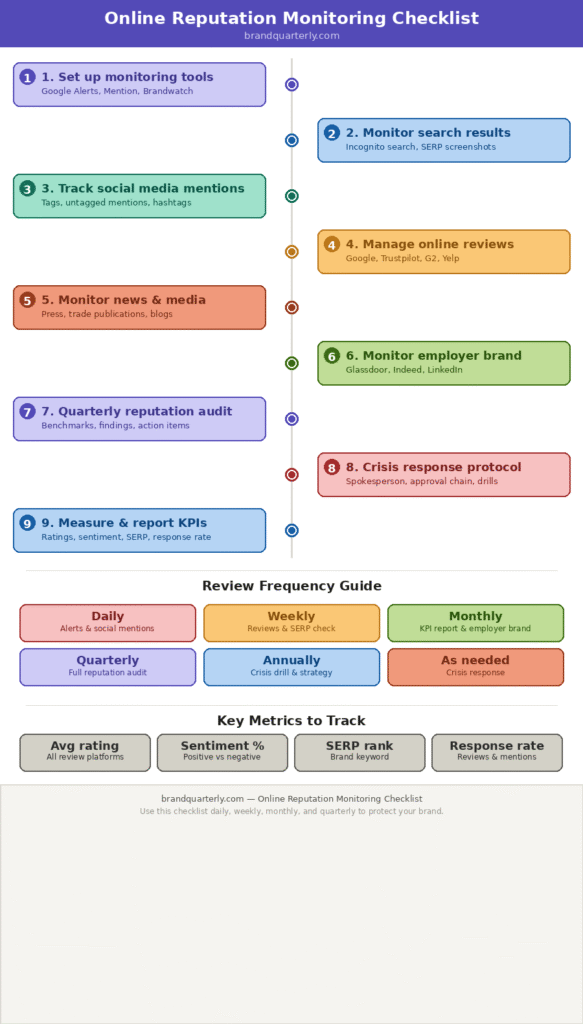
Step 1: Set Up Your Monitoring Tools
The first step in any online reputation monitoring checklist is getting the right tools in place. Start with Google Alerts — it’s free, easy to set up, and covers a wide range of web sources. Enter your brand name, product names, key executive names, and common misspellings. Set alerts to “as-it-happens” for important terms and daily digests for broader keywords. This gives you a basic early warning system at no cost. From there, you can layer in more powerful tools as your needs grow.
For deeper monitoring, consider paid platforms like Mention, Brandwatch, Sprout Social, or Talkwalker. These tools offer sentiment analysis, real-time alerts, and coverage across social media, news, and blogs. They also allow you to track competitors alongside your own brand. Most importantly, they save significant time compared to manual searches. Once your tools are configured, connect alerts to the right people on your team. The faster the right person sees a mention, the faster they can respond.
Here’s a quick setup checklist for your monitoring tools:
- Set up Google Alerts for your brand name, variations, and key products
- Choose a paid monitoring tool that fits your budget and team size.
- Configure real-time alerts for negative mentions or high-priority keywords
- Create a shared inbox or Slack channel where alerts are delivered.
- Assign a team member to review and triage alerts daily.
- Test your setup weekly to make sure no alerts are being missed.
Step 2: Monitor Your Search Engine Results
Your Google search results are your brand’s most visible real estate. Potential customers, journalists, and investors all search your name before engaging with you. Therefore, knowing what they find is critical. Run a clean search for your brand name at least once a week. For a deeper look at how this fits into a broader evaluation process, see our guide on brand audits. Use an incognito window so you see unbiased results. Take note of what appears on the first page and whether the results reflect your brand accurately.
Pay attention to Google’s autocomplete suggestions and the “People Also Ask” boxes. These features shape first impressions before anyone even clicks a result. If negative associations appear in autocomplete, that’s a warning sign worth taking seriously. Also, check whether your own website ranks first for your brand name. If it doesn’t, a competitor’s comparison page or a negative article may be claiming that prime spot. Over time, you can improve these results through content creation, link building, and encouraging positive third-party coverage.
Your search engine monitoring checklist should include:
- Search your brand name weekly in incognito mode.
- Screenshot page one results monthly to track changes over time
- Note autocomplete suggestions and “People Also Ask” questions.
- Check whether your website owns the top result for your brand name.
- Look for outdated, inaccurate, or harmful results that need addressing.
- Review Google’s knowledge panel for your brand if one exists.
Step 3: Track Social Media Mentions
Social media is where brand conversations move fastest. A single post can reach thousands of people within hours — for better or worse. That’s why social media monitoring is one of the most important parts of any online reputation monitoring checklist. You need to track direct tags and mentions, but also untagged brand references. Many people talk about brands without using the official handle. If you’re only watching tags, you’re missing a significant portion of the conversation.
Different platforms have different dynamics. Twitter/X moves fast and requires near-real-time monitoring. Instagram and TikTok tend to drive sentiment through comments and shares. LinkedIn matters more for B2B brands and employer reputation. Facebook groups can host highly engaged conversations that fly under the radar. Set up monitoring across every platform where your audience is active — not just the ones you post on most often. Use a unified tool where possible to keep everything in one place.
Your social media monitoring checklist should cover:
- Monitor direct tags and untagged mentions across all major platforms.
- Track relevant hashtags related to your brand, products, and campaigns.
- Set up keyword searches for common misspellings of your brand name.
- Review comments on your own posts within 24 hours of publishing.
- Watch competitor mentions for comparisons involving your brand.
- Review sentiment trends monthly to spot emerging patterns.
Step 4: Manage and Monitor Online Reviews
Online reviews carry enormous weight with consumers. Research consistently shows that most buyers read reviews before making a purchase decision. Moreover, a single cluster of negative reviews can drag down your average rating and push potential customers toward a competitor. That’s why review monitoring is a non-negotiable part of this online reputation monitoring checklist. The key platforms vary by industry. For most businesses, Google Business Profile is the most important. Others include Trustpilot, Yelp, G2, Capterra, Glassdoor, and TripAdvisor, depending on your sector.
Responding to reviews matters as much as monitoring them. When you reply to a negative review thoughtfully and professionally, you show future customers that you care. Ignoring reviews — even positive ones — signals the opposite. Aim to respond to every review within 48 hours. Additionally, analyze your review data regularly for patterns. Recurring complaints about the same issue are a signal that your operations or product team needs to hear.
Your review monitoring checklist should include:
- Check all major review platforms at least twice per week.
- Respond to every review — positive and negative — within 48 hours.
- Flag recurring complaints and escalate them to the right internal team
- Track your average rating across platforms month over month.
- Report on review volume trends as a leading indicator of satisfaction
- Use a review aggregation tool if you’re managing multiple locations.
Step 5: Monitor News and Media Coverage
Press coverage — positive or negative — can shape public perception quickly and broadly. A single article in an industry publication can introduce your brand to thousands of new readers. On the other hand, an inaccurate story can spread misinformation before you even know it’s been published. That’s why media monitoring belongs on every online reputation monitoring checklist. Speed is especially important here. The sooner you spot coverage, the more options you have to respond, correct, or amplify it.
Supplement Google Alerts with a media monitoring tool if your brand gets regular press coverage. Understanding the broader competitive landscape is equally important — read more in our guide to competitive intelligence.” Tools like Meltwater or Cision track news outlets, trade publications, podcasts, and broadcast media. They also help you measure your share of voice versus competitors. Build relationships with journalists who cover your industry — these connections become invaluable during a crisis. When you need to get an accurate story out quickly, knowing the right people makes a real difference.
Your media monitoring checklist should include:
- Set Google Alerts for your brand name, key executives, and main products.
- Check Google News for your brand name at least twice per week.
- Respond to inaccurate stories quickly by reaching out to the journalist or editor.
- Amplify positive coverage on your social channels and press page.
- Track which publications cover your competitors to spot missed opportunities
- Maintain a log of all media mentions with date, publication, and sentiment.
Step 6: Monitor Your Employer Brand
Your employer brand is part of your overall brand reputation — and more people are paying attention to it than ever. Job seekers research companies on Glassdoor and Indeed before applying. Investors and clients read employee reviews to get an honest view of your culture. Furthermore, employer brand affects the quality of talent you can attract, which ultimately affects the quality of your product and service. That makes it a business-critical metric, not just an HR concern.
Check your profiles on Glassdoor, Indeed, and LinkedIn regularly. When platforms allow it, respond to reviews — both praise and criticism — in a professional tone. Look for patterns in what employees say. Recurring themes about management, communication, or growth opportunities are worth taking seriously. A strong employer brand also drives organic advocacy. Employees who feel genuinely valued often become your best brand ambassadors — both online and offline.
Your employer brand monitoring checklist should include:
- Review Glassdoor and Indeed profiles at least twice per month.
- Respond to employee reviews where the platform allows it.
- Track your overall employer rating as a monthly metric.
- Flag recurring themes in reviews for HR review and action
- Monitor how employees represent the brand on personal social media.
- Ensure your LinkedIn company page is accurate and up to date.
Step 7: Conduct a Quarterly Reputation Audit
Daily monitoring keeps you informed. But a quarterly audit gives you the strategic perspective that daily check-ins simply can’t provide. During an audit, you step back and look at your reputation across all channels at once. You benchmark your current position against previous quarters, identify what’s improving, and spot what’s declining. You also check your own content for accuracy and freshness — outdated information on your own profiles can create reputational problems just as much as external criticism. A quarterly audit turns monitoring data into strategic decisions.
Assign clear ownership of the audit. It can be completed internally, but bringing in an external perspective once or twice a year is worth considering. Internal teams can develop blind spots over time. An outside view often catches things that familiarity hides. After every audit, produce a prioritized action list with a named owner for each item. Without accountability, audits are just documentation exercises that change nothing.
Your quarterly audit checklist should cover:
- Review your SERP appearance and compare it to the previous quarter.
- Audit your review profiles, average ratings, and response rates.
- Analyze social media sentiment trends over the past 90 days.
- Check all owned profiles — Google Business, LinkedIn, social bios — for accuracy.
- Assess your crisis response readiness and update your protocol if needed.
- Produce a written report with benchmarks, findings, and action items
Step 8: Build a Crisis Response Protocol
Every business will face a reputation challenge at some point. A product failure, a viral complaint, a media story, or a social media incident can escalate quickly if you’re unprepared. That’s why a crisis response protocol is an essential part of any online reputation monitoring checklist. Having a plan before you need it dramatically improves your response speed and your ability to stay calm and on-message under pressure. Your protocol should define what counts as a crisis, who speaks publicly, and what the approval process looks like for statements. Automating parts of your monitoring setup also helps you catch early warning signs faster — here’s how automating competitive monitoring systems works in practice.
When a crisis happens, the first 24 hours are the most important. Acknowledge the issue quickly. Even a brief statement saying you’re aware and investigating buys goodwill and time. Silence, on the other hand, is almost always interpreted negatively. Keep your response proportional — not every negative story needs a full press release. After the crisis passes, run a post-mortem. Understanding what happened, how you responded, and what you’d do differently is one of the most valuable exercises a brand can go through.
Your crisis response checklist should include:
- Define what constitutes a crisis versus a standard negative mention.
- Name a designated spokesperson and a backup.
- Document the approval chain for all public statements.
- Prepare holding statement templates you can adapt quickly.
- Run a tabletop crisis exercise with your team at least once a year.
- Conduct a post-mortem after every significant reputation incident.
Step 9: Measure, Report, and Improve
Monitoring only creates value when it leads to action. That means measuring your results, reporting on them regularly, and using the data to improve. Define a clear set of KPIs for your reputation program. These might include average review rating, share of positive versus negative social mentions, media sentiment score, SERP position for your brand name, and review response rate. Review these metrics monthly and present them to relevant stakeholders. Data-driven reporting keeps leadership invested in reputation management and makes the case for budget and resources far easier.
Use your data to run experiments. If your response rate is high but your average rating isn’t improving, the issue may be upstream in the customer experience. If your media sentiment is strong but social mentions are declining, your community engagement may need refreshing. The goal is to turn your monitoring data into a feedback loop — one that continuously improves your brand, your operations, and your customer relationships. Reputation management isn’t a project with an end date. It’s an ongoing practice that compounds in value the longer you commit to it.
Your measurement checklist should include:
- Track your average review rating across all platforms monthly.
- Measure the positive versus negative mention ratio using your monitoring tool.
- Report on SERP position for your brand name each quarter
- Monitor review response rate as a KPI and set a target (aim for 100%)
- Track media sentiment score and share of voice versus competitors
- Present a monthly reputation report to key stakeholders.
Final Thoughts: Start Your Online Reputation Monitoring Checklist Today
Your brand’s reputation is one of the most valuable things you own. It takes time to build and can be damaged quickly when left unmonitored. The good news is that you don’t need a big budget or a large team to protect it. You need consistency, the right tools, clear ownership, and a willingness to listen and respond. This online reputation monitoring checklist gives you everything you need to get started. Use it as a living document — revisit it regularly, adapt it as your brand evolves, and commit to it as a long-term discipline.
If you’re ready to take this further, our guide on scaling digital brand management covers how to build systems that grow with your brand.The brands that win in the long run are not the ones that never face criticism. They’re the ones that listen well, respond with integrity, and use feedback to get better. Start with the basics, build your systems, and remember: reputation is not what you say about yourself. It’s what the world says about you — and how well you’re listening.
