
Scaling Digital Brand Management across multiple markets is essential in today’s interconnected business landscape. Digital brand management is no longer constrained by borders, and from startups pushing into new regions to multinational corporations coordinating global identities, the demand for scalable digital branding strategies has never been greater. As consumer expectations evolve alongside technological advancements, managing a consistent yet adaptable brand across diverse markets poses both exciting opportunities and unique challenges. Successful brand leaders must think beyond simple replication of messaging and focus on systems, processes, and cultural intelligence that enable growth without losing authenticity.
This in‑depth article explores how organizations can scale digital brand management effectively, covering strategic frameworks, technology foundations, cultural intelligence, organizational structures, and performance measurement. By the end of this guide, you’ll walk away with actionable insights that uphold brand integrity while maximizing local resonance. Whether you’re a Chief Marketing Officer, global brand strategist, or digital marketing lead, this piece is designed to inform key decisions that drive brand success at scale.
Why Scaling Digital Brand Management Matters
Scaling digital brand management is essential because brands today are expected to communicate seamlessly across markets. Consumers interact with brands on numerous digital platforms — social media, websites, apps, marketplaces — and they expect consistency in experience and message. When a brand fails to maintain coherence across these touchpoints, trust and credibility can quickly erode. Conversely, a brand that scales well can capture customer loyalty, build recognition, and outperform competitors in new regions.
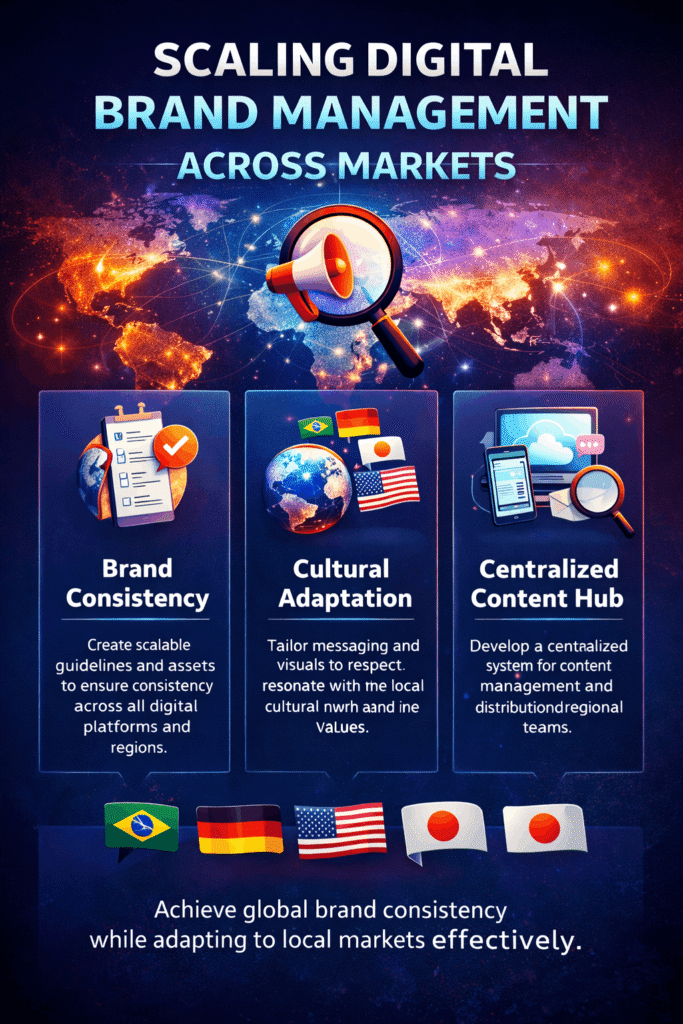
In essence, digital brand management at scale is a strategic imperative. Unlike traditional approaches limited to a single market, scalable strategies allow growth teams to replicate brand success in multiple regions without reinventing the wheel. This means creating a system where brand values, visuals, and voice adapt intelligently for diverse audiences while maintaining core identity. Achieving this balance ensures that global campaigns feel relevant locally and that local insights inform global strategy.
This topic matters even more as the pace of digital transformation accelerates. With modern tools for collaboration, data analytics, and customer engagement, brands now have the ability to respond in real time to consumer behavior. But without a scalable brand management framework, this speed can result in fragmented experiences, inconsistent messaging, and a diluted identity. Scaling digital brand management ensures that speed enhances consistency rather than undermining it.
Core Principles of Scalable Digital Brand Management
There are several foundational principles that organizations must embrace to scale digital branding across markets. The first is clarity in brand identity. Before pursuing market expansion, the brand must have well‑defined values, mission, personality, and positioning. These elements act as anchors in times of ambiguity and provide reference points for decisions. When brand identity is clear, it becomes easier to align stakeholders and make choices that reinforce rather than weaken the core brand.
Another key principle is modularity in brand assets. This means designing visual systems, tone of voice guidelines, and messaging frameworks that can be recombined for different market needs. For example, a modular graphic system might allow regional teams to adapt campaigns using local imagery or language while still maintaining a recognizable look and feel. Similarly, messaging frameworks that distinguish between functional and emotional benefits allow content creators to tailor messaging without contradicting brand essence.
Third, scalable brand management requires governance and accountability. Put simply, someone must own the brand strategy and ensure that adaptations adhere to established standards. This often takes the form of a centralized brand team backed by well‑documented processes and approval workflows. While decentralization empowers local teams, governance ensures that empowerment doesn’t result in brand dilution. Together, these principles create a strong foundation for scaling.
Building a Global Brand Architecture
When scaling digital brand management, establishing a thoughtful brand architecture is critical. Brand architecture refers to the way a company organizes its brands and sub‑brands in relation to each other. There are three primary models: branded house, house of brands, and hybrid. Each model has its advantages depending on business strategy, product portfolio, and market dynamics.
A branded house centralizes identity under a single master brand. Companies like Virgin or FedEx use this model to signal a unified experience and trust across offerings. This approach simplifies management because core brand elements — logo, values, tone — stay consistent. However, it also places higher stakes on maintaining relevance across diverse customer segments.
On the other hand, a house of brands features independent brands under one corporate umbrella. Procter & Gamble and Unilever use this strategy effectively, allowing brands to speak directly to distinct audiences without a shared visual identity. While this model offers flexibility, it can also create complexity in ensuring that overarching corporate values don’t conflict with individual brand positions.
The hybrid model combines elements of both. For example, a corporate brand might serve as an endorsement while sub‑brands maintain individuality. Toyota, with Lexus, or Marriott, with its portfolio of hotel brands, exemplify this approach. In digital spaces, brand architecture influences navigation, content strategy, SEO, and customer journeys. A carefully selected architecture enables clear expectations and efficient scaling across markets.
Harnessing Cultural Intelligence
One of the biggest challenges in scaling digital brand management is bridging cultural differences. Brands that succeed globally are those that not only adapt messaging linguistically but also understand deeper cultural norms and values. Cultural intelligence goes far beyond translation — it encompasses consumer behavior patterns, symbols, color psychology, humor norms, and purchase motivations.
An example of cultural adaptation is how brands adjust visual language for different markets. Colors that signify excitement and success in one culture might convey caution or mourning in another. Similarly, humor that resonates in English‑speaking markets may lose meaning entirely when translated. Companies that invest in cultural research — including consumer focus groups, regional marketing experts, and ethnographic studies — gain a competitive advantage.
Another aspect of cultural intelligence is empathetic storytelling. Brands that tell stories reflecting local aspirations, challenges, and norms are perceived as more authentic. This practice strengthens emotional connection, which is often more influential than product features alone. In digital campaigns, personalization tools and data analytics can help brands understand which narratives work best in each market and tailor experiences accordingly.
Implementing a Centralized Yet Flexible Content Strategy
At the heart of digital brand management lies content: text, imagery, video, and interactive experiences that communicate brand promise. To scale content effectively, organizations must design a system that balances central oversight with local flexibility.
A centralized content repository — often called a Content Hub — is a foundational tool. This hub houses core content assets, templates, style guides, and approved messaging frameworks. Regional teams can draw from these assets to ensure brand consistency, while still customizing language and creative elements to reflect local context. Using shared languages for metadata also enhances discoverability and governance.
Another key practice is adopting content recycling and repurposing frameworks. This involves identifying evergreen brand content and defining rules for how it can be adapted across markets. For instance, a campaign created for North America might be repurposed for Europe with adjusted imagery, language, and cultural cues. This reduces duplication of effort, increases efficiency, and preserves brand integrity.
However, content scalability also demands investment in technology. Digital asset management (DAM) systems, translation platforms, and brand automation tools help teams collaborate seamlessly across time zones and languages. The right technology stack not only streamlines workflows but also ensures that content remains accurate, up‑to‑date, and aligned with evolving brand standards.
The Role of Data and Analytics in Scaling Brand Management
Data plays a central role in guiding decisions around scaling digital brand management. It answers essential questions such as: Which markets respond best to certain messaging? What channels drive the most engagement? How does sentiment vary across regions? Without robust analytics, scaling becomes guesswork rather than strategy.
Brand managers should invest in qualitative and quantitative data tools. Quantitative metrics — web analytics, conversion rates, social engagement — provide measurable signals of performance. Qualitative insights — customer interviews, sentiment analysis, ethnographic research — offer depth and nuance that numbers alone can’t capture. Combining both types paints a complete picture.
Furthermore, data enables iteration and optimization. Brands that scale effectively are not fixed in their approach; they test, measure, refine, and repeat. A/B testing, controlled experiments, and continuous feedback loops help teams understand what resonates and what doesn’t in each market. This iterative mindset ensures that digital brand management is both evidence‑based and adaptive.
Organizational Structures That Support Scaling
Strategic vision and cultural intelligence must be supported by organizational structures that make scaling possible. Companies that excel at global brand management often create dual structures combining central oversight with regional autonomy. This can take the form of a global brand center of excellence paired with local brand champions.
The central brand team establishes core principles, tools, and governance frameworks. They create playbooks, run training programs, and monitor global brand health. Local brand champions, on the other hand, are steeped in cultural context and responsible for message adaptation, local campaigns, and market relationships. Together, they form a feedback loop where insights flow upward, and guidance flows downward.
Another organizational strategy is the use of cross‑functional teams. Rather than isolating brand strategy in marketing alone, high‑performing companies integrate product, customer experience, legal, HR, and digital teams into brand decision processes. This ensures that brand consistency is reflected in every customer touchpoint — from product packaging to store experience to customer support interactions.
Maintaining Brand Consistency Through Governance
Brand governance refers to the policies and processes that ensure brand standards are upheld across an organization. When scaling digital brand management, governance prevents dilution and drift. Governance frameworks should define who has decision‑making authority, how approvals are routed, and what standards content must meet.
One effective method is a brand management committee that meets regularly to review major campaigns, new assets, and market learnings. This committee includes representatives from global, regional, legal, and product teams. By centralizing decision points while preserving input from key stakeholders, organizations protect brand integrity without stifling innovation.
In addition to committees, documentation is a key governance pillar. Detailed brand guidelines, voice and tone documents, playbooks, and templates serve as the single source of truth. When regional teams have clear access to these materials, they can execute with confidence and accuracy. Ideally, these resources live in a shared digital ecosystem accessible by all relevant contributors.
Measuring Success: Key Metrics for Scaled Brand Management
Measuring the success of digital brand management efforts across markets requires a thoughtful selection of metrics. Traditional marketing metrics like impressions and clicks are valuable, but they must be complemented with brand health indicators. Some useful metrics include:
- Brand awareness and recall scores are measured through surveys or social listening.
- Net Promoter Score (NPS) and customer satisfaction indices across regions.
- Engagement quality, such as time on content, shares, and sentiment.
- Consistency audits to evaluate alignment of messaging, visuals, and brand behavior.
- Impact on revenue and loyalty, tracking how brand initiatives influence conversions and repeat purchases.
It’s important to segment measurements both globally and locally. A campaign may perform well in one region yet underperform in another. Understanding these differences helps refine strategy without compromising global coherence. The end goal is to ensure that brand investments are measurable, informed by data, and tied to business outcomes.
Case Studies: Brands That Scaled Effectively
While theory provides the foundation, learning from real‑world examples illustrates what scalable digital brand management looks like in action. Global companies like Nike, Coca‑Cola, and Spotify have demonstrated consistent brand identity while tailoring experiences to local cultures. For example, Nike’s ability to incorporate local sports heroes and culturally relevant narratives within a cohesive global identity has reinforced emotional connection worldwide.
Coca‑Cola’s longstanding approach to universal themes of joy and togetherness, paired with localized campaigns (like region‑specific holidays or languages), shows how global positioning can support informed customization. Spotify’s use of data‑driven personalization, combined with local artist features, helps the brand stay relevant in diverse music cultures while maintaining a recognizable digital experience.
These cases underscore a critical insight: scaling digital brand management is not about enforcing uniformity. Instead, it’s about creating a shared identity that flexes intelligently for local relevance without losing its essence.
Common Pitfalls and How to Avoid Them
Even experienced organizations can stumble when scaling digital brand management. A common pitfall is over‑centralization that stifles local creativity. When decisions are locked at headquarters, regional teams may resort to workarounds that create inconsistency. The solution lies in balanced governance — clear global standards paired with empowerment for localized execution.
Another challenge is underestimating cultural nuance. Brands that rely solely on translated content without understanding deeper cultural signals risk alienation. Investing in local expertise, cultural audits, and testing helps mitigate this risk. Additionally, some companies fail by neglecting ongoing training. Brand standards are not static, and continuous education ensures that teams adapt as markets evolve.
Finally, brands sometimes struggle with measurement inconsistency. Without unified metrics, organizations cannot compare performance across borders effectively. Establishing shared KPIs and reporting structures helps teams evaluate success and optimize strategies coherently.
The Future of Scalable Digital Brand Management
Looking forward, scalable brand management will become even more dynamic as technologies like artificial intelligence, augmented reality, and real‑time personalization mature. Brands that can integrate these technologies while preserving human‑centered storytelling will differentiate themselves. For example, AI can support localized content generation at scale, but human oversight ensures that cultural nuance and emotional resonance are preserved.
Another trend is the rise of brand ecosystems where community, purpose, and engagement extend beyond traditional marketing channels. Consumers increasingly expect brands to act responsibly and reflect values aligned with societal change. Scaling brand management must account for values‑based communication that resonates across markets without resorting to superficial messaging.
Ultimately, successful digital brand management across markets will remain rooted in understanding people — their language, culture, aspirations, and behaviors — and connecting these insights to a consistent brand identity that transcends borders.
Conclusion
Scaling digital brand management across markets is a strategic imperative for modern organizations seeking sustainable growth. It requires clarity of identity, cultural intelligence, integrated technology systems, strong governance, and measurement discipline. By balancing global consistency with local relevance, brands can deepen engagement, foster loyalty, and unlock new opportunities in diverse regions.
The journey to scale is ongoing and iterative, demanding alignment across teams, continuous learning, and intentional investment in both strategy and execution. When done well, digital brand management becomes a powerful engine for lasting brand equity that resonates with audiences around the world.
