
In the modern digital marketing landscape, optimizing your website for search engines is no longer just about improving your own content—it’s about understanding the competitive environment you are operating in. SEO Competitive Intelligence is the practice of identifying your search competitors, analyzing their strategies, and leveraging that insight to improve your own rankings and online visibility. Unlike traditional business competition, SEO competition often involves websites targeting the same search queries, even if they don’t sell the same products or services.
By conducting SEO competitive intelligence, marketers can uncover gaps in their own strategies, identify profitable keywords they might be missing, and find opportunities to outrank competitors. It’s a data-driven approach that informs content creation, technical SEO, and link-building strategies. Ultimately, it helps businesses stay ahead in organic search, improve traffic quality, and drive conversions. The insights from competitive analysis enable smarter, targeted efforts rather than random SEO experimentation.
1. Why SEO Competitive Intelligence Matters
Competitive intelligence is essential to an SEO strategy. Search engines rank your site relative to all online content, so your performance is influenced by competitor optimization. Without analyzing your competition, you risk wasting efforts on tactics that don’t move the needle because competitors already own key keywords and topics.
SEO competitive intelligence helps marketers prioritize efforts, ensuring they focus on areas that will deliver measurable improvements. For instance, analyzing competitors’ backlink profiles reveals where they are getting authoritative links, guiding your own link-building strategy. Similarly, reviewing competitors’ content shows the depth and structure required to meet search intent.By understanding both competitors’ strengths and weaknesses, brands can develop more effective strategies that outperform them.. It’s a proactive, strategic approach rather than a reactive one.
2. Differentiating SEO Competitors from Business Competitors
Many marketers mistakenly equate business competition with SEO competition, but the two can differ significantly. Your business competitors are companies selling similar products or services, but your SEO competitors are websites ranking for the same search queries you want to target. For example, if you sell running shoes, your business competitor might be a local sporting goods store. Your SEO competitor, however, could be a global fitness blog targeting “best running shoes for beginners.”
This distinction is critical because your SEO efforts must be guided by who ranks in search engines, not just who shares your market. SEO competitors can include blogs, media websites, directories, or even large platforms like Amazon that dominate relevant queries. Failing to identify real search competitors can lead to wasted time on strategies that don’t impact your rankings. Properly defining SEO competitors ensures your analysis targets the websites that matter for organic visibility.
3. Tools for Effective SEO Competitive Intelligence
Conducting competitive intelligence requires reliable tools that provide accurate insights. Keyword research tools like Ahrefs, SEMrush, and Moz allow you to discover which keywords competitors rank for and which ones you are missing. These tools provide critical metrics such as search volume, keyword difficulty, and traffic potential, helping you prioritize opportunities.
Backlink analysis platforms are another vital component. Tools such as Majestic, Ahrefs Site Explorer, and Moz Link Explorer let you assess competitors’ link profiles, revealing which domains are driving authority and ranking potential. High-quality backlinks are often the difference between ranking on page one versus page three of Google search results.
Finally, analytics platforms like Google Analytics and Google Search Console provide your own performance data, which is crucial for benchmarking against competitors. By combining insights from multiple tools, you can develop a comprehensive view of where competitors are excelling and identify actionable strategies to improve your own SEO performance.
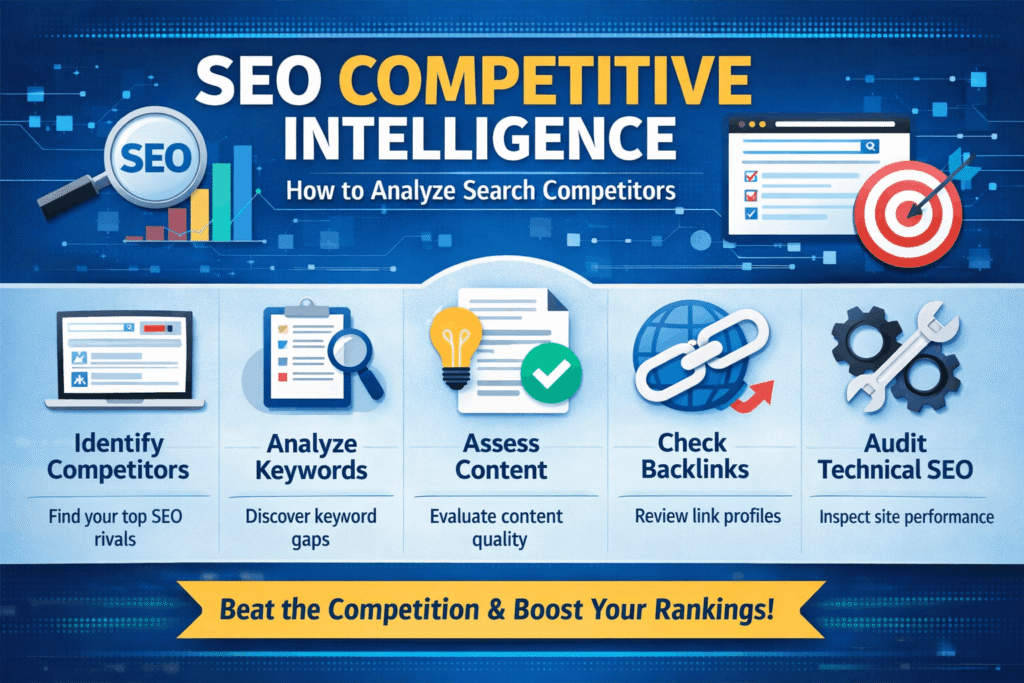
4. Step-by-Step Process for SEO Competitor Analysis
Analyzing your competitors requires a structured, systematic approach to ensure that all critical SEO aspects are addressed.
Step 1: Identify Key Organic Competitors
Begin by compiling a list of websites that consistently rank for your target keywords. Use both manual Google searches and tools like SEMrush or Ahrefs to identify competitors. Pay attention to variations of your main keywords, including long-tail phrases, as these often highlight smaller, niche competitors that are easier to outrank.
By examining multiple keywords, you can identify recurring competitors who dominate the SERPs across several relevant queries. This allows you to prioritize which websites to study in depth. Ignoring recurring competitors can lead to missing key insights into content strategy, link-building techniques, and on-page optimization that directly impact rankings.
Step 2: Analyze Competitor Keyword Rankings
Once competitors are identified, analyze their keyword rankings in detail. Look for keywords where your competitors rank higher and determine why. Are they using better content structure, targeting more specific intent, or leveraging stronger backlinks? Understanding these patterns informs your keyword strategy.
Focus on three categories: keywords where you are not ranking at all, keywords where you compete but rank lower, and high-volume keywords where competitors dominate. This categorization helps prioritize opportunities for content creation, optimization, and link-building. Without a clear understanding of keyword gaps, SEO efforts can become unfocused and less effective.
Step 3: Evaluate Content Quality and Structure
Content analysis is critical to understanding why competitors outperform you. Examine the length, depth, and structure of competitor content. Are they using headers effectively? Is the content optimized for user intent? Do they include multimedia, infographics, or videos to enhance engagement?
High-ranking content often provides comprehensive answers to search queries and satisfies both user intent and SEO best practices. Identify gaps in your own content relative to competitors and develop a plan to create superior, more informative, and better-structured content. Remember, content that is informative, engaging, and well-structured consistently outperforms thin or poorly optimized pages.
Step 4: Assess Backlink Profiles
Backlinks remain a critical ranking factor in SEO. Examine the quantity, quality, and sources of competitor backlinks. Are they receiving links from high-authority domains, industry publications, or niche blogs? Analyze the anchor text distribution to understand which keywords are being emphasized.
Use this data to inform your own link-building strategy. For instance, if a competitor has links from industry-specific sites, consider developing similar relationships, guest posting opportunities, or resource pages that naturally attract backlinks. A strategic approach to backlinks is far more effective than random link-building attempts.
Step 5: Compare Technical SEO and Site Performance
Technical SEO is often overlooked but can be a differentiator in competitive niches. Conduct a technical audit comparing your site to competitors. Look at crawlability, site speed, mobile optimization, structured data implementation, and internal linking structures.
Sites with strong technical SEO are easier for search engines to index and often rank higher even with slightly weaker content. Competitor comparison highlights areas where your technical performance lags, enabling targeted improvements that can boost rankings quickly.
5. Understanding User Intent and SERP Features
Search intent is the underlying reason behind a search query, and understanding it is critical for competitive SEO. Queries can be informational, transactional, navigational, or commercial. Competitors who align their content with user intent often capture not only rankings but also featured snippets, people also ask sections, and other SERP features.
SERP features influence visibility and click-through rates. For instance, if a competitor consistently holds the featured snippet for your target keyword, it indicates that Google perceives their content as authoritative and highly relevant. Analyzing how competitors structure their content to capture these features provides actionable insights into how to improve your own content strategy.
6. Using Insights to Strengthen Your SEO Strategy
After gathering competitor data, it’s critical to act strategically on it.
6.1 Content Gap Filling
Identify keywords and topics where competitors rank, but you do not. Develop high-quality content to fill these gaps. Ensure that your content is more comprehensive, engaging, and better structured than competitors’ offerings. Include examples, data, visuals, and multimedia elements to improve user experience and SERP performance.
6.2 Optimizing Existing Pages
Pages that already rank but lag behind competitors can be improved by optimizing content. Add related keywords naturally, restructure headings for clarity, enhance readability, and enrich the page with visuals and data. Optimizing meta tags, alt texts, and schema markup can also provide additional ranking benefits.
6.3 Strategic Backlink Acquisition
Based on competitor backlink analysis, reach out to similar high-quality sites for links. Guest posting, resource pages, or collaboration opportunities can provide valuable backlinks that enhance domain authority and improve rankings. Monitor competitor link-building activity and ethically replicate successful strategies.
6.4 Leveraging Internal Linking
Internal linking helps distribute authority across your website. Use your strongest pages to support weaker pages, targeting high-priority keywords. Competitors often outrank sites with weaker internal linking structures, even if their content is similar. A well-planned internal linking strategy ensures that authority flows where it’s needed most.
7. Monitoring, Tracking, and Iterating
SEO is not static. Regularly monitor keyword rankings, traffic patterns, and backlink growth to assess the effectiveness of your strategy. Use Google Analytics, Search Console, and other SEO tools to track improvements.
Adjust your strategy based on data trends. For instance, if a competitor suddenly ranks for a keyword that you were targeting, analyze their content and link strategy to understand how they achieved it. Iterative analysis ensures that your SEO approach remains competitive and responsive to changes in the search landscape.
8. Common Pitfalls to Avoid
Even experienced marketers make mistakes in competitive analysis:
- Focusing solely on high-volume keywords without considering difficulty
- Ignoring the underlying search intent behind a keyword
- Copying competitor content instead of improving it
- Overlooking technical SEO factors like site speed and crawlability
- Failing to track and adjust strategies over time
Avoiding these mistakes ensures your SEO competitive intelligence efforts yield meaningful results rather than wasted effort.
9. Future Trends in SEO Competitive Intelligence
The SEO landscape continues to evolve rapidly. AI-powered search results, voice and visual search, and increasing personalization are changing how content ranks. Competitors who adapt quickly to these trends can gain a significant advantage.
To stay ahead, businesses must make competitive intelligence an ongoing practice. Regular audits, content updates, and monitoring of SERP feature shifts ensure that SEO strategies remain effective and aligned with evolving user behavior and search engine algorithms.
Conclusion: Leveraging Competitive Intelligence for SEO Success
SEO Competitive Intelligence is a strategic approach that helps brands understand their search environment, identify gaps, and implement data-driven improvements. By analyzing competitor keywords, content, backlinks, and technical performance, businesses can develop actionable strategies that improve rankings and drive traffic.
Remember, SEO is not a static game—it is a dynamic competition where understanding your competitors and learning from their strengths and weaknesses is key to long-term success. Using the steps outlined in this guide, brands can outperform competitors, enhance visibility, and achieve measurable growth in organic search performance.
