
Brand architecture is a critical strategic decision that shapes how a company presents its brands to the world. It defines the relationship between a parent company and its various products or sub-brands. Choosing the right brand architecture is vital for brand equity, customer perception, and long-term growth. In this article, we will explore three major brand architecture models—House of Brands, Branded House, and Hybrid—and discuss their advantages, challenges, and real-world examples.
Understanding these models will help businesses make informed decisions about how to structure their portfolio, communicate effectively with their audience, and optimize brand performance.
What is Brand Architecture?
Brand architecture is the organizational framework that determines how a company structures and manages its portfolio of brands. It establishes the hierarchy, naming conventions, and relationships among products, services, and sub-brands. Effective brand architecture provides clarity to customers, ensuring they understand the connection between brands and the parent company.
From an internal perspective, brand architecture helps streamline marketing, reduce brand confusion, and guide decisions on launching new products. Externally, it ensures that the brand communicates consistently and efficiently, strengthening brand equity. Without a coherent brand architecture, companies risk diluting their brand image and confusing their customers.
Brand architecture also influences how resources are allocated across the portfolio. Companies with clear architecture can prioritize high-performing brands, avoid overlapping marketing efforts, and capitalize on brand synergies.
Types of Brand Architecture
Brand architecture generally falls into three main categories:
- House of Brands
- Branded House
- Hybrid
Each type has unique characteristics, advantages, and challenges. Selecting the right model depends on the company’s goals, market positioning, and growth strategy.
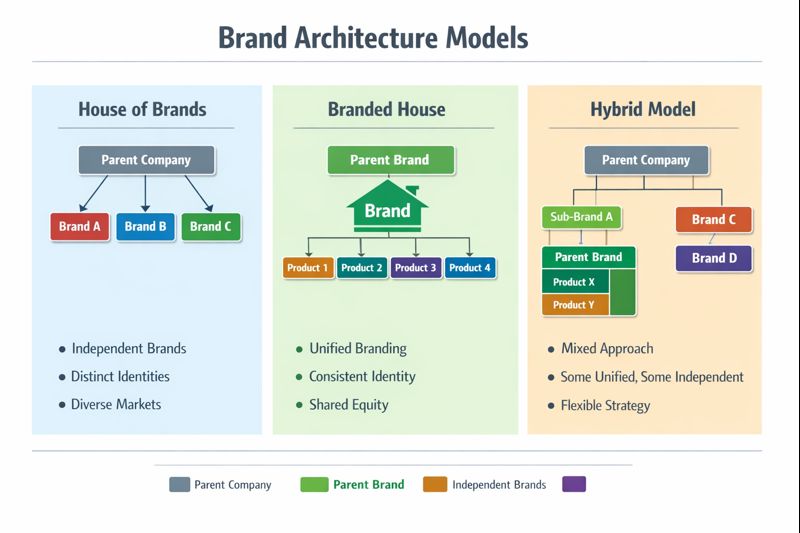
House of Brands
The House of Brands model consists of a parent company that owns multiple individual brands, each with its own identity and target audience. These brands operate independently and are often marketed as standalone entities.
For example, Procter & Gamble is a classic House of Brands. Its portfolio includes brands like Pampers, Tide, Gillette, and Oral-B. Each brand has its own marketing strategy, positioning, and customer base. When building a House of Brands, it’s essential to align each sub-brand with the overall brand strategy to ensure long-term growth and market relevance.
The main advantage of this approach is flexibility. Companies can target different market segments without the constraints of a unified brand identity. This model allows experimentation and minimizes risk—if one brand faces issues, it does not impact the reputation of others in the portfolio.
However, managing a House of Brands can be resource-intensive. Each brand requires separate marketing, research, and operational strategies. Without careful oversight, the portfolio can become fragmented, leading to inefficiencies and higher costs.
Another key advantage is that brands can appeal to niche markets effectively. A strong House of Brands allows companies to tailor messaging, design, and positioning to specific customer needs. This often results in higher brand loyalty within each segment.
Branded House
The Branded House model centers around a single, strong parent brand that is used across multiple products or services. All sub-brands share the parent company’s name and identity, creating a unified brand image.
Google is an excellent example of a Branded House. Products like Google Maps, Google Drive, and Google Photos all carry the Google brand name, reinforcing brand recognition and trust.
The primary advantage of this approach is brand equity consolidation. Every product launch benefits from the reputation and credibility of the parent brand. Marketing costs are also more efficient because campaigns promote the overarching brand rather than separate identities.
A Branded House fosters a strong emotional connection with customers. When customers trust the parent brand, they are more likely to try new offerings, enhancing customer lifetime value. Careful brand positioning ensures that all products under a Branded House resonate with the parent brand’s core values while appealing to diverse customer needs.
However, the Branded House model carries risks. Negative publicity for one product can damage the parent brand and all associated sub-brands. Additionally, expanding into diverse markets may be challenging if the parent brand’s identity does not align with new offerings.
Another benefit is simplicity. Customers can easily understand that all products come from the same source, creating a coherent and familiar brand experience. This clarity reduces confusion and strengthens brand recall.
Hybrid Brand Architecture
The Hybrid model combines elements of both House of Brands and Branded House. In this approach, some products carry the parent brand’s identity, while others operate independently.
Microsoft is a notable example of a Hybrid model. Microsoft Office products leverage the parent brand’s credibility, while Xbox and LinkedIn maintain their distinct brand identities.
The Hybrid approach offers flexibility while leveraging brand equity. Companies can strengthen key products under the parent brand while experimenting with independent brands for niche markets.
This model can be complex to manage because it requires balancing brand autonomy and brand unity. Clear guidelines and strategic oversight are essential to prevent brand confusion.
The Hybrid model is ideal for large corporations with diverse product lines. It enables growth in new markets while maintaining the credibility of established brands.
Another advantage is risk mitigation. Issues with an independent sub-brand are less likely to harm the parent brand, while flagship products continue to benefit from consolidated brand equity.
Key Differences Between the Models
| Feature | House of Brands | Branded House | Hybrid |
|---|---|---|---|
| Brand Identity | Independent | Unified | Mix of both |
| Marketing Approach | Separate campaigns for each brand | Shared parent brand campaigns | Combination of both |
| Customer Perception | Tailored for niche segments | Coherent and recognizable | Flexible based on product/brand |
| Risk Exposure | Low cross-brand risk | High cross-brand risk | Moderate risk |
| Cost Efficiency | Higher due to multiple campaigns | Lower due to consolidated marketing | Moderate; depends on strategy |
The choice of model depends on several factors, including market strategy, audience segmentation, brand equity goals, and operational resources.
Advantages and Challenges of Each Model
House of Brands
Advantages:
- Flexible targeting of diverse market segments
- Reduced risk of brand damage across the portfolio
- Ability to experiment with unique positioning
- Strong potential for niche brand loyalty
Challenges:
- Higher marketing and operational costs
- Difficult to achieve portfolio synergy
- Risk of fragmented brand perception
Branded House
Advantages:
- Consolidated brand equity
- Cost-efficient marketing
- Strong emotional connection with customers
- Clear and consistent brand messaging
Challenges:
- Negative events affect all products
- Limited flexibility for market expansion
- Risk of overextension of parent brand identity
Hybrid
Advantages:
- Balanced flexibility and brand equity leverage
- Ability to target both mass and niche markets
- Risk mitigation across portfolio
- Supports strategic diversification
Challenges:
- Complex brand management
- Requires strong governance and clear guidelines
- Risk of confusing customers if not implemented carefully
How to Choose the Right Brand Architecture
Choosing the right brand architecture requires careful consideration of the company’s goals, resources, and market positioning. Start by evaluating the following:
- Brand Equity: If your parent brand is strong and widely recognized, a Branded House or Hybrid may be advantageous.
- Market Segmentation: Diverse target audiences may benefit from a House of Brands to tailor messaging effectively.
- Operational Resources: Consider the cost and complexity of managing multiple brands.
- Risk Tolerance: Determine how negative events affecting one brand could impact the overall portfolio.
It’s also important to consider future growth plans. Brand architecture should be flexible enough to accommodate expansion, acquisitions, or entry into new markets.
Finally, customer perception is critical. A well-structured brand portfolio creates clarity, reduces confusion, and strengthens loyalty across all touchpoints.
Real-World Examples
- House of Brands: Procter & Gamble, Unilever, L’Oréal
- Branded House: Google, Virgin, FedEx
- Hybrid: Microsoft, Coca-Cola, Marriott International
These companies demonstrate how different brand architectures can align with strategic goals and market positioning. Each example shows how companies use architecture to balance flexibility, risk, and brand equity.
Conclusion
Brand architecture is more than just a naming convention—it is a strategic framework that defines how your company communicates and delivers value. Choosing between a House of Brands, Branded House, or Hybrid model affects marketing efficiency, customer perception, and long-term growth.
A House of Brands allows for independent brand identities and flexibility but comes with higher costs. A Branded House consolidates brand equity and simplifies messaging but carries higher risk. The Hybrid model balances both approaches, offering flexibility while leveraging the strength of the parent brand.
The right choice depends on your company’s objectives, resources, target audiences, and long-term vision. By carefully analyzing these factors, you can design a brand architecture that maximizes growth, strengthens loyalty, and enhances your market presence.
