
In today’s competitive marketplace, branding goes beyond just a logo or catchy tagline to directly impact your ROI. Strong branding boosts customer loyalty, enhances recognition, and builds trust, all of which can raise your financial returns. Yet, businesses often struggle to connect these benefits to measurable ROI. Calculating the Return on Investment (ROI) for branding is more complex than simply tracking sales, but measuring it allows you to see the true value of your brand strategy. This article shares actionable ways to track branding ROI and optimize your brand’s business performance.
Understanding Branding ROI
Branding ROI measures the financial return a company gets from its branding efforts. Unlike direct marketing, where you can track clicks or sales, the effects of branding are often less obvious and take time to show. For instance, a strong brand can help retain customers, drive referrals, or allow for higher prices, but these benefits may not show up in your revenue right away. To understand branding ROI, you need both numbers and feedback. By choosing key performance indicators (KPIs) and tracking them, you can see which branding actions add real value. In the end, measuring branding ROI means linking how people see your brand to actual business results.
Key Components of Branding ROI
To calculate branding ROI, you need to look at both tangible and intangible factors. Tangible factors include things like revenue growth, lead generation, and customer acquisition costs. Intangible factors cover brand awareness, loyalty, and how customers see your brand. Both are important for understanding how branding affects your business. For example, strong brand loyalty can keep your revenue steady, even when competition is tough. Knowing these factors helps you decide where to invest in branding and which strategies work best. Focusing on both types of results makes your ROI measurement more accurate and useful.
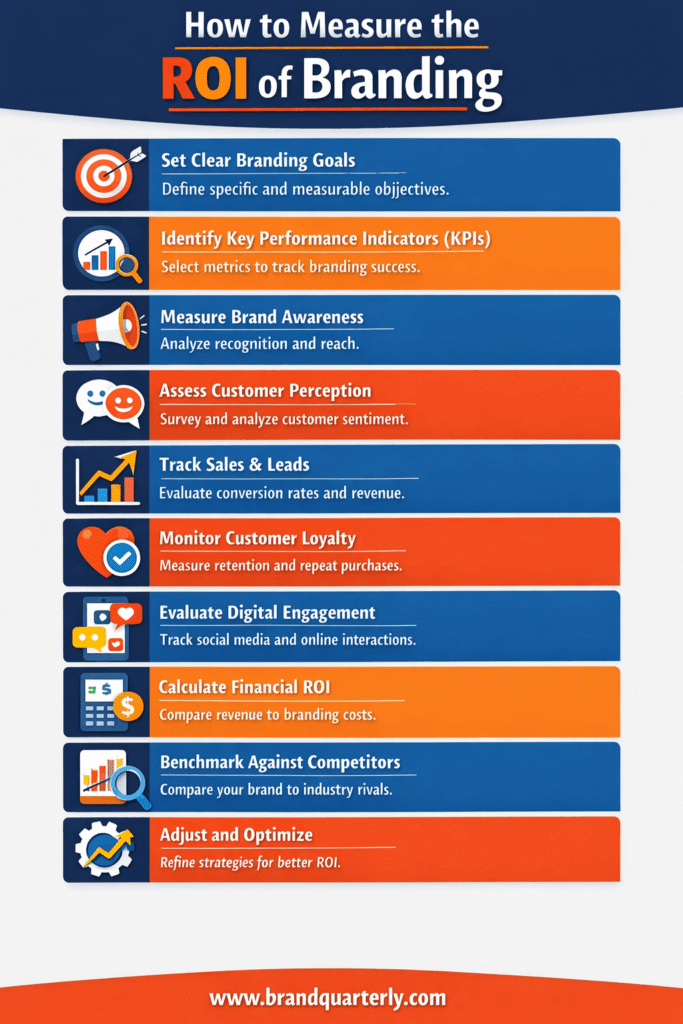
Step 1: Set Clear Branding Goals
Before you measure ROI, set clear branding goals. These goals should match your main business objectives and be specific, measurable, achievable, relevant, and time-bound (SMART). Examples include raising brand awareness, improving how customers see your brand, growing your market share, or boosting social media engagement. Clear goals give you something to measure your progress against. Without them, you can’t tell if your branding is working. Take time to define your goals and decide what results you expect from each branding effort.
Step 2: Identify Key Performance Indicators (KPIs)
After setting your branding goals, choose KPIs that align with them. KPIs are specific numbers that show if your branding is working. For brand awareness, you might track social media mentions, website visits, search volume, or media coverage. To assess customer perception and loyalty, look at Net Promoter Score (NPS), retention rates, or repeat purchase rates. Picking the right KPIs gives you clear ways to measure each branding effort. By tracking these regularly, you can see how well your branding works over time. Make sure your KPIs cover both short- and long-term results to provide a full picture of branding ROI.
Step 3: Quantify Brand Awareness
Brand awareness is a key sign of branding success. It shows how well your audience knows and recognizes your brand and products. You can measure brand awareness with surveys, social media analytics, website traffic, and search data. For example, more people searching for your brand name means higher recognition. Social media mentions, shares, and engagement also show how visible your brand is. Measuring brand awareness helps you see how far your branding campaigns reach and how they might affect sales.
Step 4: Measure Customer Perception
How customers see your brand is a big part of branding success. When people have a positive view of you, they are more likely to trust you, stay loyal, and recommend your business, which helps you grow over time. You can measure customer perception with surveys, reviews, focus groups, and social media sentiment analysis. Metrics such as brand sentiment, Net Promoter Score (NPS), and satisfaction scores reveal how customers feel about your brand. Looking at these numbers helps you find ways to improve and adjust your branding. Knowing what customers think ensures your branding connects with your audience and drives real results.
Step 5: Track Lead Generation and Sales Impact
Branding is not just about awareness and perception—it also affects lead generation and sales. A strong brand can attract better leads, accelerate sales, and boost conversion rates. To measure this, track website conversion rates, lead quality, customer acquisition cost (CAC), and revenue growth. Compare your sales before and after branding efforts to see the impact. Also, check where your leads come from to find out which branding channels work best. This helps connect branding activities to real business results, making your ROI measurement more accurate.
Step 6: Analyze Customer Retention and Loyalty
Customer retention and loyalty are key parts of branding ROI. Loyal customers buy again and often recommend your brand to others. To measure this, track retention rates, how often customers buy again, and customer lifetime value (CLV). For example, more repeat purchases can show that your branding builds trust and satisfaction. By analyzing loyalty metrics, you can adjust your branding to better support current customers and maximize value. Good branding builds strong customer relationships and steady revenue over time.
Step 7: Evaluate Social Media and Digital Engagement
Today, social media and online engagement are important signs of branding success. Platforms like Facebook, Instagram, LinkedIn, and TikTok have tools to track engagement, reach, impressions, and audience growth. High engagement means your brand connects with people, and more followers show rising brand awareness. Looking at likes, shares, comments, and video views helps you see what content works best. By tracking these numbers over time, you can improve your strategy and focus on what brings the best results. This way, your branding is both visible and effective in getting people involved.
Step 8: Monitor Brand Equity
Brand equity is the total value your brand has in the market. It includes awareness, perception, loyalty, and your position compared to others. Strong brand equity can let you charge higher prices, spend less on marketing, and stay ahead of competitors. Measuring brand equity can be tricky, but tools such as brand valuation, surveys, and market share analysis can help. For instance, if people are willing to pay more for your product than for others, it shows strong brand equity. Keeping track of brand equity helps make sure your branding builds lasting value. This long-term view is important for measuring ROI beyond just sales.
Step 9: Calculate Financial ROI of Branding
After you gather all your metrics, you can calculate the financial ROI of branding by linking your branding activities to changes in revenue. The basic ROI formula is:
ROI=Revenue Attributed to Branding−Branding CostsBranding Costs×100\text{ROI} = \frac{\text{Revenue Attributed to Branding} – \text{Branding Costs}}{\text{Branding Costs}} \times 100ROI=Branding CostsRevenue Attributed to Branding−Branding Costs×100
Revenue from branding includes higher sales, upsells, repeat purchases, and the ability to charge more because of your brand’s reputation. Branding costs include marketing, design, content creation, and public relations. Not all branding benefits show up right away in your finances, but mixing financial data with KPI analysis gives you a full picture. Calculating ROI helps you prove the value of branding and improve your strategies for better results. A clear financial review makes branding a practical business tool, not just an idea.
Step 10: Use Attribution Models
Attribution models help businesses understand which branding activities contribute most to ROI. Common models include first-touch, last-touch, linear, and multi-touch attribution. First-touch attribution assigns credit to the initial interaction a customer had with your brand, while last-touch attribution focuses on the final conversion point. Multi-touch attribution distributes credit across multiple touchpoints, providing a more balanced view of branding impact. By applying attribution models, businesses can identify high-performing channels, campaigns, and content that drive measurable results. This insight enables smarter budgeting and more effective allocation of branding resources.
Step 11: Benchmark Against Competitors
Benchmarking branding ROI against competitors provides valuable context for performance evaluation. Understanding industry standards and competitor strategies helps businesses identify gaps and opportunities. Competitive analysis can include market share comparison, social media engagement rates, brand awareness surveys, and pricing strategies. By comparing your branding outcomes to industry benchmarks, you gain insights into how well your brand stands out in the market. Benchmarking also informs strategic decisions to improve brand positioning and achieve superior ROI. Staying aware of competitive dynamics ensures that branding investments remain relevant and effective.
Step 12: Leverage Customer Feedback
Customer feedback is an invaluable tool for measuring the qualitative impact of branding. Direct feedback through surveys, reviews, and testimonials reveals how branding influences customer perception and loyalty. Analyzing feedback helps identify strengths, weaknesses, and opportunities for improvement in brand messaging and identity. For instance, repeated mentions of trustworthiness or reliability in customer reviews indicate successful branding. Integrating feedback into branding strategies ensures continuous improvement and higher ROI. Listening to customers transforms branding into a customer-centric approach that aligns with business goals.
Step 13: Invest in Brand Tracking Tools
Modern analytics tools make it easier to track and measure branding ROI. Tools like Google Analytics, HubSpot, Sprout Social, and SEMrush provide insights into website traffic, engagement, conversions, and brand visibility. Brand tracking software can also monitor sentiment, mentions, and competitor performance. Investing in these tools allows businesses to gather accurate data, identify trends, and make informed decisions. Consistent tracking ensures that branding ROI is measurable, actionable, and aligned with business objectives. Utilizing technology effectively transforms branding from a qualitative effort into a quantifiable strategic investment.
Step 14: Adjust and Optimize Branding Strategy
Measuring ROI is only valuable if businesses use insights to optimize branding strategies. Continuous evaluation helps identify underperforming initiatives and opportunities for improvement. By reallocating resources to high-impact activities and refining messaging, businesses maximize ROI and long-term brand value. Optimization also involves testing new approaches, such as personalized content, influencer partnerships, or experiential marketing. Branding is dynamic, and regular adjustments ensure strategies remain relevant, effective, and financially rewarding. A proactive approach to optimization ensures branding efforts continuously contribute to measurable business growth.
Step 15: The Long-Term Perspective of Branding ROI
Unlike short-term marketing campaigns, branding ROI often manifests over months or years. Building awareness, trust, and loyalty takes time, and the benefits compound over the long term. Businesses must adopt a long-term perspective when evaluating ROI, considering both immediate and future impacts on revenue, customer retention, and brand equity. Patience and consistent measurement are essential to understanding the full value of branding. By committing to long-term evaluation, businesses can create sustainable competitive advantages and achieve lasting growth. Ultimately, branding ROI is not just about numbers—it’s about building a brand that drives enduring business success.
Conclusion
Measuring the ROI of branding is a multifaceted process that combines quantitative metrics, qualitative insights, and long-term evaluation. By setting clear goals, identifying KPIs, tracking awareness, perception, engagement, and sales impact, businesses can accurately assess the effectiveness of their branding efforts. Leveraging attribution models, benchmarking, customer feedback, and modern analytics tools further strengthens ROI measurement. Branding is not a one-time effort—it requires continuous optimization and strategic investment. Understanding and measuring branding ROI allows businesses to justify their investments, make data-driven decisions, and build a brand that delivers lasting value. Strong, measurable branding is the cornerstone of business growth in an increasingly competitive market.
