
In today’s crowded digital landscape, customers don’t just buy products — they buy stories, values, and trust. With thousands of brands competing for attention, unclear messaging leads to confusion, lower conversion rates, and weaker brand loyalty. A brand messaging framework ensures every touchpoint communicates the same core story, making your brand recognizable and credible across platforms.
Brand messaging goes beyond catchy slogans. It shapes the customer experience on your website, ads, emails, social media, and in service. When these feel connected, customers trust and engage more quickly. Without cohesion, even strong products get lost.
Strong messaging boosts recall, shortens sales cycles, and raises lifetime value. Brands with consistent messaging grow faster than those without. Building a messaging framework is now a necessity, not a luxury.
In this guide from BrandQuarterly, you’ll discover how to craft a messaging framework that forges real clarity, genuine connection, and unshakeable loyalty — enabling your brand to flourish with purpose and heart.
What Is a Brand Messaging Framework?
A brand messaging framework is a strategic system guiding how you communicate across channels and touchpoints. It covers positioning, value proposition, voice, tone, narrative, personas, and key messages, letting teams communicate with a unified story.
The main purpose of a messaging framework is consistency. Customers should experience the same brand personality and promise whether on your website, with sales, or on social media. Consistency builds trust, credibility, and recognition.
A messaging framework scales as your brand grows. New employees and partners get clear communication guidance, preventing dilution and confusion as operations expand.
Most importantly, messaging frameworks turn communication into strategy. They shape marketing, sales, product positioning, employer branding, and leadership communication—making them vital business assets, not just marketing tools.
Why a Cohesive Brand Narrative Drives Growth
A cohesive brand narrative builds emotional alignment with your audience. Instead of focusing solely on features or price, customers connect with your purpose and values, which increases trust, loyalty, and advocacy.
Consistency strengthens memorability. When customers repeatedly encounter the same message across channels, it becomes embedded in their perception of your brand. This reduces decision friction and increases conversion rates by fostering familiarity and confidence.
Unified messaging also improves internal execution. Teams communicate faster and more effectively when they share a common language. Marketing, sales, product, and leadership alignment result in stronger campaigns and better customer experiences.
Cohesive storytelling differentiates your brand. When products and prices are similar, clarity and meaning are your best advantages.
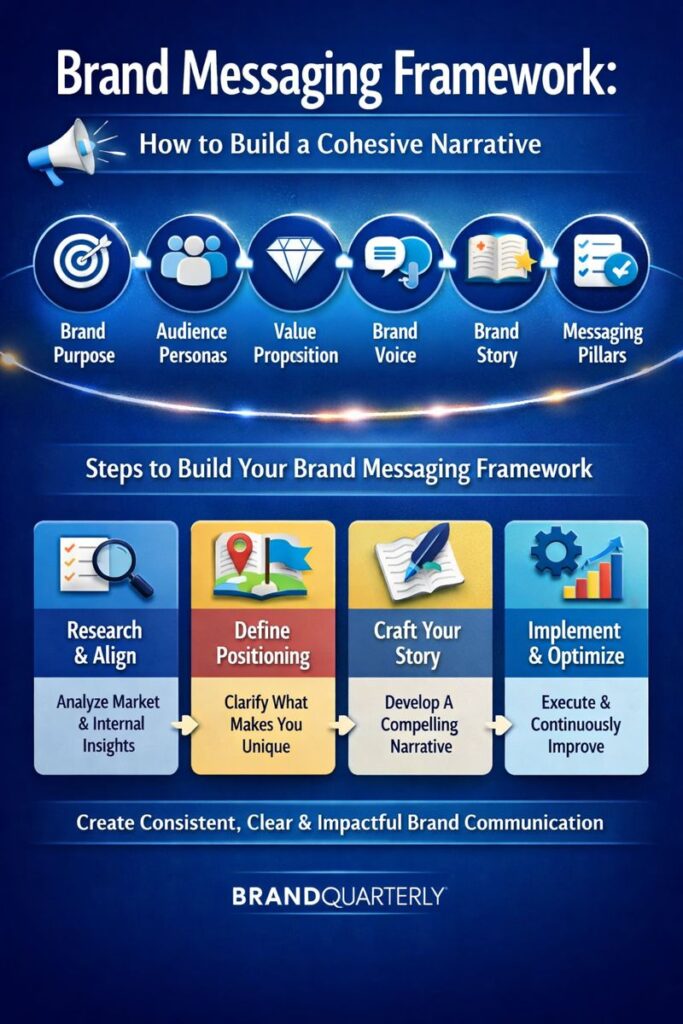
Core Components of a Brand Messaging Framework
A strong messaging framework includes elements that deliver clarity and consistency. Each supports the others, keeping communication aligned across platforms and teams.
Let’s explore the essential pillars.
1. Brand Purpose and Mission
Brand purpose defines why your company exists beyond making money. It expresses the impact you want to have on customers’ lives and the world. Purpose-driven brands connect emotionally because customers increasingly choose companies aligned with their values, not just their needs.
Mission turns purpose into action. It explains what you do, who you serve, and how you deliver value. Purpose and mission anchor messaging and keep you focused on long-term meaning.
Purpose-driven messaging builds trust, loyalty, and advocacy. It shifts marketing from promotion to participation, inviting customers to align with your beliefs. Without purpose, messaging feels transactional rather than transformational.
2. Brand Vision and Positioning
Brand vision shows where your company is headed and the future you want to create. It shapes growth and inspires customers and employees by connecting current steps to future impact.
Positioning defines how your brand is uniquely perceived compared to competitors. It answers who you serve, what problem you solve, and why your solution is different and valuable. Strong positioning eliminates ambiguity and strengthens differentiation in crowded markets.
Together, vision and positioning ensure your messaging evolves without losing identity. While tactics may change, your narrative remains anchored in purpose and distinction. This balance allows brands to grow without fragmenting their story.
3. Target Audience and Buyer Personas
Effective messaging begins with deep audience understanding. A brand messaging framework clearly defines who your customers are, what they care about, and how they make decisions. Without this clarity, messaging becomes generic and disconnected from real needs.
Buyer personas go beyond demographics to capture motivations, challenges, behaviors, emotional triggers, and buying barriers. These insights allow brands to personalize language and tone while maintaining narrative consistency. Customers engage more when they feel understood.
Audience research should be informed by interviews, surveys, sales insights, analytics, and customer feedback. When messaging reflects actual customer language rather than internal jargon, relevance and conversion rates increase significantly.
4. Value Proposition and Unique Selling Proposition (USP)
Your value proposition explains why customers should choose your brand. It communicates the outcomes and benefits your product or service delivers — not just features. Strong value propositions focus on transformation rather than functionality.
Your USP defines what makes you meaningfully different from competitors. It highlights a unique strength that cannot be easily replicated, such as innovation, simplicity, experience, trust, or performance. Without differentiation, messaging blends into market noise.
Together, value proposition and USP anchor your marketing, sales, and product messaging. They clarify your promise to customers and eliminate confusion during the buying process. Clear value positioning increases trust, confidence, and conversion.
5. Brand Voice, Tone, and Personality
Brand voice defines how your brand sounds across communication channels. It includes vocabulary, sentence style, emotional tone, and personality traits. Unlike tone, which changes by context, voice remains consistent.
Brand personality shapes how customers emotionally experience your brand. Whether your brand is confident, empathetic, bold, playful, or authoritative, personality consistency strengthens recognition and trust. Customers connect more easily with brands that feel human.
Tone adjusts based on situation — marketing may be inspirational, customer service reassuring, and investor communications professional. However, the underlying voice must remain stable. Without voice guidelines, messaging becomes inconsistent and subjective.
6. Brand Story and Narrative
Your brand story humanizes your business and builds an emotional connection with your audience. It explains who you are, why you exist, what problem inspired your creation, and what future you aim to build. Storytelling makes abstract ideas relatable and memorable.
Effective brand narratives position the customer as the hero and the brand as the guide. This structure creates empathy and relevance by focusing on customer transformation rather than company achievements. Customers want to see themselves in your story.
Brand storytelling should shape product positioning, campaigns, customer testimonials, and content strategy — not just About pages. When story guides communication, brands move from selling products to creating meaning.
7. Messaging Pillars and Talking Points
Messaging pillars represent the 3–5 core themes your brand consistently communicates. These pillars express your most important ideas and value drivers. They provide strategic focus and ensure alignment across all channels.
Each pillar should include supporting proof points such as product capabilities, data, customer stories, reviews, certifications, or performance metrics. Evidence strengthens credibility and prevents messaging from sounding vague or aspirational.
Talking points translate pillars into usable language for marketing, sales, leadership, PR, and customer service. This allows teams to communicate confidently while maintaining narrative cohesion. Without pillars, messaging becomes scattered and forgettable.
Step-by-Step Guide to Building a Brand Messaging Framework
Now, let’s walk through a practical process to create your own messaging framework.
Step 1: Conduct Brand Discovery and Internal Alignment
Effective messaging starts internally. Before speaking to customers, leadership and teams must align on who the brand is, what it stands for, and where it’s going. Discovery workshops uncover brand beliefs, culture, goals, competitive advantages, and customer insights. Conducting this process is also an essential part of your brand strategy, ensuring that messaging, positioning, and overall communication reflect the organization’s long-term objectives and market differentiation.
Audit existing messaging across your website, ads, sales decks, onboarding materials, social channels, and customer service scripts. Look for inconsistencies, contradictions, or unclear positioning. These gaps often reveal why messaging fails to resonate externally.
Internal alignment ensures everyone communicates from the same strategic foundation. Without it, marketing speaks one language while sales and product teams speak another. Alignment transforms messaging from isolated copywriting into a shared organizational language.
Step 2: Define Target Audience and Buyer Personas
Once internal clarity exists, shift focus outward. Develop detailed buyer personas that capture motivations, challenges, emotional drivers, buying triggers, objections, and success metrics. These personas guide tone, language, and message priorities.
Use customer interviews, surveys, CRM data, analytics, sales insights, and support feedback to inform personas. Real customer language should shape messaging rather than internal assumptions. This improves relevance and emotional resonance.
Audience understanding prevents generic messaging. When brands speak directly to customer needs, engagement increases, trust strengthens, and conversion improves. Personas ensure messaging stays customer-centric instead of product-centric.
Step 3: Clarify Brand Positioning and Differentiation
Positioning defines how your brand occupies a unique place in the market. It answers who your brand is for, what problem it solves, why it’s different, and why that difference matters. Strong positioning eliminates ambiguity and sharpens differentiation.
Begin with competitive analysis to identify white space. Evaluate competitors by price, experience, innovation, trust, service model, or performance. Then define how your brand uniquely excels where others fall short.
Create a positioning statement such as:
“For [target audience], [brand] is the [category] that [key benefit] because [reason to believe].”
This statement becomes the backbone of your messaging framework and ensures narrative focus.
Step 4: Define Brand Purpose, Mission, and Vision
Brand purpose articulates why your company exists beyond profit. It expresses your impact on customers, communities, or industries. Purpose-driven brands outperform because customers increasingly choose brands aligned with their values.
Mission translates purpose into action. It explains what you do daily, who you serve, and how you deliver value. Vision describes the future state you aim to create. Together, these elements guide messaging tone, positioning, and storytelling.
Avoid vague language. Strong purpose and vision statements are specific, inspiring, and credible. When purpose informs messaging, marketing shifts from promotion to meaning — building emotional loyalty rather than transactional engagement.
Step 5: Establish Brand Voice, Tone, and Personality
Voice defines how your brand communicates — including vocabulary, rhythm, emotion, and personality. Whether your voice is bold, warm, analytical, playful, or visionary, it must remain consistent across channels.
Tone adapts based on context. For example, marketing may feel inspirational, customer service empathetic, and investor communications formal — while still sounding like the same brand. This flexibility ensures relevance without fragmentation.
Document voice and tone guidelines clearly. Include sample phrases, sentence structures, emotional cues, banned words, and formatting preferences. This speeds up content creation while protecting brand consistency as teams scale.
Step 6: Create Your Brand Story and Narrative
Your brand story transforms business strategy into an emotional connection. It explains why your company was founded, what problem it exists to solve, and what future it seeks to build. Stories humanize brands and make value propositions memorable.
Strong brand narratives position the customer as the hero and your brand as the guide. This approach builds empathy and relevance by focusing on customer success rather than company achievements. Customers want to see themselves in your story.
Integrate storytelling across campaigns, websites, onboarding experiences, sales presentations, and content marketing. When story drives communication, brands shift from selling products to building meaning and loyalty.
Step 7: Define Messaging Pillars and Proof Points
Messaging pillars distill your strategy into 3–5 core themes that anchor communication. These pillars reflect your positioning, value proposition, and customer priorities. They provide narrative focus and simplify content creation.
Each pillar requires proof points — including customer testimonials, product capabilities, metrics, certifications, awards, partnerships, or case studies. Evidence strengthens credibility and prevents messaging from sounding generic or exaggerated.
Talking points translate pillars into everyday language for sales, marketing, leadership, and customer success teams. This ensures everyone communicates confidently while reinforcing the same brand story.
Step 8: Translate Strategy into Tactical Messaging
Next, convert strategy into executional assets such as:
- Brand tagline
- Elevator pitch
- Homepage hero copy
- Product descriptions
- Campaign headlines
- Sales scripts
- Email templates
- PR boilerplates
- Social media voice guidelines
Each asset should map directly back to your framework pillars, positioning, voice, and narrative. This ensures tactical execution reinforces strategic intent. Modular messaging blocks allow flexibility without diluting consistency.
Without translation into tools, frameworks remain theoretical. Tactical messaging turns strategy into action — enabling faster, clearer, and more consistent communication across teams.
Step 9: Implement Across Teams and Channels
Messaging frameworks succeed only when adopted organization-wide. Train marketing, sales, customer success, HR, leadership, and partners on the framework’s purpose, structure, and application. Education ensures consistency and alignment.
Integrate messaging into onboarding, brand guidelines, campaign briefs, agency workflows, and performance reviews. Messaging becomes a cultural habit rather than a marketing document. This systemic adoption ensures long-term consistency.
Audit live touchpoints to ensure alignment — including websites, ads, emails, presentations, support scripts, and social media. Identify gaps and optimize accordingly. Consistent execution compounds trust and recognition.
Step 10: Measure, Optimize, and Evolve
Brand messaging must evolve as markets change, customers shift, and business priorities grow. Monitor performance metrics such as conversion rates, brand recall, engagement, sentiment, retention, and customer feedback.
Use qualitative insights from customer interviews, sales teams, reviews, and support tickets to understand how customers perceive your messaging. Their language reveals whether your narrative resonates or confuses.
Refine messaging continuously without losing core identity. The strongest brands evolve their communication while preserving meaning — balancing adaptability with consistency for long-term relevance.
Common Brand Messaging Mistakes
Feature-Focused Messaging
Many brands focus on features instead of customer outcomes. Customers buy results, not tools. Messaging should translate functionality into emotional and practical transformation.
Inconsistent Voice Across Channels
Tone inconsistency creates cognitive friction. Customers expect the same brand personality across websites, emails, ads, and support interactions. Consistency builds trust and recognition.
Weak Differentiation
Generic positioning makes brands forgettable. If your messaging could apply to competitors, it doesn’t differentiate. Specificity strengthens memorability and competitive advantage.
Internal Misalignment
When departments communicate different messages, customers receive mixed signals. Alignment is essential for consistent execution and a strong brand experience.
Ignoring Customer Language
Brands that use internal jargon fail to resonate. Messaging should reflect how customers describe their problems, goals, and needs — not internal terminology.
Real-World Example: Messaging Framework in Action
Consider a SaaS company, FlowSync, offering workflow automation tools.
Before Framework:
- Website: “Advanced automation for business productivity.”
- Sales: “Flexible integrations and scalable workflows.”
- Ads: “Streamline operations and reduce complexity.”
- Feedback: “Not sure what makes you different.”
After Framework:
- Positioning: Workflow automation built for scaling operations teams that need speed without complexity.
- Messaging Pillars: Simplicity, reliability, scalability, human-centered automation.
- Value Proposition: Eliminate operational bottlenecks by unifying workflows in minutes — not months.
Results:
- Conversion rate increased 42%
- Sales cycle shortened 26%
- Brand recall significantly improved.
This demonstrates how cohesive messaging improves clarity, differentiation, and business performance.
How Brand Messaging Frameworks Improve SEO
Messaging frameworks strengthen SEO by improving clarity, consistency, and topical authority. When content aligns around defined pillars and positioning, search engines recognize relevance and coherence across pages.
Clear messaging reduces bounce rates and improves dwell time — important behavioral signals for ranking. When visitors immediately understand your value proposition, they engage longer and explore deeper.
Frameworks also support content clustering and internal linking strategies. Instead of fragmented blog topics, brands build cohesive topical ecosystems that improve authority and ranking potential.
Most importantly, strong messaging increases branded search over time — reducing reliance on paid acquisition and improving the sustainability of long-term organic growth.
Brand Messaging Framework Template (Quick Guide)
- Brand Purpose
- Brand Mission
- Brand Vision
- Target Audience & Personas
- Positioning Statement
- Value Proposition
- Brand Voice & Tone
- Brand Story
- Messaging Pillars
- Supporting Proof Points
- Tactical Messaging Assets
This framework becomes a living strategic asset — guiding every communication decision across your brand ecosystem.
How to Audit and Improve Existing Messaging
Start with a messaging audit:
- Gather all brand touchpoints across channels.
- Identify inconsistencies in tone, positioning, and value propositions.
- Compare messaging against your strategic framework.
- Rewrite core messaging elements.
- Update campaigns, websites, and internal materials.
Messaging audits often unlock growth without changing products or pricing. Improved clarity alone can significantly increase conversion and customer trust.
The Business Impact of Brand Messaging Frameworks
Brand messaging frameworks drive measurable business outcomes.
Brand messaging frameworks improve revenue by increasing conversion rates, reducing acquisition costs, and shortening sales cycles. Strong messaging also builds brand equity by strengthening trust, memorability, and emotional connection. At the organizational level, clear communication enhances alignment, execution speed, and strategic clarity.
Frameworks also improve differentiation and reduce price sensitivity. When customers clearly understand your unique value, they choose based on meaning rather than cost. Messaging transforms communication into a competitive advantage.
Final Thoughts
A brand messaging framework transforms scattered communication into cohesive storytelling. It aligns strategy with execution, emotion with logic, and meaning with performance. Without it, brands drift. With it, brands lead.
Customers choose clarity. They trust brands that consistently communicate purpose, relevance, and value. A cohesive narrative is no longer optional — it’s foundational.
At BrandQuarterly, we believe brands grow not by shouting louder, but by speaking more clearly. A strong brand messaging framework turns clarity into strategy — and strategy into sustainable growth.
FAQs
What is a brand messaging framework?
A brand messaging framework is a structured system that defines how a brand communicates its value, purpose, and personality across all channels. It ensures consistency, clarity, and alignment between internal teams and external audiences.
Why is a brand messaging framework important?
It helps build trust, improve brand recognition, and increase conversions by delivering a cohesive and memorable brand narrative. Consistent messaging also strengthens internal alignment and execution.
What are the key elements of a brand messaging framework?
Core elements include brand purpose, positioning, target audience, value proposition, voice and tone, brand story, and messaging pillars. Together, they create a unified communication strategy.
How often should brand messaging be updated?
Brand messaging should be reviewed annually or whenever major business, market, or audience changes occur. Regular updates ensure continued relevance and effectiveness.
Who should use a brand messaging framework?
Startups, growing businesses, and established brands can all benefit from a messaging framework. It supports marketing, sales, leadership, customer experience, and employer branding efforts.
