
Brand storytelling is now a business necessity. In today’s saturated digital environment, consumers are bombarded with advertisements, making it difficult for brands to stand out. Traditional marketing focused on features and price is no longer enough—modern audiences seek authenticity, emotional connection, and purpose-driven communication.
Personal branding is essentially about telling your story in a way that resonates with others. Just as brands use storytelling to connect with audiences, individuals can craft a personal narrative that highlights their values, expertise, and unique perspective. On social media, sharing authentic stories and consistent messaging allows you to build recognition, trust, and engagement—turning your personal presence into a meaningful brand. These principles mirror how organizations communicate their brand stories, proving that narrative-driven communication works at both corporate and individual levels.
Storytelling humanizes brands and helps create meaningful connections with customers. By sharing compelling stories, brands shift from sellers to trusted companions, turning marketing into value-driven engagement and making storytelling an effective branding strategy.
More importantly, storytelling enables brands to communicate not just what they sell, but why they exist. When audiences truly connect with a brand’s mission, values, and impact, their emotional and financial support deepens. Research shows people remember stories up to 22 times more than facts alone, making narrative-driven branding one of the most powerful tools for long-term brand recall and loyalty.
In this in-depth guide from BrandQuarterly.com, we’ll explore what brand storytelling truly means, how to craft a powerful brand narrative, and how to communicate it effectively across channels. You’ll also learn proven frameworks, real-world examples, and actionable strategies to ensure your brand story resonates, converts, and builds lasting trust.
What Is Brand Storytelling?
Brand storytelling uses narrative to communicate a brand’s identity, values, purpose, and promise in a way that emotionally resonates with its audience. Rather than focusing just on products or services, it centers around meaningful experiences and human connection, making the brand relatable and inviting customers to participate in its journey.
Brand storytelling addresses deeper questions, such as “Why do we exist?” and “How do we improve customers’ lives?” This focus moves beyond transactions, positioning brands as meaningful contributors and creating lasting emotional bonds.
Effective brand storytelling also helps differentiate companies in crowded markets. When competitors offer similar features or pricing, the story becomes the deciding factor. People naturally connect with companies that reflect what they believe in and care about, reflect their identity, and make them feel understood. A strong brand narrative turns your company into a symbol rather than just a supplier.
Brand storytelling is about articulation, not fabrication. The best brand stories are grounded in real experiences and purpose. Authentic storytelling transforms brands into movements and customers into advocates, making marketing meaningful rather than noise.
Why Brand Storytelling Works in Modern Marketing
The effectiveness of brand storytelling lies in human psychology. Our brains are wired to process information through narrative because stories activate emotional centers rather than purely logical ones. When people connect emotionally, they are more likely to remember, trust, and act upon what they experience. This neurological response explains why storytelling consistently outperforms traditional advertising methods in engagement and retention.
Storytelling works because it matches how people choose brands today. Modern buyers check options, values, and impact, wanting to support brands that reflect their own beliefs. A compelling story gives customers meaning and lets them feel part of something bigger than a transaction.
Brand storytelling also builds trust more effectively than promotional messaging. Instead of telling people how great your product is, storytelling shows real outcomes, real challenges, and real impact. This transparency fosters credibility and reduces skepticism, especially at a time when audiences are becoming more cautious and skeptical about manipulative advertising.
Additionally, storytelling builds lasting loyalty, not just quick sales. While promotions may briefly boost numbers, story-driven branding forms meaningful bonds that deepen trust and inspire advocacy. When customers see themselves in your story, they return, recommend, and champion your brand—making storytelling a true catalyst for sustainable growth.
The Psychology Behind Brand Storytelling
Understanding the psychology behind storytelling helps brands craft narratives that resonate deeply and drive meaningful action. Stories engage multiple regions of the brain simultaneously, activating sensory, emotional, and cognitive pathways. This neurological immersion causes audiences to feel as if they are experiencing the story themselves, making messages more memorable and persuasive.
Emotions drive decisions, even in practical purchases. Studies show people lean more on feelings than facts in choosing what to buy. Stories that evoke inspiration, trust, hope, or belonging shape buying decisions better than lists of features, creating deep, lasting brand connections.
Storytelling also taps into identity formation. Consumers often use brands to express who they are, what they believe in, and how they want to be perceived. When a brand story aligns with a customer’s personal narrative, it becomes part of their self-expression. This alignment transforms customers into loyal supporters rather than passive buyers.
Additionally, stories simplify complexity. Instead of overwhelming audiences with technical specifications or industry jargon, storytelling presents information in relatable and digestible formats. This clarity reduces decision-making friction and helps customers quickly understand your brand’s value proposition without cognitive overload.
The Core Elements of a Powerful Brand Story
Every successful brand story contains foundational elements that work together to create meaning, clarity, and emotional resonance. Without these components, storytelling becomes fragmented or ineffective, failing to inspire connection or action. Understanding these elements ensures your brand narrative is both compelling and strategically aligned.
1. Purpose
Purpose reveals why your brand matters beyond profit. It shows the change you want to make and builds loyalty through shared values. Brands with a clear purpose inspire customers by standing for something real and emotional.
Purpose also acts as a guiding compass for storytelling. Every message, campaign, and piece of content should reinforce this central mission. When your purpose is clear, your brand story becomes consistent and authentic rather than scattered or opportunistic. This consistency strengthens trust and makes your narrative more believable over time.
Importantly, purpose should be rooted in truth rather than aspiration alone. Customers quickly detect inauthenticity when brands claim values they do not live by. Authentic purpose reflects actual behaviors, decisions, and commitments within the organization. When purpose aligns with action, storytelling becomes powerful rather than performative.
2. Protagonist
In effective brand storytelling, the customer — not the company — is the hero. The brand serves as a guide, mentor, or facilitator, helping the protagonist overcome challenges and achieve success. This shift in perspective makes the story relatable because audiences see themselves reflected in the narrative. Rather than hearing about how great your brand is, they experience how it improves their lives.
Making the customer the hero builds deeper emotional investment. When people see their own struggles and hopes in your story, they become active supporters, not just buyers. This connection fosters real trust.
The brand’s role as a guide adds credibility without arrogance. By showing understanding of the customer’s challenges and offering solutions with humility, brands avoid sounding self-centered or promotional. This narrative structure strengthens the connection while positioning the brand as supportive rather than dominant.
3. Conflict
Conflict drives every powerful story. In branding, the real challenges your customers face—frustration, fear, or unmet needs—create emotional momentum. Naming these obstacles shows understanding and empathy.
Conflict also creates relevance by showing that your brand understands real-world problems rather than abstract concepts. When customers see their struggles articulated clearly, they feel understood and acknowledged. This emotional validation builds trust and signals that your brand is genuinely invested in solving meaningful problems.
However, conflict should never be exaggerated or fabricated. Authenticity is essential to credibility, and exaggeration undermines trust. Instead, conflict should reflect genuine customer pain points and industry realities. When portrayed honestly, conflict sets the stage for transformation and resolution.
4. Resolution
Resolution represents the transformation your brand enables. It shows how the customer’s situation improves through your product, service, or philosophy. Rather than focusing solely on features, resolution emphasizes outcomes — confidence gained, time saved, growth achieved, or problems solved. This outcome-oriented storytelling highlights real-world impact rather than abstract benefits.
Effective resolutions are aspirational yet realistic. They inspire audiences by showing what’s possible while remaining grounded in attainable results. This balance avoids false promises and builds credibility. Customers should feel hopeful without feeling misled or manipulated.
Resolution also reinforces brand positioning. The way your story resolves conflict reveals what your brand stands for and how it approaches solutions. Whether through innovation, empathy, simplicity, or empowerment, resolution communicates your brand’s unique identity in action.
5. Authentic Voice
Voice defines how your story is told — its tone, language, and emotional texture. An authentic voice reflects your brand’s personality, values, and culture rather than mimicking competitors or trends. Consistent voice across platforms builds familiarity and trust, making your brand recognizable and relatable over time.
Authenticity in voice also fosters emotional connection. Audiences respond to language that feels human rather than corporate or robotic. When your storytelling sounds like a genuine conversation instead of a marketing pitch, people are more likely to engage and respond positively.
Developing a strong voice requires clarity about who you are and who you’re speaking to. It should align with your audience’s language, values, and emotional expectations. When voice and audience identity intersect authentically, storytelling becomes magnetic rather than transactional.
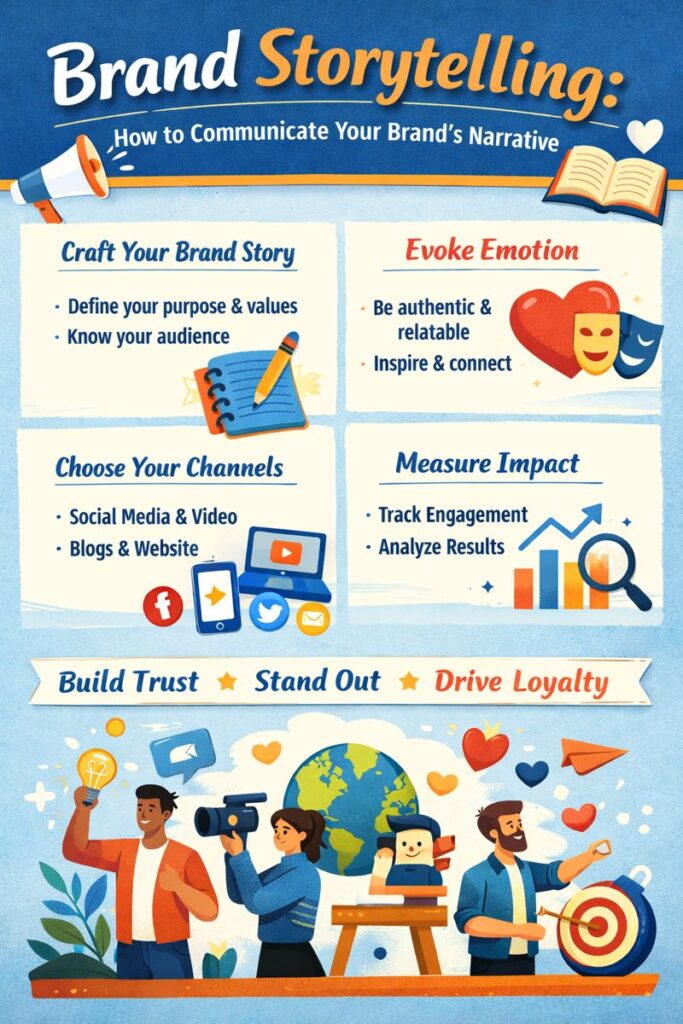
How to Define Your Brand Narrative
Crafting a compelling brand narrative requires intentional strategy rather than spontaneous creativity. While storytelling may feel artistic, effective brand narratives are built through structured exploration, alignment, and refinement. The goal is not to invent a story, but to uncover the authentic story already embedded in your brand’s purpose, culture, and customer relationships.
Step 1: Clarify Your Mission and Vision
Your mission defines what your brand does today, while your vision articulates where you aspire to go. Together, they provide directional clarity for your narrative. Without a clear mission and vision, storytelling becomes fragmented and reactive rather than cohesive and purposeful. These statements should guide every story you tell.
To clarify your mission, ask what problem you solve and why it matters. To define your vision, consider what change you want to create in your industry or society. These answers should be emotionally resonant rather than purely operational. When mission and vision are emotionally compelling, storytelling becomes naturally inspiring rather than forced.
Documenting these elements also ensures alignment across teams. When everyone understands the brand’s core direction, communication is consistent across channels and campaigns. This consistency strengthens brand credibility and recognition over time.
Step 2: Understand Your Audience Deeply
Effective storytelling begins with empathy. You must understand your audience’s motivations, fears, aspirations, and struggles before you can communicate meaningfully with them. This requires more than demographic data — it demands psychological and emotional insight into how customers experience their world and your brand within it.
Customer research methods such as interviews, surveys, social listening, and journey mapping reveal patterns in needs and behaviors. These insights inform narrative tone, themes, and language choices. When storytelling reflects real customer experiences, audiences feel seen rather than targeted.
Understanding your audience also helps determine which stories resonate most strongly. Not every brand story appeals to every audience segment, so personalization and relevance become essential. Tailored storytelling improves engagement and conversion by aligning narratives with audience priorities.
Step 3: Identify Your Brand Values
Values define what your brand believes in and how it behaves. They shape decision-making, culture, and customer relationships. In storytelling, values serve as thematic anchors, giving narratives depth and moral clarity. Without values, stories feel shallow or opportunistic rather than meaningful.
To identify your values, examine how your brand responds to challenges, treats customers, and contributes to society. Look beyond slogans to actual behaviors and commitments. Values should be lived consistently, not just stated aspirationally.
Once defined, values should be woven naturally into your narratives rather than explicitly declared. Stories that demonstrate values through action are more credible than those that simply claim them. This subtle integration strengthens authenticity and emotional resonance.
Step 4: Articulate Your Origin Story
Your origin story explains how and why your brand was created. It humanizes your organization by revealing motivations, challenges, and defining moments. Origin stories resonate because they mirror the hero’s journey — struggle, insight, and transformation — making them inherently compelling.
An effective origin story focuses less on chronology and more on purpose. Rather than listing milestones, it highlights the problem that sparked creation and the passion that drove resolution. This framing connects emotionally by showing that your brand exists for meaningful reasons rather than opportunistic gain.
Origin stories also build trust by revealing vulnerability and perseverance. When brands share obstacles and failures honestly, audiences perceive them as authentic and relatable. This transparency strengthens credibility and emotional connection.
Step 5: Define Your Brand Promise
Your brand promise articulates what customers can consistently expect from your business in every interaction. It sets emotional and experiential expectations rather than technical specifications. This promise becomes the emotional contract between brand and audience, shaping perception and trust.
A strong brand promise is clear, realistic, and differentiated. It should reflect your unique value while remaining deliverable across touchpoints. Overpromising undermines credibility, while under-promising fails to inspire. Balance is essential to building trust and loyalty.
Your brand narrative should consistently reinforce this promise through stories, experiences, and outcomes. When customers repeatedly see your promise fulfilled in real-world contexts, storytelling becomes self-validating rather than promotional.
Storytelling Frameworks for Brand Communication
Structured storytelling frameworks provide clarity and consistency while allowing creative flexibility. They help brands organize narratives around customer experience rather than internal messaging. Below are three proven frameworks widely used in brand storytelling.
1. The Hero’s Journey
The Hero’s Journey, popularized by Joseph Campbell, follows a universal narrative arc: the ordinary world, the call to adventure, challenges, transformation, and the return. In branding, the customer is the hero, while the brand serves as a guide. This framework resonates because it mirrors real human experiences of struggle and growth.
Using this structure allows brands to position themselves as supportive mentors rather than dominant heroes. The customer’s transformation becomes the story’s focal point, making the brand’s role meaningful rather than self-centered. This approach fosters empowerment rather than dependency.
The Hero’s Journey is particularly effective in case studies, testimonials, and brand documentaries. It allows audiences to see themselves in the narrative, increasing emotional engagement and memorability. When customers identify with the hero, they become invested in the story’s outcome.
2. Problem–Solution–Outcome
This framework focuses on identifying a customer problem, presenting the brand as a solution, and demonstrating tangible outcomes. It works well in product storytelling, landing pages, and performance marketing because it aligns closely with conversion-driven objectives. However, when executed emotionally rather than mechanically, it also supports long-term brand building.
The key to effectiveness lies in empathy. The problem must be framed in customer-centric language that reflects real experiences rather than generic pain points. This framing shows understanding rather than assumption, which builds trust.
Outcomes should highlight transformation rather than features. Instead of stating what your product does, focus on what customers gain — clarity, confidence, freedom, or growth. This emotional framing strengthens relevance and persuasion.
3. Purpose-Driven Narrative
Purpose-driven storytelling centers around impact rather than transactions. It focuses on how the brand contributes to societal progress, community well-being, or environmental sustainability. This framework resonates strongly with modern consumers who seek alignment between their values and purchasing behavior.
Rather than highlighting products, purpose-driven stories highlight people, causes, and change. The brand becomes a catalyst rather than a centerpiece. This positioning elevates brand perception from vendor to movement.
However, authenticity is essential. Purpose-driven narratives must be supported by genuine action rather than symbolic gestures. When storytelling aligns with real impact, audiences respond with trust, loyalty, and advocacy rather than skepticism.
How to Communicate Your Brand Story Across Channels
Building a strong brand narrative begins the journey, but it’s just the foundation. Communication requires consistency, adaptability, and strategic integration across all customer touchpoints. Every channel offers unique opportunities to reinforce your narrative while meeting audiences where they are.
Website
Your website is the central hub of your brand story. It should clearly articulate who you are, why you exist, and how you create value. Homepage messaging, About pages, product descriptions, and blog content should all align with your core narrative. Inconsistencies undermine credibility and confuse visitors.
Visual storytelling also plays a critical role on websites. Images, videos, typography, and layout should reinforce emotional tone and brand personality. Design elements are not merely aesthetic — they communicate values, positioning, and experience quality. When visuals align with narrative, storytelling becomes immersive rather than abstract.
Website storytelling should prioritize Simple, direct messaging that works better than smart wordplay — your audience should instantly grasp what you do and how it helps them. It matters. When storytelling simplifies rather than complicates understanding, it increases engagement, retention, and conversion rates.
Social Media
Social media platforms offer real-time storytelling opportunities through micro-content, conversations, and community engagement. Rather than broadcasting promotional messages, brands should use social channels to share behind-the-scenes moments, customer stories, and cultural insights. These narratives humanize the brand and foster emotional connection.
Consistency across platforms is essential, but tone should adapt to platform context. What works on LinkedIn may differ from what works on Instagram or TikTok. However, the underlying narrative — values, purpose, and personality — should remain consistent across all channels.
Engagement-driven storytelling encourages participation rather than passive consumption. By inviting audiences to share their own stories, feedback, and experiences, brands transform storytelling into dialogue rather than a monologue. This collaborative narrative strengthens community and trust.
Content Marketing
Content marketing allows brands to explore their narrative in depth through blogs, videos, podcasts, and educational resources. Rather than focusing on direct promotion, content storytelling provides value by addressing customer challenges, insights, and aspirations. This value-first approach positions the brand as a trusted authority rather than a vendor.
In-depth materials like expert insights, educational features, and industry perspectives, case studies enable deeper exploration of brand philosophy and impact. These formats support credibility and trust-building by demonstrating expertise and empathy. Over time, consistent content storytelling shapes brand perception and authority within the industry.
SEO-optimized storytelling ensures discoverability without sacrificing authenticity. When content aligns with audience search intent while maintaining narrative depth, it balances performance marketing with brand-building objectives. This integration supports sustainable traffic growth and engagement.
Email Marketing
Email storytelling fosters intimacy through direct, personalized communication. Unlike social media or websites, email allows brands to speak one-on-one with customers, deepening emotional connection and trust. Narrative-driven emails share stories of impact, customer success, or brand evolution rather than transactional promotions.
Effective email storytelling balances relevance with consistency. Messages should align with subscriber interests while reinforcing the brand’s core narrative. Personalization based on behavior, preferences, and journey stage enhances resonance and engagement.
Email storytelling also supports long-term relationship building. Rather than focusing solely on conversions, narrative-driven emails nurture trust and loyalty over time. This approach transforms email marketing from a sales channel into a relationship platform.
Advertising and Campaigns
Advertising provides high-impact storytelling opportunities through visuals, video, and narrative sequencing. Rather than isolated promotions, campaigns should reinforce the broader brand story. Each advertisement becomes a chapter rather than a standalone message, creating continuity and coherence.
Story-driven advertising focuses on emotional impact rather than feature lists. It shows customers in real-life contexts experiencing transformation rather than presenting abstract benefits. This human-centered approach enhances relatability and memorability.
Campaign storytelling also supports brand positioning. Whether humorous, inspirational, provocative, or empathetic, tone communicates identity and values. Consistent tone across campaigns strengthens recognition and emotional association.
Real-World Examples of Brand Storytelling Done Right
Spotify – Personalized Storytelling
Spotify excels at data-driven storytelling by turning user listening habits into emotionally resonant narratives. Campaigns like “Spotify Wrapped” transform analytics into personalized stories that celebrate identity, mood, and memory. This approach creates emotional delight while reinforcing platform value.
Spotify’s storytelling works because it makes users feel seen and understood. Rather than marketing features, Spotify celebrates moments, emotions, and cultural connections through music. This personalized narrative drives massive social sharing and organic brand visibility. It demonstrates how storytelling can be both data-informed and emotionally engaging.
Ben & Jerry’s – Activism-Driven Branding
Ben & Jerry’s integrates social justice, environmental advocacy, and political engagement into its storytelling. Rather than avoiding controversial topics, the brand openly communicates its values and beliefs. This bold narrative positions Ben & Jerry’s as a voice for social change rather than just an ice cream company.
The brand’s storytelling resonates with audiences who value transparency and ethical leadership. By aligning activism with business practices, Ben & Jerry’s reinforces authenticity and trust. Their stories demonstrate how brands can lead cultural conversations without sacrificing commercial success. This approach strengthens emotional loyalty and advocacy.
Slack – Workplace Transformation
Slack tells stories about collaboration, productivity, and modern work culture rather than messaging software. Their campaigns highlight how teams communicate more effectively, move faster, and work more meaningfully with their platform. Slack positions itself as a facilitator of workplace harmony rather than just a tool.
This narrative resonates with professionals seeking better work-life balance and team efficiency. Slack’s storytelling humanizes enterprise software by focusing on people rather than technology. The brand’s friendly tone and relatable scenarios differentiate it in the crowded SaaS space. This emotional positioning strengthens adoption and retention.
Common Mistakes in Brand Storytelling
Being Self-Centered
One of the most common storytelling mistakes is positioning the brand as the hero rather than the customer. When brands focus excessively on their achievements, products, or accolades, they alienate audiences rather than engage them. Customers want to see themselves reflected in the story, not the brand’s ego.
Effective storytelling centers on customer transformation, with the brand acting as a guide rather than a protagonist. This perspective shift creates empathy and relatability. When customers feel understood rather than sold to, trust and engagement increase.
Avoiding self-centered narratives requires consistent audience focus. Every story should answer how the customer benefits emotionally, practically, or socially. When storytelling prioritizes customer experience, relevance and resonance naturally follow.
Lacking Authenticity
Inauthentic storytelling undermines trust and damages brand credibility. Consumers are increasingly skilled at detecting exaggeration, virtue signaling, and hollow promises. When brand stories are disconnected from real actions, audiences respond with skepticism rather than loyalty.
Authenticity requires alignment between narrative and behavior. Brands must live their values through decisions, policies, and practices rather than merely communicating them. When storytelling reflects lived experience, it becomes credible and powerful.
Avoiding inauthenticity also means resisting trends that don’t align with brand identity. Not every storytelling style or cause fits every brand. Consistency and integrity matter more than relevance or popularity.
Overcomplicating the Message
Complex storytelling dilutes impact and reduces clarity. When narratives become overloaded with jargon, subplots, or abstract concepts, audiences disengage. Effective storytelling simplifies rather than complicates, making messages easy to understand and emotionally resonant.
Clarity begins with focus. Every story should center around a single core message or transformation. Supporting details should reinforce rather than distract from this central theme. When storytelling maintains narrative discipline, it becomes more persuasive and memorable.
Simple stories are not shallow — they are strategic. They respect audience attention, cognitive capacity, and emotional needs. Clarity strengthens impact far more than complexity ever could.
Inconsistent Storytelling Across Channels
Inconsistency undermines brand trust and recognition. When narratives vary across platforms without coherence, audiences struggle to understand brand identity and positioning. This fragmentation weakens emotional connection and reduces memorability.
Consistency does not mean repetition — it means alignment. Stories should adapt to platform context while reinforcing core values, tone, and message. This coherence creates familiarity and emotional continuity across touchpoints.
Maintaining consistency requires documented brand guidelines and narrative frameworks. When teams align around shared storytelling principles, communication becomes unified and effective rather than scattered or contradictory.
Measuring the Impact of Brand Storytelling
Evaluating storytelling effectiveness requires both quantitative and qualitative metrics. While emotional impact can be difficult to measure directly, behavioral indicators provide insight into narrative resonance and performance. Tracking engagement, retention, and advocacy reveals whether stories are building meaningful connections.
Engagement Metrics
Interaction indicators like how long visitors stay and how far they explore a page, social shares, comments, and video completion rates indicate audience interest and emotional involvement. High engagement suggests storytelling is resonating, while low engagement signals disconnect or irrelevance. These metrics help identify which narratives capture attention and which require refinement.
However, engagement alone does not measure long-term impact. Stories may entertain without influencing perception or behavior. Therefore, engagement should be evaluated alongside conversion and retention metrics for comprehensive insight.
Analyzing engagement patterns across platforms also reveals where storytelling performs best. This insight enables strategic optimization of channel-specific narratives and formats.
Conversion and Retention Metrics
Sales performance, returning customer behavior, and long-term brand profitability reflect storytelling’s impact on business outcomes. When storytelling strengthens emotional connection, customers become more likely to buy, return, and recommend. These behaviors signal trust and loyalty rather than transactional engagement.
Retention metrics such as churn rate, subscription renewal, and repeat engagement indicate narrative sustainability. Effective storytelling builds long-term relationships rather than short-term conversions. Monitoring these metrics reveals whether stories are fostering enduring brand affinity.
The correlation between storytelling campaigns and performance outcomes strengthens confidence in the narrative strategy. Over time, consistent patterns validate storytelling as a growth driver rather than a branding expense.
Brand Perception and Sentiment Analysis
Brand perception surveys, reviews, and social sentiment analysis provide qualitative insight into storytelling effectiveness. These measures capture emotional response, trust levels, and perceived authenticity. When storytelling resonates, sentiment becomes more positive, aligned, and emotionally charged.
Listening tools help monitor how audiences naturally describe your brand. Language patterns reveal whether your narrative themes are being adopted or ignored. When customers echo your story in their own words, storytelling has achieved true resonance.
Combining sentiment analysis with performance metrics provides a holistic view of storytelling impact. This integration informs strategic refinement and long-term brand development.
The Future of Brand Storytelling
Brand storytelling continues to evolve alongside technology, culture, and consumer behavior. As audiences demand greater transparency, personalization, and participation, storytelling must become more interactive, immersive, and authentic. Static narratives will give way to dynamic story ecosystems shaped by customer contribution and real-time engagement.
Emerging technologies such as AI, virtual reality, and augmented reality are expanding storytelling possibilities. Brands can now create immersive experiences that place customers directly within the narrative rather than observing from afar. These innovations deepen emotional engagement and memory formation, redefining how stories are experienced.
Community-driven storytelling is also gaining momentum. Rather than controlling the narrative, brands increasingly empower customers to co-create stories through user-generated content, testimonials, and advocacy. This participatory model strengthens authenticity and trust while reducing reliance on top-down messaging.
Finally, purpose-driven storytelling will become even more critical as consumers prioritize ethics, sustainability, and social impact. Brands that communicate genuine commitment to positive change — supported by action — will outperform those that rely solely on transactional messaging. Storytelling will shift from persuasion to participation, from promotion to purpose.
How to Build Your Brand Story: A Practical Checklist
- Define your purpose, mission, and vision clearly.
- Understand your audience’s emotional needs and motivations.
- Articulate your origin story and core values.
- Position the customer as hero and your brand as guide.
- Use conflict and resolution to structure transformation.
- Maintain authenticity by aligning story and behavior.
- Ensure consistency across all channels and touchpoints.
- Measure impact through engagement, conversion, and sentiment
- Adapt narratives based on feedback and performance.
- Evolve storytelling as your brand grows and changes.
This checklist provides a structured foundation for creating, refining, and scaling your brand narrative over time. Storytelling is not a one-time exercise — it is a continuous strategic process that evolves alongside your brand and audience.
Conclusion: Turning Stories Into Strategy
Brand storytelling is no longer optional — it is fundamental to modern business success. A strong brand strategy ensures your storytelling remains consistent, authentic, and aligned with long-term business success In an environment defined by competition, commoditization, and consumer skepticism, stories offer brands a way to differentiate, connect, and inspire. They transform marketing from persuasion into participation and transactions into relationships.
Effective storytelling requires more than creativity — it demands clarity, empathy, authenticity, and strategic alignment. Brands must deeply understand their purpose, audience, and values before communicating externally. When a story aligns with behavior, culture, and customer experience, it becomes a powerful engine for trust and loyalty.
The most successful brands do not simply tell stories — they live them. Their narratives are reflected in every interaction, decision, and experience they create. This consistency transforms storytelling into identity rather than messaging, making brands memorable, meaningful, and resilient.
At BrandQuarterly, we believe that storytelling goes far beyond promotion and serves as the core framework for enduring brand success. By crafting authentic narratives that resonate emotionally and strategically, brands can communicate not only what they sell, but who they are, why they exist, and how they make the world better.
FAQ
What is brand storytelling?
Brand storytelling is the practice of using meaningful narratives to communicate a brand’s purpose, values, and impact rather than just promoting products or services.
Why is brand storytelling important for businesses?
It helps businesses build emotional connections, increase trust, and differentiate themselves in competitive markets.
How can small businesses use brand storytelling effectively?
Small businesses can share their origin stories, customer experiences, and values-driven missions to create authenticity and relatability.
What makes a brand story successful?
A strong brand story is authentic, customer-focused, emotionally engaging, and consistently communicated across all channels.
How do you measure brand storytelling success?
Success is measured through engagement, customer retention, brand sentiment, and long-term business growth.
