
In today’s hyper-competitive market, having a strong brand strategy is no longer optional—it’s essential. A key component of building an effective brand strategy is competitive analysis. Competitive analysis allows businesses to identify market trends, understand competitor strengths and weaknesses, and uncover opportunities for growth. By leveraging proven frameworks and tools, brands can make informed strategic decisions that differentiate them from their competitors.
In this article, we’ll explore what competitive analysis is, why it matters for brand strategy, the top frameworks you should use, and the best tools to streamline your competitive research.
What is Competitive Analysis?
Competitive analysis is the systematic process of evaluating your competitors’ strategies, offerings, and market positioning. It involves collecting and interpreting data on competitor products, pricing, marketing tactics, customer engagement, and overall market performance.
For brands, competitive analysis is essential because it provides actionable insights into what works in your industry and what doesn’t. By understanding competitors’ strengths and weaknesses, you can identify opportunities to differentiate your brand. It also helps in anticipating market changes, avoiding costly mistakes, and creating marketing campaigns that resonate with your target audience.
A thorough competitive analysis also aligns your brand strategy with market realities. It ensures that your messaging, product development, and customer experience are optimized for maximum impact. Without competitive analysis, a brand risks operating in a vacuum, missing critical trends and falling behind in market relevance.
Why Competitive Analysis is Crucial for Brand Strategy
A robust brand strategy goes beyond logos and color palettes. It requires a deep understanding of your market landscape. Competitive analysis plays a pivotal role in this process.
Firstly, it helps identify gaps in the market. By analyzing competitors, brands can spot underserved customer segments or unmet needs. These insights can drive product innovation, marketing campaigns, and customer engagement strategies.
Secondly, competitive analysis informs positioning. Understanding how competitors communicate their value allows brands to carve out a unique positioning statement. This ensures that your messaging resonates with your audience while standing out from the competition.
Finally, it supports risk management. Knowing your competitors’ weaknesses and vulnerabilities allows your brand to anticipate potential threats and react proactively. It also helps in benchmarking performance metrics and setting realistic, measurable goals.
Top Frameworks for Competitive Analysis
When performing competitive analysis, using structured frameworks ensures that your research is comprehensive and actionable. Below are some of the top frameworks used by brands today.
1. SWOT Analysis
SWOT stands for Strengths, Weaknesses, Opportunities, and Threats. It is one of the most widely used frameworks for competitive analysis.
- Strengths: Identify what your competitors do well. This could include product quality, customer service, or strong brand loyalty. Understanding competitor strengths helps your brand find ways to differentiate.
- Weaknesses: Recognize areas where competitors fall short. Weaknesses are opportunities for your brand to capture market share by addressing unmet needs.
- Opportunities: Evaluate external trends and market gaps that could benefit your brand. Opportunities often arise from technological advances, regulatory changes, or shifting consumer behavior.
- Threats: Assess external factors that could negatively impact your brand. Competitor innovation, new market entrants, or economic downturns are common threats to monitor.
Using SWOT analysis helps brands identify strategic priorities, improve positioning, and plan marketing campaigns that leverage competitor weaknesses.
2. Porter’s Five Forces
Developed by Michael Porter, this framework helps businesses assess the competitive forces in their industry. It provides insight into profitability and market dynamics.
The five forces include:
- Competitive Rivalry: Analyze how intense competition is in your market. High rivalry often leads to pricing wars and increased marketing spend.
- Threat of New Entrants: Evaluate the ease with which new competitors can enter your market. Barriers to entry, like patents or brand loyalty, influence this threat.
- Threat of Substitutes: Identify alternative products or services that customers may choose over yours. Substitutes can reduce market share if ignored.
- Bargaining Power of Suppliers: Assess how much control suppliers have over pricing and availability. Supplier power can affect production costs and margins.
- Bargaining Power of Customers: Understand customer leverage in negotiating price and quality. Strong customer power often demands superior service and competitive pricing.
Porter’s Five Forces framework provides a holistic view of the competitive environment and helps brands develop long-term strategies for growth and resilience.
3. Competitor Benchmarking
Competitor benchmarking involves comparing your brand’s performance metrics against key competitors. This can include market share, social media engagement, website traffic, product offerings, and pricing.
Benchmarking allows brands to measure where they stand in relation to the competition. It identifies performance gaps and highlights best practices that can be adopted. Regular benchmarking also tracks industry trends, enabling brands to remain agile and responsive.
4. Perceptual Mapping
Perceptual mapping is a visual tool used to analyze brand positioning in the market. It plots brands along key attributes, such as price vs. quality or innovation vs. tradition.
This framework helps brands identify clusters, gaps, and opportunities in the market landscape. For instance, if most competitors occupy a “high-price, high-quality” quadrant, positioning your brand as “affordable and high-quality” can create a competitive advantage.
Perceptual maps are particularly effective for consumer-facing brands, as they provide insights into how customers perceive your brand relative to competitors.
5. Value Chain Analysis
Value chain analysis examines the activities involved in delivering a product or service to the market. This framework identifies areas where competitors excel and where your brand can innovate.
By analyzing inbound logistics, operations, marketing, sales, and customer service, brands can uncover inefficiencies, cost-saving opportunities, and areas for differentiation. Value chain analysis also aligns internal capabilities with market expectations, strengthening overall brand strategy.
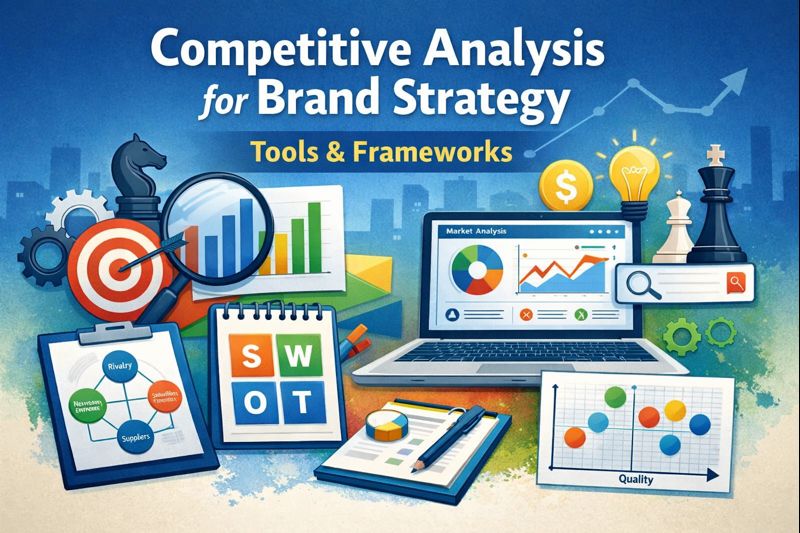
Essential Tools for Competitive Analysis
In addition to frameworks, leveraging the right tools can streamline research, save time, and enhance accuracy. Here are some of the best tools for competitive analysis.
1. Ahrefs
Ahrefs is a powerful SEO tool that provides insights into competitor backlink profiles, top-performing pages, and content strategies.
By analyzing competitors’ link-building tactics, brands can improve their own SEO performance and identify content opportunities. Ahrefs also helps track keyword rankings, monitor traffic growth, and analyze market trends.
2. SEMrush
SEMrush is a comprehensive digital marketing tool that offers competitor insights across SEO, advertising, and content marketing. It provides data on organic traffic, keyword rankings, backlink profiles, and paid campaigns.
Brands can use SEMrush to identify which keywords competitors are targeting, discover high-performing content, and monitor market share. Its analytics also enable benchmarking and performance tracking over time.
3. SimilarWeb
SimilarWeb provides website analytics, traffic sources, and audience demographics. By analyzing competitor websites, brands can understand user behavior, top referral sources, and engagement trends.
This tool is invaluable for identifying new market opportunities and refining online marketing strategies. SimilarWeb also offers insights into competitor app performance and digital advertising effectiveness.
4. SpyFu
SpyFu focuses on competitor keyword research and PPC campaigns. It allows brands to uncover which keywords competitors are buying, their ad spend, and ranking history.
By leveraging SpyFu, brands can optimize paid search campaigns, reduce wasted ad spend, and identify untapped keyword opportunities. It also provides competitor domain comparisons for more granular insights.
5. Brandwatch
Brandwatch is a social listening and analytics tool that tracks competitor mentions, sentiment, and trends across social media platforms.
Understanding how audiences perceive competitors helps brands refine messaging, identify gaps, and proactively respond to market shifts. Brandwatch also provides influencer analysis, allowing brands to monitor competitor partnerships.
Steps to Conduct an Effective Competitive Analysis
While frameworks and tools are critical, following a structured process ensures your competitive analysis is actionable.
- Identify Key Competitors: Start by listing direct and indirect competitors. Include emerging brands and substitute products.
- Gather Data: Use tools like SEMrush, SimilarWeb, and Ahrefs to collect quantitative and qualitative data on competitors.
- Analyze Strengths and Weaknesses: Apply frameworks like SWOT or Value Chain Analysis to interpret the data.
- Evaluate Market Positioning: Use perceptual maps to visualize brand positioning relative to competitors.
- Benchmark Performance: Compare metrics such as traffic, social engagement, pricing, and customer satisfaction.
- Develop Strategic Recommendations: Translate insights into actionable strategies for differentiation, growth, and risk mitigation.
- Monitor Continuously: Competitive landscapes evolve rapidly. Regular analysis ensures your brand strategy stays relevant.
Conclusion
Competitive analysis is the backbone of an effective brand strategy. By using structured frameworks and advanced tools, brands can gain a deep understanding of market dynamics, competitor tactics, and customer expectations.
Frameworks like SWOT, Porter’s Five Forces, Perceptual Mapping, and Value Chain Analysis provide structured ways to interpret market data, while tools like SEMrush, SimilarWeb, SpyFu, Brandwatch, and Ahrefs streamline research and enhance accuracy.
Brands that integrate competitive analysis into their strategy can identify growth opportunities, differentiate themselves effectively, and anticipate market shifts. In an increasingly crowded marketplace, competitive analysis is not just an option—it is a strategic imperative.
By following these insights and leveraging the right tools, your brand can stay ahead of the competition, make informed decisions, and strengthen its market position.
FAQs
1. What is competitive analysis in brand strategy?
Competitive analysis is the process of evaluating competitors’ strengths, weaknesses, and market positioning. It helps brands make informed decisions about marketing, product development, and customer engagement.
2. Why is competitive analysis important for brands?
It provides insights into market trends and competitor tactics, helping brands identify opportunities and gaps. It also ensures strategies are aligned with customer needs and market realities.
3. Which frameworks are best for competitive analysis?
Popular frameworks include SWOT Analysis, Porter’s Five Forces, Perceptual Mapping, Value Chain Analysis, and competitor benchmarking. They provide a structured approach to understanding competitors and making strategic decisions.
4. What tools can I use for competitive analysis?
Top tools include Ahrefs, SEMrush, SimilarWeb, SpyFu, and Brandwatch. These tools help track competitors’ traffic, SEO, social media, and marketing strategies efficiently.
5. How often should a brand conduct competitive analysis?
Competitive analysis should be done regularly, ideally every few months. Frequent monitoring helps brands stay agile and respond to market changes quickly.
6. How does competitive analysis improve brand positioning?
It identifies gaps and opportunities to differentiate your brand from competitors. This ensures your messaging and products resonate with your target audience.
7. Can small businesses benefit from competitive analysis?
Yes, even small brands can gain a competitive edge by analyzing competitors. It helps them find niche opportunities and make strategic decisions efficiently.
