
Understanding Competitive Analysis vs Competitive Intelligence is essential. Competitive analysis is a critical discipline for any brand leader, growth marketer, or strategy director who wants to understand how their business compares to competitors and make better strategic decisions.
Every brand leader, growth marketer, and strategy director eventually faces this moment. Two people sit in a meeting. Each is confident they mean the same thing. “We need better competitive intelligence,” says the CMO. “Agreed — let’s do a competitive analysis,” replies the strategist. The room nods. Nobody asks for clarification.
That is where the problem starts. Competitive intelligence and competitive analysis are not synonyms. They are related — connected at the hip, even — but they serve different purposes, operate on different timelines, and answer fundamentally different questions. Treating them as interchangeable is like confusing a weather forecast with a climate study. Both involve data about the atmosphere. One tells you whether to bring an umbrella today. The other tells you whether to build a seawall.
This article is your definitive guide to understanding what separates competitive intelligence from competitive analysis. You will also learn why that distinction matters for your brand strategy, and how to use both more effectively. By the end, you will know which one you actually need — and when you need both. The difference between these two disciplines is not semantic hairsplitting. Real consequences follow from confusing them: in how organisations structure capabilities, allocate resources, and ultimately make better decisions.
Competitive Intelligence vs Competitive Analysis: Definitions First
Before getting into the nuance, anchor the conversation with working definitions — precise enough to be useful, but simple enough to stick. Both terms belong to the same family of strategic practice. Yet they represent different layers of that practice. Conflating them creates serious gaps in how organisations understand and respond to their competitive environment.
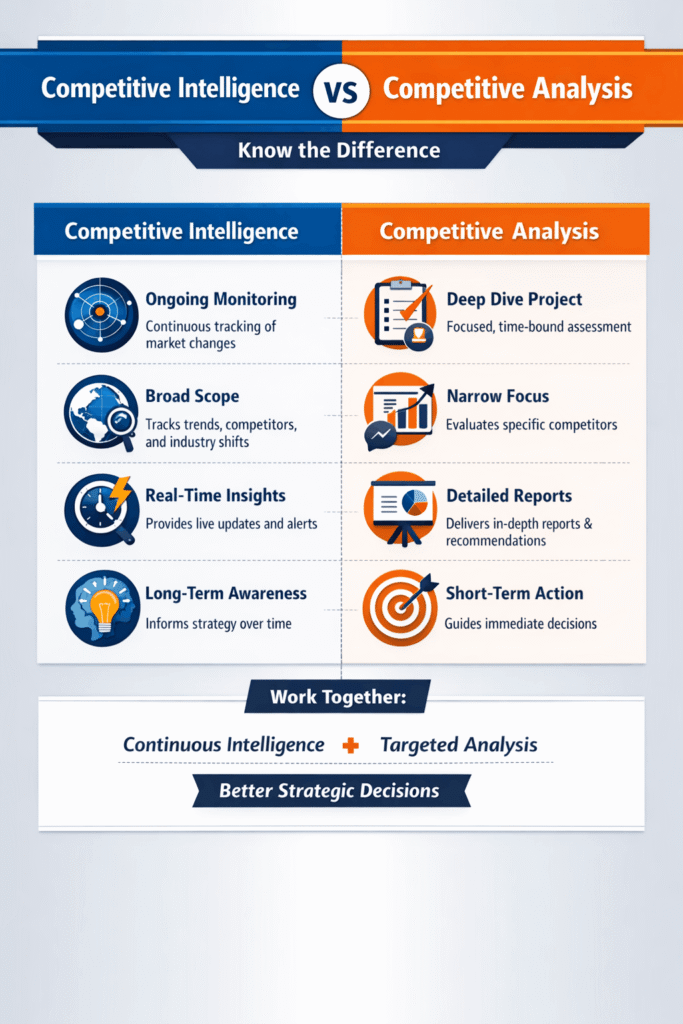
Competitive intelligence (CI) is the ongoing, real-time process of gathering, monitoring, and interpreting information about your competitive environment. It covers rivals, market shifts, emerging threats, regulatory changes, consumer behaviour signals, and any external factor that could affect your competitive standing. CI is a continuous practice — a living function within the business — not a project with a start and end date. It answers one core question: what is happening out there right now, and what might happen next? When organisations do it well, competitive intelligence becomes a form of institutional memory. Every strategic decision gets sharper as a result.
Competitive analysis is a structured, time-bound examination of specific competitors or competitive dynamics. It typically produces a deliverable — a report, a framework, a deck — that captures a snapshot of the landscape at a given moment. Competitive analysis draws on intelligence as its raw material, but its purpose is to evaluate, compare, and recommend. It answers a focused question: how do we stack up against our specific competitors right now, and what should we do about it? Unlike competitive intelligence, analysis has a defined scope, a clear starting point, and a finish line.
Think of it this way: competitive intelligence is the radar system constantly scanning the horizon. The detailed investigation you launch once that radar picks up something worth examining is your competitive analysis. The radar never switches off. Investigations are targeted, purposeful, and time-limited. Both are essential. Neither replaces the other.
What Is Competitive Intelligence, Really?
Competitive intelligence is often misunderstood as corporate espionage or industrial spying. This misconception has followed the discipline since its formalisation in the 1980s. In reality, the vast majority of actionable competitive intelligence comes from entirely public, legal, and ethical sources. Earnings calls, press releases, job postings, patent filings, pricing pages, social media behaviour, customer reviews, conference presentations, and industry reports are all legitimate inputs. Even the visual design choices a competitor makes on their homepage can yield useful intelligence.
The defining characteristic of competitive intelligence is its continuity. It never stops. A dedicated CI function monitors the competitive landscape every week, every month, every quarter — building a picture of trends, trajectories, and inflection points over time. A competitor that suddenly hires forty engineers in a specific technical discipline signals a potential product initiative long before launch. CI can detect this pattern early.If a rival brand shifts its messaging from product features toward sustainability values, CI captures that evolution in real time.Similarly, when a new entrant gains disproportionate media coverage in a niche your brand has historically owned, CI flags the development before it becomes a serious threat.
How CI Gathers Information
Competitive intelligence spans multiple categories of data. Primary intelligence comes from direct sources — customer conversations, sales team feedback, win/loss interviews, and market research your organisation commissions. Secondary intelligence comes from published sources: analyst reports, trade press, academic studies, and syndicated data. Digital intelligence has grown enormously as a category, encompassing SEO performance data, paid advertising patterns, social listening, app store reviews, and web traffic estimates from tools like SimilarWeb or Semrush. Each category contributes a different dimension to the overall picture of competitive reality.
The output of competitive intelligence is not a single document. Instead, it is a continuous stream of insights, alerts, briefings, and signals that feed into multiple parts of the organisation simultaneously. Product teams use CI to understand what features competitors are building. Sales teams use it to sharpen battle cards and handle objections more effectively. Marketing uses it to refine brand positioning and spot whitespace in messaging. The executive team uses it to make informed decisions about market entry, pricing strategy, and resource allocation.
Who Owns CI — and How It Gets Done
In mature organisations, a centralised team ideally owns competitive intelligence — market intelligence, strategy, or a dedicated CI function — and serves multiple internal clients across the business. Effective CI requires consistent methodology, dedicated tooling, and sustained investment of time and attention. Clear ownership benefits all of this enormously. When CI is nobody’s explicit job, it tends to get done inconsistently or not at all, regardless of how much everyone agrees it matters.
Perhaps the most important thing to understand about competitive intelligence is its forward-looking orientation. It draws on historical data, but its purpose is to anticipate. The goal is to give decision-makers enough lead time to respond to competitive moves before those moves reshape the market. The best CI practitioners blend the skills of analyst, strategist, and journalist. They find signal in noise, pattern in apparent randomness, and meaning in the fragments of information that competitors inevitably leak simply by operating in the open world.
What Is Competitive Analysis, Really?
If competitive intelligence is the radar, competitive analysis is the deep-dive mission launched when something on that radar deserves a closer look. Competitive analysis is purposeful, bounded, and outcome-oriented. It starts with a specific question or business problem and works toward a concrete, actionable answer. The process involves selecting a defined set of competitors, choosing an evaluation framework, gathering relevant data, drawing comparisons, and producing insights that directly inform a decision already on the table.
The most widely used framework for competitive analysis is probably Michael Porter’s Five Forces. It examines competitive rivalry, supplier power, buyer power, threat of substitution, and threat of new entrants. Another popular structure is the SWOT analysis, which maps a competitor’s strengths, weaknesses, opportunities, and threats relative to your own position. Feature comparison matrices, pricing ladders, brand positioning maps, customer journey benchmarking, and go-to-market assessments are all forms of competitive analysis. Each illuminates a specific dimension of competitive reality that a team needs to understand before making a decision.
What Triggers a Competitive Analysis
Competitive analysis is typically triggered by a strategic event. A new competitor enters the market and disrupts the category. Your win rate drops and no one can explain exactly why. The board wants to enter a new segment and needs a thorough view of the incumbent landscape. A major competitor announces a rebrand that shifts customer expectations. These are the moments when leadership commissions a competitive analysis — not because the business was not paying attention before, but because the situation demands a structured, comparative assessment that goes beyond ongoing intelligence.
The deliverable of a competitive analysis is a document that tells a coherent story. It does not simply dump data onto pages. It interprets that data with strategic intent. A well-executed competitive analysis tells you not only what competitors are doing, but why they are probably doing it, what it likely means for your brand, and what concrete options you have in response. It synthesises multiple data points into a clear strategic picture that decision-makers can act on directly.
Acknowledging the Limitations
One of the most important — and most frequently overlooked — aspects of competitive analysis is its acknowledgment of its own limitations. Because competitive analysis is a snapshot, it captures reality at a specific point in time. Markets move. Competitors pivot. Pricing changes overnight. An analysis commissioned in January may have partially outdated conclusions by March in a fast-moving category. This is not a flaw in the methodology. It is simply a function of how markets behave. The solution is not to avoid competitive analysis, but to treat its outputs as living documents that warrant refreshing when underlying competitive conditions shift materially.
Competitive analysis is inherently comparative — its entire purpose is to understand your position relative to others. This means the quality of your analysis is directly proportional to the quality of the intelligence feeding into it. If your CI function is weak, patchy, or non-existent, your competitive analysis will rest on incomplete foundations. The strategic conclusions it produces will be correspondingly unreliable. The two disciplines are not just loosely related. They are structurally dependent on each other in ways that matter enormously in practice.
Competitive Analysis vs Competitive Intelligence: Key Differences
1. Timeframe and Continuity
Competitive intelligence operates on a rolling, continuous basis. There is no finish line. No moment arrives when it is safe to declare the job done. Stop monitoring the competitive environment and you begin accumulating blind spots — and in fast-moving markets, blind spots carry direct financial consequences. CI runs around ongoing rhythms: weekly news scans, monthly intelligence briefings, quarterly deep-dives on specific themes, and annual landscape reviews that take stock of how the environment has evolved. Each cycle builds on the last.
Competitive analysis, by contrast, has a defined scope, a clear trigger, and an endpoint. It begins when a specific question is posed and ends when the deliverable is produced, reviewed, and acted upon. This episodic nature does not make analysis less valuable than intelligence. A penetrating competitive analysis at exactly the right strategic moment can transform a business’s direction. It is reactive to specific needs rather than perpetually running in the background. Analysis is not designed to substitute for the sustained awareness that only ongoing intelligence can provide.
2. Scope and Breadth
Competitive intelligence casts a deliberately wide net. It monitors not just direct competitors but adjacent players, emerging disruptors, technology trends, regulatory shifts, consumer behaviour changes, and macroeconomic signals that could alter competitive dynamics in ways that are not yet visible. Its scope is the entire competitive ecosystem. Since the volume of potentially relevant information is theoretically infinite, CI must be selective about what it surfaces and prioritises. The skill of CI is knowing what actually matters.
Competitive analysis is deliberately narrow by design. It focuses on a defined set of competitors — typically direct rivals within the same category and price tier — and examines them along specific dimensions relevant to the decision at hand. Redesigning your pricing architecture? Your competitive analysis focuses on pricing. Developing a new content strategy? It focuses on content. The narrowness is not a limitation. It is a feature that allows the depth necessary to produce genuinely useful strategic insight within a manageable scope.
3. Primary Output
The primary output of competitive intelligence is a continuous stream of insight — alerts, briefings, newsletters, updated battle cards, and maintained databases that keep relevant parts of the organisation informed without requiring them to do their own monitoring. CI produces knowledge that distributes and embeds itself across functions. It rarely produces a single polished document. Instead, it builds an ongoing information infrastructure that becomes part of how the organisation thinks.
The primary output of competitive analysis is a structured document or presentation. It has a narrative arc, clearly articulated conclusions, and usually a set of recommendations tied to a specific decision. Teams design it to be shared with defined stakeholders, presented in a meeting, debated constructively, and acted upon with confidence. The deliverable itself is the point — the mechanism through which competitive insight gets translated into strategic action.
4. Who Owns It
In larger organisations, a centralised team ideally owns competitive intelligence — market intelligence, strategy, or a dedicated CI function — and serves multiple internal clients across the business. Effective CI requires consistent methodology, dedicated tooling, and sustained investment of time and attention. Clear ownership benefits all of this enormously. When CI is nobody’s explicit job, it tends to get done inconsistently or not at all, regardless of how much everyone agrees it matters.
Competitive analysis ownership varies by context and the question being answered. A product team might run a feature-by-feature competitive analysis before a major roadmap planning cycle. A marketing team might produce a positioning analysis ahead of a brand refresh. A corporate development team might analyse competitive dynamics as part of M&A due diligence. The trigger and the context determine the owner, not a fixed organisational assignment.
5. Relationship to Decision-Making
Competitive intelligence informs decision-making in a diffuse, cumulative, and often indirect way. It feeds into the ambient awareness of leadership and functional teams, subtly improving the quality of decisions without necessarily being directly cited. A CMO who reads a thorough CI briefing every week develops a richer intuitive understanding of the market. That understanding improves every decision they make — even decisions that appear to have nothing directly to do with competitors. Good CI is like good nutrition: the effects are systemic and cumulative rather than immediate and isolated.
Competitive analysis influences specific decisions at specific moments. Teams design it to be directly actionable, and its impact concentrates at the moment it is presented and discussed. A strong competitive analysis shapes a particular strategic choice — which market to enter, how to structure a pricing architecture, how to position a new campaign, whether to accelerate or delay a product launch. Its value is concentrated and time-sensitive, unlike the diffuse, long-term value that accrues from a sustained CI practice over months and years.
When You Need Competitive Intelligence
You need competitive intelligence when the competitive landscape around your brand is actively shifting — which, in most markets, means you need it all the time. CI becomes especially critical when you operate in a high-velocity category where new entrants arrive frequently, pricing is dynamic, and product development cycles are short. In these environments, being even three months behind on competitive awareness can cost you meaningful market share and customer relationships that are difficult to recover.
CI is also essential during periods of significant strategic transition within your own business. When you prepare to launch a new product, enter a new market, pursue a major partnership, restructure your pricing, or rebrand, the last thing you want is to discover mid-execution that a competitor just made a move that fundamentally changes the strategic context. A live CI practice ensures that leadership is never caught off guard by competitive developments that were, in hindsight, entirely visible if only someone had been watching systematically.
CI During Acquisitions and Brand Work
Organisations growing through acquisition benefit enormously from competitive intelligence as an ongoing practice. Understanding which players in an adjacent space represent genuine strategic threats versus potential acquisition targets requires sustained monitoring — not a one-time snapshot. The same applies to organisations navigating significant regulatory change, where the competitive implications of new rules often take months or years to fully manifest in observable market behaviour.
Even at the brand positioning level, competitive intelligence pays dividends that point-in-time analysis cannot replicate. Tracking how competitor brands evolve their visual identity, tone of voice, content strategy, and media investment over time gives marketers a far more nuanced view of competitive positioning. Brand intelligence — the systematic monitoring of how rivals build and communicate their identity — is one of the most underinvested areas of CI. Yet it can be one of the most strategically valuable.
When You Need Competitive Analysis
Use a competitive analysis when you have a specific strategic question that requires a structured, evidence-based answer within a defined timeframe. The most common trigger is a major business decision that hinges on understanding your competitive position relative to the specific players you will encounter. Apply it before entering a new category or geography. It is also valuable when redesigning your pricing strategy, especially if you need to compare your proposed structure against current market offerings. In urgent situations—such as when your sales team begins losing deals at an unusual rate, and the cause is unclear—it becomes particularly critical.
Competitive analysis is also the right response when your CI function flags a significant competitive development that demands more thorough investigation than ongoing monitoring can provide. If your intelligence practice reveals that a major competitor is dramatically expanding their product suite in a direction that directly overlaps with your core offering, a targeted competitive analysis of that specific threat is warranted. Here, CI and analysis work in direct productive sequence: the radar picks up the signal, and the deep-dive investigation determines whether it represents a genuine strategic threat or something more manageable.
Planning Cycles and Brand Strategy
Annual strategic planning cycles are natural and productive moments for thorough competitive analysis. Before locking in priorities, resource allocation, and strategic positioning for the year ahead, leadership benefits from a clear-eyed assessment of where the competitive landscape currently stands. Many organisations approach this only loosely — a hasty survey of key rivals in the final days before a planning offsite. The organisations that treat competitive analysis as a serious, properly resourced discipline tend to emerge from planning cycles with sharper, more differentiated, and more defensible strategies.
Brand strategy work is another key occasion for structured competitive analysis. If you are embarking on a brand refresh, repositioning exercise, or new campaign platform, understanding precisely how your competitors position themselves — and where genuine whitespace exists — is not optional background work. It is the foundation on which effective differentiation is built. Attempting to create a distinctive brand position without first understanding the competitive positioning landscape is like designing a building without surveying the site.
How Competitive Intelligence and Analysis Work Together
The most strategically sophisticated organisations do not choose between competitive intelligence and competitive analysis. They recognise the two are symbiotic and invest in both. Competitive intelligence provides the ongoing flow of raw material that makes competitive analysis more accurate, more timely, and more relevant. Competitive analysis, in turn, surfaces specific questions and hypotheses that sharpen the focus of the CI function’s ongoing monitoring priorities.
Consider a practical scenario that illustrates the relationship clearly. Your CI function flags a pattern over three consecutive months: a major competitor consistently wins deals in the mid-market segment where your brand has traditionally been strongest. Win/loss interview data, customer review analysis, and social listening all point toward the same conclusion — the competitor has significantly improved their onboarding experience and dramatically reduced time-to-value. This pattern, identified through ongoing intelligence work, triggers a targeted competitive analysis of the competitor’s customer journey from first touchpoint to full activation. That analysis ultimately informs a specific product roadmap decision worth significant investment.
Without the CI practice, the competitive threat might have gone unnoticed until the win rate decline became too severe to address quickly. Without the subsequent competitive analysis, the CI signal might have remained abstract — an interesting data point without a concrete strategic response. Together, they form a complete decision-making loop: monitor, detect, investigate, decide, act, and monitor again with refined priorities. This is the flywheel that separates strategically agile organisations from those that are perpetually reactive.
Organisational Design and Culture
The integration of CI and competitive analysis also matters at the organisational design level. When intelligence teams and strategy teams operate in silos, valuable intelligence never gets synthesised into actionable analysis — it accumulates in databases that nobody reads. Analysis teams also waste significant time re-gathering intelligence that CI already collected. The most effective setups create explicit handoff processes between the two functions, ensuring that CI outputs feed directly into analytical frameworks and that analytical findings feed back into CI priorities.
A cultural dimension to getting this integration right is easy to underestimate. Organisations that genuinely value evidence-based decision-making — where leaders actively seek competitive intelligence rather than relying on gut instinct or secondhand anecdote — create the conditions for both disciplines to deliver maximum value. Leaders who commission a competitive analysis and then ignore its conclusions because they contradict a pre-existing belief waste the investment entirely. The tools are only as powerful as the organisational culture that chooses to use them honestly.
Common Mistakes Brands Make
The most common mistake is conflating the two disciplines, which typically results in neither being done particularly well. Organisations that believe they are doing competitive intelligence when they are actually commissioning occasional competitive analyses end up with scattered, inconsistent market knowledge — strong in the weeks following an analysis, dangerously stale in the long stretches between them. Conversely, organisations that invest heavily in data collection through CI tools without ever synthesising findings into structured analysis produce information overload without strategic insight.
Another frequent and costly error is treating competitive analysis as a one-and-done exercise with permanent validity. An analysis produced for a planning cycle in January should not be treated as current intelligence in October. Markets shift. Competitors pivot their strategy. New players emerge from adjacent categories. The analysis that was accurate and actionable at the time of production may be actively misleading twelve months later. Building a defined refresh cadence — or establishing specific conditions that would automatically trigger a refresh — is part of responsible analytical practice that many organisations skip.
Underinvesting in Infrastructure
Organisations also consistently underinvest in the infrastructure that makes both disciplines genuinely effective. Good competitive intelligence requires dedicated tooling — social listening platforms, competitive tracking software, news monitoring systems, and data aggregation tools that transform raw signals into structured insight. Good competitive analysis requires skilled analysts who know how to structure complex problems, gather and weight relevant data, and communicate findings clearly. Neither discipline can be done well on the side of someone’s primary role without systematically producing inferior results.
A subtler but equally damaging mistake is focusing CI and competitive analysis too narrowly on known direct competitors. The disruption that reshapes most industries rarely comes from the established players that everyone on the leadership team is already watching. It tends to emerge from adjacent categories, from technology platform shifts, from startups that appear irrelevant until they suddenly are not. A competitive intelligence practice that only monitors known rivals — and a competitive analysis that only compares direct category competitors — will consistently miss the most significant threats and the most valuable opportunities.
Practical Takeaways for Brand Leaders
If your organisation does not currently have a structured approach to competitive intelligence — even a lean, informal one — that is the first and most important gap to address. Competitive intelligence does not require a large dedicated team or an expensive technology stack to begin delivering real value. It requires a regular cadence, clear ownership within someone’s role, and a genuine commitment to distributing insights to the people who have authority to act on them. Even a weekly fifteen-minute scan of competitor news, pricing changes, and key job postings delivers more value than the nothing that most organisations currently do.
How to Brief a Competitive Analysis
When you commission a competitive analysis, be specific and demanding about the question you are trying to answer. Vague briefs produce vague analyses that nobody acts on. The more precisely you define the decision the analysis needs to inform, the more targeted, useful, and actionable the output will be. A brief like “tell me about our competitors” guarantees a forgettable document. A brief like “help me understand how our pricing compares to the top three alternatives our sales team encounters in mid-market deals, and identify the specific segments where we are systematically over- or under-priced” produces something worth reading.
Build the disciplined habit of connecting competitive intelligence outputs to competitive analysis triggers. When your CI function surfaces a significant development — a competitor funding round, a major product launch, a measurable shift in messaging strategy, an acquisition announcement — ask explicitly whether that development warrants a structured analytical response. Not every signal requires the investment of a full competitive analysis. But signals that potentially affect your strategic positioning deserve considerably more than a passing mention in a weekly briefing email.
Finally, create mechanisms and accountability structures for competitive insights to actually influence decisions. This sounds obvious to the point of being trivial, but it is surprisingly rare in practice. Competitive intelligence and competitive analysis only create business value when they change behaviour. Track how often competitive insights lead to tangible decisions — when a product team adjusts its roadmap, when a marketing team repositions a campaign based on identified whitespace, when a leadership team revises its go-to-market approach in response to a concrete competitive threat. If the answer is rarely, the problem is almost certainly not the quality of the intelligence or the analysis. The problem is the culture and decision-making processes that surround both.
Final Thoughts
Competitive intelligence and competitive analysis are two of the most powerful tools available to brand strategists — and two of the most consistently misused. The distinction between them is not a matter of terminological precision for its own sake. It has real and practical consequences for how organisations structure their capabilities, allocate their resources, and ultimately compete in their markets.
Competitive intelligence is the practice of staying perpetually aware — building a living, breathing understanding of the competitive environment that quietly informs every strategic decision your organisation makes. Competitive analysis is the practice of going deep — structuring a rigorous, evidence-based examination of specific competitive dynamics in response to a specific, high-stakes strategic question. One keeps the lights on. The other investigates what the lights reveal.
You need both. The question is never which one to invest in. The question is how to make them work together seamlessly — so that your ongoing intelligence continuously improves your periodic analyses, your analyses continuously sharpen your intelligence priorities, and the whole system keeps your brand one step ahead in a market that never stops moving.
In a world where markets accelerate, competitors multiply, and the cost of strategic missteps grows higher with every passing quarter, the winning brands are those that treat competitive intelligence and competitive analysis as core organisational competencies — practised with discipline every single week. They do not treat them as occasional exercises to dust off when a crisis demands it. The brands that treat them as the same thing — or worse, opt out of both — will keep finding themselves surprised by competitive developments they should have anticipated months earlier.
And in competitive strategy, surprise is rarely a good thing.
