
Most teams build their GTM strategy backward.
They start with tactics — ads, cold outreach, content, “growth hacks.”
Then they work their way up, trying to retrofit a strategy onto a list of activities.
That approach used to work when markets were slower, options were fewer, and customer expectations were simpler.
But 2026 is different.
Buyers move faster.
Channels evolve monthly.
AI accelerates competition.
And if you don’t build your GTM with intention, you’ll lose momentum before you even launch.
A modern GTM strategy isn’t a document.
It’s a system for deciding where you play, how you win, and how the entire company aligns behind that momentum.
Here’s the 7-step framework built for the way markets work in 2026.
1. Define the Real Problem You Solve (Not the One You Think You Solve)
Most GTM failures start at the very beginning: misdiagnosing the customer problem.
Teams often describe the problem in product terms:
- “They need a better scheduling tool.”
- “They need faster analytics.”
- “They need simpler onboarding.”
But customers don’t buy tools.
They buy outcomes.
In 2026, problem articulation needs to match how customers experience the problem today — shaped by new AI habits, changing workflows, higher expectations, and lower tolerance for friction.
A strong GTM starts by answering:
- What is the job customers are trying to get done?
- What triggers the buying journey?
- What alternatives do they use today (including “do nothing”)?
- What is the emotional cost of the current problem?
Your positioning, pricing, messaging, and channel selection all depend on getting this step right.
2. Identify Your True ICP
The biggest mistake companies make in 2026: overly broad ICPs.
“SMBs”
“Enterprise teams”
“Agencies”
“Remote workers”
These are categories, not ICPs.
The modern ICP is defined by behavior, not size or industry:
- What do your best customers do before buying?
- What do they care about disproportionately?
- What signals that someone is ready to purchase?
- What usage patterns define high-retention customers?
In 2026, you can segment ICPs based on:
- product usage simulations
- AI-inferred intent patterns
- community signals
- workflow context
- adjacent tool stack
- content interaction patterns
Your goal is to locate the highest-probability buyers, not the largest total addressable audience.
Because a tight ICP makes every step downstream easier:
- clearer messaging
- more efficient channels
- faster sales cycles
- stronger retention
3. Craft a Positioning Narrative That Creates Contrast
Great GTM isn’t about describing your product.
It’s about positioning your product relative to everything else your customer could choose.
2026 GTM requires a narrative that creates:
- contrast (how you differ)
- context (why you matter now)
- stakes (what customers lose without you)
The strongest GTM narratives use a simple formula:
1. The old way →
2. Why it no longer works (market shift) →
3. The new way →
4. How your product enables that new way
This narrative structure is everywhere in winning brands:
- Linear: “The old way of project management is slow and bloated → Linear is fast, clean, sharp.”
- Runway: “The old way of video editing is manual → Runway is generative and real-time.”
- Figma: “The old way of design is siloed → Figma is collaborative.”
Your narrative becomes the lens that shapes messaging, sales arguments, ads, and content.
Without it, teams default to feature lists — and disappear into the noise.
In 2026, brand strategy isn’t a separate exercise — it’s the compounded result of clear positioning, consistent messaging, and the experience customers have every time they interact with your product.
4. Choose Your GTM Motion(s)
In 2016, you could pick a single GTM motion: product-led, sales-led, marketing-led.
In 2026, winning companies use hybrid motions that evolve as they grow.
The main motions:
1. Product-Led Growth (PLG)
For self-serve users, fast adoption, viral loops, and low-friction onboarding.
2. Sales-Led Growth (SLG)
For accounts needing demos, procurement, security reviews, pilots, and ROI proof.
3. Community-Led Growth (CLG)
For categories where education, trust, or creator ecosystems shape buying decisions.
4. AI-Augmented Growth (AIG)
Where automated agents:
- qualify leads
- personalize messaging
- simulate onboarding
- score intent
- customize demos
- predict churn
The question is not “Which motion do we pick?”
The question is:
Which motion gets us initial traction, and which ones unlock scale?
Your GTM must define:
- the first motion
- the expansion motion
- how they work together
5. Build the Messaging Architecture
Your ICP hears dozens of pitches a week. In 2026, clarity beats creativity every time.
A strong messaging architecture includes:
Core value proposition
The single, sharp outcome your product delivers.
Supporting value pillars
Three to four specific, differentiated strengths.
Audience-specific value props
Tailored for segments, use cases, or industries.
Feature-to-benefit translations
So teams never revert to technical jargon.
Competitive contrast points
Built on a thorough competitor mapping, ensuring your messaging highlights real differentiation, not generic “better than X.”
Message consistency is now a revenue lever.
If sales, marketing, landing pages, and product all speak differently, your GTM fails silently.
6. Choose the Channels That Match Your ICP’s Behavior
A modern GTM strategy doesn’t spray channels.
It matches channels to behavior patterns.
Examples:
- Developer tools → GitHub, X, YouTube, communities, open-source contributions
- SMB tools → TikTok, YouTube, paid social, creator partnerships
- Enterprise tools → outbound, events, LinkedIn, partner ecosystems
- AI tools → communities, creator content, viral demos, interactive landing pages
The question is not “Which channels work?”
It’s “Where does my ICP naturally move?”
In 2026, channel selection also depends on:
- how fast you need traction
- whether buyers prefer to self-educate
- whether procurement is involved
- whether community influences decisions
- whether top-of-funnel virality matters
Strong GTM focuses on 2–3 core channels, not 10 mediocre ones.
7. Build the GTM Strategy Activation System
Most GTM plans end at “acquire the customer.”
But 2026 GTM is won or lost at activation.
Activation = the moment a customer experiences enough value to continue on their own.
To build a modern activation system:
- design a guided paths for each ICP
- personalize onboarding
- build an AI-assisted setup flow
- remove all early friction
- shorten time-to-value
- show quick wins before deep wins
- create “aha moments” in minutes, not days
Activation isn’t a UX task.
It’s a GTM multiplier.
High activation = efficient acquisition.
Low activation = expensive churn.
You can’t out-market a weak activation system.
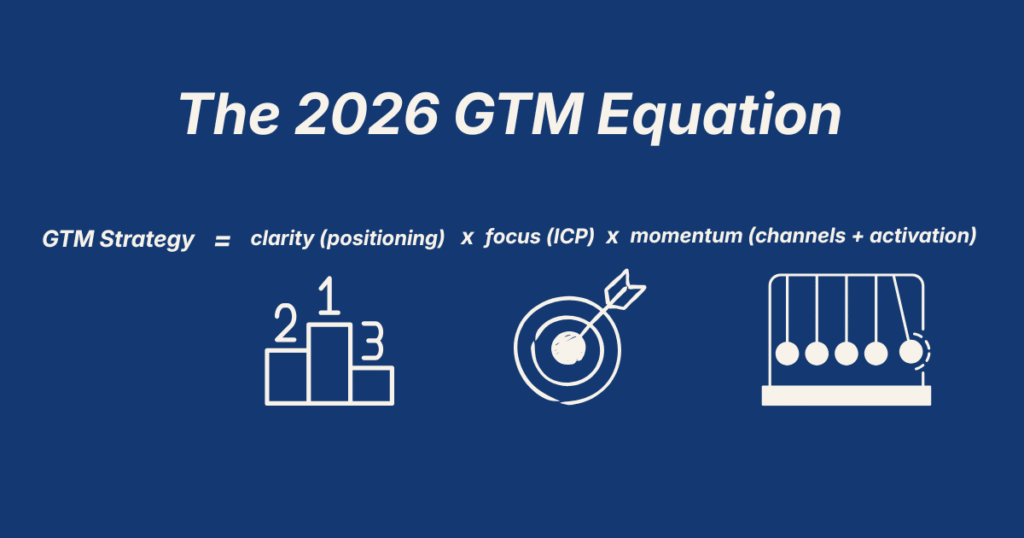
The 2026 GTM Equation
If you want a one-sentence summary, it’s this:
A winning GTM strategy is clarity (positioning) × focus (ICP) × momentum (channels + activation).
Most companies try to grow by adding more:
more content
more ads
more features
more experiments
The companies that win in 2026 grow by removing:
removing complexity
removing unclear messages
removing weak segments
removing low-performing channels
removing friction in onboarding
GTM isn’t about doing more.
It’s about aligning the right things — and eliminating everything else.
Final thoughts
A modern GTM strategy isn’t a static plan.
It’s a living system that evolves with the market.
The companies that succeed in 2026 will be the ones that:
- understand their category deeply
- position themselves with intention
- choose tight ICPs
- build hybrid growth motions
- align messaging across every touchpoint
- invest heavily in activation
- iterate every quarter, not every year
Do this, and your GTM strategy becomes a competitive advantage — not a slide deck.
FAQ
1. What is a GTM strategy?
A go-to-market strategy is the plan that defines how you introduce your product to the right audience, through the right channels, with the right messaging to drive adoption and revenue.
2. How long does it take to build one?
Most teams complete a solid GTM strategy in 2–4 weeks, depending on research depth and how many stakeholders are involved.
3. Should every product have its own GTM strategy?
Yes. Even major feature releases often need tailored GTM plans because the audience, positioning, or channels can differ.
4. When should you update a GTM strategy?
Anytime your market shifts, your audience changes, you add pricing updates, or you launch a new product or feature.
5. What’s the main reason GTM plans fail?
Cross-functional misalignment. If Product, Marketing, and Sales use different ICPs, messages, or KPIs, demand collapses.
6. What’s the most overlooked GTM asset?
A clear, defensible “why now?” narrative. Even world-class positioning fails without temporal urgency. The best GTM strategies tie the offer to macro trends, regulatory shifts, or emerging behaviors that make the solution feel inevitable.
