
Understanding the right target audience is crucial for sustainable business growth. Many companies don’t fail because of weak products, but because they target the wrong customers. Defining your Ideal Customer Profile (ICP) identifies those who benefit most from your offering and who provide the greatest value in return. Focusing on an ICP sharpens your marketing, sales, and product development efforts. Key takeaway: A clear ICP keeps your growth strategies focused on the right customers.
An Ideal Customer Profile is not just a vague description of your audience; it is a detailed, data-driven representation of your best-fit customer. It goes beyond basic demographics and dives into firmographics, behaviors, motivations, and pain points. When properly defined, your ICP acts as a strategic guide that aligns all departments in your organization. From content creation to customer support, everyone can work with a shared understanding of who the business is built to serve. By clarifying what makes an ideal customer, you lay the groundwork for smarter targeting and collaboration across your company.
In today’s competitive landscape, businesses that fail to define their ICP often waste resources targeting leads that will never convert or retain. On the other hand, companies with a clear ICP tend to see higher conversion rates, better customer retention, and more efficient growth. To help your business avoid common pitfalls, this article will walk you through everything you need to know about defining your Ideal Customer Profile, step by step, with actionable strategies you can implement immediately.
What Is an Ideal Customer Profile (ICP)?
An Ideal Customer Profile (ICP) is a detailed description of the type of company or individual that would gain the most value from your product or service. It represents the customers who are most likely to convert, remain loyal, and generate the highest lifetime value. Unlike a general target audience, an ICP is highly specific and rooted in real data and insights rather than assumptions. It helps businesses avoid broad targeting and instead focus on quality over quantity.
ICP is especially important for B2B companies, where buying decisions can be complicated and involve many people. But it’s also useful for B2C businesses that want to improve their marketing and attract valuable customers. By defining your ICP, you learn who your best buyers are, what problems they have, and how your product or service helps them.
An effective ICP includes several key elements such as company size, industry, revenue, geographic location, and technological maturity in B2B contexts. For B2C, it may include demographics, lifestyle, purchasing behavior, and personal motivations. The more detailed your ICP, the easier it becomes to tailor your messaging and outreach strategies. Ultimately, your ICP is not static—it should evolve as your business grows and as market conditions change.
ICP vs Buyer Persona: Understanding the Difference
Many people mix up an Ideal Customer Profile and a buyer persona, but they are not the same. An ICP describes the type of company or person that fits your business best, looking at things like company size, industry, or income. It helps you answer, “Which customers should we target?”
A buyer persona is a made-up example of a person within your ideal customer group. It covers things like their job, daily tasks, challenges, goals, and how they make decisions. The ICP gives you the big picture, while buyer personas add real-life details. Together, they help you fully understand your target audience.
Knowing the difference between ICP and buyer personas is important for good marketing and sales. If you create personas without first defining your ICP, you might focus on the wrong people. If you only have an ICP and no personas, your messages may seem too general. The best way is to define your ICP first, then build buyer personas that match it.
Why Defining Your ICP Matters
Defining your Ideal Customer Profile is more than a marketing task; it is a key part of your business strategy. One big benefit is better efficiency. When you know who you want to reach, you can use your resources wisely and avoid spending time on leads that won’t work out. This means you get more value from your marketing and sales efforts.
Another big advantage is higher conversion rates. When your message connects with the right people, they are more likely to trust your brand and buy from you. Your sales team can also close deals faster because they are talking to people who already fit your ideal customer profile. This makes the sales process smoother and boosts results.
A clear ICP also helps you keep customers longer. When customers match your ICP, they are more likely to stay happy and loyal. They may even recommend your business to others, helping you grow through referrals. Over time, this leads to steady and reliable income for your business.
Key Components of an Ideal Customer Profile
To build a strong ICP, you need to understand several key parts. These help you create a clear and useful profile for decision-making. One important part is firmographics, which means details like company size, industry, revenue, and location. These help you spot which organizations will benefit most from your product or service.
Behavioral data is another key part. This covers how customers interact with your brand, which channels they use, and how they decide to buy. Knowing these behaviors lets you adjust your marketing and connect better with your audience. It also helps you spot trends for future campaigns.
It’s also important to know your customers’ pain points and challenges. You should understand what problems they face and how your product or service helps solve them. This lets you show your offering as a real solution, not just another choice. By focusing on these areas, you can make your ICP useful and effective.
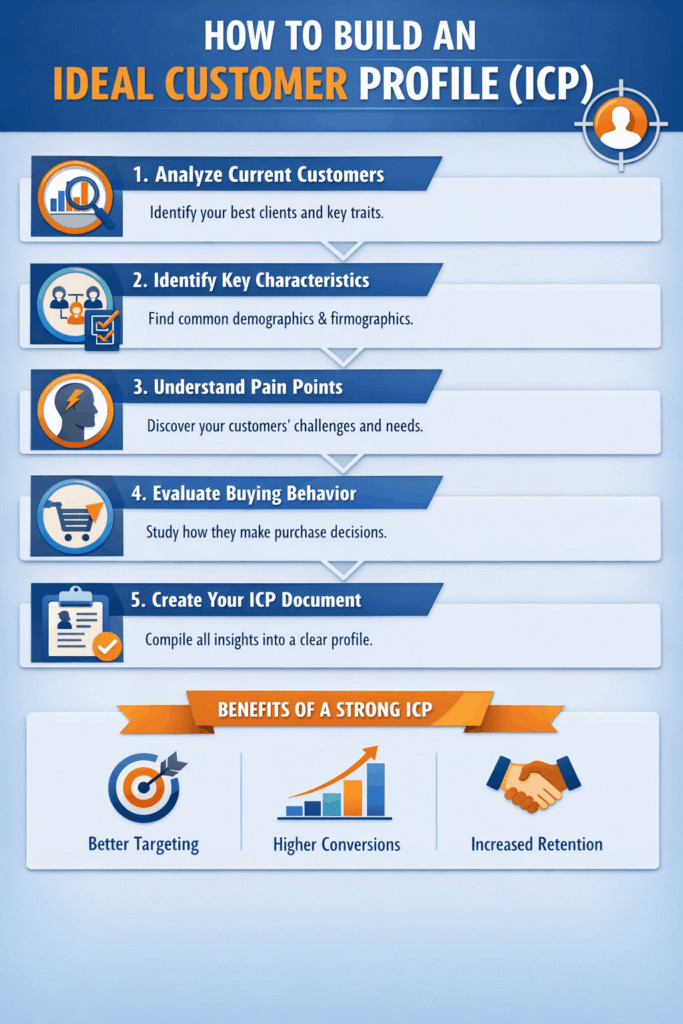
Step-by-Step Guide to Defining Your ICP
1. Analyze Your Start
Defining your ICP by looking at your current customers. Focus on your most successful and satisfied clients, and find what they have in common. This might be their industry, company size, buying habits, or the problems they had before choosing you. This analysis gives you a strong base for your ICP, using real data instead of guesses.rather than assumptions.
Focus on your high-value customers—the ones who bring in the most revenue and stay with you the longest. They are likely your ideal customers. By learning what makes them successful, you can look for similar traits in new prospects. This way, your ICP is based on real results and matches your business goals.
Use tools like CRM systems, analytics platforms, and customer surveys to collect this data. The more you learn, the more accurate your ICP will be. Keep in mind, this is not a one-time task—you should keep updating your analysis as your customers change.
2. Identify Common Characteristics
After you review your current customers, look for traits they share. These common features will shape your ICP. Check for patterns in things like age, company details, and behaviors that show up often among your best clients. These patterns help you focus your target audience.
Focus on the traits that really affect customer success. For example, if your best clients are mid-sized companies in one industry, make that a main part of your ICP. Don’t add too many details, or your profile will get too complicated. Stick to the most important factors.
Take your time with this step and think carefully. Make sure the traits you pick really matter, not just things that happen together by chance. This helps you build a more accurate and useful ICP that gets better results.
3. Understand Customer Pain Points
Knowing your ideal customers’ problems is key to building your ICP. These insights help you show how your product or service solves their needs. If you don’t understand their challenges, your message might not connect with them.
You can learn about customer pain points by using surveys, interviews, and support tickets. Watch for problems that come up often—these are usually important issues your product can solve. This information is very helpful for shaping your value and marketing.
When your ICP matches your customers’ pain points, your campaigns become more focused and effective. This leads to better engagement and more sales. In the end, knowing your customers’ challenges helps you give them more value and build better relationships.
4. Evaluate Buying Behavior
Another key step is to learn how your ideal customers decide to buy. Find out how they make choices, which channels they use, and who influences them. By studying their buying habits, you can adjust your sales and marketing to fit what they like.
For example, some customers do a lot of online research before buying, while others want to talk directly to a sales rep. Knowing these preferences helps you adjust your approach and improve your results. It also lets you spot and fix any problems in the buying process early.
Marketing and sales teams need to work together on this step to share and use insights well. By teaming up, you can build a stronger, more customer-focused strategy. This teamwork is key to making your ICP work best.
5. Create Your ICP Document
After you collect all your data and insights, put them together in a clear ICP document. This document should list the main traits, behaviors, and pain points of your ideal customer. Make sure it’s easy to read and available to everyone who needs it in your company.
Your ICP document should have sections like company profile, customer challenges, buying habits, and value proposition. Each part should give clear details to help teams make good decisions. This way, everyone works toward the same goals.
Keep your ICP document updated as your business changes. Market trends, customer needs, and industry shifts can happen, so your ICP should change too. Review and update it often to keep it useful.
Common Mistakes to Avoid
A common mistake when defining your ICP is making it too broad. If your profile is too general, your targeting won’t work well and you’ll waste resources. It’s better to focus on a smaller, more specific group that matches your product. This leads to better results and more personal connections.
Another mistake is using only guesses instead of real data. Trusting your gut can help, but it shouldn’t replace facts. If you base your ICP on wrong assumptions, you may get poor results. Always check your ideas with real data and feedback from customers.
Not updating your ICP is another big mistake. As your business and the market change, your ideal customer might change too. If you don’t review and adjust your ICP, your strategies can become outdated and you might miss new chances. Check your ICP often to keep it useful.
Tools and Resources to Help Define Your ICP
Many tools and resources can help you build and improve your Ideal Customer Profile. CRM systems are especially helpful because they keep detailed records of your customers and how they interact with your business. This information gives you useful insights into customer behavior and preferences.
Analytics platforms are also important for seeing how customers use your website and respond to your marketing. These tools help you spot trends that shape your ICP. Survey and feedback tools can also give you direct insights into what your customers need and struggle with.
To get the most from these tools, you need a clear plan and teamwork across your company. By bringing together data from different sources, you can build a more complete and accurate ICP. Using data in this way is important for long-term success.
How to Use Your ICP for Business
After you define your ICP, use it to help your business grow. One of the best ways is to match your marketing strategies to your ICP. This means making targeted content, improving your messages, and choosing the best channels to reach your audience. This helps you get more engagement and better leads.fied leads.
Your ICP can also make your sales process better by helping your team focus on the best prospects. This way, they spend time on leads that are more likely to buy and bring in revenue. As a result, your sales team works more efficiently and gets better results.
Your ICP can also guide product development and new ideas. By knowing what your ideal customers need and struggle with, you can make products that fit them better. This boosts customer satisfaction and gives you an edge over competitors.
Conclusion
Defining your Ideal Customer Profile is a key step in building a successful business that can grow. It gives you clarity and direction for your marketing, sales, and product development. When you know who your best customers are and what they need, you can make better plans and get better results.
Defining your ICP takes careful study, data gathering, and regular updates. It’s not something you do just once—it should grow and change with your business and the market. By putting time and effort into a strong ICP, you set your business up for long-term success.
In the end, your ICP is more than just a profile. It’s a key tool that helps your business grow and innovate. When you use it well, you can attract the right customers, build better relationships, and reach your goals.
