
Rebranding isn’t just a new logo, color palette, or tagline. It’s a strategic opportunity to realign purpose, sharpen relevance, and grow — without confusing or alienating the people who already believe in you. At its best, rebranding brings clarity that strengthens connection. At its worst, it erodes trust, dilutes brand meaning, and drives audiences to competitors. The difference lies in strategy, structure, and empathy toward the audience you already have — and the audience you want to win next.
In this deep dive, you’ll learn how to navigate a successful rebrand without losing your audience — from understanding why you’re rebranding, to executing change that feels natural, not disorienting, to your most loyal advocates.
Why Rebranding Is More Than a Visual Refresh
Too many brands treat rebranding as a surface exercise — new colors, new fonts, a fresh website — and assume that’s all it takes. But brands are not just visuals. They are:
- Stories people believe
- Expectations formed over time
- Real emotional connections between you and your customers
Your audience doesn’t fall in love with a logo — they fall in love with meaning. So when you rebrand, the real question isn’t “How does it look?” but “How does it feel, and what does it signal to the people who already trust us?”
At BrandQuarterly, we define brand strategy as the intersection of clarity, intelligence, and relevance — not just aesthetics. That’s why a successful rebrand begins with understanding who your audience is, what they value, and why they came to you in the first place.
The Root Reasons Brands Rebrand
Before you change anything, ask: Why are we rebranding? Common catalysts include:
- Business evolution: products, pricing, or positioning have shifted dramatically.
- Market disruption: competitors have redefined the category and your brand feels outdated.
- Audience expectations: your core customers’ needs have evolved.
- Growth goals: you’re expanding into new markets or segments.
- Internal clarity: the brand no longer reflects your mission, values, or culture.
These reasons matter because they influence how you approach the rebrand. A rebrand driven by growth goals looks different from one responding to competitive disruption. If you start with why you’re rebranding — and validate that with audience and market insights — you can design a plan that keeps your current community engaged rather than confused.
The Hidden Risk of Rebranding Without Losing Your Audience
When a brand changes direction without thoughtful communication or empathy for its existing audience, three things typically happen:
1. Confusion
Your loyal audience asks: “Is this still the brand I trust?”
Confusion erodes clarity, and clarity is the foundation of connection. When a rebrand introduces unfamiliar language, visuals, or positioning without context, audiences are forced to re-evaluate what the brand stands for. In that moment of uncertainty, trust weakens — not because the brand has changed, but because the audience no longer understands the meaning behind the change. Brands that fail to guide this transition risk replacing confidence with hesitation.
2. Perceived abandonment
Long-time customers may feel like the brand has turned its back on them or their needs. When a rebrand appears to prioritize new audiences or trends without acknowledging existing relationships, loyalty can quickly feel taken for granted. This sense of abandonment isn’t always vocal — it often shows up quietly through reduced engagement, slower conversions, or gradual disengagement. Without reassurance, audiences may conclude that the brand no longer represents them, even if the core value proposition remains unchanged.
3. Loss of emotional continuity
Brands are emotional anchors — they signal stability and consistency. Abrupt or unexplained change breaks that continuity.
But these are not inevitable. With the right strategy, rebranding can deepen loyalty and strengthen your audience’s sense of belonging.
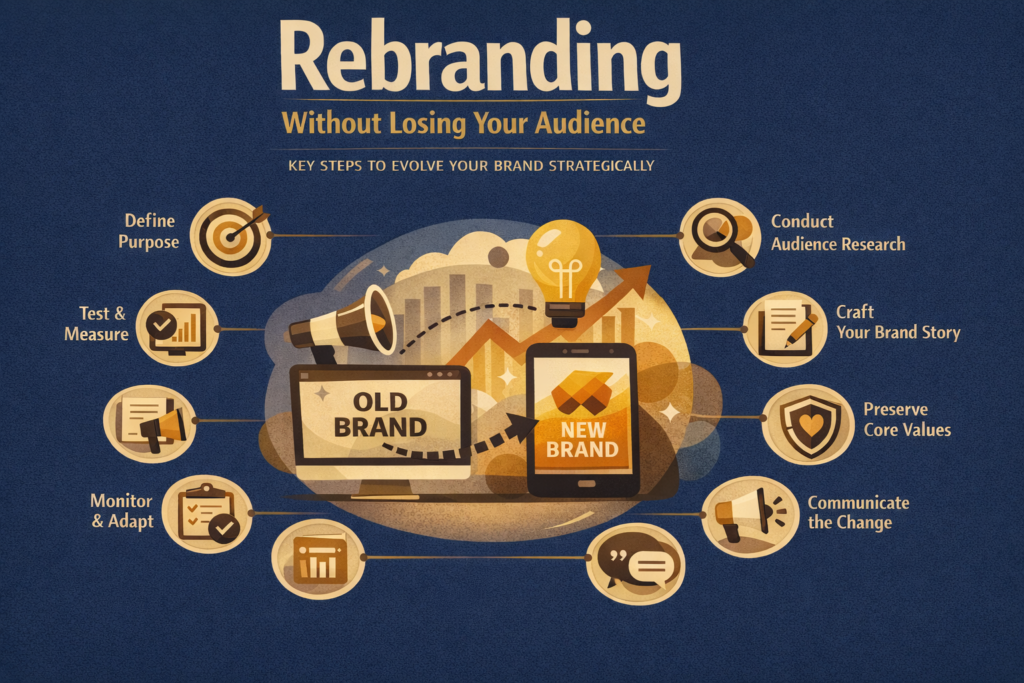
Step 1: Align Around Purpose — Before You Redesign Anything
Purpose isn’t a buzzword. It’s the central reason your brand exists in the minds of your audience.
Core Purpose Drives Emotional Loyalty
When audiences care about why you exist, they lean into what you do — and feel invested in where you are headed.
Ask these foundational questions:
- What are we trying to solve for our audience?
- How have our customers’ needs shifted?
- What do we want our audience to feel when they interact with the brand?
Your answers should guide every decision in the rebranding process — from strategic positioning to visual expression.
Step 2: Start With Research and Brand Intelligence
Rebranding isn’t guesswork. It’s grounded in insight.
Conduct a Brand Audit
A brand audit is not a creative exercise — it’s an evidence-based analysis of how your brand currently performs in perception, performance, and positioning. It tells you:
- What audiences really think about you
- Where your brand is failing to connect
- What conversations your competitors are winning
Without this data, you’re rebranding in the dark. A brand audit reveals the truths your audience already holds — whether you like them or not.
Use Customer Feedback
Talk to real customers — not assumptions. Surveys, one-on-one interviews, and behavioral data reveal the emotional and rational drivers behind why people choose your brand, stay loyal to it, or quietly move away. Beyond surface-level satisfaction, customer feedback exposes trust gaps, unmet expectations, and moments of friction that may not appear in analytics alone. These insights ensure your rebrand is grounded in reality, not internal bias, and aligned with what your audience actually values.
Competitive Intelligence
Understanding how others position themselves within your category helps you identify where your brand truly belongs. Competitive intelligence goes beyond visual comparisons — it examines messaging, promises, tone, and perceived authority. By mapping where competitors succeed and where they fall short, you uncover opportunities to differentiate with purpose rather than imitation. This clarity allows your rebrand to stand apart with confidence, not noise.
Research is not optional. It is the strategic bedrock of any rebrand that aims to retain existing audiences while expanding reach. Without insight, change becomes guesswork — and guesswork is the fastest way to lose trust. Brands that invest in intelligence-led rebranding build relevance that lasts, not just attention that fades.
Step 3: Build a Strategic Narrative for the Rebrand
This is where many brands fail: they assume the change will speak for itself.
It won’t.
Your audience needs a narrative — a story that explains:
- Why the brand is changing
- What’s staying the same
- What improvements they should expect
- How the change benefits them
Whether communicated in a launch video, press release, or email sequence, your narrative must be authentic, transparent, and audience-centric.
Great narrative does not sell your brand’s change — it sells why the audience should care.
Step 4: Preserve What Matters Most
Not all elements of your brand are equal. Some carry emotional and cognitive weight that your audience has internalized. The strategic art of rebranding is knowing what to update — and what to preserve.
Areas to evaluate:
- Core values that resonate with your audience
- Product experiences your customers love
- Messaging that drives engagement and loyalty
- Signature visual elements with strong recognition
You may update the look while preserving your voice and core promise. This creates evolution, not rupture.
Step 5: Communicate With Intent — Before, During, and After
A rebrand’s success depends just as much on communication as it does on design.
Before Launch
- Prepare your community with teasers, context, and transparency
- Share the why behind the change
- Invite feedback — and show you’re listening
During Launch
- Lead with clarity, not mystery
- Showcase improvements alongside continuity
- Highlight audience benefits first, brand achievements second
After Launch
- Keep messaging consistent across channels
- Monitor sentiment and feedback
- Adjust based on real-time responses
Effective communication builds trust. Silence breeds uncertainty. When audiences feel included in the journey, they stay.
Step 6: Maintain Brand Voice and Tone
While visuals may evolve, your brand voice — how you speak — must maintain familiarity and authority. In a world where tone shapes how audiences feel before they think, maintaining continuity in voice is strategic.
BrandQuarterly’s own approach reflects this: combining insight with imagination, and clarity with purpose in messaging that feels human and intelligent. BrandQuarterly
Your audience should recognize the way you speak even when what you say changes.
Step 7: Reinforce Values Through Every Touchpoint
Rebranding isn’t a single moment. It’s a systemwide alignment of experience, language, and promise.
Every interaction your audience has with your brand must now reflect the new positioning — whether it’s:
- Customer support replies
- Website content
- Social media
- Product packaging
- Email newsletters
Consistency breeds trust. Discrepancy breeds doubt.
Step 8: Test, Monitor, and Iterate
Rebranding does not end at launch.
Today’s best brands embrace continuous iteration — a mindset that acknowledges that brand relevance is not static.
Use:
- Analytics to measure changes in engagement
- Sentiment analysis to assess audience reaction
- A/B testing to refine messaging
- Quarterly check-ins to evaluate brand performance
BrandQuarterly’s Quarterly Clarity Method is one example of how brands can stay sharp over time — using structured review systems to keep messaging and strategy aligned between bigger overhauls.
Common Mistakes That Lose Audiences (and How to Avoid Them)
Even with a plan, brands can misstep. Here are frequent pitfalls — and the strategic fix:
Mistake: Ignoring Audience Research
Fix: Invest in data and qualitative insights upfront.
Mistake: Rebranding Without Audience Narrative
Fix: Lead with storytelling that centers the audience’s experience.
Mistake: Changing Everything at Once
Fix: Keep core meaning while updating what needs modernization.
Mistake: Weak Communication
Fix: Build a launch sequence that informs, not surprises.
Mistake: No Post-Launch Follow-Up
Fix: Monitor performance and iterate continuously.
The Payoff: A Rebrand That Strengthens Loyalty
When done correctly, rebranding:
- Deepens audience trust
- Clarifies who you are and what you stand for
- Improves relevance and competitiveness
- Invites both old and new audiences into the brand story
Your audience doesn’t want to feel left behind. They want to feel understood, respected, and brought along — not pushed aside.
A thoughtful rebrand honors the past while guiding the future.
Conclusion: Rebranding With Wisdom and Empathy
Rebranding is one of the most strategic — and potentially transformative — initiatives a company can undertake. But success doesn’t come from aesthetic choices alone. It comes from:
- Knowing your audience intimately
- Listening before you revise
- Preserving what matters most
- Communicating with clarity and care
- Reinforcing your values across every interaction
A rebrand done well doesn’t just keep your audience — it validates their belief in you and strengthens the emotional bond they share with your brand.
Your brand is not the sum of its visuals — it’s the promise your audience believes you will keep. Rebrand with that promise in mind, and your audience won’t just stay — they’ll advocate.
