
Selecting the most effective Go‑To‑Market (GTM) strategy is one of the most consequential decisions a business can make. A strong GTM strategy bridges the gap between having an awesome product and achieving meaningful market adoption, revenue growth, and customer retention. In 2026, companies face a diverse set of GTM approaches — yet among them, three stand out as foundational: Product‑Led, Sales‑Led, and Partner‑Led strategies. These three models guide how a product engages prospects, converts them into paying customers, and scales over time.
In this article, we deeply explore each GTM model, including real-world examples, strategic frameworks, success metrics, and practical implementation advice — all grounded in current market realities and trends for 2026. By the end, you’ll not only understand these GTM frameworks — you’ll know how to evaluate and implement them for your own business success.
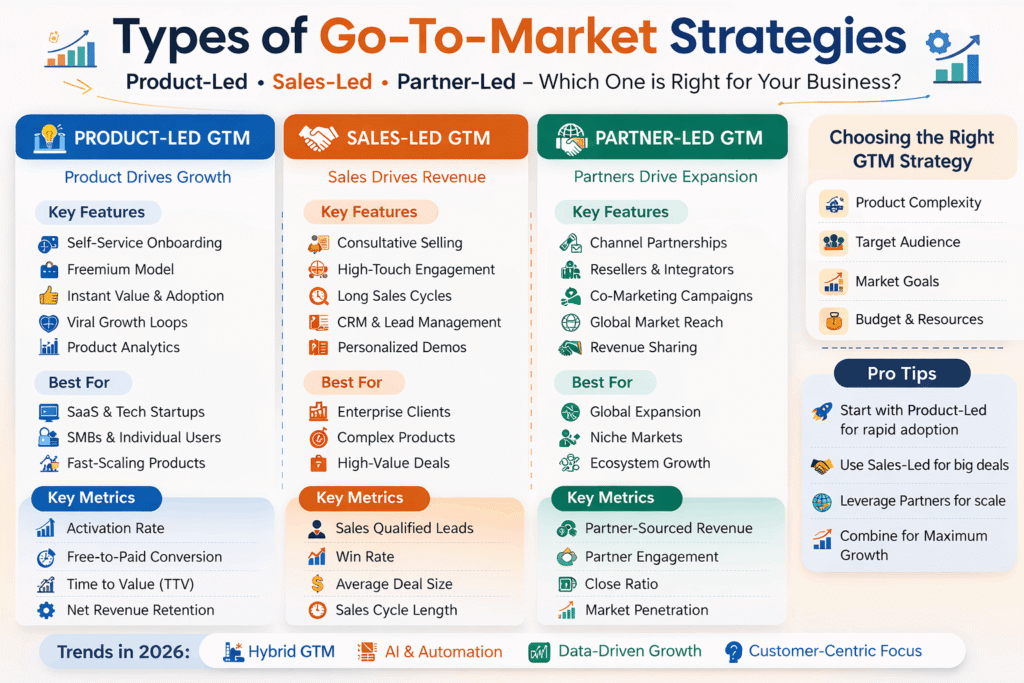
Go-To-Market Strategy: Product-Led Approach Explained
A Product‑Led Growth (PLG) strategy puts the product at the center of the acquisition, expansion, and retention funnel. Rather than relying on outbound sales or heavy marketing, PLG lets users experience value firsthand, often through free tiers, trials, or powerful onboarding flows. The core belief is simple: when users get value quickly, they adopt, expand, and advocate without heavy sales intervention.
1. How Product‑Led GTM Works
Product‑Led GTM begins with the premise that the product itself should act as the primary vehicle for customer acquisition and revenue generation. Users sign up, explore features, and realize value — ideally within minutes. This time to value (TTV) is foundational; companies like Slack or Notion engineered experiences where users see benefits almost immediately upon first use.
To support this, companies often adopt freemium models, in‑app onboarding workflows, and usage‑based incentives that guide users toward premium tiers. By minimizing friction and letting users discover value organically, PLG reduces reliance on sales representatives and significantly lowers customer acquisition costs.
2. Core Characteristics of Product‑Led GTM
- Self‑Serve Onboarding: Users can start, learn, and derive value without speaking to sales — a hallmark of successful PLG.
- Instant Time to Value (TTV): The faster a user sees value, the more likely they are to convert. Best‑in‑class products deliver meaningful value within minutes, not days.
- Usage‑Driven Expansion: As users engage more, companies can introduce premium features or team‑based pricing.
- Viral Growth Funnels: Built‑in loops (like sharing, inviting teammates, or collaborative workflows) accelerate adoption.
- Lower CAC: With minimal sales involvement, customer acquisition cost stays lean compared to Sales‑Led models.
- Product Analytics‑First Mindset: Detailed usage data informs roadmap priorities and conversion triggers.
3. Examples of Product‑Led GTM in Action
Many modern SaaS platforms exemplify PLG:
- Calendly removes scheduling friction entirely; the act of using it naturally introduces others to the product, driving viral growth.
- Figma makes collaboration seamless; sharing a design file invites team members automatically and spreads adoption organically.
- Notion blends productivity tools into a modular workspace that users love — free templates and effortless sharing boost widespread use.
- Zapier connects apps through automation that users build themselves, reinforcing value with each workflow.
- Grammarly offers basic grammar help for free, while advanced suggestions and analytics drive upgrades.
These companies don’t rely on sales teams early on — their products do the heavy lifting.
4. Metrics and KPIs for Product‑Led Growth
A Product‑Led GTM strategy is measured by distinct metrics that focus on both adoption and expansion:
- Activation Rate: Percentage of new users who reach the “aha moment” — a key indicator of onboarding success.
- Free‑to‑Paid Conversion: Portion of freemium or trial users who convert to paying customers.
- Product Qualified Leads (PQLs): Users whose product behavior signals readiness to buy — often more predictive than traditional leads.
- Time to Value (TTV): Time it takes a new user to derive the core product benefit.
- Net Revenue Retention (NRR): Measures how well existing customers expand spending over time — a strong retention signal.
- Expansion Revenue: Revenue generated from upgrades, additional seats, or usage — central to PLG growth loops.
These metrics, when tracked rigorously, help PLG companies connect product behavior with revenue outcomes — a capability traditional Sales‑Led teams often lack.
5. Challenges and Misconceptions
While Product‑Led GTM has many advantages, it also has pitfalls:
- Not universally applicable: Highly complex enterprise products still require sales guidance.
- Freemium fatigue: Users may sign up but never convert without effective engagement strategies.
- Limited control over pricing perception: Product experience must deliver unmistakable value to justify premium tiers.
- Onboarding bottlenecks: If users don’t hit value quickly, they churn before converting.
In short, PLG is not a magic bullet — but when executed well, it delivers unmatched scalability and efficiency in GTM.
Go-To-Market Strategy: Sales-Led Approach Explained
In contrast to Product‑Led approaches, Sales‑Led GTM strategies hinge on skilled sales teams to guide prospects from awareness to conversion. These models excel in environments with complex products, multiple stakeholders, and long contract cycles. In a Sales‑Led GTM, the sales function — not the product — drives revenue.
1. Understanding Sales‑Led GTM
At its core, a Sales‑Led GTM strategy prioritizes the human touch. Sales representatives engage potential customers early, educate them about the product’s value, handle objections, and close deals. These teams often collaborate closely with marketing to generate qualified leads, and with customer success to nurture long‑term relationships.
The Sales‑Led model works especially well with products that require explanation, customization, or negotiation — particularly in enterprise settings. Deals often involve multiple decision‑makers, long evaluation cycles, and bespoke pricing, all of which benefit from consultative selling.
2. Core Features of Sales‑Led GTM
- Consultative Selling: Reps build relationships, understand pain points, and tailor solutions to the customer’s context.
- High‑Touch Engagement: Multiple meetings, demos, and strategic conversations are standard.
- Longer Sales Cycles: Deals can take months due to complex procurement processes and multiple stakeholders.
- Territory Planning and Segmentation: Sales teams often have designated markets or accounts.
- CRM‑Driven Processes: Tools like Salesforce, HubSpot, and Outreach orchestrate the sales funnel.
- Team Structure Variation: Inside sales, field sales, sales engineers, and account executives each play distinct roles.
Sales‑Led GTM is resource‑intensive, but when executed well, it can capture high‑value customers with long‑term revenue potential.
3. Real‑World Examples of Sales‑Led GTM
Several enterprise leaders rely on Sales‑Led GTM strategies:
- Salesforce — Focused on consultative selling to enterprise clients, tying complex CRM needs with tailored solutions.
- Oracle — Deploys seasoned sales forces to navigate large organizations and negotiate customizable contracts.
- IBM — Combines deep technical expertise with sales teams to win complex enterprise infrastructure deals.
- Workday and SAP — Sell mission‑critical systems where every implementation involves multiple stakeholders and prolonged evaluation periods.
In each case, the GTM motion depends on relationship building, deep discovery, and strategic positioning — not pure product demos alone.
4. Sales‑Led Metrics to Track
Sales‑Led strategies rely on metrics that align with human effort and pipeline performance:
- Sales Qualified Leads (SQLs): Leads that meet pre‑defined criteria indicating strong purchase intent.
- Pipeline Velocity: Speed at which prospects move through the funnel.
- Win Rate: Percentage of opportunities that convert into closed deals.
- Average Deal Size: Indicates deal quality and revenue impact.
- Quota Attainment: Measures sales performance against targets.
- Sales Cycle Length: Duration from first contact to closed‑won deal.
These metrics help sales leaders forecast revenue, optimize team performance, and allocate resources effectively.
5. Challenges of Sales‑Led GTM
Despite its strengths, Sales‑Led GTM has drawbacks:
- Higher Customer Acquisition Cost (CAC): Sales teams require salaries, tools, and lead generation support, raising CAC.
- Longer Time to Revenue: Deals take longer to close, which can challenge cash flow.
- Scalability Constraints: Scaling often requires proportionally scaling the sales team.
- Dependency on Talent: Recruiting and retaining top sales talent is expensive and competitive.
However, for the right product and market, Sales‑Led GTM can unlock high‑value customers and build deep enterprise relationships.
Go-To-Market Strategy: Partner-Led Approach Explained
Partner‑Led GTM leverages external organizations — like resellers, system integrators, reseller networks, affiliates, or channel partners — to extend market reach and drive adoption. Rather than selling exclusively through your own teams, partners become extensions of your GTM engine, often in markets where you lack a direct presence or expertise.
1. What Partner‑Led GTM Entails
Partner‑Led strategies revolve around building a partner ecosystem that can sell, implement, and support your product. This model is especially effective when breaking into new geographies, niche industries, or highly specialized customer segments where local knowledge and established relationships matter.
Partner categories might include:
- Value‑Added Resellers (VARs)
- Managed Service Providers (MSPs)
- System Integrators
- Technology Alliances
- Affiliate Networks
In these setups, partners often earn commissions, share revenue, or receive margin incentives for driving sales and customer engagements.
2. Key Components of Partner‑Led GTM
- Partner Recruitment and Onboarding: Identifying partners with strategic fit and training them on your product.
- Co‑Selling and Co‑Marketing: Creating joint campaigns, webinars, or bundled solutions to expand reach.
- Incentive Structures: Shared revenue, tiered rewards, or co‑op funds motivate deeper engagement.
- Enablement and Support: Providing resources, training, and sales kits to empower partner success.
- Performance Tracking: Monitoring partner‑sourced revenue, closed deals, and customer satisfaction.
3. Benefits of Partner‑Led GTM
Partner‑Led GTM offers several strategic advantages:
- Faster Market Penetration: Partners help you access existing customer bases without building infrastructure from scratch.
- Lower Direct Costs: Shared responsibilities reduce the need for internal sales expansion.
- Localized Expertise: Partners with regional or vertical knowledge to improve adoption rates.
- Scalability without Headcount Growth: Partners scale with you, helping cover vast markets efficiently.
- Enhanced Credibility: Trusted partners lend authority and trustworthiness to your offerings.
These benefits make Partner‑Led GTM especially attractive for SaaS platforms, technology vendors, and enterprise solutions that support ecosystem integrations.
4. Real‑World Examples of Partner‑Led GTM
Global technology giants often rely on Partner‑Led GTM:
- Microsoft has one of the most extensive channel partner programs in the world, with resellers, integrators, and managed services providers offering Microsoft solutions globally.
- Cisco works with systems integrators and VARs to sell complex networking hardware and software around the world.
- Adobe and SAP similarly leverage partner ecosystems to extend reach into local markets and industry verticals.
Their success stems from structured partner enablement programs, revenue-sharing agreements, and collaborative marketing strategies that make partners feel like a growth engine rather than just distributors.
5. Metrics for Partner‑Led Success
Tracking performance in a Partner‑Led GTM is distinct from direct sales approaches. Some key indicators include:
- Partner‑Sourced Pipeline: Deals originated by partners rather than internal teams.
- Close Ratio of Partner Deals: Measures how well partner engagements turn into revenue.
- Partner Satisfaction and Engagement: Active collaborators bring better outcomes.
- Revenue Attributed to Partners: Demonstrates the partner ecosystem’s contribution to overall growth.
- Retention of Partner‑Acquired Customers: Tracks whether customers acquired through partners stay and expand.
These metrics give insight into ecosystem health and identify which partners are most impactful.
6. Challenges in Partner‑Led GTM
Despite its advantages, Partner‑Led GTM is not without complexity:
- Alignment of Goals: Partners must be incentivized to sell your product, not just promote competing offerings.
- Brand Control: You may lose control of customer messaging when partners take the lead.
- Coordination Complexity: Running joint campaigns and ensuring training consistency can be challenging.
When executed well, however, this strategy becomes a force multiplier — accelerating growth far beyond what internal teams alone could achieve.
Choosing Your GTM Strategy in 2026 and Beyond
By 2026, the lines between these GTM models will be blending, and many successful companies will adopt hybrid strategies that incorporate multiple motions. Most modern go‑to‑market playbooks mix:
- Product‑Led motion for bottom‑up adoption,
- Sales‑Led motion for enterprise and strategic accounts, and
- Partner‑Led motion for market expansion and niche reach.
For example, a SaaS company might let users start with a free product demo (PLG), engage a dedicated sales rep for mid‑market deals (Sales‑Led), and then leverage system integrators for global distribution (Partner‑Led).
Strategic Considerations When Choosing Your GTM
To determine the right path, assess the following factors:
- Product Complexity
- Simple, intuitive tools with immediate value favor Product‑Led GTM.
- Complex solutions requiring education or customization often need Sales‑Led approaches.
- Ideal Customer Profile (ICP)
- SMB or individual consumers frequently adopt self‑serve motions.
- Enterprises and regulated sectors often require Sales‑Led engagement.
- Market Dynamics
- Rapidly evolving markets may benefit from a hybrid motion that adapts quickly.
- Geographically diverse markets may benefit from Partner‑Led distribution.
- Resource Allocation
- Internal teams with a strong product and engineering focus may excel with PLG.
- Rich sales talent and budget may justify a Sales‑Led GTM.
- Strong external networks and partners suggest a Partner‑Led model.
- Goal Alignment
- GTM must align with growth targets, pricing strategy, and customer retention goals.
By analyzing these factors, companies can craft a GTM strategy that not only delivers revenue but also scales sustainably.
Conclusion
In 2026, the Go‑To‑Market strategy remains a strategic cornerstone of business success. Whether through Product‑Led, Sales‑Led, or Partner‑Led approaches — or a thoughtful combination of all three — the key is alignment with product, market, and growth goals. Product‑Led GTM delivers scalability and customer autonomy; Sales‑Led excels in complex and high‑value markets; and Partner‑Led unlocks reach and expansion in diverse geographies and verticals.
The companies that win tomorrow are those that choose not just one GTM model, but the right motion for the right segment at the right time, backed by data, and refined through ongoing feedback.
With a clear understanding of the strategies outlined above — paired with the right implementation frameworks — your business can unlock revenue potential, drive meaningful engagement, and outpace competitors with confidence.
