
In today’s competitive digital marketplace, standing out is no longer about having the loudest advertising campaigns or the biggest budgets. Instead, brands succeed by owning a clear and meaningful position in the minds of their customers. Nearly every industry is saturated with companies offering similar products, comparable pricing, and overlapping feature sets, which makes differentiation harder than ever before. When customers face too many choices, they gravitate toward brands that communicate clarity, relevance, and purpose. This clarity does not happen accidentally. It comes from strategic positioning that defines exactly who the brand serves, what it delivers, and why it matters more than alternatives. At the heart of that strategy sits the brand positioning statement.
Many companies either skip positioning entirely or treat it as a branding exercise rather than a strategic one. Some rely on taglines or slogans to communicate differentiation, even though those tools are designed for marketing expression, not strategic alignment. Others write positioning statements filled with vague terms like “innovative,” “best-in-class,” or “customer-first,” which fail to distinguish them meaningfully from competitors. A brand positioning statement is not a slogan, mission statement, or value proposition. It is an internal strategic document that guides product decisions, marketing communication, customer experience, and long-term business growth. Without it, brands struggle with inconsistent messaging, confused audiences, and diluted market perception.
Strong positioning creates coherence across everything a company does. It helps marketing teams communicate more clearly, product teams build with intention, sales teams articulate value confidently, and leadership teams make strategic decisions faster. Over time, positioning compounds into stronger brand equity, deeper trust, and higher customer loyalty. It also creates a competitive advantage that goes beyond features or pricing, because it shapes how customers feel about the brand, not just what they know about it. In markets where products can be copied quickly, perception becomes the most defensible asset.
In this guide, you will learn how to create a brand positioning statement that actually works in the real world, not one that simply sounds impressive in theory. You will discover what a positioning statement truly is, why it matters more than ever, how it differs from other brand tools, and how to build one step by step. You will also explore real-world examples and practical ways to activate positioning across your business. Whether you are launching a startup, scaling a growing company, or repositioning an established brand, this article will give you a clear, structured framework to follow.
What Is a Brand Positioning Statement?
A brand positioning statement is a concise internal declaration that defines how your brand should be perceived in the minds of your target audience relative to competitors. It clarifies who the brand is for, what problem it solves, what category it plays in, and why it is meaningfully different. Unlike slogans or ad copy, positioning statements are not written for customers. Teams use them internally to guide decisions across marketing, product development, sales, partnerships, and customer experience. When written well, positioning becomes the strategic compass that ensures every brand touchpoint moves in the same direction.
Positioning statements work because they force clarity and focus. Instead of trying to appeal to everyone, they require brands to define a specific audience and a specific value proposition. This focus strengthens differentiation and makes communication more relevant and persuasive. When employees understand exactly what the brand stands for, they can express it more consistently in everything they do. Over time, this consistency builds recognition, trust, and preference. Customers begin to associate the brand with a clear promise and a distinctive experience rather than just a product or service.
A strong positioning statement also operates at a strategic level rather than a tactical one. While campaigns, messaging, and visuals may change frequently, positioning should remain relatively stable. It evolves only when the business model, market context, or customer needs shift significantly. This stability allows positioning to guide long-term strategy rather than short-term tactics. It helps organizations avoid reactive decisions and stay focused on building sustainable competitive advantage.
Another defining characteristic of effective positioning is that it balances aspiration with credibility. It should stretch the organization toward a compelling future while remaining grounded in authentic strengths and capabilities. Customers and employees must be able to recognize the positioning in real experiences, not just in marketing language. When positioning feels disconnected from reality, trust erodes quickly. When it aligns with what people experience, it reinforces confidence and loyalty.
Finally, positioning is inherently selective. It defines not only who the brand is for but also who it is not for. This selectivity is not a weakness. It is what makes differentiation possible. Brands that attempt to appeal to everyone usually fail to resonate deeply with anyone. Positioning creates focus, clarity, and strategic discipline. That focus allows brands to compete on meaning rather than noise, which becomes increasingly important in saturated markets.
Why Brand Positioning Matters More Than Ever
Today’s marketplace is defined by abundance rather than scarcity. Customers face an overwhelming number of choices in nearly every category, which leads to decision fatigue and reliance on mental shortcuts. When people cannot easily differentiate between brands based on features or price, they default to those that feel familiar, trustworthy, and relevant. Brand positioning simplifies this decision process by clarifying who the brand is for and what makes it distinct. It reduces friction in the buying journey and increases the likelihood of preference and loyalty. Without positioning, even strong products struggle to gain traction because customers cannot quickly understand why they matter.
Another reason positioning matters more today is rapid commoditization. Technology, supply chains, and business models evolve so quickly that functional advantages disappear faster than ever before. What was once a breakthrough feature becomes standard in months, not years. In this environment, sustainable differentiation rarely comes from product features alone. It comes from perception, experience, and emotional connection. Positioning enables brands to compete on meaning rather than mechanics. It allows them to occupy unique mental territory that competitors struggle to copy, even if they replicate similar offerings.
Positioning also plays a critical role in internal alignment and organizational efficiency. When teams lack clarity about what the brand stands for, decision-making becomes fragmented. Marketing pursues one narrative, product teams prioritize different outcomes, and sales teams tell yet another story. This misalignment weakens brand consistency and wastes resources. A strong positioning statement creates a shared framework for evaluating ideas and initiatives. Teams can ask, “Does this strengthen our positioning?” instead of debating based on opinion or urgency. Over time, this alignment increases execution speed, coherence, and strategic impact.
Trust represents another dimension where positioning creates measurable value. Modern consumers research brands extensively, compare alternatives carefully, and rely heavily on reviews and peer recommendations. They expect transparency, consistency, and authenticity. When a brand clearly articulates what it stands for and consistently delivers on that promise, trust grows. Customers feel confident that they understand the brand and can predict how it will behave. This predictability reduces perceived risk and increases emotional attachment. Positioning provides the foundation for that consistency across touchpoints.
Finally, positioning shapes long-term growth trajectories. Brands that compete primarily on price or features often struggle to scale profitably because they lack defensible differentiation. By contrast, brands with strong positioning can expand into new products, services, or markets while maintaining coherence and relevance. Their positioning becomes a platform for growth rather than a constraint. Over time, this strategic clarity compounds into stronger equity, higher margins, and greater customer lifetime value. Positioning, therefore, is not just a branding exercise. It is a business strategy.
Brand Positioning Statement vs. Value Proposition vs. Mission
Brand positioning statements are often confused with value propositions, mission statements, and taglines, but each serves a different strategic purpose. A brand positioning statement defines how your brand should be perceived relative to competitors in the minds of your target audience. It operates internally and guides long-term strategy and decision-making. A value proposition, on the other hand, is customer-facing and explains what benefit the customer receives and why your offering is better than alternatives. While positioning informs the value proposition, the two are not interchangeable. Positioning sets the strategic foundation, and the value proposition expresses that strategy in customer language.
A mission statement answers a different question altogether. It defines why your organization exists and what broader purpose it serves beyond profit. Mission statements often speak to impact, values, and long-term vision, such as improving lives, empowering communities, or advancing sustainability. Positioning focuses on competitive differentiation, while mission focuses on meaning and direction. A brand can have a compelling mission but weak positioning if it fails to define how it uniquely delivers value in the market. Conversely, a brand can have strong positioning but lack deeper purpose if its mission feels hollow or uninspiring.
Taglines and slogans add another layer of confusion. These short phrases support marketing campaigns and brand recall, but they do not replace positioning. Taglines are external and expressive, while positioning statements are internal and strategic. A tagline might change frequently, but positioning should remain relatively stable over time. When brands skip positioning and jump straight to taglines, they often end up with creative messaging that lacks coherence and strategic depth. Over time, this inconsistency weakens brand recognition and trust.
Understanding these distinctions matters because each element plays a different role in building a coherent brand system. Positioning informs your value proposition, which shapes your messaging framework, which influences your creative execution. Your mission guides your culture and purpose, while your positioning defines your competitive strategy. When these elements align, your brand becomes clearer, more credible, and more powerful. When they conflict or blur together, confusion spreads internally and externally, weakening brand performance.
Strong brands treat positioning as the foundation upon which everything else is built. They use it to guide product decisions, marketing communication, customer experience design, partnerships, and long-term growth planning. Rather than creating these elements in isolation, they ensure that each reinforces the same core narrative. This consistency compounds over time, strengthening mental associations and emotional connection in the minds of customers.
What Makes a Brand Positioning Statement Actually Work?
Not all brand positioning statements create real strategic value. Many organizations go through the exercise only to produce statements that sound impressive but fail to guide decisions or differentiate meaningfully. Others create positioning that looks good in presentations but does not translate into real-world behavior or experience. The difference between positioning that works and positioning that fails comes down to five essential qualities: clarity, relevance, differentiation, credibility, and actionability. Without these elements, positioning remains theoretical. With them, it becomes a powerful growth engine.
Clarity sits at the core of effective positioning. A positioning statement should be easy to understand and interpret consistently across the organization. If teams need to debate what it means or how to apply it, it lacks clarity. Clear positioning specifies the audience, need, category, and differentiation without relying on jargon or vague language. This clarity reduces ambiguity and enables faster, more confident decision-making. When everyone in the organization can explain the brand’s positioning in their own words and arrive at the same meaning, alignment becomes possible.
Relevance ensures that positioning resonates with real customer needs rather than internal assumptions. Even the most differentiated positioning will fail if it does not address something customers care deeply about. Effective positioning reflects genuine pain points, aspirations, and motivations. It connects the brand’s value to outcomes that matter emotionally and functionally. Relevance bridges the gap between strategy and experience by ensuring that what the brand promises aligns with what customers seek. Without relevance, positioning may sound clever but will not influence behavior or loyalty.
Differentiation gives positioning its competitive power. In crowded markets, saying what everyone else says leads to invisibility. Strong positioning articulates a point of difference that is meaningful, defensible, and noticeable. This difference does not need to be radical, but it must matter to your audience and be difficult for competitors to copy. Differentiation can come from product design, service model, brand personality, values, customer experience, or business philosophy. What matters most is that it creates a compelling reason to choose your brand over alternatives.
Credibility ensures that positioning is believable and sustainable. Aspirational positioning can be powerful, but it must align with reality and supported by proof. If a brand claims to be the most customer-centric or innovative without evidence, trust erodes quickly. Internally, teams must also believe the positioning for it to guide behavior effectively. Credibility requires alignment between what the brand says and what it consistently does. When experience reinforces positioning, trust grows. When it contradicts positioning, confidence disappears.
Actionability transforms positioning from theory into practice. A strong positioning statement should guide decisions across marketing, product development, sales, partnerships, and customer experience. Teams should be able to use it to evaluate ideas, prioritize initiatives, and resolve strategic debates. If a positioning statement cannot answer questions like “Is this on brand?” or “Does this strengthen our differentiation?”, it fails to fulfill its purpose. When clarity, relevance, differentiation, credibility, and actionability work together, positioning becomes one of the most powerful tools in brand strategy.
The Brand Positioning Statement Framework
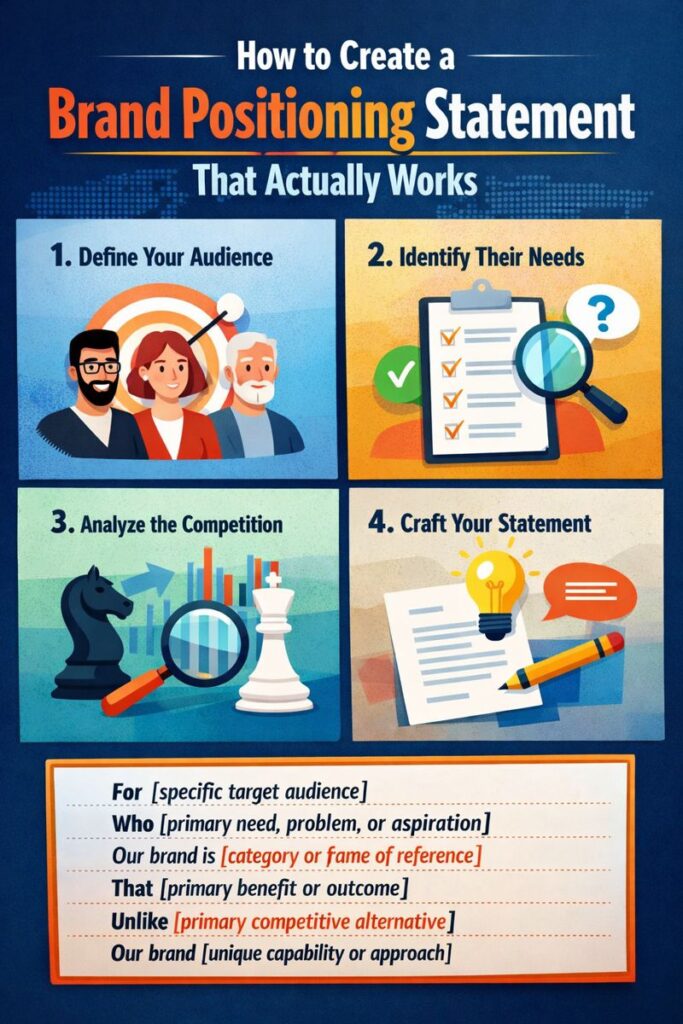
One of the most effective frameworks for writing a brand positioning statement follows this structure:
For [specific target audience]
Who [primary need, problem, or aspiration]
Our brand is [category or frame of reference]
That [primary benefit or outcome]
Unlike [primary competitive alternative]
Our brand [unique capability, approach, or philosophy that enables this benefit]
This framework works because it forces strategic clarity around five essential elements: audience, need, category, benefit, and differentiation. Rather than allowing vague or aspirational language, it requires brands to make explicit choices. Each line answers a critical strategic question, and together they form a coherent narrative that guides long-term brand direction. While your final positioning statement does not need to appear in this exact format, using this structure during development ensures rigor and alignment.
Target Audience
The first line defines who your brand exists to serve. Effective positioning requires focus rather than breadth. Instead of describing everyone who could potentially use your product, you identify the specific audience for whom your brand creates the most meaningful value. This audience definition should go beyond demographics to include motivations, behaviors, pain points, and aspirations. When you clearly define your ideal customer, your messaging becomes more relevant, your differentiation sharper, and your strategy more coherent. Focused positioning strengthens impact rather than limiting growth.
Customer Need or Aspiration
The second line articulates the core problem, need, or aspiration your audience experiences. This is not about what your product does but about what your customer struggles with or hopes to achieve. Strong positioning addresses underlying motivations rather than surface-level features. For example, customers may seek not just efficiency but peace of mind, not just tools but confidence, not just information but clarity. By framing positioning around real human needs, brands create emotional resonance and deeper connection.
Category or Frame of Reference
The third line defines what kind of brand you are or what business you are really in. This category framing shapes customer expectations and competitive comparisons. For example, positioning yourself as a “customer experience platform” rather than a “help desk tool” changes how customers perceive your value and who they compare you to. Choosing the right frame of reference allows you to compete on more favorable terms and unlock new differentiation opportunities. Category definition is not neutral; it is a strategic choice.
Primary Benefit or Outcome
The fourth line describes the main benefit your brand delivers. This benefit should reflect a meaningful outcome rather than a list of features. It should answer the question, “What does the customer gain by choosing us?” Strong benefits connect functional performance with emotional impact. They explain not only what the brand does but how it improves the customer’s life or work. This benefit becomes the core promise that anchors your messaging and experience design.
Competitive Alternative and Differentiation
The final lines contrast your brand with the primary alternative and articulate your unique capability, approach, or philosophy. This explicit comparison sharpens differentiation and prevents generic claims. Instead of saying you are “better,” you clarify how you are different in ways that matter. This contrast also helps internal teams make clearer trade-offs and strategic choices. When brands know what they are not, they can focus more effectively on what they are.
Real-World Brand Positioning Statement Examples
Apple
Apple positions itself around simplicity, creativity, and human-centered design rather than technical specifications or price competitiveness. Its implied positioning focuses on individuals who want technology that enhances their lives, positioning Apple as the premium consumer electronics brand that delivers beautifully designed, intuitive products that empower creativity and productivity. This positioning explains Apple’s emphasis on user experience, ecosystem integration, and design excellence. It also supports premium pricing and deep customer loyalty. Over time, this clarity has enabled Apple to expand into new categories while maintaining a coherent brand identity.
Nike
Nike positions itself not merely as an apparel company but as a brand that empowers human potential through movement. Its implied positioning centers on athletes of all levels who want to push their limits, positioning Nike as the performance sports brand that inspires and equips people to achieve their personal best. This positioning broadens Nike’s audience beyond professionals to anyone with a body and a desire to move. It informs storytelling, athlete partnerships, innovation priorities, and cultural relevance. By positioning itself around empowerment rather than products, Nike creates emotional resonance and enduring brand equity.
Patagonia
Patagonia differentiates itself through environmental responsibility rather than performance or price alone. Its implied positioning focuses on outdoor enthusiasts who care deeply about protecting the planet, positioning Patagonia as the sustainable outdoor brand that creates high-performance products while actively working to preserve the environment. This positioning influences everything from supply chain decisions to activism campaigns and product materials. It builds loyalty among values-driven consumers and creates differentiation in a crowded outdoor market. Patagonia demonstrates how purpose-driven positioning can become a competitive advantage.
Airbnb
Airbnb disrupted hospitality by reframing accommodation around belonging and experience. Its positioning centers on travelers seeking authentic, local stays rather than standardized hotels, positioning Airbnb as the global hospitality marketplace that enables people to belong anywhere. This positioning shifts the competitive frame from lodging to connection and community. It informs product design, host relationships, storytelling, and brand purpose. By positioning itself around belonging rather than rooms, Airbnb created a new category rather than competing head-to-head with hotel chains.
Step-by-Step: How to Create a Brand Positioning Statement
Step 1: Define Your Ideal Target Audience
The first step in creating a strong brand positioning statement is defining exactly who your brand exists to serve. This requires more than listing demographic traits like age, income, or job title. You need to understand your audience’s motivations, goals, frustrations, behaviors, and decision-making contexts. Effective positioning begins with empathy rather than assumptions. When you understand what success looks like to your customers and what obstacles they face, you can craft positioning that resonates emotionally as well as functionally. This depth of understanding strengthens relevance and differentiation.
Strategic focus matters here. Many brands try to target broad audiences in the hope of maximizing market reach, but this usually leads to diluted messaging and weak positioning. Strong brands narrow their focus to the segment for whom they deliver the most meaningful value. This focus does not limit future growth. Instead, it creates a strong foundation for expansion by establishing credibility and relevance within a core audience first. Over time, adjacent segments often follow organically once the brand earns trust and recognition.
To define your audience effectively, combine quantitative data with qualitative insight. Use analytics, customer interviews, surveys, usability testing, and social listening to identify patterns in behavior, perception, and motivation. Look for shared problems and aspirations rather than surface-level traits. Segment customers by needs and contexts rather than demographics alone. This approach leads to more powerful positioning because it reflects real human drivers rather than abstract categories. It also improves marketing effectiveness and product relevance.
Context matters as much as identity. Customers do not make decisions in isolation. Their choices are shaped by environment, timing, social influence, emotional state, and constraints. Understanding when, why, and how customers engage with your category reveals opportunities for differentiation. It also uncovers moments of unmet need that competitors may overlook. Positioning that reflects this contextual insight feels timely, relevant, and human rather than generic or abstract.
Without a clearly defined audience, positioning becomes vague by default. It tries to appeal to everyone and ends up resonating with no one. By contrast, brands that invest in deep audience understanding create positioning that feels personal, authentic, and meaningful. This clarity strengthens not only marketing but product strategy, customer experience design, and long-term growth planning.
Step 2: Identify the Core Customer Problem or Need
Once you define your audience, the next step is to identify the core problem, need, or aspiration your brand exists to address. Customers rarely buy products for features alone. They buy outcomes, confidence, peace of mind, status, belonging, or transformation. Effective positioning speaks to these deeper motivations rather than surface-level functionality. When brands understand what customers are truly trying to achieve, they can frame value in ways that resonate emotionally and strategically.
To uncover these needs, engage directly with customers through interviews, surveys, and observation. Ask open-ended questions about challenges, goals, frustrations, and experiences. Listen for emotional language and recurring themes rather than focusing solely on explicit requests. Customers may say they want faster software, but their deeper need might be reduced stress or more time for meaningful work. These underlying motivations often create more powerful positioning than feature-based benefits.
Distinguishing symptoms from root causes matters greatly. If positioning focuses only on surface-level problems, competitors can easily copy it by matching features or pricing. By contrast, positioning around deeper needs creates differentiation that is harder to replicate. Brands like Nike and Airbnb succeed not because they sell shoes or rooms, but because they connect with identity, aspiration, and belonging. These emotional drivers create loyalty beyond rational comparison.
Prioritization also plays a critical role. Customers often experience multiple needs simultaneously, but effective positioning focuses on the most meaningful and underserved one. Attempting to address everything dilutes clarity and impact. Strategic focus requires choosing the problem your brand is best equipped to solve and committing to that narrative. This choice does not eliminate other benefits but establishes a primary lens through which customers understand your value.
Finally, ensure that the identified need aligns with your brand’s authentic strengths and long-term strategy. Positioning must reflect not only market opportunity but organizational capability. If your brand claims to solve a problem it cannot consistently address, credibility will suffer. When customer need and brand capability align, positioning becomes sustainable, believable, and powerful.
Step 3: Analyze the Competitive Landscape
Positioning is inherently relative. It defines how your brand compares to alternatives in the customer’s mind. Without a clear understanding of your competitive landscape, differentiation becomes guesswork. Competitive analysis involves more than listing rival brands or comparing features. It requires understanding the narratives competitors use, the emotional territory they occupy, and the expectations they set for customers. This insight reveals opportunities to stand apart meaningfully rather than blending into the noise.
Begin by identifying both direct and indirect competitors. Direct competitors offer similar products to the same audience. Indirect competitors solve the same problem through different approaches or compete for the same attention or budget. For example, a productivity app competes not only with other productivity tools but also with coaching, workflows, or organizational systems. Understanding this broader competitive set helps you frame your positioning more strategically. It also uncovers alternative categories or frames of reference that may offer stronger differentiation.
Next, analyze how competitors position themselves across key dimensions such as price, convenience, performance, personalization, innovation, values, and emotional appeal. Review their websites, ads, social media, content, customer reviews, and thought leadership. Look for patterns in language, tone, imagery, and storytelling. Identify crowded territories where many brands make similar claims and white spaces where unmet needs or underrepresented narratives exist. These gaps often present the best positioning opportunities.
Customer perception matters as much as competitor intent. Examine reviews, forums, and social discussions to understand what customers love, what frustrates them, and what trade-offs they perceive when choosing one brand over another. These insights reveal real-world strengths and weaknesses rather than marketing promises. They also help you position your brand in ways that directly address unmet needs or pain points competitors leave unresolved.
Finally, assess how your own brand is currently perceived relative to competitors. Conduct internal interviews, customer research, or brand perception surveys to understand strengths, weaknesses, and differentiation in the market. Compare this reality with your intended positioning to identify gaps or misalignments. Effective positioning often involves reframing existing strengths rather than inventing new ones. When you ground positioning in both market reality and brand truth, you increase credibility and strategic advantage.
Step 4: Identify Your Brand’s Unique Value and Strengths
Once you understand your audience and competitive environment, the next step is identifying what your brand uniquely brings to the table. This requires honest self-assessment rather than aspirational wish-casting. Your positioning must reflect authentic strengths that your organization can consistently deliver and sustain over time. These strengths may come from product design, service experience, business model, culture, values, heritage, expertise, community, or operational excellence. What matters most is not uniqueness alone but meaningful uniqueness in ways that customers care about.
Start by examining internal assets and capabilities. Identify what you consistently do better than others, what customers praise most often, and where you achieve standout results. Look at customer feedback, performance metrics, internal culture, operational processes, and historical wins. These insights often reveal competitive advantages that feel normal internally but appear distinctive externally. Surfacing these strengths provides raw material for positioning that feels authentic rather than forced.
Next, evaluate which strengths align most closely with your audience’s core needs and motivations. Effective positioning sits at the intersection of customer relevance, competitive differentiation, and brand authenticity. A strength that customers do not value will not drive preference. Similarly, a customer need you cannot authentically fulfill will undermine credibility. Positioning emerges from the overlap between what customers want, what competitors lack, and what your brand can uniquely deliver.
Emotional and experiential strengths deserve as much attention as functional ones. Many brands focus narrowly on features or performance metrics while overlooking how they make customers feel. Confidence, trust, empowerment, relief, belonging, and inspiration often drive loyalty more strongly than technical specifications. Emotional benefits also tend to be harder for competitors to copy, making them powerful positioning anchors. When brands integrate emotional and functional value, positioning becomes more memorable and defensible.
Future relevance matters as well. Positioning should not only reflect current strengths but also support long-term strategic growth. Avoid anchoring positioning to narrow product features that may become obsolete. Instead, frame differentiation around broader outcomes, experiences, or philosophies that can evolve with the business. This flexibility allows positioning to remain stable while products, markets, and offerings change. Sustainable positioning balances present credibility with future potential.
Finally, prioritize focus. Most brands have multiple strengths, but effective positioning requires choosing the one or two that matter most. Trying to communicate everything leads to diluted messaging and unclear differentiation. A sharp positioning statement makes clear what the brand stands for and, equally importantly, what it does not. This clarity enables consistent storytelling, stronger recognition, and more disciplined strategic decision-making.
Step 5: Draft Your Brand Positioning Statement
With your audience, customer need, competitive landscape, and unique value clearly defined, you can now draft your brand positioning statement. This step transforms strategic insight into concise, actionable language. Although the statement is internal, it should still be clear, concrete, and easy to understand. Avoid jargon, vague buzzwords, and overly abstract phrasing. The goal is clarity, not cleverness. A positioning statement succeeds when teams can use it to guide real decisions, not when it sounds impressive in presentations.
Begin by applying the positioning framework to structure your thinking. Draft multiple versions rather than aiming for perfection immediately. Explore different ways of framing your audience, need, and differentiation. Test alternative category definitions and benefit statements. Small wording changes can have major strategic implications. For example, positioning as a “platform” rather than a “tool” or as a “partner” rather than a “provider” can reshape customer expectations and competitive dynamics. Treat drafting as strategic exploration rather than copywriting.
As you draft, ensure that each component reinforces the others. The audience should align with the need, the category should support the benefit, and the differentiation should reflect authentic strengths. Look for contradictions, generalities, or statements that could apply equally well to competitors. If any part of the statement feels interchangeable, refine it further. Strong positioning requires specificity and courage. It often involves choosing a clear point of view rather than hedging with broad claims that feel safe but ineffective.
Tone and voice also matter. While positioning statements are not customer-facing, they should reflect your brand’s personality and ethos. A challenger brand might adopt bold, energetic language, while an enterprise brand might emphasize authority and reliability. The tone should feel natural and credible to internal teams. When employees resonate with the positioning emotionally, they are more likely to embody it in behavior and decision-making.
Remember that positioning is a strategic tool, not a creative slogan. Precision matters more than poetry. Once you have several strong drafts, move to validation before finalizing. Positioning improves through iteration, feedback, and testing, not through isolated brainstorming.
Step 6: Test and Validate Your Positioning
A positioning statement should never be finalized without validation. While positioning ultimately reflects strategic choice rather than consensus, testing reduces the risk of creating something that sounds good internally but fails to resonate externally. Validation ensures that positioning is credible, relevant, and actionable. Both internal and external validation play critical roles in strengthening positioning before full-scale activation.
Internal validation focuses on clarity, alignment, and usability. Share draft positioning statements with stakeholders across marketing, product, sales, customer success, operations, and leadership. Ask whether the positioning reflects reality, supports strategy, and guides decisions effectively. Evaluate whether teams understand it easily and feel motivated by it. If employees struggle to interpret or believe the positioning, it will not succeed in the market. Internal buy-in is essential because positioning only works when people live it consistently.
External validation focuses on relevance and differentiation. While customers should not see your positioning statement directly, you can test its underlying assumptions through research and experimentation. Conduct interviews, surveys, and message testing to explore whether your proposed positioning resonates emotionally and functionally. Assess whether customers perceive the differentiation you claim and whether it influences preference or intent. Compare your messaging against competitors to ensure clarity and distinction in the market.
Practical testing also helps. Apply your positioning to landing pages, ad copy, onboarding flows, or sales scripts and observe how audiences respond. Monitor engagement, conversion, retention, and feedback patterns. Strong positioning often leads to clearer messaging, higher relevance, and better performance across touchpoints. If positioning-based messaging consistently outperforms alternatives, it provides strong validation. If not, refine your approach and test again.
Pay attention to both explicit feedback and implicit behavior. Customers may not always articulate why something resonates, but their actions often reveal the truth. Internally, observe whether teams naturally reference positioning when making decisions or resolving debates. When positioning becomes part of organizational language and culture, you know it is working. Validation is not about perfection but about increasing confidence and effectiveness before activation.
Step 7: Activate and Operationalize Your Positioning
Creating a positioning statement only creates value when the organization actively uses it. Too many brands treat positioning as a branding exercise rather than a strategic operating system. As a result, positioning lives in documents rather than in decisions, behaviors, and experiences. To drive real impact, positioning must be embedded across strategy, culture, product development, marketing, sales, and customer experience. Activation turns positioning from theory into practice.
Begin with internal communication and education. Every employee should understand what the brand stands for, who it serves, and how it differentiates. This requires more than a single presentation. It involves workshops, onboarding programs, leadership storytelling, and ongoing reinforcement. Teams should see how positioning informs their roles, priorities, and performance expectations. When employees connect their work to the brand’s positioning, alignment and motivation increase significantly.
Next, integrate positioning into your brand strategy and messaging framework. Positioning should guide tone of voice, messaging pillars, storytelling themes, and visual identity. Marketing campaigns, content strategy, social presence, website copy, and sales materials should reinforce the same core narrative. This consistency builds recognition, trust, and recall over time. Without alignment between positioning and messaging, customers receive fragmented signals that weaken perception and confidence.
Positioning must also influence product and service design. A brand built around simplicity should deliver an intuitive, frictionless user experience. When positioning emphasizes personalization, offerings must feel flexible and adaptive. Brands that stand for sustainability must reflect that commitment through their supply chain, materials, and partnerships. Positioning is not about what you say but about what you deliver. When experience reinforces promise, trust and loyalty grow.
Customer experience and culture represent another critical activation layer. Positioning should shape how employees interact with customers, resolve issues, and deliver value. It should influence service standards, communication tone, and success metrics. Culture and positioning reinforce each other. What your brand stands for externally must align with how people work internally. Leaders play a vital role in modeling positioning through decisions and behavior. When positioning is lived, not just stated, it becomes a true competitive advantage.
Finally, establish systems for ongoing measurement and refinement. Track brand perception, differentiation, trust, loyalty, and performance over time. Monitor whether positioning remains relevant as customer needs, competitive dynamics, and business strategy evolve. While positioning should be stable, it should not be static. Periodic review ensures that it continues to guide growth effectively. Activation is not a one-time event but a continuous process of alignment, execution, and reinforcement.
Common Brand Positioning Mistakes to Avoid
Trying to Appeal to Everyone
One of the most common positioning mistakes is attempting to serve too broad an audience. Brands often fear that narrowing their focus will limit growth, but the opposite is usually true. Broad positioning leads to vague messaging, weak differentiation, and low relevance. Strong positioning requires choosing a specific audience and committing to serving them exceptionally well. Over time, this focus often leads to broader appeal organically, as clarity and credibility attract adjacent segments.
Using Generic Claims and Buzzwords
Another frequent mistake is relying on vague descriptors such as “innovative,” “world-class,” or “customer-first.” Nearly every brand uses these terms, which makes them meaningless as differentiators. Without specific context or proof, they fail to communicate real value. Effective positioning avoids clichés and instead articulates concrete differences rooted in customer insight and authentic brand strengths. Specificity creates clarity, credibility, and memorability.
Confusing Positioning with Messaging or Slogans
Many brands jump straight to taglines or campaigns without establishing positioning first. This leads to creative work that lacks strategic coherence and changes frequently without building long-term equity. Positioning should precede messaging, not follow it. It provides the strategic foundation that ensures campaigns reinforce the same narrative over time. Without positioning, marketing becomes reactive and inconsistent rather than strategic and cumulative.
Creating Aspirational Positioning Without Operational Support
Some brands create positioning statements that describe who they want to be rather than who they are or can realistically become. While aspiration matters, positioning must align with actual capabilities and experiences. When brand promise exceeds performance, trust erodes quickly. Effective positioning balances ambition with authenticity, stretching the organization while remaining credible and deliverable.
Failing to Activate Positioning Across the Organization
Even strong positioning fails when teams treat it as a document rather than a decision-making tool. Positioning must influence strategy, culture, product design, marketing, sales, and customer experience. Without activation, positioning remains theoretical and unused. Brands that operationalize positioning create coherence, trust, and differentiation across every touchpoint. Those that do not see little return on their positioning efforts.
How to Use Your Brand Positioning Statement Across Your Business
Once finalized, your positioning statement should shape everything your organization does. In marketing, it guides messaging frameworks, campaign themes, content strategy, tone of voice, and visual identity. This consistency builds recognition and trust over time. Marketing teams can use positioning as a filter to evaluate creative ideas and ensure alignment with long-term brand strategy rather than short-term tactics.
In product and service development, positioning helps prioritize features, functionality, and experience design. It answers questions like, “What should we build next?” and “Which opportunities align with our brand promise?” When product teams use positioning as a strategic filter, they create offerings that reinforce differentiation rather than dilute it. This alignment ensures that what the brand delivers matches what it promises.
In sales and customer success, positioning shapes how value is articulated, how prospects are qualified, and how relationships are built. Sales narratives, onboarding processes, support interactions, and retention strategies all benefit from a clear positioning foundation. Customers experience a coherent brand story from first contact through long-term engagement, which increases confidence and loyalty.
In culture and leadership, positioning influences how people work, collaborate, and make decisions. It shapes organizational values, behaviors, and priorities. Leaders who embody positioning through action reinforce its importance and credibility. Hiring, training, performance evaluation, and internal communication can align with positioning to ensure that the brand is lived internally as well as expressed externally.
In strategy and growth planning, positioning provides a long-term anchor. It guides expansion into new markets, product lines, and partnerships. It helps leaders evaluate whether opportunities strengthen or dilute the brand’s core identity. Rather than chasing trends or reacting to competitors, positioning enables disciplined, coherent growth. Over time, this clarity compounds into stronger equity, loyalty, and financial performance.
Final Thoughts: Positioning Is Strategy, Not Just Branding
A brand positioning statement is not a cosmetic branding exercise. It is a strategic declaration of who your brand is, who it serves, and why it matters in the market. When crafted thoughtfully and activated consistently, positioning becomes the foundation of clarity, differentiation, trust, and long-term growth. It aligns teams, guides decisions, shapes experiences, and builds emotional connection. Without positioning, brands drift, compete on price, and struggle to stand out. With positioning, brands move with focus and purpose.
The strongest brands in the world succeed not because they have the largest budgets or the most features, but because they have the clearest point of view. They know exactly who they are for, what they stand for, and how they differ. Their positioning informs product design, customer experience, storytelling, and culture. Over time, this coherence compounds into powerful brand equity that competitors struggle to replicate.
When launching a new brand, positioning provides clarity and focus from day one. During periods of growth, strong positioning helps companies scale without losing coherence. For rebrands, positioning offers a strategic foundation that drives meaningful transformation rather than surface-level change. In every case, positioning is the starting point for meaningful brand building.
Creating a brand positioning statement that actually works requires clarity, courage, and commitment. It requires choosing focus over breadth, meaning over noise, and strategy over tactics. When you get it right, positioning becomes more than a statement. It becomes a competitive advantage.
