
A rebrand is one of the most significant moves a business can make — and also one of the most dangerous from an SEO perspective. Without a structured rebranding SEO checklist, even the most carefully planned brand transformation can wipe out years of search equity overnight. Rankings that took years to build can disappear within weeks if the technical and content groundwork is not laid before launch day.
The good news is that a rebrand does not have to destroy your organic visibility. In fact, when handled strategically, it can strengthen your position in search — especially if your previous brand had accumulated penalties, weak authority, or a fragmented domain structure. This guide walks you through every critical step, from the pre-launch audit to the post-launch monitoring phase, so your rebranding SEO checklist is comprehensive enough to protect what you have built.
Why SEO Must Be Part of Every Rebrand Strategy
Most marketing teams treat SEO as a final checklist item before launch, rather than a foundational layer of the rebranding process. This is a costly mistake. Search engines index your content, links, and brand signals constantly — and any disruption to those signals sends a negative quality indicator to algorithms that can take months to correct.
Therefore, SEO planning must begin at the same time as your brand strategy discussions. The moment you decide on a new brand name, a new domain, or a new URL structure, your SEO team or consultant needs a seat at the table. Waiting until design is finished or developers have begun building leaves almost no room to course-correct without adding significant delays. Consequently, the most successful rebrands treat SEO architecture as inseparable from brand architecture.
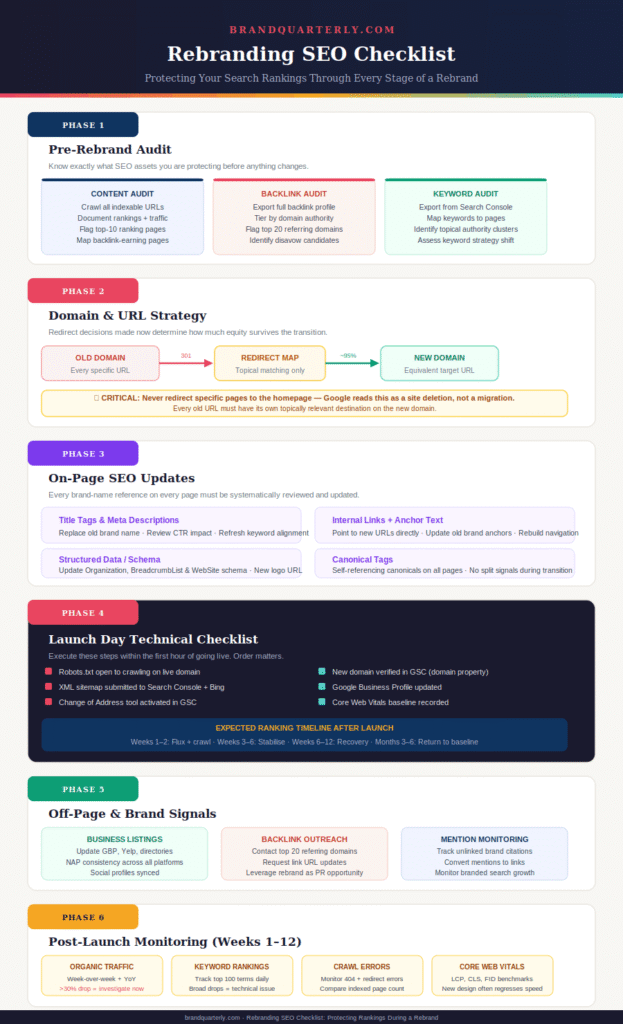
Phase 1: Pre-Rebrand Audit — Know What You’re Protecting
Before anything else, you need a complete inventory of your existing SEO assets. This audit phase is not glamorous, but it is foundational. Without it, you are flying blind through one of the riskiest transitions in digital marketing.
Conduct a Full Content and URL Audit
Start by crawling your entire existing website using a tool like Screaming Frog, Sitebulb, or Ahrefs Site Audit. Every indexable URL must be documented with its current ranking position, organic traffic volume, backlink count, and metadata. This gives you a working map of which pages are generating real SEO value and which are essentially invisible.
Moreover, you should document your top-performing pages separately — specifically those ranking in positions one through ten for any keyword. These pages carry the highest risk during a rebrand. They also carry the highest reward if you migrate them cleanly. Additionally, document all pages that have earned external backlinks pointing to them, since those links represent accumulated authority that must be preserved.
Audit Your Backlink Profile
Backlinks are the connective tissue of SEO. When you change your domain or URL structure, you effectively cut every one of those connections unless you take active steps to preserve them. Therefore, export your full backlink profile from Ahrefs, SEMrush, or Moz before touching anything else.
Classify your backlinks into tiers: high-authority referring domains (DA 60+), mid-tier links (DA 30–59), and low-quality or spammy links worth disavowing. Furthermore, identify your ten to twenty most authoritative backlinks and flag those referring domains for outreach after launch — you will want to ask them to update their links to your new URL. This is especially important for editorial links from publications, industry directories, and partner sites.
Map Your Existing Keyword Rankings
Export your current keyword rankings from Google Search Console and a third-party rank tracker. Specifically, you need to know which pages rank for which keywords, and how much traffic those rankings generate. Furthermore, you need to understand the topical authority structure of your site, which content clusters signal expertise in which areas.
This mapping exercise is also the right moment to assess whether your brand positioning shift will require you to target entirely new keyword sets, or whether your existing keyword strategy remains valid under the new brand. Both scenarios require different content migration approaches.
Phase 2: Domain and URL Strategy
Once you have a clear picture of your existing SEO assets, the next phase is to decide on your domain and URL structure. These decisions are irreversible in the short term — getting them wrong means months of recovery work.
Choosing Between a New Domain and a Subdomain
The cleanest approach from an SEO perspective is migrating all content to a new root domain and implementing 301 redirects from every old URL to its equivalent on the new domain. A 301 redirect tells search engines that a page has moved permanently and passes approximately 90–99% of link equity to the new destination.
However, some rebrands do not require a full domain change. If you are keeping the same domain but changing your subdomain structure (for example, moving from a subdomain blog to a root directory), the migration is considerably less risky. In either case, your redirect map must be exact — every page needs a designated destination, not a blanket redirect to the homepage. A homepage redirect to a specific product or blog page is a significant signal of poor site quality to Google.
Building a Redirect Map
A redirect map is a spreadsheet that lists every old URL alongside its new equivalent. Building this map is time-consuming but non-negotiable. Therefore, use your content audit data to pair old and new URLs based on topical equivalence — not just structural similarity.
For pages that have no direct equivalent on the new site, redirect to the closest thematically relevant page rather than the homepage. Additionally, mark any pages that will be permanently retired and ensure they redirect cleanly rather than returning a 404 error. Broken pages after a migration are one of the fastest ways to lose rankings and damage user experience simultaneously.
Preserving URL Structure Where Possible
Every change to a URL — even a minor one — creates a redirect signal that marginally dilutes link equity. Consequently, where it is feasible to preserve your existing URL structure under the new domain, do so. For example, if your current URL is oldbrand.com/blog/seo-tips and your new domain is newbrand.com, the ideal new URL is newbrand.com/blog/seo-tips, not newbrand.com/resources/seo-tips.
This is also the right moment to clean up any legacy URL structures that have accumulated over time — unnecessary query parameters, duplicate category paths, or inconsistently capitalized URLs. Just be aware that every unnecessary change adds cumulative redirect chain complexity that search engines must process.
Phase 3: On-Page SEO During a Rebrand
Once your domain and redirect strategy are defined, plan how your on-page SEO elements will change across the new site. This includes metadata, internal linking, structured data, and content.
Updating Title Tags and Meta Descriptions
Every page on your new site needs updated title tags and meta descriptions that reflect the new brand name. This sounds straightforward, but it is easy to overlook in the chaos of a rebrand launch. Moreover, any title tags that previously included your old brand name need to be reviewed to determine whether that mention contributed to the click-through rate.
Similarly, if your old brand name had strong recognition in your industry, consider how quickly the new brand name will carry equivalent recognisability in search results. This context is relevant when deciding how aggressively to include the new brand name in title tags versus relying on descriptive, keyword-rich titles in the interim. You might also revisit your brand messaging framework to ensure that your meta language reflects your new positioning clearly.
Updating Internal Links and Anchor Text
Internal links are the navigational skeleton of your site, and they are also a significant on-page SEO signal. After a rebrand, every internal link needs to point to its new URL destination — not rely on redirect chains from old URLs. Redirect chains work, but they slow page load times and dilute equity more than direct links.
Additionally, review anchor text patterns across your internal links. If your old brand name appears as anchor text in hundreds of internal links, those references need to be updated systematically rather than left for search engines to figure out via redirects. Internal linking is also a key tool for signaling topical authority within your new brand’s content structure.
Updating Structured Data and Schema Markup
Schema markup — particularly the Organization, BreadcrumbList, and Website schemas — is directly tied to your brand name, logo, and domain. All of these need to be updated at launch. In particular, your Organization schema should reflect your new legal name, new logo URL, and new domain.
Furthermore, if you have any reviews, products, or FAQ schemas deployed across your site, audit them for any instances of the old brand name or domain. Structured data inconsistencies can trigger rich result drops in the weeks following a migration, which compounds the traffic disruption from the domain change itself.
Phase 4: Technical SEO Checklist for Launch Day
The launch phase of a rebrand is where technical execution determines how quickly search engines process and accept your new brand signals. Speed and precision matter here.
The Day-of-Launch Technical SEO Checklist
This is the core of your rebranding SEO checklist — the set of actions that must happen on or immediately before launch day:
Robots.txt and crawl access: Ensure your new domain’s robots.txt allows full crawling of all key pages. If your staging environment was blocked from indexing (as it should be), confirm that the live environment has crawling open.
XML sitemap submission: Submit an updated XML sitemap to Google Search Console and Bing Webmaster Tools within the first hour of launch. The sitemap should include only canonical URLs — no redirect destinations or duplicate variants.
Google Search Console verification: Add your new domain as a property using the domain property method, which covers all subdomains and protocols. Also, use the Change of Address tool if you are migrating to a new domain — this is an explicit signal to Google that your site has moved.
Canonical tags: Verify that every page on the new site has a self-referencing canonical tag. Additionally, during any transition period where old content may be temporarily accessible on both domains, canonical tags pointing to the new domain are essential.
Crawl budget for large sites: If your site has more than ten thousand indexable pages, request indexing for your highest-priority pages via the URL Inspection tool in Search Console on launch day. This accelerates the re-crawl of your most valuable content.
Phase 5: Brand Signals and Off-Page SEO After a Rebrand
Technical SEO handles the architecture. Off-page SEO handles the authority signals that search engines use to understand your brand’s standing in your industry. Both need attention during a rebrand.
Updating Business Listings and Citations
Your brand name appears in dozens or hundreds of external locations: Google Business Profile, industry directories, review platforms, social media profiles, and partner sites. All of these are brand signals that search engines cross-reference. Inconsistency between your old and new brand names during the transition period can create confusion in search algorithms and users alike.
Therefore, create a master list of every external location where your brand name, address, phone number, or website URL appears. Prioritize Google Business Profile first, then Yelp, industry-specific directories, and social profiles. NAP (Name, Address, Phone) consistency is particularly important for local SEO signals, but brand name consistency matters for all sites regardless of local relevance.
Backlink Outreach Campaign
After launch, proactively reach out to your most valuable referring domains and request that they update their links to your new URL. This eliminates redirect chains and rebuilds direct link equity to your new domain faster than waiting for crawlers to process 301s. Your competitive intelligence data can also help you identify competitor backlink patterns that you should be targeting with your new brand.
Additionally, a rebrand is a genuine news event in your industry. This creates a legitimate PR opportunity to earn new backlinks from press coverage, brand-mention articles, and industry newsletters. A well-executed rebrand announcement — particularly one that explains the strategic rationale — gives journalists and bloggers a compelling reason to write about you, which translates directly into new inbound links to the new domain.
Monitoring Brand Mentions and Unlinked Citations
After a rebrand, some publications will write about you using your new brand name but link to your old domain — or not link at all. Tools like Mention, BrandMentions, or Ahrefs Content Explorer help you catch these unlinked brand mentions and convert them into actual links through simple outreach. This is one of the highest-ROI link-building tactics available to a company post-rebrand.
Phase 6: Content Strategy During a Rebrand
Content is where brand strategy and SEO intersect most visibly. Your rebrand almost certainly involves changes to your messaging, tone, audience targeting, and value proposition — all of which have direct SEO implications.
Auditing Content for Brand-Voice Alignment
Once your new brand personality and messaging pillars are defined, review your existing content inventory for alignment. Some pages may need only light edits — updated brand name references, refined terminology — while others may require a more significant rewrite to reflect your new positioning.
Specifically, your most-trafficked content should be a priority for voice alignment because those are the pages most users will encounter first. Furthermore, updated content performs better than stale content, so refreshing these pages to align with the brand can also provide a modest SEO lift through freshness signals.
Creating New Content Around Your New Brand’s Keyword Territory
A rebrand frequently involves shifting into new market territory — either vertically (new customer segments) or horizontally (new product categories). Consequently, your keyword strategy needs to evolve in parallel. Conduct a gap analysis between your current keyword rankings and the keyword territory your new brand intends to own.
Furthermore, use your target audience definition and customer segmentation data to inform which new keyword clusters to pursue first. Search intent analysis — understanding whether users are looking for information, comparison, or purchase options — should guide how you structure new content pillars within your updated brand architecture.
Retiring and Consolidating Underperforming Content
A rebrand is also an opportunity to clean up content debt — pages that get little or no organic traffic, generate no backlinks, and serve no strategic purpose. Retiring this content (with appropriate redirects to thematically relevant pages) improves your site’s crawl efficiency and concentrates link equity on pages that actually contribute to your authority. This is particularly important if your old site had accumulated hundreds of thin blog posts or outdated product pages over many years.
Phase 7: Post-Launch Monitoring — Protecting Your Rankings
After launch, the work is not over. The post-launch monitoring phase is where you catch problems before they compound and confirm that your rebranding SEO checklist was executed correctly.
Metrics to Track Weekly for the First Three Months
The first twelve weeks after a rebrand launch are the highest-risk period for search ranking volatility. You should be tracking the following metrics weekly at a minimum:
Organic traffic volume: Compare week-over-week and year-over-year traffic using Google Analytics. A temporary dip of ten to twenty percent is normal as search engines reprocess your signals. A decline of more than 30% that persists beyond 6 weeks warrants immediate investigation.
Keyword ranking positions: Track your top fifty to one hundred target keywords daily during the first month, then weekly thereafter. Rankings will fluctuate as Google re-evaluates your domain — this is expected. However, persistent drops across broad keyword groups signal a technical issue.
Crawl errors and indexing: Monitor Google Search Console for spikes in 404 errors, redirect errors, or soft-404s. These indicate gaps in your redirect map that need to be patched immediately. Additionally, compare the number of indexed pages before and after the rebrand to ensure you are not losing significant content from Google’s index.
Core Web Vitals: A new site design often changes page speed and layout stability metrics. Core Web Vitals directly influence rankings, so monitor your LCP, CLS, and FID scores closely in the first weeks after launch.
Using SEO Data to Refine Your Brand Messaging
Post-launch SEO data is one of the most honest signals you will receive about whether your new brand messaging is resonating. Click-through rates on your new title tags and meta descriptions — visible in Google Search Console — reveal whether users find your new brand language compelling.
Additionally, tracking how quickly your new branded keyword volume grows (searches containing your new brand name) provides a real-time measurement of brand awareness that complements survey data and social listening. These signals are part of a broader brand monitoring strategy that should be running throughout your rebrand transition.
Common Rebranding SEO Mistakes to Avoid
Even teams that invest heavily in planning make predictable errors during a rebrand. Understanding these patterns in advance can save you significant recovery time.
Redirecting everything to the homepage: This is the single most common and most damaging mistake. When every old URL redirects to the homepage, search engines interpret this as a site deletion rather than a migration. Each page needs its own redirect destination.
Launching without Search Console verification: If Google has not verified your new domain before launch, it cannot process your Change of Address signal or attribute your backlinks correctly. Verify ownership before you flip the switch.
Forgetting international SEO: If your site has hreflang tags for multiple languages or regions, these must be updated as part of the rebrand migration. Broken hreflang configurations can cause significant ranking drops in international markets, and recovery can take months.
Ignoring page speed regressions: New brand designs often introduce heavier JavaScript, larger hero images, or more complex CSS animations. These improvements to visual design can significantly harm Core Web Vitals if page speed optimization is not treated as a launch-blocking requirement.
Rushing the timeline: A rebranding SEO checklist cannot be executed well in a week. The crawl audit, redirect map creation, and technical implementation require weeks of lead time. Furthermore, the post-launch monitoring phase requires consistent attention for three months. Compressing this timeline consistently produces ranking drops that take longer to recover than the time saved.
Measuring SEO Success After a Rebrand
Success after a rebrand is not a single metric — it is a composite picture that includes traffic recovery, ranking stabilization, brand keyword growth, and link equity transfer. A useful framework is to set a baseline recovery benchmark: your goal should be to return to pre-rebrand organic traffic levels within three to six months. For a well-executed migration, this is achievable.
Beyond traffic recovery, track the growth of your new branded keyword volume. A successful rebrand should see branded search accelerate over the 12 months following launch — evidence that your new brand name is becoming recognized in your market. Pair this with your brand equity measurement framework and your branding ROI analysis to connect SEO performance to broader commercial outcomes.
Furthermore, monitor your domain rating and the count of referring domains over the 12 months post-rebrand. A healthy migration should see these metrics stabilize within thirty to sixty days as the link equity from your redirects is processed, and then resume growth as your new brand earns its own links organically.
Integrating SEO Into Your Broader Rebranding Process
A rebranding SEO checklist works best when it is integrated into a broader, strategic rebranding framework rather than treated as a separate workstream. The decisions you make about brand architecture, URL structure, content strategy, and messaging all have downstream SEO consequences that compound over time.
If you are at the early stages of a rebrand, the most valuable thing you can do is understand the full scope of the process before committing to execution decisions. Rebranding without losing your audience — both in search and in direct relationships — is entirely possible when rebranding without losing your audience is treated as a strategic priority from day one, not an afterthought managed post-launch.
Similarly, your SEO keyword data offers one of the best available windows into how your market understands your category. The language your customers use in search queries is the language your brand should be speaking — and that alignment between brand differentiation and search intent is what separates brands that bounce back quickly from those that spend years recovering.
Final Rebranding SEO Checklist Summary
Use this checklist as a reference throughout your rebranding process. Every item represents a decision point where poor execution can cost months of SEO recovery time.
Pre-launch:
- Complete site crawl and URL inventory
- Full backlink profile export and tier classification
- Keyword ranking baseline export from Search Console
- Redirect map creation (every URL mapped to a destination)
- New site technical SEO review (canonicals, robots.txt, sitemap)
- Structured data updated across all templates.
- Internal links updated to new URLs (no reliance on redirect chains)
- Schema markup reviewed for brand name and domain references.
Launch day:
- Old domain 301 redirects confirmed as live and correct
- New XML sitemap submitted to Search Console and Bing.
- Change of Address request submitted in Search Console
- Google Business Profile updated
- Social profiles updated
- Core Web Vitals baseline measured
Post-launch (weeks 1–12):
- Weekly organic traffic comparison (current vs. pre-rebrand baseline)
- Weekly keyword ranking review for the top 100 terms
- Search Console crawl error monitoring
- Indexed page count verification
- Backlink outreach to the top twenty referring domains
- Brand mention monitoring for unlinked citations
- Branded keyword volume tracking
A rebrand is a high-stakes moment for any business. However, with a comprehensive rebranding SEO checklist executed with precision and proper lead time, it is entirely possible to emerge from the transition with your organic authority intact — and in many cases, significantly stronger than before.
