
Online reputation management for brands is the ongoing process of monitoring, shaping, and protecting your brand’s online presence. In today’s digital-first environment, reputation is shaped not only in boardrooms but also across comment sections, review platforms, social media, and search engine results. Every conversation about your brand, whether you participate or not, influences potential customers’ perceptions before they make a purchase. Understanding what online reputation management entails is the first step toward actively managing your public image.
Reputation now evolves rapidly. A single viral post, critical news article, or unaddressed review can alter public perception of your brand within hours. This speed makes reputation management a core business function, not just a PR issue. Brands that neglect reputation consistently fall behind proactive competitors. This article provides a clear overview of what online reputation management means, why it matters, how it works, and how to get started.
What Online Reputation Management for Brands Actually Means
Online reputation management (ORM) for brands is the strategic process of shaping your company’s digital narrative. It goes beyond responding to negative reviews or press; ORM integrates content strategy, customer experience, public relations, SEO, and data analysis. Its primary goal is to ensure that search results accurately reflect your brand’s value and earned trust.
Many businesses mistake ORM for crisis management. While crisis response is one aspect, effective online reputation management is primarily proactive. It focuses on building a consistent, positive presence across channels before issues occur. This includes publishing authoritative content, earning positive mentions, engaging with your audience, and tracking sentiment in real time to respond promptly to changes.
The scope of ORM has grown with the digital landscape. Brands must now manage reputation across search engines, social platforms, review sites, industry forums, podcasts, influencer content, and AI-generated summaries. An effective digital brand management strategy addresses all these touchpoints.
ORM is closely tied to your broader brand identity. Your online perception should match your core positioning, values, and messaging. Any gap between internal definition and public perception creates reputational risk. Bridging this gap requires strategic communication and adaptability.
Why Online Reputation Management Matters More Than Ever
Consumer trust is more difficult to earn and easier to lose than ever before. Most consumers read online reviews before purchasing, and negative search results reduce click-through and conversion rates. Your digital reputation now directly impacts revenue, hiring, and long-term market position.
Your reputation also affects how algorithms rank your content. Search engines consider brand signals such as mentions, reviews, links, and user engagement. Brands with strong, positive reputations gain more organic visibility. As a result, ORM and SEO are increasingly interconnected. A strong reputation enhances search presence, while search visibility helps you shape the narrative.
Competition has made reputation even more critical. When two brands offer comparable products at similar price points, the one with a stronger, more trusted reputation almost always wins. This is why understanding your competitive intelligence landscape matters — you need to know not just what competitors are saying about themselves, but also how their reputations compare to yours in the minds of shared customers. Reputation is one of the few brand assets that is genuinely difficult to replicate quickly.
There is also the growing influence of AI tools and large language models on how brands are discovered and described. AI assistants now summarize brand reputations based on the content they have indexed. If the dominant online narrative is negative or inaccurate, AI tools will reflect it to users. Brands that fail to manage their online presence today risk having their reputation literally defined by machines pulling from poorly managed digital signals. Building an LLM monitoring strategy is increasingly relevant to any serious reputation management program.
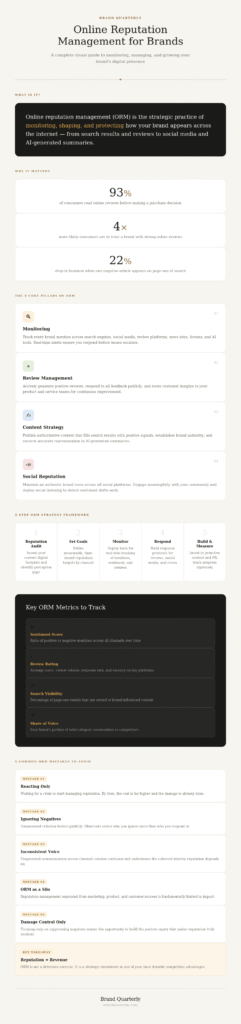
The Core Components of Online Reputation Management for Brands
Monitoring: Knowing What Is Being Said
You cannot manage what you do not measure. Effective online reputation management starts with comprehensive monitoring—tracking every mention of your brand, products, executives, and key phrases across the web. This includes social media, news sites, blogs, forums, review aggregators, podcasts, and video platforms. The goal is real-time visibility into conversations that shape your brand’s image.
Monitoring should be structured around clear signals. Not every mention carries equal weight — a review on a high-traffic platform matters more than a comment in an obscure forum. Similarly, sentiment analysis helps you understand not just where your brand is mentioned, but how it is perceived in those mentions. Positive, negative, and neutral mentions each require different responses and different strategic considerations. Using an online reputation monitoring checklist ensures you systematically cover all necessary channels without missing critical conversations.
Brand monitoring automation has made this much more scalable. Modern tools can flag mentions in near real-time, automatically categorize sentiment, and alert your team to spikes in negative attention before they escalate. However, automation should complement human judgment, not replace it. Nuance matters enormously in reputation management — context, tone, and the specific audience of a piece of content all affect how you should respond. Investing in brand monitoring automation tools gives your team the efficiency needed to stay on top of a high-volume information environment.
Monitoring also delivers competitive intelligence. Tracking competitor mentions alongside your own provides insight into market perception, customer frustrations, and opportunities to position your brand as the trusted choice. This dual function makes monitoring a high-value activity in reputation management.
Review Management: Building Trust at Scale
Online reviews are among the most visible and influential aspects of a brand’s reputation. Platforms such as Google, Trustpilot, G2, Yelp, Tripadvisor, and industry directories act as public scorecards for potential customers. Unaddressed negative reviews suggest indifference, while thoughtful, personalized responses show genuine customer care.
Effective review management goes beyond responding to criticism. It includes encouraging satisfied customers to share experiences, simplifying the review process, and creating workflows to route feedback to relevant teams. Customer feedback on defects or service failures should inform quality improvement. Reviews thus serve as both a reputation asset and a product development resource.
Responding to negative reviews requires care and strategy. The aim is not to win arguments publicly, but to show empathy, accountability, and a commitment to resolution. Other readers observe your responses. A gracious, solution-focused reply to a one-star review can enhance your reputation, while a defensive or dismissive response can worsen it.
Volume and recency of reviews are important. Both search algorithms and consumers favor brands with many recent, positive reviews. Review generation should be ongoing, not a one-time effort. Integrating review requests into post-purchase experiences creates a steady flow of authentic social proof that strengthens your reputation.
Content Strategy: Shaping the Narrative You Own
Content is a key tool for proactive reputation management. Consistently publishing high-quality, authoritative content aligned with your brand positioning fills the digital landscape with positive signals. This content occupies search results, earns backlinks, and provides accurate information for journalists, bloggers, and influencers.
A strong content strategy ensures that top search results for your brand are assets you own or influence, such as your website, blog, social profiles, and press coverage. This approach, known as “owning the SERP,” is essential for effective reputation management. Negative content is less harmful when it appears beyond the first page of search results.
Your content should consistently reflect your brand messaging framework, including core themes, proof points, and language. Consistent messaging across channels reinforces recognition and trust, while inconsistency creates confusion and undermines credibility. Every piece of content either strengthens or weakens your reputation; there is no neutral output.
Thought leadership content is especially valuable for ORM. When executives or experts share useful, insightful perspectives on industry topics, your brand earns credibility as knowledgeable and trustworthy, not just self-promotional. Although this content is harder to produce, it delivers long-term reputational benefits.
Social Media Reputation Management
Social media is the most immediate and volatile environment for brand reputation. Conversations occur in real time, audiences are large, and content can go viral unexpectedly. Effective social media reputation management requires an active, authentic presence and clear protocols for handling criticism, crises, and community dynamics.
Authenticity is the currency of social media reputation. Audiences are exceptionally good at detecting inauthentic brand communication — overly scripted responses, generic platitudes, or defensive deflection all undermine trust. The brands that fare best on social media are those that communicate with a genuine, human voice that reflects their brand personality consistently across all platforms and interactions.
Community management—engaging with comments, messages, and mentions—is often undervalued in social media reputation. How your brand responds to questions, handles complaints, and participates in conversations shapes community perceptions of your values and character. Small interactions accumulate to define your reputation over time.
Social listening—tracking conversations about your brand and industry beyond your own channels—adds strategic depth to reputation management. It helps identify sentiment trends, spot issues early, and engage in relevant conversations to reinforce your brand’s expertise and values. Monitoring digital brand awareness across social channels provides data to assess reputation trends.
Online Reputation Management and Brand Strategy Alignment
A common mistake is treating ORM as a standalone function, separate from broader brand strategy. Reputation management is most effective when integrated with brand positioning, customer experience, and marketing communications. Brands lacking clear positioning struggle to manage reputation due to an unstable identity.
Brand positioning defines your place in the audience’s mind and forms the foundation of your reputation. Clear, consistent, and credible positioning allows you to reinforce and protect your reputation. Vague or inconsistent positioning leads to reactive efforts to control narratives made vulnerable by unclear identity.
Brand values play an equally important role. Consumers increasingly hold brands accountable to stated values — and when a brand’s behavior contradicts its declared principles, the reputational fallout is severe. Therefore, reputation management is not just about communications; it is about ensuring organizational behavior actually aligns with brand promises. This requires internal accountability mechanisms, not just external messaging. Clearly articulated brand values serve as both a compass for internal decision-making and a public commitment that customers will hold you to.
Similarly, your brand trust through customer experience is inseparable from your online reputation. Every customer interaction — from the first touchpoint to post-purchase support — generates signals that flow online. Customers who feel genuinely well-served become advocates; those who feel ignored or mistreated become critics. Building reputation, therefore, requires building genuinely excellent experiences at every stage of the customer journey.
How to Build an Online Reputation Management Strategy
Step 1: Conduct a Reputation Audit
Before improving your reputation, conduct an honest assessment of its current state. A reputation audit systematically reviews search results, analyzes sentiment and content of reviews and mentions, and identifies gaps between desired and actual perception. This audit establishes the baseline for measuring progress.
During the audit, pay attention to which content dominates your search results and whether it is accurate, positive, and aligned with your brand. Identify which review platforms have the most visibility and what your aggregate ratings look like. Look for recurring themes in negative feedback — these patterns often reveal systemic issues that, when addressed, can significantly improve reputation at the source. A thorough brand audit process provides the framework for this systematic evaluation.
Step 2: Define Your Reputation Goals
Reputation management requires clear goals. After establishing your baseline, define specific outcomes, such as improving average review ratings, increasing positive media coverage, reducing the visibility of negative content in search results, or improving sentiment scores in social listening reports.
Goals should be measurable and time-bound. For example, “Increase our Google Business Profile rating from 3.8 to 4.3 within 12 months” is more actionable than “improve our reputation.” Specific goals enable effective resource allocation, ownership assignment, and progress tracking, and help prioritize activities.
Step 3: Establish a Monitoring Infrastructure
Once goals are set, establish infrastructure to track progress and identify issues in real time. Select and configure monitoring tools, set up keyword alerts, establish reporting schedules, and assign clear ownership for responses. Your monitoring should cover search engines, social platforms, review sites, news outlets, and relevant industry forums.
Monitoring infrastructure should also include competitor tracking. Understanding how your reputation compares to competitors’ and how their reputation challenges compare to yours gives you strategic context that pure self-monitoring cannot provide. Tools that integrate automating competitive monitoring systems with brand monitoring create a more complete intelligence picture.
Step 4: Develop Response Protocols
Speed and consistency are essential in reputation management. Develop clear protocols for responding to various reputation signals, including positive and negative reviews, social media mentions, press coverage, and crises. Each category requires a tailored approach, tone, and escalation process.
Response protocols should include template frameworks, approval workflows, escalation criteria, and clear ownership. When issues arise, documented protocols prevent confusion about who responds, response timing, and tone. This ensures professional, consistent responses under pressure.
Step 5: Invest in Proactive Content and PR
The most effective reputation management strategy is built on earned credibility, not just reactive damage control. Consistently invest in content that reinforces your brand’s authority, values, and expertise. Build relationships with journalists, analysts, and influencers, and seek speaking opportunities, podcast appearances, and award nominations for third-party validation.
Proactive PR and content work ensure that when someone searches for your brand, they find an ecosystem of credible, positive signals rather than a vacuum filled with whatever critics have published. This investment takes time to compound, but its returns are significant and long-lasting. Scaling digital brand management effectively means building systems that consistently produce these positive signals, not sporadically.
Reputation Management in the Age of AI
Artificial intelligence is changing how brands are discovered, described, and evaluated. AI-powered search and generative assistants now synthesize brand information and present confident summaries, often without users visiting your website. These tools draw from all online content about your brand, including reviews, articles, social posts, your web content, and third-party analyses.
This shift raises the stakes for ORM. Outranking negative content in search is no longer sufficient. Brands must ensure the dominant online narrative—the collective signal AI models use—is accurate, positive, and aligned with their positioning. Using AI for competitive intelligence helps brands understand how AI tools characterize both themselves and competitors, turning this challenge into an opportunity.
AI in digital brand management allows brands to process and respond to reputation signals at unprecedented scale. AI-powered sentiment analysis, automated responses, predictive crisis detection, and real-time dashboards make ORM more efficient and effective. Brands that use AI to augment, not replace, human judgment will maintain a competitive advantage.
Common Mistakes in Brand Reputation Management
Even brands with dedicated ORM programs make avoidable mistakes. Recognizing common pitfalls helps you build a more resilient strategy from the outset.
Reacting instead of being proactive. Many brands address reputation only after issues arise. Managing a crisis is much harder and more costly than building a proactive foundation. Reputation, like trust, is best established in advance.
Ignoring negative feedback. Unanswered criticism festers. Whether on review platforms, social media, or public forums, unanswered negative content signals to observers that your brand does not care. Even if you cannot resolve every complaint, acknowledging it publicly and offering to help privately demonstrates accountability.
Inconsistent brand voice. When different people manage different channels without shared guidelines, your brand’s tone and messaging become fragmented. This inconsistency confuses audiences and weakens the coherent identity that reputation depends on. Brand guidelines solve this problem by giving everyone on your team a shared framework for communication.
Treating ORM as a silo. Reputation management that operates separately from marketing, product, customer success, and leadership is fundamentally limited. The most effective ORM programs are integrated across functions, because reputation is shaped by every aspect of how a business operates — not just what the communications team publishes.
Focusing only on damage control. Reputation management is not just about minimizing negatives; it is equally about maximizing positives. Brands that focus exclusively on suppressing bad content miss the opportunity to build the positive equity that makes reputation resilient in the first place.
Measuring the Effectiveness of Your ORM Strategy
Reputation management must be measurable to be improvable. There are several categories of metrics that together provide a comprehensive picture of your reputation health and the effectiveness of your ORM program.
Sentiment metrics track the ratio of positive to negative to neutral mentions across channels over time. Improving sentiment scores — particularly on high-visibility platforms — is a direct indicator of ORM progress. Sentiment analysis tools can automate this tracking at scale, giving you trend data that reveals whether your reputation is strengthening or eroding across different audience segments.
Review metrics include your average rating on key platforms, the volume of new reviews generated per month, your response rate, and the percentage of negative reviews that receive public responses. These metrics matter both for reputation and for SEO, since review signals influence local and organic search rankings. Consistently monitoring these allows you to identify plateaus or regressions before they become significant problems.
Search visibility metrics track which content appears on page one for branded searches and whether that content is owned, earned, or third-party. Over time, a successful ORM strategy should result in more of page one being occupied by positive, brand-controlled, or brand-influenced content. This can be tracked using standard SEO tools alongside manual search monitoring.
Share of voice measures how much of the overall conversation in your category your brand owns, compared to competitors. Growing share of voice — particularly in positive conversations — is a strong indicator that your reputation is gaining relative strength in your market. This connects directly to broader brand equity measurement frameworks that track the total value of your brand’s market position.
Conclusion: Reputation Is a Business Asset You Can Build
Online reputation management for brands is not a defensive exercise — it is a strategic investment in one of your most valuable and durable competitive advantages. The brands that lead their categories consistently are not just those with the best products; they are those with the deepest trust, the clearest identity, and the most credible presence in the conversations that matter to their audience.
Building that kind of reputation requires intentionality, infrastructure, and integration across the entire organization. It requires listening as much as publishing, responding as much as broadcasting, and aligning internal behavior with external promise. It requires treating every customer interaction as a reputation-building opportunity and every negative signal as a source of insight rather than just a problem to suppress.
The good news is that reputation, unlike many competitive advantages, is buildable by any brand willing to make a sustained commitment. Start with a clear audit of where you stand. Define where you want to go. Build the monitoring and response infrastructure to stay informed and agile. Invest in the content and relationships that establish your brand as a trusted authority. Then measure rigorously and iterate consistently. Done well, online reputation management for brands becomes less a function you manage and more a flywheel that compounds your brand’s value with every passing month.
