
Digital brand management is the ongoing practice of controlling, protecting, and growing your brand across digital channels. It covers everything from how your website looks to how your team responds to reviews. In short, it is how you make sure your brand stays consistent and trustworthy online.
Many business owners think digital brand management is just social media posting. However, it is much broader than that. It affects your content, reputation, search presence, and customer experience. Because of this, it deserves its own dedicated strategy — not just a checklist.
Your brand exists online whether you manage it or not. So the real question is: who is defining it? If you are not, your competitors and your unhappy customers will do it for you.
Why Digital Brand Management Matters for Your Business
Strong digital brand management gives your business a real edge. It builds trust, drives traffic, and helps you stand out in a crowded market. Therefore, it is one of the smartest investments you can make.
Consider this: most buyers research a brand online before they spend a single dollar. They read reviews, scroll through social media, and check search results. As a result, every digital touchpoint either helps or hurts your chances of winning that sale.
Furthermore, consistency is what separates memorable brands from forgettable ones. When your brand looks and sounds the same across every channel, people trust you more. In contrast, an inconsistent brand confuses potential customers — and confusion rarely converts.
For a deeper look at why consistent positioning wins, read our guide on why good positioning beats good ads.
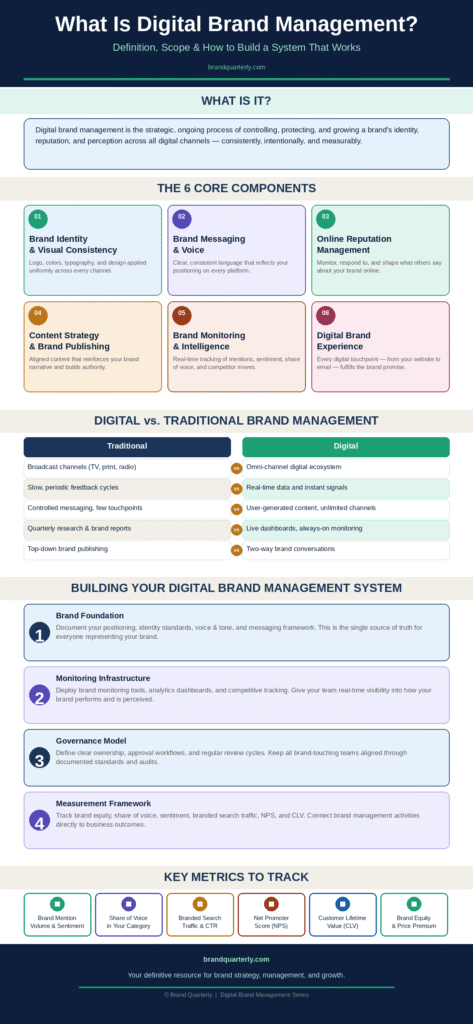
The 6 Core Components of Digital Brand Management
Digital brand management is not one single task. Instead, it is a system of six interconnected parts. Together, they keep your brand strong, coherent, and competitive.
1. Brand Identity and Visual Consistency
Your visual identity includes your logo, colors, fonts, and image style. Consequently, every piece of content you publish should reflect these elements. This creates instant recognition — no matter where someone finds your brand.
Inconsistency is one of the biggest mistakes brands make online. For instance, a completely different look on Instagram versus your website creates doubt in the reader’s mind. Over time, that doubt erodes the trust you have worked hard to build.
To prevent this, document your standards clearly. Then enforce them across every team that creates brand content. Our guide on brand guidelines: what to include and why they matter will help you build those standards.
Managing visual identity in a digital world is complex. You are no longer handling a few pieces of print material. Instead, you are managing hundreds of digital assets across multiple formats and platforms. A solid brand identity system makes that manageable.
2. Brand Messaging and Voice
How you say things matters just as much as what you say. Your brand voice covers your tone, your word choices, and the stories you tell. Moreover, it must stay recognizable across every channel — from your homepage to your email footer.
This does not mean every post sounds identical. However, the underlying tone and values should always feel consistent. When your messaging is clear and steady, it builds authority. Because of this, prospects begin to trust you before they even contact you.
Differentiation is also critical here. In competitive markets, the brand with the clearest and most consistent message usually wins. Our article on messaging pillars that influence decisions offers a practical framework for building that clarity.
Additionally, your message must adapt to each platform without losing its core. A LinkedIn post sounds different from a tweet. Nevertheless, both should feel unmistakably like you.
3. Online Reputation Management
Your reputation online is shaped by what others say about you. Therefore, managing it means monitoring reviews, social mentions, and press coverage — then responding in a way that reflects your values.
For example, a negative Google review left unanswered sends a clear signal: this brand does not care. In contrast, a thoughtful, timely response can actually strengthen trust. It shows you are listening and that you stand behind your work.
Proactive reputation building matters just as much as damage control. Specifically, this means publishing authoritative content, encouraging happy customers to leave reviews, and building relationships with journalists and community members.
To get started, use our online reputation monitoring checklist as your guide. It will help you set up a system before a crisis occurs—not scramble to respond after the damage is done.
4. Content Strategy and Brand Publishing
Content is how your brand speaks when you are not in the room. Each blog post, video, and email either reinforces your brand — or dilutes it. Therefore, your content strategy must align tightly with your brand identity and positioning.
Strong content also supports your SEO. When you publish authoritative, on-brand content consistently, your search rankings improve. As a result, more people discover your brand through high-quality touchpoints rather than random, off-brand ones.
Always start your content planning with one key question: Does this piece reinforce who we are? If the answer is unclear, go back to your brand strategy before you hit publish. Our guide on brand storytelling shows you exactly how to do this.
Furthermore, think of your blog, email list, and social channels as one coordinated publishing system. They should all tell the same story — just in different formats for different audiences.
5. Brand Monitoring and Intelligence
You cannot manage what you cannot see. Brand monitoring means tracking how your brand is discussed and perceived in real time. Specifically, it covers mentions, sentiment trends, share of voice, and competitor activity.
Modern brand monitoring goes beyond Google Alerts. Instead, it uses dedicated tools to surface insights fast — so you can respond before small issues become big problems. Our guide on brand monitoring automation walks you through building this capability.
Monitoring also feeds into smarter decisions. Because you can see what is working and what is not, you can adjust your strategy quickly. Without this layer, digital brand management is essentially guesswork.
Additionally, monitoring your competitors gives you valuable context. Our article on competitive intelligence explains how to track competitor brand moves alongside your own.
6. Digital Brand Experience
Your brand experience is the sum of every digital interaction a customer has with you. This includes your website speed, your onboarding emails, your customer service response time, and dozens of other micro-moments.
A brand that promises one thing in its marketing but delivers something different in the actual experience will struggle to build loyalty. Therefore, managing the brand experience means aligning every team — not just marketing.
Clearly mapping this experience is the first step. Our article on customer journey mapping shows you how to visualize every stage of the journey. From there, you can identify the gaps between what your brand promises and what it actually delivers.
Our guide on brand trust through customer experience explores how to close those gaps and build lasting loyalty.
Digital Brand Management vs. Traditional Brand Management
Traditional brand management was built for broadcast channels — TV, print, and radio. In that world, brands had strong control over their message. Feedback was slow, and the number of touchpoints was small.
Digital brand management is fundamentally different. First, the number of channels has multiplied. Second, feedback is instant — and public. Third, customers are active participants in brand conversations, not passive recipients.
Moreover, data changes everything. Traditional brand managers relied on quarterly surveys. By contrast, digital brand managers have access to real-time, granular data. This enables faster, more precise decision-making.
Both disciplines share the same goals: consistency, trust, and strong positioning. However, the tools, speed, and scope are completely different. Understanding this distinction helps you invest your resources in the right places.
How to Build a Digital Brand Management System
Understanding digital brand management is a great start. However, the real advantage comes from building a system that runs consistently. Here are the four essential building blocks.
Step 1: Build Your Brand Foundation
Your foundation includes your positioning, brand identity standards, voice and tone guidelines, and messaging framework. Together, these form the single source of truth for every team member who represents your brand.
Without a solid foundation, consistency is impossible. Therefore, document everything clearly and make it easy to find. Our article on brand identity fundamentals is a strong starting point for this work.
Step 2: Set Up Your Monitoring Infrastructure
Next, build the systems that give you real-time brand intelligence. This means brand monitoring tools, analytics dashboards, and competitor tracking. Specifically, you want to know how your brand is perceived at all times — not just when something goes wrong.
Our guide on tracking digital brand awareness outlines the key metrics and tools you need to build this capability.
Step 3: Create a Governance Model
Governance means clear ownership and defined processes. In other words, someone must be responsible for brand consistency, and there must be a process for approving new content and assets.
Regular brand audits are also part of this step. They help you catch drift early, before inconsistency becomes embedded. Our guide to brand audits explains how to run them effectively.
Step 4: Build a Measurement Framework
Finally, you need to measure the impact of your digital brand management efforts. This includes tactical metrics like sentiment scores and branded search traffic. However, the most important measure is brand equity — the trust and preference your brand commands over time.
Our guide on brand equity: models, metrics, and how to measure it provides the framework for tracking this at a strategic level. Furthermore, our article on branding ROI connects your brand activities directly to business outcomes.
Common Challenges in Digital Brand Management
Even with a strong system in place, challenges will arise. Knowing what they are helps you prepare for them rather than react to them.
Channel fragmentation is the most common issue. As the number of platforms grows, maintaining a consistent brand across them becomes harder. The solution is not to be everywhere. Instead, choose your channels strategically and manage each one with depth.
Speed and volume create real pressure. Digital environments move fast, and the volume of signals your brand must manage is enormous. Automation helps, but human judgment is still essential — especially when your reputation is at stake.
Internal alignment is often underestimated. When marketing, sales, and customer success teams are not aligned on brand standards, inconsistency creeps in. Therefore, digital brand management must be an organization-wide commitment — not just a marketing department project.
Brand evolution is also a recurring challenge. As your business grows, your brand needs to evolve too. However, changing too much too fast can confuse your audience. Our guide on rebranding without losing your audience walks you through how to manage this carefully.
Digital Brand Management and Brand Strategy: How They Connect
Digital brand management does not work in isolation. Instead, it is the operational expression of your brand strategy. Your strategy defines who you are and how you want to be positioned. Digital brand management is how that strategy comes to life every day.
This means that strong management starts with a strong strategy. Without clear positioning and a well-defined audience, your management efforts will be reactive and scattered. Therefore, strategy always comes first.
Our comprehensive brand strategy guide is the best place to start if you are building or revisiting your foundation. From there, our article on brand positioning helps you define exactly where you stand in your market.
Importantly, the relationship flows in both directions. Digital brand management generates intelligence — about what resonates, what competitors are doing, and how your audience perceives you. Consequently, this data should continuously feed back into your strategy and sharpen it over time.
The Future of Digital Brand Management
Digital brand management will continue to evolve as the landscape changes. Several trends are shaping where it is headed — and knowing them now helps you stay ahead.
AI and automation are transforming how brands monitor and respond at scale. Because AI can quickly process enormous amounts of signal data, it frees your team to focus on judgment and strategy. However, the human element remains irreplaceable.
Authenticity is becoming a competitive advantage. Consumers today are quick to spot hollow brand messaging. Therefore, brands that manage their presence with a genuine and consistent point of view will consistently outperform those that optimize purely for reach. Our articles on brand purpose and brand values explore how to express these authentically.
Earned media and community are growing in importance as paid digital attention gets more expensive. Brands that build genuine communities of engaged advocates have a sustainable advantage. As a result, cultivating these relationships is becoming a core part of digital brand management — not just a nice-to-have.
Key Metrics to Track in Digital Brand Management
Measuring your results is non-negotiable. Without clear metrics, you cannot tell what is working. Here are the most important ones to track.
- Brand mention volume and sentiment — how often people talk about you, and whether the tone is positive, neutral, or negative.
- Share of voice — how much of the online conversation in your category your brand owns versus competitors.
- Branded search traffic — how many people search specifically for your brand name, which signals strong brand awareness.
- Net Promoter Score (NPS) — how likely your customers are to recommend you, which reflects real brand loyalty.
- Customer Lifetime Value (CLV) — how much revenue each customer generates over time, which strong brands consistently improve.
- Brand equity — the premium and preference your brand commands, measured through surveys, pricing data, and qualitative research.
For a comprehensive framework for measuring these, see our guide to tracking digital brand awareness.
Conclusion
Digital brand management is not a trend. It is a core business discipline that determines whether your brand grows on your terms or gets shaped by forces outside your control. Therefore, it deserves the same strategic attention you give to product development or sales.
Start with your brand foundation. Then build the monitoring and governance systems that keep it consistent. Measure your progress regularly and adjust your approach as you learn.
The brands that do this well do not just look better online. They build deeper trust, earn stronger loyalty, and grow faster than competitors who treat their digital presence as an afterthought.
