
Using AI for competitive intelligence is no longer a luxury reserved for enterprise brands with large research budgets. Today, AI tools give marketers, brand strategists, and growth teams the ability to gather, process, and act on competitor data at a speed and scale that was simply impossible just a few years ago. The result is a fundamentally different kind of intelligence — one that is continuous, contextual, and far more actionable. If your brand is still relying on quarterly spreadsheets and manual research to understand the competitive landscape, you are already behind.
Competitive intelligence has always been central to effective brand strategy. However, the sheer volume of signals available today — from social media conversations to search engine rankings, product reviews, pricing changes, and executive interviews — makes manual monitoring both time-consuming and incomplete. AI changes that equation entirely. By automating data collection, pattern recognition, and even strategic interpretation, AI allows your team to focus on decisions rather than data gathering. This guide explains exactly how to make that shift, what tools to use, and how to build an AI-powered intelligence system that genuinely moves the needle for your brand.
What Is AI-Powered Competitive Intelligence?
Competitive intelligence refers to the systematic process of gathering, analyzing, and applying information about your market, competitors, and industry environment. Traditionally, this involved hiring analysts, commissioning research reports, and conducting periodic reviews of competitor activity. AI-powered competitive intelligence, by contrast, is continuous, automated, and dramatically more comprehensive than anything a human team can produce at scale.
At its core, AI competitive intelligence uses machine learning, natural language processing (NLP), and large language models to monitor and interpret vast streams of competitor data. These systems can track competitor websites for content and messaging changes, analyze sentiment across thousands of customer reviews, identify keyword strategy shifts in real time, and even model competitor pricing behavior. Furthermore, AI does not just collect this data — it synthesizes it into insights that map directly to your brand’s strategic decisions. The difference between raw data and actionable intelligence is where AI earns its value.
It is important to distinguish between competitive intelligence and competitive analysis. Analysis is a point-in-time exercise — a snapshot of where competitors stand right now. Intelligence, on the other hand, is a living process that tracks momentum, anticipates moves, and updates continuously as the market evolves. AI makes the intelligence approach not only feasible but genuinely scalable for brands of any size. Consequently, teams that invest in AI-driven intelligence workflows gain a structural advantage that compounds over time.
Why Competitive Intelligence Needs AI Now
The volume of publicly available competitor data has exploded. A single competitor might publish dozens of blog posts per month, update their pricing weekly, run dozens of ad variations simultaneously, earn thousands of new customer reviews, and shift their messaging across multiple channels — all at the same time. Additionally, monitoring all of this manually across multiple competitors is not just inefficient; it is effectively impossible without sacrificing depth or accuracy.
AI solves this problem by operating at machine speed across unlimited data sources simultaneously. Moreover, AI does not suffer from the cognitive biases that affect human analysts — it does not dismiss a competitor’s move as unimportant because it seems small, and it does not overlook a trend because it contradicts an existing assumption. This objectivity, combined with processing speed, is what makes AI the essential engine for modern competitive intelligence programs. Teams that use it consistently outpace those that do not because they are simply working with more current and more complete information.
There is also the question of signal versus noise. As our article on signals vs. noise in competitor monitoring explores in detail, not every competitor action deserves a strategic response. AI helps you separate meaningful signals from background noise by weighting data against historical patterns, sentiment trends, and market context. Therefore, your team spends time responding to what actually matters rather than reacting to every minor development. This is the shift from reactive monitoring to a proactive, intelligence-driven strategy.
Key Use Cases for AI in Competitive Intelligence
Monitoring Competitor Content and Messaging
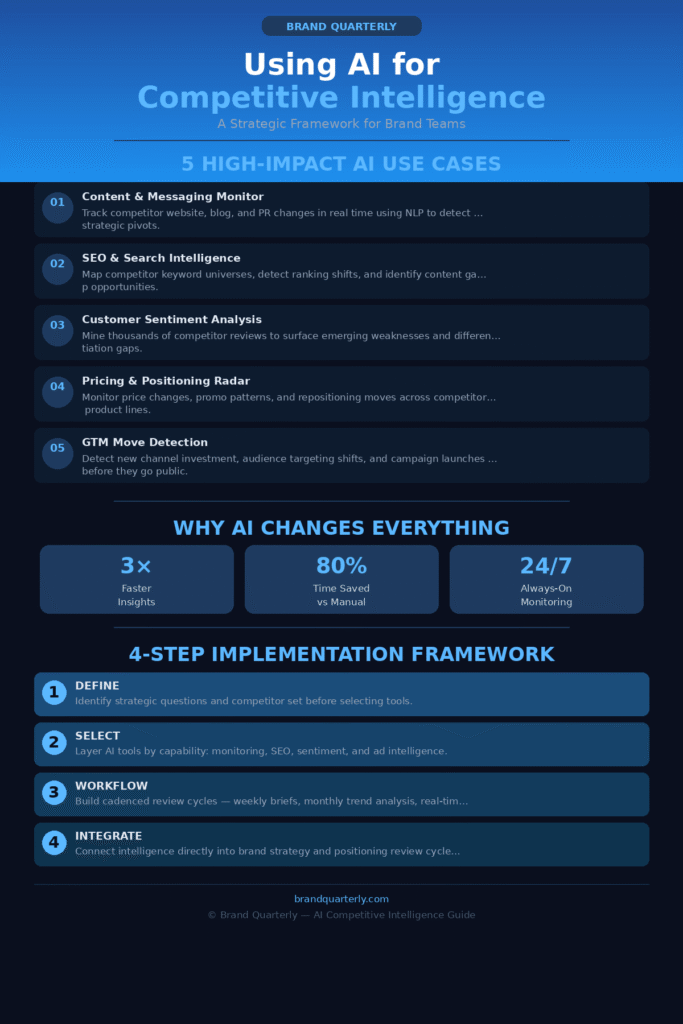
One of the most immediate applications of AI in competitive intelligence is tracking how your competitors communicate with their market. AI tools can crawl competitor websites, blog posts, and press releases in real time and flag significant changes in messaging, positioning, or content strategy. For instance, if a key competitor begins publishing content targeting a new audience segment or suddenly shifts their tone toward a more urgent, problem-focused narrative, that signals a strategic reorientation worth understanding.
Natural language processing allows AI to not just detect changes but interpret them. It can identify which messaging pillars a competitor is emphasizing, what pain points they are now addressing, and even what keywords they are newly targeting. This level of granularity gives your team the context to evaluate whether the shift represents a genuine strategic move or simply a content refresh. Furthermore, consistent monitoring over time builds a rich historical record that reveals patterns invisible in any single snapshot.
Tracking Competitor SEO and Search Presence
Search engine visibility is one of the most transparent and data-rich areas of competitive activity. AI-powered tools can continuously monitor competitor keyword rankings, identify which pages are gaining or losing traction, and detect when a competitor publishes new content optimized for high-value search terms. Additionally, these tools can map the full keyword universe a competitor is targeting and identify gaps your brand has not yet claimed.
SEO competitive intelligence is particularly powerful when combined with content strategy. For example, if AI detects that a competitor has published ten pieces of content around a topic you have not covered, and those pages are gaining significant traction, that is both a warning and an opportunity. Your team can respond with a more comprehensive, better-positioned content asset that directly challenges their growing authority. Consequently, AI transforms SEO monitoring from a periodic audit into a continuous strategic input.
Analyzing Customer Reviews and Sentiment
Customer reviews are a goldmine of competitive intelligence that most brands leave largely unmined. AI can analyze thousands of competitor reviews across platforms like G2, Trustpilot, Google, and industry-specific directories to identify recurring themes, emerging complaints, feature requests, and sentiment shifts. This data reveals exactly where your competitors are failing to meet customer expectations — and those gaps represent your brand’s most credible differentiation opportunities.
Sentiment analysis powered by AI can detect subtle shifts before they become visible in aggregate ratings. For instance, if negative mentions of a competitor’s customer support begin rising over a three-month window, that is an early signal of an emerging weakness your brand can address proactively. Moreover, positive sentiment analysis reveals what customers genuinely love about your competitors, which should inform your own product and messaging decisions. Understanding your target audience through the lens of what they say about your competitors is one of the most underused strategies in brand intelligence.
Monitoring Competitor Pricing and Positioning
Pricing is a real-time expression of competitive strategy, and AI makes it possible to track it continuously. Automated monitoring tools can detect pricing changes across competitor product lines, identify promotional patterns, and model the relationship between pricing moves and market response. Furthermore, AI can contextualize pricing data within the broader competitive landscape to help your team understand whether a price change reflects cost pressure, market expansion, or a repositioning play.
Pricing intelligence connects directly to your brand positioning strategy. If a competitor moves downmarket with aggressive pricing, your brand needs to decide whether to compete on price, double down on premium positioning, or find a new angle entirely. AI gives you the data to make that decision with confidence rather than intuition. Therefore, pricing monitoring should be treated not as a procurement function but as a strategic intelligence input that informs your positioning decisions on an ongoing basis.
Mapping Competitors’ Go-to-Market Moves
Understanding how your competitors go to market — what channels they prioritize, what audiences they target, how they sequence their campaigns — is one of the most strategically valuable forms of intelligence available. AI tools can track competitor ad spend patterns, identify new market segments they are entering, detect partnership announcements, and map the timing of major campaign launches. This gives your team a running picture of where your competitors are investing their growth energy.
Connecting this intelligence to your own GTM strategy allows you to anticipate competitive moves rather than simply react to them. For example, if AI detects a competitor beginning to invest heavily in a new channel or geography three months before their official announcement, your team has a meaningful window to prepare a response. This kind of forward-looking intelligence is what separates brands that lead markets from those that perpetually follow. As part of a broader competitor mapping process, AI-driven GTM monitoring is essential.
Building an AI-Powered Competitive Intelligence System
Define What You Are Monitoring and Why
Before deploying any AI tools, your team needs clarity on what intelligence actually serves your strategy. Monitoring everything generates noise; monitoring the right things generates insight. Start by identifying your key competitors — not just the obvious ones, but the emerging players your ideal customer profile may be considering as alternatives. Then define the specific strategic questions you need to answer: Where are competitors gaining share? What messaging is resonating with your shared audience? Where are they weakest?
This strategic framing prevents AI from becoming an elaborate data collection exercise that never translates into decisions. Moreover, a clear intelligence brief helps you select the right tools for each monitoring task rather than adopting a fragmented stack that produces overlapping, inconsistent outputs. The goal is a system that continuously answers strategic questions, not one that simply delivers more data for someone else to interpret. Think of it as designing your brand monitoring automation layer around strategic intent, not technical capability.
Select the Right AI Tools for Each Layer
AI competitive intelligence is not a single-tool solution. Different capabilities require different tools, and the most effective systems layer multiple AI capabilities into a coherent workflow. Web monitoring tools track competitor content and messaging changes. SEO platforms provide keyword and traffic intelligence. Review analysis tools handle sentiment and customer feedback. Social listening platforms capture brand mentions and campaign activity. Ad intelligence tools monitor paid media strategy.
When selecting tools, evaluate not just what data each platform collects but how it surfaces insights. A tool that requires hours of manual interpretation to extract a single insight is not genuinely saving your team time. Look for platforms that use AI to summarize, prioritize, and contextualize data automatically. Additionally, consider how your chosen tools integrate with each other and with your existing workflow systems, since fragmented data across disconnected dashboards significantly reduces the strategic value of your intelligence program.
Create a Structured Intelligence Workflow
Raw AI output needs a structured workflow to become actionable intelligence. This means establishing a regular cadence for reviewing AI-generated insights, assigning ownership of different intelligence domains within your team, and creating clear protocols for escalating significant findings to decision-makers. Without this structure, even the most sophisticated AI tools produce dashboards that nobody acts on.
A practical approach involves weekly intelligence briefs that summarize key developments across your monitored competitors, monthly deeper analyses that identify emerging trends and strategic shifts, and real-time alerts for high-priority signals like major pricing changes or significant messaging pivots. The Quarterly Clarity Method offers a useful framework for structuring these review cycles within a broader strategic planning rhythm. Furthermore, each intelligence cycle should connect directly to your brand’s active strategic priorities rather than existing as a parallel research function.
Integrate Intelligence Directly into Brand Strategy
The ultimate test of any competitive intelligence system is whether it changes how your team makes decisions. Intelligence that lives in a separate report nobody reads is worthless, regardless of how sophisticated the AI behind it is. Therefore, the most important design decision in your intelligence system is not which tools to use — it is how intelligence feeds directly into your brand and marketing strategy cycles.
Build explicit connections between your intelligence outputs and your brand strategy review process. When your intelligence system detects a significant competitor move, there should be a clear pathway for that insight to reach the right decision-maker with enough context to act. Moreover, intelligence should inform not just reactive decisions but proactive strategy — the positioning choices, messaging investments, and product priorities that determine your brand’s trajectory over the next twelve to twenty-four months. Brands that achieve this integration consistently outperform those that treat intelligence as an afterthought.
Common Mistakes to Avoid When Using AI for Competitive Intelligence
Monitoring Competitors Instead of Learning From Them
There is an important distinction between tracking what competitors do and understanding why they do it. AI makes it easy to accumulate vast amounts of competitor data, but data without interpretation is not intelligence. Many teams fall into the trap of building elaborate monitoring systems that tell them what happened without providing the strategic context to understand what it means. Consequently, they react to competitor moves rather than anticipating them.
Effective AI competitive intelligence always asks the “why” behind the “what.” When a competitor changes their messaging, the question is not just what they changed but what market insight or customer data may have driven that decision. When a competitor enters a new segment, the question is not just where they went but what opportunity they identified that your brand may have missed. This interpretive layer is what transforms AI output into a genuine competitive advantage. Your qualitative vs. quantitative intelligence methods should work together to provide both the data and the context.
Neglecting Your Own Brand’s Blind Spots
Competitive intelligence done poorly can create an outward fixation that causes brands to lose sight of their own strategic foundations. If your brand’s positioning is unclear, your messaging is inconsistent, or your value proposition is undifferentiated, no amount of competitor intelligence will fix those fundamental problems. In fact, an obsession with competitor monitoring can actually distract leadership from the internal strategic work that matters most.
Use AI competitive intelligence to sharpen your own positioning, not to copy your competitors. The insights you gather should flow back into your brand differentiation strategy, clarifying what makes your brand genuinely distinct and irreplaceable for your target customers. Moreover, regular brand audits conducted alongside competitive monitoring give you an honest picture of how your brand compares — not just to competitors but to your own strategic intent. This dual perspective is what keeps intelligence productive rather than paralyzing.
Overlooking Emerging and Indirect Competitors
Most competitive intelligence programs focus on the obvious direct competitors — the brands in the same category, targeting the same customers, with roughly similar products. However, the most disruptive competitive threats often come from adjacent categories or entirely new entrants that do not yet look like competitors. AI is exceptionally well-suited to detecting these emerging threats because it can monitor far broader competitive sets than any human analyst team.
Include indirect competitors, alternative solutions, and emerging category entrants in your monitoring scope. Additionally, track the broader conversation your target customers are having about their problems and goals, not just their conversations about your category. This wider aperture is what allows AI to surface strategic risks before they become existential threats. Your customer segmentation data should inform which adjacent competitive spaces deserve monitoring alongside your primary competitive set.
Measuring the Impact of Your AI Intelligence Program
Like any strategic investment, your AI competitive intelligence program needs clear success metrics. The most important measurement is not the volume of data collected but the quality of decisions informed. Track how often intelligence insights directly influenced a strategic decision, how many competitor moves your team anticipated versus reacted to, and whether your brand’s positioning is becoming more differentiated over time as a result of intelligence-driven strategy.
Quantitative metrics also matter, particularly at the operational level. Measure how much time AI automation saves your team compared to manual research, how quickly intelligence reaches decision-makers after a significant competitive development occurs, and whether your team’s confidence in competitive positioning decisions has improved. Furthermore, connect intelligence outcomes to business results where possible — if repositioning driven by competitive insights leads to improved win rates or pricing power, that is the clearest possible evidence of impact.
Tracking digital brand awareness alongside competitor monitoring gives you a comparative view of how your brand’s presence evolves relative to the competitive field. This relative perspective is more strategically meaningful than absolute metrics, since brand performance always exists in a competitive context. Therefore, build measurement frameworks that capture both your absolute performance and your competitive trajectory simultaneously.
The Future of AI in Competitive Intelligence
AI competitive intelligence is evolving rapidly. Large language models are becoming sophisticated enough not just to summarize competitor data but to generate strategic hypotheses, model likely competitor responses to your moves, and identify market opportunities that no human analyst would have surfaced. Additionally, the integration of AI with real-time data streams — news feeds, earnings calls, patent filings, hiring activity — is creating intelligence systems that track competitor strategy at extraordinary depth and speed.
One emerging area of particular importance is LLM monitoring strategy — understanding how your brand appears in AI-generated responses and recommendations. As more customers use AI assistants to research products and services, the competitive intelligence question expands beyond traditional search and social channels to include how AI systems perceive and represent your brand relative to competitors. Brands that begin building intelligence frameworks for this new landscape now will be far better positioned as AI-mediated discovery becomes the dominant mode of product research.
The brands that will benefit most from this evolving landscape are those that treat AI not as a research tool but as a strategic system. This means investing in the infrastructure, workflows, and analytical capabilities to translate AI output into genuine strategic decisions. It also means building a culture of intelligence — one where competitive insights are not the exclusive domain of a research team but are embedded into every brand, marketing, and product decision your organization makes.
Conclusion
Using AI for competitive intelligence represents one of the highest-leverage investments a brand can make in its strategic capabilities today. The ability to monitor competitors continuously, detect emerging threats early, understand customer sentiment at scale, and translate all of this into clear strategic action gives AI-powered brands a structural advantage that compounds over time. Furthermore, as AI capabilities continue to advance, the gap between brands that have built these systems and those that have not will only widen.
The path forward starts with strategic clarity — knowing what intelligence your brand actually needs and why — and builds from there into a structured system of AI tools, workflows, and decision-making protocols. Begin with the use cases most directly relevant to your current strategic priorities, establish clear ownership and review cadences, and measure impact at the decision level rather than the data level. Most importantly, keep intelligence connected to action. AI gives you the insights; your brand strategy determines what you do with them.
If you are building or refining your competitive intelligence capabilities, exploring the full depth of competitive analysis for brands alongside your AI implementation will ensure your program is grounded in sound strategic methodology from the start.
