
For years, search engine optimization felt like a game rigged against small businesses. The rules were complex, the tools were expensive, and the agencies playing the game best were charging retainers that only enterprise brands could afford. Ranking on page one meant competing not just on quality but on budget — and budget almost always won.
2026 has quietly rewritten that equation.
AI-powered SEO services have matured from novelty tools into genuine competitive equalizers. Small businesses that once needed a six-figure agency relationship to move the needle are now building real search visibility on their own terms — faster, smarter, and at a fraction of the historical cost. Understanding how these tools work and where they deliver the most impact is no longer a nice-to-have for small business owners. It’s a survival skill.
This article breaks down exactly how AI SEO services are changing the ranking game in 2026, what small businesses stand to gain, and how to use these tools strategically rather than just reactively.
The Old SEO Problem for Small Businesses
Before diving into solutions, it’s worth naming the specific friction that made traditional SEO so brutal for small operations.
Bandwidth. Good SEO is labor-intensive. Keyword research, competitor analysis, content briefs, on-page optimization, link audits, and technical crawls — each of these tasks demands hours of skilled attention. A small business owner wearing five hats simply doesn’t have that time, and hiring a full-time SEO specialist means salaries north of $70,000 per year before benefits.
Expertise gaps. Even motivated business owners who tried to learn SEO found themselves running into a moving target. Google’s algorithm updates dozens of times per year. What worked in 2022 actively hurt rankings by 2024. Staying current required ongoing professional development that most small operators couldn’t sustain.
Content volume. Search visibility correlates strongly with content depth. Businesses that publish consistently — and publish well — compound their authority over time. But producing even two or three high-quality articles per week is a significant production challenge for lean teams.
Competitive intelligence. Knowing what your competitors are doing in search — their keyword gaps, their backlink strategies, their content clusters — used to require expensive tools and the analytical chops to interpret them. Most small businesses were operating blind.
Delayed feedback loops. Traditional SEO offered notoriously slow feedback. You’d implement changes and wait weeks or months to understand their impact. Without fast data, iteration was nearly impossible.
AI SEO services don’t solve all these problems perfectly, but they make serious inroads into each of them. That’s what makes 2026 different.
What AI SEO Services Actually Do
The phrase “AI SEO service” covers a lot of ground. It’s worth being precise about what these tools actually offer, because the category includes everything from glorified keyword suggestion boxes to sophisticated platforms that integrate content strategy, technical auditing, and competitive analysis into a single workflow.
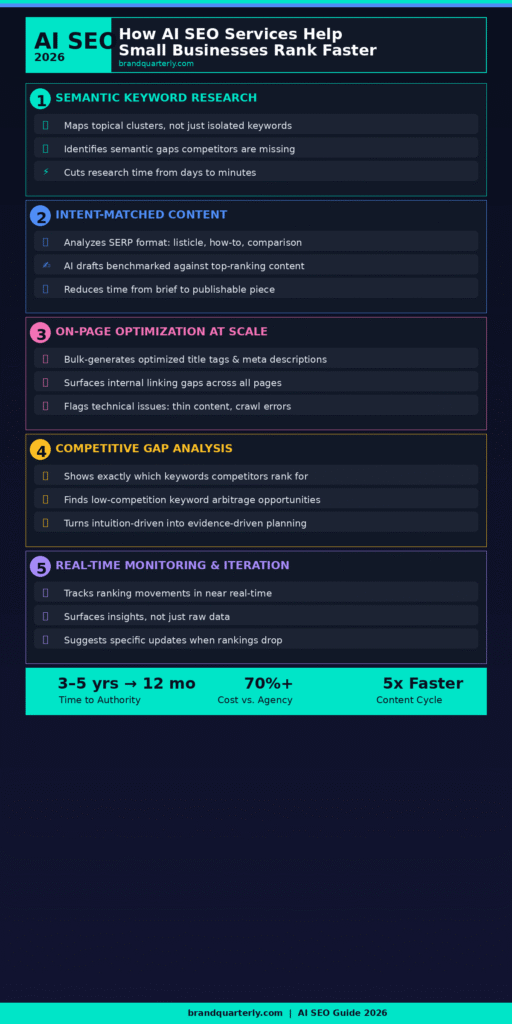
At the capable end of the spectrum — where most of the reputable platforms now operate — AI SEO services are doing five things that genuinely matter:
1. Semantic Keyword Research and Topical Mapping
Early keyword tools gave you search volume and competition scores. Useful, but shallow. AI-powered research goes a layer deeper by understanding semantic relationships between topics — the way Google itself now understands content.
Instead of targeting isolated keywords, modern AI tools help businesses build topical clusters: interconnected groups of content that signal subject-matter authority to search engines. An HVAC company, for example, doesn’t just need a page targeting “air conditioning repair.” It needs a cluster covering everything from seasonal maintenance checklists to energy-efficiency ratings to common compressor problems — content that, taken together, signals genuine expertise in the domain.
AI tools automatically identify these cluster structures. They analyze top-ranking content in any vertical, map the semantic landscape, and surface the gaps that represent ranking opportunities. This kind of analysis used to take an experienced SEO strategist multiple days. It now takes minutes.
What this means practically for small businesses: you stop guessing at what to write and start working from a data-backed content roadmap that mirrors how Google categorizes expertise.
2. Intent-Matched Content Creation
Volume was once the north star of content SEO. Publish more, rank more. That era is thoroughly over. Google’s systems — particularly the Helpful Content updates that have been rolling out since 2022 — aggressively deprioritize content that exists to capture rankings rather than serve readers.
The new north star is intent alignment: content that precisely matches what the searcher actually wants when they type a query.
AI writing tools in 2026 are meaningfully better than their predecessors at understanding and serving search intent. When you brief them on a target keyword, the better platforms don’t just generate content — they analyze the SERP landscape for that keyword, identify the content format that’s ranking (listicle, how-to guide, comparison piece, FAQ), assess the reading level and depth of top results, and structure output accordingly.
This matters enormously for small businesses because it reduces the gap between “AI-assisted draft” and “publishable content” considerably. The editorial lift required to take an AI-drafted piece from raw output to something you’d be proud to put your name on has dropped significantly — not to zero, but enough that a small team can realistically produce and publish high-quality content at scale.
3. On-Page Optimization at Scale
On-page SEO — title tags, meta descriptions, header hierarchies, internal linking, schema markup, image alt text — is the unglamorous backbone of search performance. It’s also the thing most small business websites execute inconsistently, because doing it right across hundreds of pages requires systematic attention that’s hard to sustain manually.
AI platforms now audit on-page elements across entire websites and surface prioritized recommendations with specific implementation guidance. More importantly, they can generate optimized versions of title tags and meta descriptions in bulk, suggest internal linking opportunities based on topical relevance, and flag technical issues — such as thin content, duplicate metadata, crawl errors, and page speed problems — that are silently limiting performance.
For small businesses that inherited a neglected website, this systematic technical cleanup often produces faster ranking gains than creating new content. You’re not building something new; you’re clearing the obstacles that have been suppressing existing content.
4. Competitive Gap Analysis
One of the most powerful shifts AI has enabled in SEO is making competitive intelligence genuinely accessible to non-specialists.
Platforms like Semrush, Ahrefs, and newer AI-native tools now allow small businesses to enter a competitor’s domain and receive a structured breakdown of where that competitor ranks, which keywords they’re targeting that you aren’t, their content gaps, and where their backlink profile is strongest. The analysis that used to require an experienced consultant to interpret is now surfaced with clear, actionable callouts.
This matters strategically because it shifts content planning from intuition-driven to evidence-driven. Instead of writing what you think your customers want, you’re writing what the search data shows your competitors are successfully capturing — and then doing it better.
Competitive gap analysis also helps small businesses find keyword arbitrage opportunities: terms with meaningful search volume that large competitors haven’t bothered to target because the volume isn’t worth their effort. For a small business, a keyword driving 200 searches per month might represent the difference between a slow month and a good one.
5. Real-Time Performance Monitoring and Iteration
The feedback loop problem — waiting months to understand whether your SEO work is having an effect — has improved substantially. AI-powered analytics platforms now track ranking movements, traffic attribution, and content performance in near real-time, and more importantly, they surface insights rather than just data.
This distinction matters. A dashboard showing you that a piece of content dropped from position four to position twelve is data. An AI system that flags the drop, identifies that a competitor published more comprehensive content on the same topic two weeks ago, and suggests specific updates to close the gap is an insight — and it’s what modern platforms are increasingly capable of delivering.
For small businesses without a dedicated analyst to interpret reporting, this shift from raw data to surfaced insights is genuinely transformative. It means you can run leaner and still make smart, informed decisions about where to focus your SEO energy.
Why Small Businesses Are Seeing Faster Results in 2026
Speed of ranking improvement has historically been a difficult promise to make in SEO. The honest answer to “how long will this take?” has always been “it depends,” and the dependencies are numerous. Domain authority, competitive intensity, content quality, technical health, and backlink profile: all of these factors interact in ways that resist simple prediction.
That said, small businesses using AI-assisted SEO are genuinely seeing faster results in 2026 for several concrete reasons.
Faster Execution Cycles
The single biggest accelerant is cycle time. Identifying an opportunity, creating content to capture it, optimizing that content, and publishing it — this workflow used to take weeks when managed manually. AI tools compress it to days or even hours.
Faster execution means more iterations within the same time window. More iterations mean faster learning about what works in your specific niche. And faster learning means faster improvement.
This is especially impactful for small businesses in competitive local markets, where ranking well in a specific city or region depends on producing consistent, locally relevant content. A local law firm that can publish two well-optimized, locally relevant articles per week is compounding its authority faster than one that manages the same output monthly.
AI-Optimized Content Scores Higher, Faster
Modern content scoring tools — tools that evaluate content quality against what’s currently ranking for a given keyword — allow businesses to validate content quality before publishing rather than after. You’re not releasing something and hoping it ranks; you’re releasing something that’s been benchmarked against top-performing existing content.
This validation layer catches common quality gaps — thin coverage of related subtopics, missing schema markup, weak internal linking — before they become ranking liabilities. The result is content that’s more competitive on first publication, which means it starts earning search visibility sooner.
AI Finds the Path of Least Resistance
Not all ranking opportunities are created equal. In any niche, there are always some target keywords where ranking quickly is realistic and others where years of sustained effort might not be enough to crack page one.
AI tools are now quite good at helping small businesses identify their “quick win” landscape: keywords with meaningful volume, moderate competition, and topical relevance to the business — the kind of terms where a well-executed piece of content can realistically reach page one within weeks rather than years.
Building early momentum from quick wins matters beyond the traffic those rankings directly generate. It builds domain authority, demonstrates to Google that your site is a legitimate resource in your niche, and creates the foundation for targeting more competitive terms later. AI tools make this tiered strategy accessible to businesses that lack the analytical experience to build it manually.
Structured Data and Technical SEO Are No Longer Optional
Google’s increasing emphasis on structured data — schema markup that helps search engines understand the nature of your content — has created a technical gap between businesses that implement it and those that don’t. For small businesses without a developer on staff, schema markup has historically been one of those best practices that falls through the cracks.
AI platforms now automatically generate and implement schema recommendations. Recipe sites get the right markup for rich snippets. Service businesses get the LocalBusiness and Service schema. E-commerce sites get Product schema with all the right attributes. This technical lift, once requiring developer hours, is now handled at the platform level.
Better structured data means better SERP features — rich results, featured snippets, people-also-ask boxes, local packs — which means more visibility per ranking position. You’re not just ranking; you’re taking up more real estate on the results page.
Specific Use Cases: How Different Small Businesses Are Winning
The abstract case for AI SEO is compelling. The concrete cases are more instructive.
Local Service Businesses
For plumbers, electricians, landscapers, contractors, and similar local service providers, search visibility in a specific geographic market is the single most valuable marketing channel. Someone with a burst pipe isn’t browsing Instagram ads; they’re searching for an emergency plumber near them.
AI tools have made local SEO dramatically more accessible. Automated local citation management keeps NAP (Name, Address, Phone) information consistent across directories — a foundational local ranking factor. AI content tools generate locally relevant service pages (e.g., “emergency plumbing in [city]”) at scale, covering the full geographic footprint of the business. Google Business Profile optimization tools, increasingly AI-driven, help service businesses manage reviews, optimize categories, and maintain the profile freshness that local ranking algorithms reward.
The businesses seeing the fastest local ranking gains in 2026 are typically running systematic campaigns across all three vectors simultaneously — and doing so consistently rather than in bursts.
E-Commerce and Product-Based Businesses
Small e-commerce businesses have long struggled with category and product page optimization. Writing compelling, unique, search-optimized descriptions for hundreds of products is a content production challenge that’s historically either been ignored (resulting in thin, duplicate content that tanks rankings) or delegated to freelancers (expensive and inconsistent).
AI tools now generate product descriptions at scale, informed by both SEO requirements and conversion optimization principles. More importantly, they can generate content that’s genuinely differentiated at the product level — drawing on specifications, use cases, and competitive differentiators — rather than producing the templated filler that Google is increasingly hostile to.
Category page optimization, which has an outsized impact on e-commerce SEO, has also become more accessible. AI platforms help structure category hierarchies that map to how people actually search, write editorial content for category pages that elevate them beyond mere product grids, and manage internal linking to distribute authority intelligently across the catalog.
Professional Service Firms
For lawyers, accountants, financial advisors, consultants, and similar professional service businesses, authority and trust are both human factors and SEO factors. Google’s E-E-A-T framework (Experience, Expertise, Authoritativeness, Trustworthiness) heavily weights the perceived expertise of content creators, particularly in YMYL (Your Money or Your Life) categories where professional accuracy matters.
AI tools help these businesses in a specific way: they handle the structural and technical SEO work — identifying keyword opportunities, optimizing on-page elements, managing schema markup, building content calendars — freeing the actual professionals to focus on contributing genuine expertise to the content itself. The combination of AI efficiency and human expertise is more powerful than either alone, particularly in sectors where Google’s trust signals scrutinize authorship quality.
Brick-and-Mortar Retail
Physical retail stores with online presences face a particular challenge: they need to rank for both local discovery (to drive foot traffic) and product-specific searches (to capture e-commerce demand). These two objectives require somewhat different SEO strategies that small retailers have historically found difficult to execute simultaneously.
AI platforms help by clearly distinguishing the content and optimization work required for each objective and prioritizing based on the business’s specific goals. A specialty kitchenware shop, for example, might prioritize local visibility during the holiday season while shifting to recipe and educational content during slower periods to build product-specific topical authority. AI tools make this kind of strategic seasonal adjustment both faster to plan and easier to execute.
What AI SEO Can’t Do (And Why That Matters)
An honest assessment has to include the limitations, because understanding what AI doesn’t do well is part of using it effectively.
AI can’t manufacture authority. Domain authority is earned through consistent, sustained publishing of quality content and legitimate link acquisition over time. AI tools accelerate the production of quality content and can help identify link-building opportunities, but they can’t shortcut the cumulative trust-building that domain authority represents. New websites still need time; AI helps them use it more effectively.
AI-generated content still requires human editorial judgment. The platforms have improved dramatically, but AI drafts still require knowledgeable review — particularly for technical, medical, legal, or financial topics where factual accuracy is non-negotiable. Publishing AI content without editorial oversight is a reputational and ranking risk. The businesses seeing the best results treat AI as a capable first-draft writer, not a finished-product publisher.
AI doesn’t build relationships. High-quality backlinks — links from other authoritative sites pointing to yours — remain a critical ranking factor, and the best ones come from genuine relationships: journalists who’ve featured your expertise, industry publications that cite your research, complementary businesses that refer their audiences to your content. No AI tool replaces the relationship-building that earns these links.
AI can’t create brand differentiation. Ranking helps people find you. What happens when they arrive is a different problem — one that requires genuine brand personality, clear value communication, and compelling offers. AI SEO drives traffic; it doesn’t convert that traffic into customers. Small businesses that invest heavily in SEO without improving the quality of the experience they deliver to that traffic will see diminishing returns.
Choosing the Right AI SEO Service in 2026
The market for AI SEO tools has become genuinely crowded, with meaningful differences in quality between platforms. A few criteria worth prioritizing when evaluating options:
Transparency about recommendations. The best platforms show you why they’re making a recommendation, not just what the recommendation is. An AI tool that tells you to add a keyword to your H2 without explaining the reasoning is less valuable than one that shows you competitor analysis and search intent data to support the suggestion.
Integration with your workflow. SEO work that lives in a separate system you have to manually check tends to fall through the cracks. Platforms that integrate with your CMS, Google Search Console, and your existing analytics tools create better habits and more consistent execution.
Quality of content generation. If content creation is a primary use case, rigorously evaluate the quality of AI outputs — including factual accuracy, readability, and the amount of editorial work required to turn raw output into a publishable piece. Benchmark against your own standards, not the platform’s marketing claims.
Support for your specific business type. Local, e-commerce, and professional services SEO each have different requirements. Look for platforms with feature sets tailored to your category rather than generic tools that try to serve everyone.
Actionability over reporting depth. Many platforms produce beautiful reports that take hours to interpret and act on. For small businesses without dedicated analysts, platforms that surface clear, prioritized, actionable recommendations are more valuable than those that provide comprehensive but overwhelming data.
Building an AI-Assisted SEO Strategy: A Practical Framework
Having access to powerful tools is not a strategy. Here’s a practical framework for how small businesses should think about integrating AI SEO into their operations in 2026.
Start with a technical audit. Before creating new content, understand what’s holding back your existing content. AI technical audits often surface quick wins — pages with thin content that can be enriched, title tags that can be optimized, internal linking gaps that can be closed — that improve performance without requiring significant new production effort.
Build a content calendar from data. Use AI keyword research and topical-mapping tools to build a 90-day content calendar targeting a specific cluster of related topics. Cluster-based content production is more efficient than one-off articles and signals topical authority to search engines more effectively.
Establish a publication rhythm you can sustain. Consistency matters more than volume. Two high-quality articles per week, published reliably, will outperform a burst of ten articles followed by silence. AI tools help you maintain consistency by reducing the production burden, but you still need to build the habit.
Review and refine at 30-day intervals. Use AI performance monitoring to evaluate which content is gaining traction, which isn’t, and why. Prioritize updates to underperforming content — often a more efficient investment than producing entirely new pieces.
Layer in link-building intentionally. SEO authority doesn’t come from content alone. Build a systematic (if modest) outreach practice: guest contribution opportunities, local business partnerships, industry directories, PR-driven placements. AI tools can identify these opportunities; the relationship building is on you.
Maintain the human layer. Set a non-negotiable editorial standard for everything you publish. Every piece of AI-drafted content should be reviewed by someone with genuine knowledge of your business and industry before it goes live. This protects your brand, satisfies Google’s quality signals, and ensures that the content you’re driving traffic to actually serves your customers well.
The Compounding Advantage
The most important thing to understand about AI-assisted SEO for small businesses is its compounding advantage.
Traditional SEO has always compounded — each piece of quality content, each earned backlink, each technical improvement builds on the ones before it. What AI tools change is the rate of compounding. Faster execution, better optimization at first publication, smarter opportunity identification, and more consistent output all accelerate the rate at which the base builds.
A small business that starts running a disciplined AI-assisted SEO program today — not perfectly, but consistently — will have built a meaningful search presence within 12 months that would have taken 3 to 5 years with traditional manual approaches. That’s not hype; it’s a function of the execution speed these tools enable.
The businesses that will benefit most aren’t the ones that treat AI SEO as a magic bullet or outsource the thinking entirely to automation. They’re the ones that combine the efficiency and analytical power of AI tools with genuine subject-matter expertise, consistent publishing habits, and a commitment to actually serving the people who are searching for what they offer.
Search engines have always rewarded businesses that do this. AI has finally made it realistic for small businesses to do it at scale.
Conclusion
The gap between small business SEO and enterprise SEO has been closing for years, but 2026 represents a genuine inflection point. AI-powered SEO services have moved from expensive experiments and unreliable shortcuts into mature, accessible tools that small businesses can deploy systematically.
The mechanics are clear: faster keyword research, smarter content planning, better technical optimization, more actionable competitive intelligence, and tighter feedback loops on what’s working. Individually, each of these improvements is meaningful. Together, they represent a fundamentally different — and far more accessible — path to search visibility.
The businesses that will rank fastest aren’t simply the ones that adopt these tools. They’re the ones that adopt them with a strategy: understanding what they’re trying to accomplish, building sustainable habits around execution, maintaining the human judgment that keeps content genuinely valuable, and treating SEO as the long-term compounding investment it has always been.
In a world where every competitor has access to the same AI tools, the differentiator will be consistency, quality, and genuine value creation. Those things were never AI’s job. They’ve always been yours.
