
AI-powered digital marketing tips are everywhere right now — but most of them stop at the surface. They tell you to use AI for content, automate your emails, and try a chatbot. That advice is not wrong, but it is incomplete. The brands seeing real results from AI are not just using more tools. They are rethinking how their entire marketing operation works — how they research, create, distribute, optimize, and measure. This guide goes deeper. Each section gives you specific, actionable tips you can apply to your brand’s digital marketing today.
AI does not replace the strategic thinking behind great marketing. It amplifies it. A weak strategy with AI tools still produces weak results — just faster and at a greater scale. A strong strategy with AI tools compounds its advantage with every campaign, every piece of content, and every customer interaction. Before adopting any tool, anchor your AI marketing efforts in a clear brand strategy and a well-defined target audience. Everything else builds from there.
What Makes AI Marketing Different
Traditional digital marketing operates on fixed schedules and manual decisions. AI marketing operates on signals and continuous optimization. Instead of deciding once what your audience wants, AI helps you discover what different segments want in real time. Traditional marketing waits until the end to review results. AI surfaces optimization opportunities while the campaign still runs. This shift from periodic to continuous is the most important change AI brings to digital marketing.
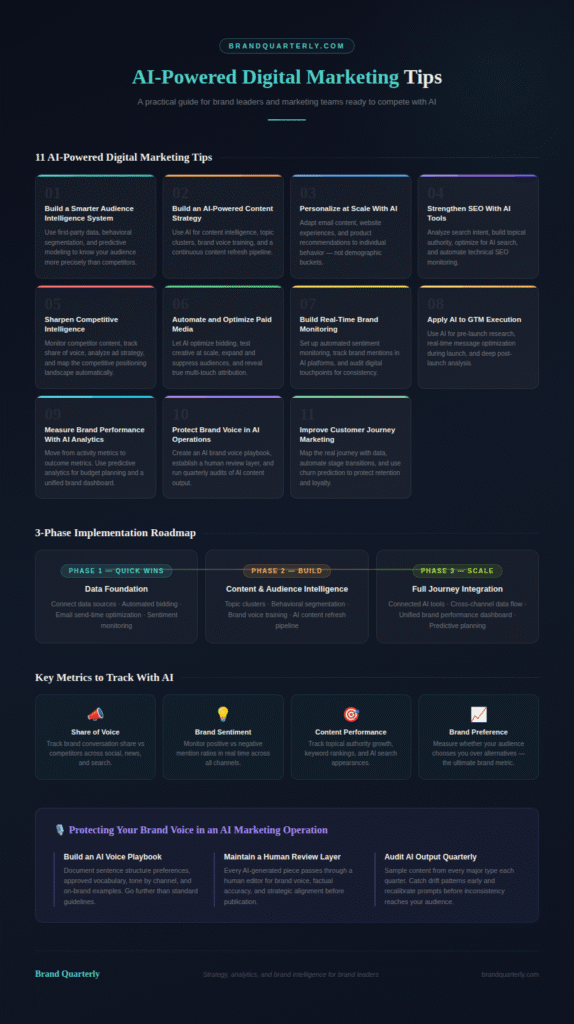
Tip 1: Use AI to Build a Smarter Audience Intelligence System
Most marketing teams know their audience at a surface level — demographics, job titles, broad interests. AI lets you go far deeper. It processes behavioral signals, purchase patterns, and content engagement simultaneously. The result is a far more precise picture of who your audience is and what they genuinely care about.
Start With First-Party Data
Your first-party data is your most valuable input for AI. Connect your CRM, website analytics, email platform, and any customer support data into a single data environment. AI tools can then identify patterns across these sources that no human analyst could spot manually. They find the behavioral sequences that predict conversion. They identify the content topics that correlate with high lifetime value and the channel combinations that drive the strongest retention. This depth of audience intelligence directly sharpens your ideal customer profile beyond what traditional research methods can deliver.
Layer in Behavioral Segmentation
Once your first-party data is connected, use AI to create behavioral segments rather than demographic ones. Demographic segments describe your customers. Behavioral segments describe what they do, when they do it, and why. A customer visiting your pricing page three times in a week is in a very different buying moment. That is not the same person as someone who engages only with your educational content. AI identifies these micro-segments automatically and continuously updates them as behavior evolves. Your customer segmentation strategy becomes dynamic rather than static — a significant competitive advantage in fast-moving markets.
Use Predictive Audience Modeling
Predictive audience modeling uses your existing customer data to find lookalike audiences in the broader market. AI analyzes the characteristics and behaviors of your best customers. It then identifies prospects who match those patterns across ad platforms, social media, and content channels. This goes beyond the basic lookalike audience features most marketers already use. Advanced AI modeling finds second and third-order behavioral signals. These are the patterns that precede the patterns that precede conversion. That depth gives your prospecting campaigns a real precision advantage.
Tip 2: Build an AI-Powered Content Strategy
Content is where most brands feel AI’s impact first — and where many also feel its first disappointment. AI-generated content that lacks strategy, brand voice, or editorial judgment performs poorly. AI-assisted content that combines machine efficiency with human creativity and strategic direction performs exceptionally well. The distinction matters enormously.
Use AI for Content Intelligence, Not Just Creation
Before using AI to write anything, use it to research. AI-powered content intelligence tools analyze what ranks in your category and what questions your audience asks. They also identify which formats drive the most engagement and where gaps exist in the content landscape. This research phase takes hours manually. AI completes it in minutes and with far greater coverage. Going into content creation with this intelligence gives every piece a stronger strategic foundation.
Build Topic Clusters With AI Assistance
Topic cluster strategy builds interconnected content around a central pillar topic. It is one of the most effective structures for both SEO performance and audience engagement. AI tools map your existing content against a topic cluster model and identify the gaps. They then suggest the supporting pieces that will strengthen the cluster the most. They can also identify the internal linking opportunities that improve how search engines understand the depth of your expertise. Your brand messaging framework should anchor each cluster — every piece reinforcing the same core brand ideas from a different angle.
Train AI on Your Brand Voice
Generic AI content sounds generic. Trained AI content sounds like your brand. Invest time in building a brand voice guide specifically for AI use — more detailed than your standard guidelines. Include examples of on-brand and off-brand sentences. Specify the vocabulary your brand uses and avoids. Define how your brand handles different emotional registers—educational, promotional, and empathetic support. Feed this guide into your AI writing tools alongside strong editorial prompts. The output quality difference is significant. Every AI-assisted piece should be reviewed by a human editor before publication. That editor checks for brand voice, factual accuracy, and strategic alignment.
Create a Content Refresh Pipeline
AI is particularly powerful for content refreshes. Most brands have large archives of content that rank moderately well but haven’t been updated in years. AI tools audit your archive and identify pieces with the highest refresh potential. They pull in updated data, expand thin sections, and improve overall quality. A well-executed content refresh often delivers faster SEO results than creating new content from scratch. Pair this with a clear brand storytelling lens to ensure that refreshed content strengthens your narrative, not just your rankings.
Tip 3: Personalize at Scale With AI
Personalization has always been a marketing goal. Delivering it at scale has always been the obstacle. AI removes that obstacle. It makes genuinely relevant experiences possible at scale. That means adapting content, offers, timing, and channels based on individual behavior—not just inserting a first name into an email.
Personalize Your Email Marketing With AI
Email is still one of the most effective and highest-ROI digital marketing channels, and AI makes it even more powerful. Use AI to optimize send times for each individual subscriber based on when they usually open emails. Let it pick their historical open behavior. Use it to dynamically select the content blocks each person sees, based on their browsing and purchase history. AI can also write different subject line patterns. Use it to write subject line variants and test them automatically, updating toward the best-performing one in real time. These layers of personalization add up. Subscribers who get relevant, timely emails are more likely to stay engaged, while those who get generic messages tend to lose interest. A subscriber receiving relevant, timely emails engages far more over time. One receiving generic broadcasts gradually tunes out.
Implement Dynamic Website Personalization
Your website serves thousands of different visitors with different needs, buying stages, and interests. AI-powered personalization tools adapt your website content for different visitor segments in real time. A returning customer sees different homepage content than a first-time visitor. A visitor who came from a specific ad campaign sees messaging that matches what attracted them. A prospect who has read three pieces of content on a specific topic sees a relevant next-step offer. Each of these personalization moments increases the likelihood that the visit will lead to a meaningful next step. This approach connects directly to building stronger brand trust through customer experience — personalization signals that your brand pays attention.
Use AI for Offer and Recommendation Personalization
AI-powered recommendations outperform manually curated ones. They update continuously based on real behavior rather than editorial assumptions. AI recommendation engines analyze what each user has engaged with. They also track what similar users valued and what content or products are trending in that segment. The result is a recommendation layer that feels genuinely helpful rather than algorithmically random. For B2B brands, this applies equally to content recommendations. AI surfaces the next most relevant case study, guide, or comparison piece based on where a prospect sits in the buying journey.
Tip 4: Strengthen Your SEO With AI Tools
Search engine optimization has become significantly more complex. Search intent has diversified. AI-generated content has flooded every category. Featured snippets, knowledge panels, and now AI-powered search overviews have changed how results pages look and behave. AI tools help brands navigate this complexity and find the optimization opportunities that matter most.
Use AI for Search Intent Analysis
Search intent analysis identifies what people search for and why. It also shows which content best satisfies that intent. AI tools classify keywords by intent: informational, navigational, commercial, or transactional. They analyze the top-ranking content for each query type to understand the format, depth, and angle each demands. Aligning your content strategy to these intent signals is one of the highest-impact SEO investments you can make. It ensures that every piece you create targets a real search need with the right kind of content.
Optimize for AI Search and Brand Visibility
AI-powered search tools change how brands need to think about visibility. Conversational AI interfaces now answer queries directly, bypassing traditional results pages entirely. Ranking on a results page is no longer the only goal. Appearing in AI-generated answers, knowledge panels, and voice search responses requires a different optimization approach. Focus on building clear, structured, authoritative content on topics your brand should own. Use schema markup to help search engines understand your content’s context. Build consistent brand signals across your digital presence. Your LLM monitoring strategy should include tracking how your brand appears in AI-generated search responses — a newer but increasingly important dimension of brand visibility.
Build Topical Authority Through AI-Assisted Content
Topical authority is one of the strongest SEO advantages a brand can build. It means search engines recognize your brand as a deep, reliable source on a specific subject. AI tools map your topical authority gaps and identify the content needed to fill them. They then prioritize creation based on search volume and competitive difficulty. This is not about producing more content. It is about producing the right content to complete the topical picture your brand needs to own. Connect this work to your SEO competitive intelligence process to ensure you are building authority in areas where competitors are vulnerable, not just in areas that feel comfortable.
Automate Technical SEO Monitoring
Technical SEO issues erode search performance silently. Broken links, slow load times, crawl errors, and missing metadata all qualify. AI-powered monitoring tools continuously scan your site. They flag issues as they appear rather than waiting for your next manual audit. They prioritize issues by impact. Your team focuses on what most affects ranking rather than treating every technical problem as equally urgent. Automated technical monitoring paired with regular content optimization creates a compounding SEO advantage. Manual processes cannot match it at scale.
Tip 5: Use AI to Sharpen Your Competitive Intelligence
Understanding your competitive landscape is a core marketing discipline — and AI has transformed what is possible here. Competitive research once required significant manual effort and produced only snapshots in time. AI tools now provide continuous, multi-dimensional intelligence. They surface opportunities and threats far faster than human analysis alone.
Monitor Competitor Content and Messaging With AI
AI-powered content monitoring tools track what your competitors publish, how it performs, and what themes they are doubling down on. This gives you a real-time view of the competitive narrative landscape. You see who is saying what, which messages gain traction, and where the content white space sits. Use these insights to sharpen your own messaging rather than copying competitors. The goal is to identify the angles they are not covering and the audiences they are not serving well. Signals versus noise in competitive monitoring is a critical skill here — not every competitor move deserves a response.
Track Share of Voice Automatically
Share of voice is one of the clearest indicators of brand momentum. It measures the proportion of relevant online conversations your brand owns versus competitors. AI-powered social listening tools continuously track share of voice. They cover social media, news coverage, review platforms, and search visibility simultaneously. They calculate your share of voice against a defined competitor set and flag significant shifts. A rising share of voice typically signals growing brand momentum. A declining share, even when revenue appears stable, often signals a relevance problem developing ahead of financial consequences. Competitive intelligence done at this level of automation gives brand and marketing leaders a genuine early-warning system.
Use AI to Analyze Competitor Ad Strategy
Paid advertising transparency has increased significantly. Ad libraries on major platforms show what competitors run. AI tools analyze these ads at scale. They identify the messages that run longest — a proxy for performance — the audiences targeted, the landing page strategies, and the lead offers. This intelligence informs your own paid strategy without requiring you to spend budget on testing what competitors have already validated. It also reveals the positioning angles competitors consistently avoid. That white space is yours to claim.
Map the Competitive Positioning Landscape
AI tools analyze large volumes of competitor content, website copy, and customer reviews. From this, they generate a data-driven competitive positioning map. This map shows where each competitor sits on key positioning dimensions — premium versus accessible, specialist versus generalist. It reflects market perception, not self-description. Use this map to identify the territory your brand should own and defend. Connect this analysis to your competitor mapping process for a complete picture of where opportunity and risk sit in your market.
Tip 6: Automate and Optimize Paid Media With AI
Paid digital media is one of the most mature applications of AI in marketing — and one where the gap between brands that use AI well and those that use it poorly translates most directly into cost and performance differences.
Let AI Optimize Bidding and Budget Allocation
Manual bidding strategies in paid search and social advertising are increasingly outperformed by AI-driven automated bidding. Modern ad platforms use machine learning to optimize bids at the individual auction level. They adjust in real time based on device, location, time, and conversion probability. Smart bidding strategies, when properly configured with the right conversion goals and sufficient data, consistently outperform manual approaches. Your role shifts from setting individual bids to setting strategic goals. Ensure the AI has the right conversion data to optimize toward.
Test Creative at Scale With AI
Creative testing is one of the highest-leverage activities in paid media — and AI makes it dramatically faster. Use AI tools to generate multiple ad copy variants, headline combinations, and call-to-action options. Launch them simultaneously and let AI identify the top performers based on real audience response rather than internal opinions. Extend this to visual creative by testing multiple images or video thumbnails across audience segments. The creative insights you generate feed back into your broader content and messaging strategy. This is live market data confirming which brand messages resonate most with which audiences.
Use AI for Audience Expansion and Suppression
AI also helps you find new audiences you have not yet reached. It suppresses audiences unlikely to convert and those who have already converted. AI-powered audience expansion tools analyze your top-performing customer segments and identify similar patterns in the broader addressable market. Suppression tools remove recent buyers, current customers, and low-quality traffic from your targeting. Budget then reaches genuinely qualified prospects instead. Together, these tools make your paid media spending significantly more precise.
Connect Paid and Organic With AI Attribution
Understanding how paid and organic efforts work together to drive conversions is one of digital marketing’s most persistent challenges. AI-powered attribution models go beyond last-click and first-click. They model the actual contribution of each channel across the full conversion journey. This multi-touch attribution gives you a far more accurate picture of which marketing investments are genuinely driving value. These models often reveal that brand-building channels contribute far more to downstream conversions than last-click models credit. This changes how you think about budget allocation. Understanding this changes how you allocate budget across your marketing mix. Review your go-to-market strategy with this attribution data in hand and let the evidence guide your channel investment decisions.
Tip 7: Use AI to Build a Real-Time Brand Monitoring System
Your brand exists in a constant stream of online conversation — mentions, reviews, social posts, news coverage, forum discussions, and AI-generated content. Most of this conversation happens without your knowledge unless you build a system to surface it. AI makes comprehensive brand monitoring not just possible but manageable.
Set Up Automated Sentiment Monitoring
AI-powered sentiment monitoring tools analyze brand mentions across social media, review platforms, news sites, and forums in real time. They classify each mention by sentiment and by topic. You see not just how people feel about your brand but which specific aspects generate the strongest reactions. Set up alerts for significant shifts in sentiment. Your team learns immediately when perception changes rather than discovering it weeks later. This connects directly to online reputation management for brands — the foundation of which is knowing what is being said before it becomes a problem.
Monitor Brand Mentions Across AI Platforms
A growing share of brand discovery now happens through AI-powered search and conversational AI tools rather than traditional search engines. Customers ask AI assistants for recommendations, comparisons, and reviews — and the answers they receive shape purchase decisions. Your brand monitoring automation strategy needs to extend into these AI platforms. Track how your brand appears in AI-generated responses and what context surrounds those appearances. Check whether the information stays accurate and aligned with your current positioning. This is an emerging but increasingly critical dimension of brand visibility management.
Track Brand Consistency Across Digital Touchpoints
AI tools audit your brand’s visual and verbal consistency across every digital touchpoint simultaneously. They scan your website, social profiles, directory listings, and partner sites for inconsistencies. They flag wrong logo versions, outdated messaging, and brand descriptions that drift from your current positioning. This automated consistency monitoring extends your brand governance capability far beyond what manual reviews could cover. Strong digital brand management at scale depends on systematic monitoring rather than occasional spot checks.
Tip 8: Apply AI to Your Go-to-Market Execution
Go-to-market launches are high-stakes, high-complexity operations where timing, messaging precision, and channel coordination all matter. AI tools improve execution at every stage of the GTM process. That covers pre-launch research, live optimization, and post-launch analysis.
Use AI for Pre-Launch Market Research
Before any GTM launch, use AI to accelerate and deepen your market research. AI tools analyze category conversations at scale to identify unmet needs. They map the language customers use when describing problems and assess positioning gaps in the target market. This research takes weeks to do manually. AI completes it in days and with broader source coverage. Going into a launch with AI-generated market intelligence sharpens your positioning and messaging. It significantly reduces the risk of missing the mark. Your GTM messaging framework becomes far sharper when built on this quality of pre-launch insight.
Optimize Launch Messaging in Real Time
During a GTM launch, AI tools optimize messaging based on live audience response. You do not wait for post-campaign analysis to know what is working. Run multiple message variants simultaneously across paid and owned channels. Let AI identify which versions drive the strongest engagement, click-through rates, and conversions in the first 48 to 72 hours. Shift budget and attention toward the top performers while the launch momentum is still building. This real-time optimization loop makes every launch smarter than the last. Track your results against clearly defined GTM KPIs to ensure you measure what the launch was actually designed to achieve.
Run Post-Launch AI Analysis
Post-launch analysis with AI goes far deeper than standard campaign reporting. AI tools analyze which segments responded most strongly and which messages drove the highest-quality conversions. They also track how your share of voice shifted and how competitors responded. This analysis becomes the intelligence base for your next campaign — a continuous improvement loop that compounds over time. Each launch makes the next one more precise, more efficient, and more impactful.
Tip 9: Measure Brand Performance With AI-Powered Analytics
Measurement is where many AI marketing implementations fall short. Many teams adopt AI tools and generate more activity. Then they measure it with the same old metrics — impressions, clicks, and reach. AI-powered analytics unlocks a fundamentally better way to measure what your marketing actually achieves.
Move From Activity Metrics to Outcome Metrics
AI analytics tools make it far easier to track outcome metrics. Brand awareness, preference, sentiment, and equity sit alongside activity metrics in the same dashboard. Set up dashboards that surface the numbers directly connected to brand health rather than just campaign performance. Use AI to connect brand metrics to downstream business outcomes—revenue, retention, and referrals. This clearly demonstrates the business value of brand investment. Your branding ROI guide provides the framework for structuring these measurement conversations with leadership.
Use Predictive Analytics for Budget Planning
AI-powered predictive analytics models forecast how different budget allocations are likely to affect brand and business metrics. You allocate based on modeled outcomes rather than last year’s plan. Instead of allocating budget based on last year’s plan or internal negotiations, you allocate based on modeled outcomes. This shifts budget planning from a political exercise to an evidence-based one. It also gives you a stronger basis for defending brand-building investments. These typically appear in predictive models as high long-term value, even when short-term attribution is hard to prove.
Build a Unified Brand Performance Dashboard
Bring your AI-generated brand insights together in a single performance dashboard. Your entire marketing and brand leadership team reviews it regularly. Include brand awareness trends, sentiment scores, share of voice, and campaign performance metrics. Add predictive indicators of future brand health to complete the picture. Reviewing this data together — rather than in channel silos — creates shared understanding. That alignment drives better, faster brand decisions. Scaling digital brand management requires this kind of unified visibility as a foundation.
Tip 10: Protect Your Brand Voice in an AI-Powered Marketing Operation
As AI takes on more content creation, campaign optimization, and customer communication, protecting your brand voice becomes an active discipline. It does not happen by default. AI amplifies whatever voice you give it. If you give it a vague, poorly defined voice, it produces vague, generic output at scale. If you give it a precise, distinctive, well-documented voice, it consistently and efficiently produces on-brand content.
Create an AI Brand Voice Playbook
Develop a dedicated AI brand voice playbook — a practical document that tells AI tools exactly how your brand communicates. Go further than your standard brand guidelines. Include sentence structure preferences, approved and prohibited vocabulary, and tone variations by channel. Add examples of excellent and poor brand communication. Cover how your brand handles sensitive topics, humor, and technical detail. Your brand personality document provides the strategic foundation — the AI playbook translates it into operational instructions that tools can follow.
Establish a Human Review Layer
Every piece of AI-generated marketing content should undergo human review before reaching your audience. This layer checks for brand voice accuracy, factual correctness, strategic alignment, and any tone or language that feels off. The review does not need to be exhaustive. A quick read and edit takes minutes for most AI-assisted content. But skipping it entirely creates real risk. AI tools make mistakes, drift from brand voice, and occasionally generate content that is technically accurate but strategically wrong. A consistent human review layer catches these issues before they reach your audience.
Audit Your AI Content Output Regularly
Run a quarterly audit of the content your AI tools have produced. Pull a representative sample from each major content type — blog posts, social content, email copy, ad creative. Assess each piece against your brand voice playbook. Look for drift patterns. If your AI content has drifted — more formal, more casual, or less distinctive than intended — catch it early. Recalibrate your prompts, guidelines, and review process before the drift reaches your audience. Brand voice drift in AI-generated content compounds quickly because of the volume involved. Regular audits keep it in check before it becomes visible to your audience.
Tip 11: Use AI to Improve Customer Journey Marketing
The customer journey from first awareness to loyal advocacy involves dozens of touchpoints across multiple channels and timeframes. AI tools help you understand, optimize, and coordinate this journey in ways that manual marketing management cannot.
Map the AI-Enhanced Customer Journey
Use AI to create a data-driven customer journey map based on actual customer behavior, not assumptions. AI tools analyze real data to reveal the true paths customers take from initial contact to conversion and beyond. They identify the most influential touchpoints, highlight where customers most often drop off, and determine which content types are most effective at advancing the journey. Base your customer journey map on this behavioral data instead of workshop assumptions.
Automate Journey Stage Transitions
Once you understand the real customer journey, use AI automation to accelerate transitions between stages. A prospect who reads three pieces of content, visits a pricing page, and opens two emails has likely moved from awareness to consideration. AI spots this sequence in real time. AI triggers the appropriate next communication immediately. That might be a case study, a trial offer, or a direct outreach from your sales team. Behavior-based transitions outperform time-based sequences. They respond to where the customer actually is, not where your calendar assumes they should be.
Use AI to Reduce Churn and Increase Loyalty
AI churn prediction models identify accounts at elevated risk of leaving before they actually disengage. They analyze behavior patterns that precede churn by weeks or months. They flag early warning signals: declining login frequency, reduced content engagement, and decreased purchase velocity. Acting on these signals with targeted retention campaigns or loyalty incentives recovers customers who would otherwise leave quietly. This application of AI often delivers the highest ROI in the marketing operation. Retaining an existing customer costs far less than acquiring a new one.
Building an AI-Powered Digital Marketing Operation: Where to Start
With so many AI applications available, the question is not whether to use AI, but how. It is where to start. Trying to implement everything simultaneously creates chaos, dilutes quality, and makes it impossible to accurately attribute results. A phased approach builds capability, confidence, and measurable results at each stage.
Phase One: Data Foundation and Quick Wins
In the first phase, connect your data sources. Focus on the AI applications with the highest immediate impact and the lowest implementation complexity. Automated bidding optimization in paid media, AI-powered send time optimization in email, and basic sentiment monitoring are strong first moves. Each delivers measurable results quickly and builds your team’s confidence in working with AI tools.
Phase Two: Content and Audience Intelligence
In the second phase, invest in AI-powered content intelligence and audience segmentation. Build your topic cluster strategy with AI assistance. Implement behavioral segmentation in your CRM and email platform. Train your AI writing tools on your brand voice. These investments take longer to show results. However, they build compounding advantages — stronger content, sharper targeting, and more relevant communications with every iteration.
Phase Three: Full Journey Integration
In the third phase, connect your AI tools across the entire customer journey. Make sure insights from your content performance inform your SEO strategy. Use your paid media audience data to improve your email segmentation. Let your brand monitoring data guide your content strategy. When your AI tools share data instead of working separately, the results are much greater than what each tool can do alone. This integration is what turns a group of AI tools into a truly AI-powered marketing operation.
Conclusion
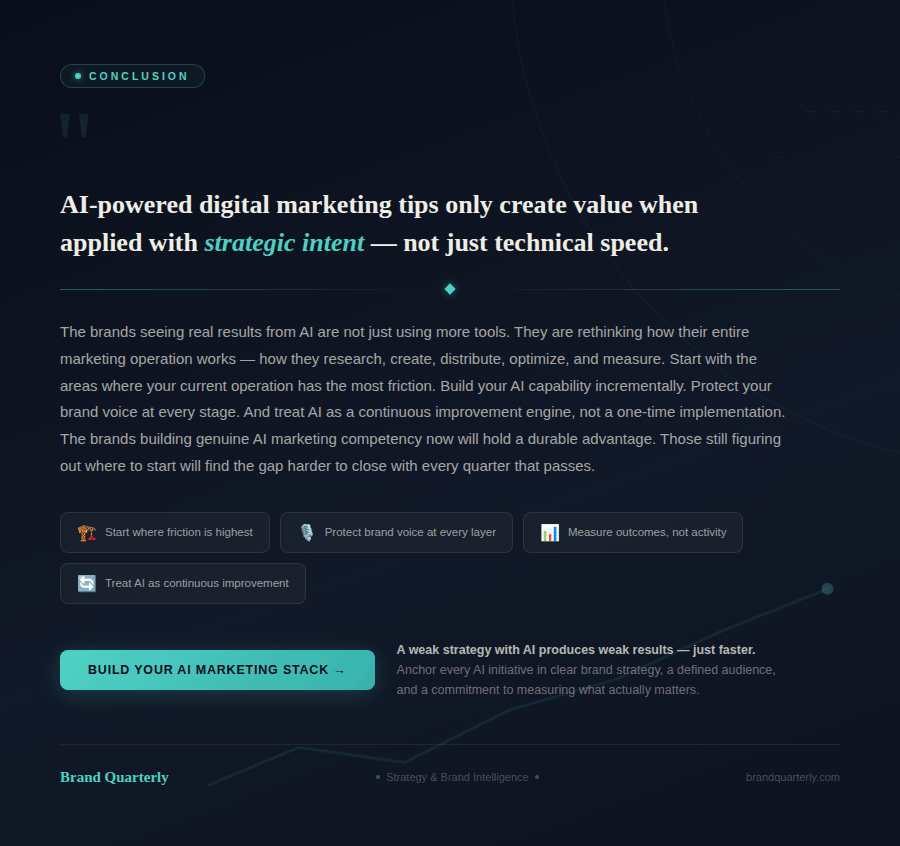
AI-powered digital marketing tips only create value when you apply them with strategic intent. Each tip in this guide addresses a real marketing challenge that AI solves more effectively than manual approaches. From audience intelligence to brand voice protection, the opportunity is concrete. Implementing them without a clear brand foundation or defined audience will not produce the results you are looking for. Measure outcomes, not activity.
Start with the areas where your current marketing operation has the most friction or the biggest gaps. Build your AI capability incrementally and measure every step. Protect your brand voice at every stage. And treat AI as a continuous improvement engine rather than a one-time implementation. The brands building genuine AI marketing competency now will hold a durable advantage. Those still figuring out where to start will find it harder to close the gap with each passing quarter.
