
Brand equity is a key asset that shapes perception, pricing, and business outcomes. Many struggle to measure it effectively.
In this comprehensive guide, we’ll explore:
- What brand equity really means
- The most influential brand equity models
- Top metrics and KPIs to evaluate equity
- Practical techniques for measuring your brand equity
- How brand equity delivers measurable business value
This article is a practical, structured guide to brand equity for marketing and business professionals.
What Is Brand Equity? — A Clear, Actionable Definition
Brand equity captures how much importance and trust consumers attach to a brand, shaping their choices and loyalty over time. It is the cumulative effect of brand awareness, associations, loyalty, and overall reputation. When people think of your brand, what emotions, expectations, or actions are triggered? That’s the heart of brand equity.
Brand equity exists whether or not a company actively measures it. However, brands with strong equity enjoy benefits such as increased customer preference, reduced price sensitivity, stronger competitive advantage, and more resilient business performance.
In simple terms, strong brand equity means people recognize your brand, trust it, prefer it, and are willing to pay more for it compared to alternatives. These perceptions become drivers of real, measurable business growth.
Why Brand Equity Matters — The Strategic Value
Brand equity goes beyond marketing jargon; it is a tangible asset that can impact customer behavior and business growth. It is a strategic business asset. Here are key reasons it matters:
- Price Premium — Brands with high equity can charge higher prices because customers perceive greater value. They’re seen as worth more, which directly affects profit margins.
- Customer Loyalty — A strong brand equity breeds repeat business and long‑term loyalty. When customers trust a brand, they stick with it even when competitors offer lower prices.
- Brand Resilience — In times of crisis or market disruption, brands with strong equity recover faster because their customer relationships and goodwill are durable.
- Expansion Opportunities — High equity makes it easier to launch new products or enter new markets. People tend to explore new products or services from brands they trust, which makes trust a key factor in product adoption.
Understanding these strategic benefits clarifies why measuring brand equity is not optional—it’s essential for sustainable growth. By measuring brand equity accurately, companies can make informed decisions that strengthen customer relationships, inform positioning, and guide their overall brand strategy. Start assessing your brand equity today and use your insights to drive future business success.
Core Components of Brand Equity
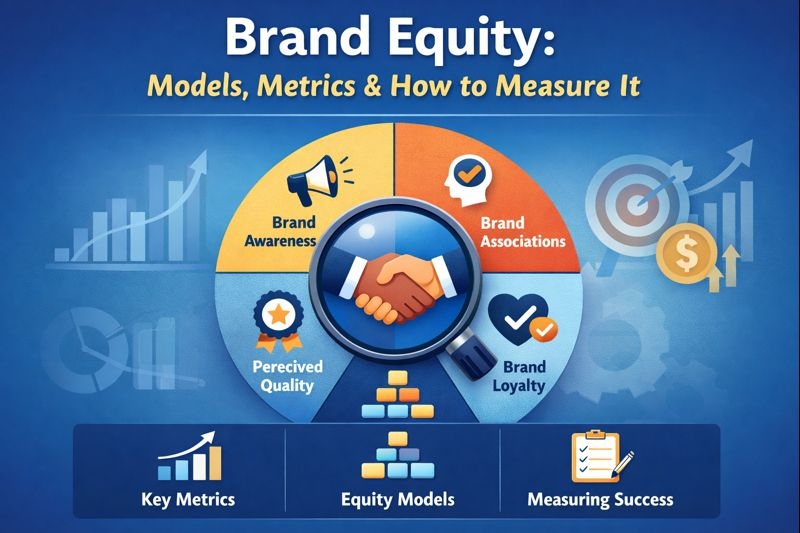
Brand equity is not a single abstract concept; it has distinct components. These components help marketers break down and analyze what’s driving perceptions and value. The four essential components are:
1. Brand Awareness
Brand awareness measures how easily customers can identify or remember a brand when considering a purchase. It is the foundation of brand equity because no other brand benefits occur if customers can’t recognize your brand in the first place.
When a brand is widely recognized, customers are more likely to think of it when making buying decisions, boosting its chances of being chosen. You can evaluate awareness through recall surveys, search volume trends, and social listening.
2. Brand Associations
Brand associations are the attributes, emotions, and imagery linked in people’s minds with a brand. These associations could be tangible qualities, such as product performance, or intangible qualities, such as prestige and trustworthiness.
Positive associations reinforce brand value and shape customer expectations. Understanding the quality and strength of these associations helps brands tailor positioning and communication strategies.
3. Perceived Quality
Perceived quality reflects the customer’s judgment of a product or service’s excellence, which may differ from its actual technical specifications. Instead, it reflects how consumers perceive the overall excellence of a brand’s products or services.
Even if two products have similar specifications, the one associated with higher perceived quality often commands greater consumer preference and price tolerance.
4. Brand Loyalty
Brand loyalty is shown when customers consistently prefer a particular brand and actively promote it to others, rather than switching to alternatives. Loyal customers are essential because they generate consistent revenue and act as powerful brand ambassadors.
Brands with deep loyalty benefit from reduced acquisition costs and more stable long‑term business outcomes.
Brand Equity Models — What They Are and How They Help
To measure something as complex as brand equity, researchers and practitioners have developed structured frameworks. These models help marketers diagnose strengths, identify gaps, and benchmark performance.
The following brand equity models are commonly used by marketers to evaluate and strengthen a brand’s market position.
1. Aaker’s Brand Equity Model
Developed by branding pioneer David Aaker, this model breaks brand equity into five key elements:
- Brand Loyalty
- Brand Awareness
- Perceived Quality
- Brand Associations
- Other Proprietary Brand Assets (Trademarks, Patents)
Aaker’s model emphasizes the importance of loyalty as the driver that ties all other elements together. According to Aaker, brands should cultivate loyalty first because it stabilizes revenue streams and strengthens the other equity components.
This model also supports qualitative research such as interviews, surveys, and brand audits to measure how each element performs.
2. Keller’s Customer‑Based Brand Equity (CBBE) Model
Kevin Keller’s CBBE model focuses on how consumers think and feel about a brand, rather than just what the brand says about itself.
This framework is organized as a four-tier pyramid that illustrates the stages of building strong brand relationships.
- Brand Identity (Who are you?)
- Brand Meaning (What are you?)
- Brand Response (What about you?)
- Brand Resonance (What about you and me?)
At each level, the goal is to strengthen customer perceptions and build deeper emotional connections. The highest level—brand resonance—refers to deep loyalty and active engagement.
Keller’s model is particularly useful for marketers seeking to connect brand identity with consumer psychology.
3. BrandAsset® Valuator (BAV)
The BrandAsset Valuator is a sophisticated model developed by advertising giant Young & Rubicam. It measures brand equity through four pillars:
- Differentiation — What makes the brand unique?
- Relevance — How meaningful is the brand to consumers?
- Esteem — How highly is the brand regarded?
- Knowledge — How well do people understand the brand?
Unlike some models that focus on a single dimension, BAV provides a multidimensional score that helps brands identify both strengths and gaps.
This model is often used in large corporate environments and competitive benchmarking.
Key Metrics to Measure Brand Equity
Measuring brand equity requires a mix of quantitative and qualitative metrics. Data should be valid, relevant, and actionable. Below are the most important metrics every marketer should track.
1. Brand Awareness Metrics
- Unaided Recall — Percentage of people who recall your brand without prompts. This shows deep mental availability.
- Aided Recall — Measures the proportion of consumers who can identify your brand when it is presented alongside others, reflecting how familiar they are with it.
- Search Volume Trends — How often people are searching for your brand online. Consistent growth signals rising awareness.
Brand awareness metrics help you assess whether your marketing efforts are effectively increasing visibility and memory salience.
2. Brand Association Metrics
- Sentiment Analysis — Measures positive vs negative emotions associated with your brand online. Many social listening tools automatically provide this.
- Attribute Mapping — Identifies the key qualities people associate with your brand, such as “innovative,” “trustworthy,” or “premium.”
These metrics help you understand which associations are strengthening or weakening—critical for positioning and messaging.
3. Perceived Quality Metrics
- Customer Ratings & Reviews — Aggregated scores from trusted sources like e‑commerce platforms or review sites.
- Net Promoter Score (NPS) — A powerful indicator of customer sentiment and perceived quality. High NPS correlates with strong perceived value.
Perceived quality measures how customers feel about your brand’s offering versus competitors. It contributes directly to purchase decisions.
4. Brand Loyalty Metrics
- Repeat Purchase Rate — tracks the share of customers who make multiple purchases, highlighting loyalty and satisfaction.
- Customer Lifetime Value (CLV) — estimates the total income a brand can anticipate from a single customer over the duration of their engagement.
Strong loyalty metrics translate into long‑term revenue predictability and lower acquisition costs.
5. Financial Impact Metrics
Brand equity should ultimately tie back to the bottom line. Financial metrics include:
- Price Premium — The difference in price consumers are willing to pay compared to competitors.
- Market Share Growth — Strong equity often correlates with expanded market share.
- Revenue Growth & Profit Margins — Sustainable brands consistently deliver better financial performance.
Connecting brand metrics to financial outcomes ensures equity is evaluated as a strategic business driver rather than an abstract marketing concept.
How to Measure Brand Equity — Step‑by‑Step
Measuring brand equity doesn’t require massive budgets or advanced analytics tools. Begin implementing this practical framework today to build a stronger brand foundation and realize the measurable value of brand equity.
Step 1: Define Your Brand Objectives
Before measurement, clarify what you want to achieve. Are you launching a new product? Improving customer loyalty? Entering new markets?
Your goals will determine which brand equity components and metrics matter most.
Step 2: Choose the Right Framework
Choose the framework that best matches your strategic goals and measurement needs.
- Use Aaker’s Model for holistic internal evaluation.
- Use Keller’s CBBE for consumer‑centric insights.
- Use BAV for competitive benchmarking.
This ensures that your measurement approach fits your strategic needs.
Step 3: Collect Data
Gather data from multiple sources:
- Surveys and polls
- Social listening platforms
- Web analytics
- Customer feedback and reviews
- Sales and financial reports
Using multiple data sources improves reliability and reduces bias.
Step 4: Analyze and Score
Convert data into meaningful scores:
- Compare awareness scores across periods.
- Evaluate sentiment trends
- Track changes in loyalty and purchase behavior
Scoring makes it easier to visualize progress and identify areas for improvement.
Step 5: Benchmark and Report
Compare your brand’s results to rivals and industry benchmarks to identify strengths, gaps, and areas for improvement. Include visual dashboards and summaries to communicate findings to leadership.
Good reporting translates data into strategic decisions.
Challenges in Measuring Brand Equity — What to Watch For
Even with solid metrics and frameworks, measuring brand equity has challenges:
Data Complexity
Brand perceptions are subjective. Combining qualitative and quantitative data requires thoughtful analysis and interpretation.
Attribution Difficulty
Determining how much a specific campaign or activity contributed to brand equity can be hard. Long‑term measurements and controlled experiments help reduce guesswork.
Changing Consumer Behavior
Markets evolve rapidly. Brands must continuously update measurement approaches to reflect current consumer attitudes and digital behaviors.
Understanding these challenges ensures measurement is realistic, ongoing, and adaptive.
Conclusion — Why Brand Equity Deserves Strategic Focus
Brand equity is far more than a theoretical concept. It is a practical, measurable asset that influences pricing, loyalty, market competitiveness, and financial performance.
By using proven brand equity models, carefully chosen metrics, and a structured measurement approach, companies can gain clarity about how their brand is perceived and how it delivers business value.
For brands that invest in understanding and improving their equity, the payoff is not just stronger marketing—it’s stronger growth, resilience, and long‑term success.
Ready to Elevate Your Brand Equity?
Whether you’re launching a new brand or strengthening an existing one, measuring brand equity is essential. Start with clear objectives, choose the right model, gather meaningful data, and track results consistently.
At BrandQuarterly, we help businesses strategize smarter, measure better, and grow sustainably.
FAQ
Q1: What is brand equity?
A: Brand equity is the value and perception a brand holds in consumers’ minds, influencing loyalty, trust, and purchasing decisions.
Q2: Why is brand equity important for businesses?
A: Strong brand equity allows companies to charge premium prices, build customer loyalty, expand into new markets, and withstand market disruptions.
Q3: What are the main components of brand equity?
A: The key components are Brand Awareness, Brand Associations, Perceived Quality, and Brand Loyalty.
Q4: How can I measure brand equity?
A: Brand equity can be measured using models like Aaker’s Model, Keller’s CBBE, or BAV, along with metrics like awareness, loyalty, sentiment, and financial impact.
Q5: How does brand equity relate to brand strategy?
A: Measuring and understanding brand equity helps shape an effective brand strategy, guiding marketing decisions and long-term growth.
