
In today’s crowded marketplace, standing out is no longer optional — it’s essential. Brands are no longer judged solely by what they sell but by how they look, feel, and communicate. This is where brand identity fundamentals come into play, acting as the invisible bridge between business strategy and visual design. A strong brand identity doesn’t just look good — it strategically shapes perception, influences decisions, and builds emotional connections.
Many businesses mistakenly view branding as decoration, focusing on logos, colors, and typography without a strategic foundation. This leads to branding that feels inconsistent or disconnected from business goals. True brand identity aligns vision with execution, ensuring meaningful and cohesive experiences. A strong brand identity starts with a clearly defined brand strategy that guides every design and communication decision across the business.
Before diving in, let’s first examine how brand identity fundamentals act as the connective tissue between strategy and design. Understanding this link is essential to see why it matters—and sets the stage for building identities that drive growth, loyalty, and long-term relevance.
What Is Brand Identity? (And Why It’s More Than Just Visuals)
Brand identity is the system of elements representing how a brand wants to be perceived—visually, verbally, emotionally, and experientially. Logos and colors are just expressions of the brand’s deeper purpose, positioning, personality, and promise. Identity is not only appearance; it is consistent behavior and communication across touchpoints.
Unlike branding campaigns or advertising efforts, brand identity is a long-term infrastructure. It informs how a company designs products, speaks to customers, trains employees, and enters new markets. Without a strong identity foundation, marketing efforts become fragmented and transactional rather than cohesive and trust-building.
The key takeaway: brand identity is more than visuals. It serves as a decision-making filter, ensuring every interaction reinforces a unified, memorable brand story that transforms customers into advocates.
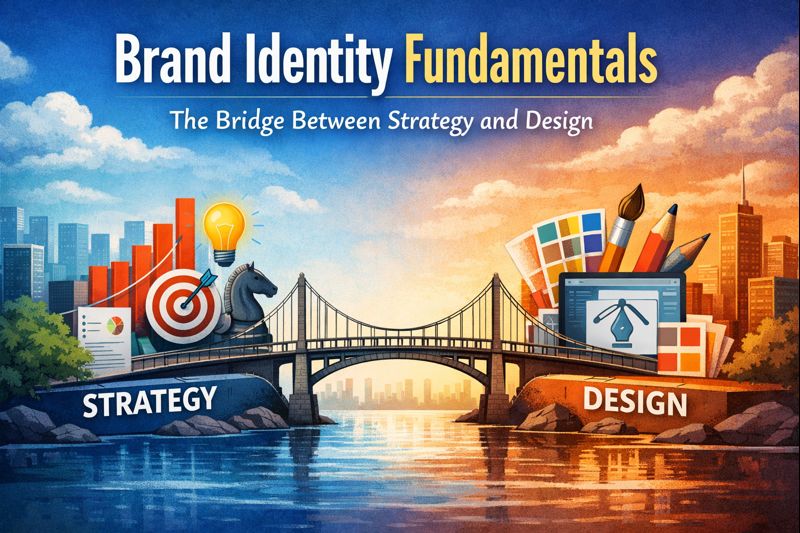
Why Brand Identity Is the Bridge Between Strategy and Design
Strategy defines where a brand wants to go, while design determines how that destination is experienced. Brand identity exists between these two forces, translating business intent into tangible expressions that people can see, feel, and remember. Without identity, strategy remains abstract, and design becomes superficial.
Strategic goals such as market differentiation, customer trust, and long-term growth cannot be achieved solely through visuals. Design must be informed by insight — about the audience, the competitive landscape, and the brand’s unique value proposition. Brand identity connects those insights to execution by establishing rules, principles, and systems that guide design decisions.
The key takeaway: connecting strategy to design through identity ensures that creative choices are intentional rather than arbitrary. Only then do brands achieve meaning and memorability beyond aesthetics.
The Strategic Foundation of Brand Identity
1. Brand Purpose and Vision
Every successful brand begins with purpose — not just what the company does, but why it exists. Purpose defines the brand’s reason for being beyond profit and serves as the emotional anchor for identity development. Without purpose, branding becomes cosmetic instead of meaningful.
Vision, on the other hand, describes where the brand is heading. It shapes long-term aspirations and helps align internal teams around a shared future. When purpose and vision are clearly articulated, design gains direction and narrative power, ensuring that visuals communicate more than style — they communicate intent.
The main takeaway: brands rooted in purpose build deeper loyalty and trust. Purpose-driven identity delivers lasting differentiation and cultural resonance.
2. Brand Positioning and Market Differentiation
Brand positioning shapes the way people understand and remember a business. It answers critical questions: Who is this brand for? What problem does it solve better than anyone else? Why should people choose it over alternatives? Without strong positioning, even the most beautiful design will struggle to create a lasting impact.
Brand identity translates positioning into tangible signals. If a brand positions itself as premium, minimalist, disruptive, or approachable, those attributes must be reflected visually and verbally. Typography, tone of voice, photography style, and color palettes all reinforce positioning cues — often subconsciously.
Key takeaway: meaningful differentiation is about standing out in ways that matter to your specific audience. Identity acts as shorthand for your unique promise.
3. Target Audience and Brand Relevance
A brand identity that isn’t designed for a specific audience is unlikely to resonate with anyone. Understanding the audience — their needs, motivations, behaviors, and cultural context — is foundational to effective identity development. Strategy defines who the brand is for; identity defines how that relationship feels.
Design decisions must be informed by audience psychology. A fintech platform targeting Gen Z will likely use different visual language, tone, and interaction patterns than a wealth management firm serving retirees. These differences are not stylistic preferences; they are strategic necessities.
Takeaway: aligning identity with audience expectations builds both trust and originality. This balance is essential in competitive markets.
The Design Expression of Brand Identity
4. Visual Identity System
A visual identity system includes the logo, color palette, typography, iconography, photography style, layout rules, and motion principles, working together for brand consistency and recognition at every touchpoint.
However, effective visual identity is not about decoration — it’s about communication. Each visual element should reflect strategic attributes such as credibility, innovation, warmth, authority, or accessibility. When visuals align with strategic intent, they create emotional signals that shape perception instantly.
Takeaway: strong visual systems are both consistent and adaptable, helping brands evolve while staying recognizable.
5. Verbal Identity and Brand Voice
Brand identity is not only what people see — it’s what they hear and feel through language. Verbal identity includes tone of voice, messaging style, vocabulary choices, and narrative structure. It determines how a brand speaks across marketing, customer support, social media, and internal communication.
The tone of voice should reflect both the brand personality and audience expectations. A playful startup, a luxury fashion house, and a healthcare provider will each communicate differently — but consistently — across platforms. Without a defined verbal identity, messaging becomes fragmented and generic.
Key takeaway: coherence between language, visuals, and strategic positioning builds trust and memorability.
6. Brand Experience and Touchpoints
Brand identity extends beyond visuals and language into experience. Every interaction a customer has with a brand — website navigation, onboarding emails, packaging, customer service conversations, in-store environments — reinforces or weakens perception. Identity becomes real through experience.
Strategic brands design experiences intentionally, not accidentally. They map customer journeys and ensure each touchpoint reflects the brand’s values and personality. For example, a brand positioned around simplicity should deliver frictionless interactions, intuitive interfaces, and clear communication.
Takeaway: consistency across experiences turns brand identity into reputation — the ultimate asset for customer trust.
Why Brand Identity Without Strategy Fails
Many brands invest heavily in visual redesigns without addressing strategic foundations. While this can generate short-term excitement, it rarely produces long-term results. Without clarity around purpose, positioning, and audience, design becomes aesthetic experimentation rather than business infrastructure.
This misalignment leads to inconsistent messaging, diluted differentiation, and customer confusion. A brand may look modern but feel hollow. It may appear bold, but behave cautiously. These contradictions erode trust and weaken market presence over time.
Main takeaway: strategy-first identity transforms branding into a system that supports growth and adaptability, not just surface changes.
Why Strategy Without Design Is Equally Ineffective
On the other side of the spectrum, some organizations develop strong business strategies but fail to translate them into compelling brand expression. Their positioning remains buried in documents rather than embodied in experiences. As a result, customers struggle to understand or remember what makes the brand different.
Without visual and verbal expression, strategy remains abstract. People don’t connect with frameworks — they connect with stories, emotions, and symbols. Design transforms strategic intent into something people can feel, recognize, and relate to instinctively.
When strategy and design operate in isolation, brands become fragmented. When they operate together through identity, brands become cohesive, memorable, and influential.
Essential Building Blocks of an Effective Brand Identity
1. Brand Purpose and Values
Brand purpose defines why a brand exists, while brand values define how it behaves. Together, they shape internal culture and external perception. A brand identity rooted in authentic values creates consistency between what a company says and what it does.
Values inform everything from hiring decisions to customer experience design. They become filters for behavior, tone, and interaction. When values are visible in action, not just words, brands gain credibility and emotional equity.
Strong identity systems make values tangible through storytelling, visuals, tone, and experiences. This translation is what transforms corporate statements into lived brand reality.
2. Brand Personality and Archetype
Personality defines how a brand behaves socially — whether it’s bold, warm, witty, authoritative, adventurous, or calm. Brand archetypes, drawn from psychology and storytelling, provide a structure for consistently defining this personality.
When personality is clearly articulated, it guides tone of voice, visual style, and emotional expression. It prevents brands from sounding robotic or generic and instead enables a human connection. Customers don’t build relationships with companies — they build them with personalities.
A well-defined brand personality also improves internal alignment. Teams understand how to communicate, make decisions, and interact with customers in ways that feel coherent and intentional.
3. Visual Identity Guidelines
Brand guidelines are the operational layer of identity. They document how visual elements should be used across contexts, ensuring consistency and scalability. Without guidelines, even strong design systems degrade over time due to inconsistent application.
Effective guidelines go beyond logo usage and color codes. They explain the rationale, principles, and intent behind design choices. This enables designers, marketers, and partners to apply the identity intelligently rather than mechanically.
Modern guidelines are often digital, modular, and adaptive — designed to evolve alongside platforms, technologies, and business needs. Flexibility within structure is what makes identity systems sustainable.
4. Messaging Framework and Tone System
Messaging frameworks articulate how a brand talks about itself, its products, and its audience. They include positioning statements, key messages, elevator pitches, taglines, and narrative structures. These frameworks ensure consistency across campaigns and channels.
Tone systems define how messaging shifts across contexts while remaining recognizably on-brand. For example, tone may become warmer in customer support, more inspirational in marketing, and more authoritative in investor communications — all while maintaining core personality traits.
Together, messaging and tone systems prevent fragmentation. They ensure that brand voice feels unified whether encountered on a billboard, website, email, chatbot, or social feed.
How Brand Identity Drives Business Growth
Brand identity is not a creative luxury — it is a business growth engine. When identity is aligned with strategy, it accelerates recognition, trust, and loyalty. These factors reduce customer acquisition costs, increase retention, and strengthen lifetime value.
Consistent identity also improves operational efficiency. Teams spend less time debating design decisions because standards are clear. Marketing execution becomes faster, partnerships become easier, and scaling into new markets becomes smoother.
Most importantly, a strong identity increases perceived value. People are willing to pay more for brands they trust, recognize, and emotionally connect with. Identity transforms commodities into meaning-driven experiences — and meaning drives preference.
Brand Identity in the Digital-First Era
In today’s digital landscape, brand identity must function across websites, mobile apps, social platforms, video, motion, audio, and emerging technologies. This requires systems thinking rather than static design. Identity is no longer about fixed logos — it’s about adaptable behavior.
Motion design, micro-interactions, UI patterns, sound branding, and conversational interfaces are now part of the identity ecosystem. Brands must express themselves through movement, rhythm, responsiveness, and emotion — not just visuals.
Digital-first identity also requires accessibility, inclusivity, and usability. Design must be readable, navigable, and equitable across devices and audiences. Identity that excludes is identity that fails — both ethically and commercially.
The Role of Brand Identity in Trust and Credibility
Trust is built through consistency over time. When people encounter a brand that looks, sounds, and behaves reliably across contexts, they develop confidence in its reliability. Brand identity is the system that enables that consistency at scale.
Credibility is reinforced when brand expression aligns with brand promise. A brand that claims innovation but uses outdated visuals or confusing experiences creates cognitive dissonance. Identity closes the gap between words and reality.
In industries such as finance, healthcare, education, and technology, trust is not optional — it’s foundational. Strong identity signals professionalism, stability, competence, and care long before a transaction occurs.
Common Brand Identity Mistakes to Avoid
One of the most common mistakes is designing identity in isolation from strategy. When visuals are created before purpose, positioning, and audience clarity, they lack depth and relevance. This leads to rebrands that look fresh but feel hollow.
Another mistake is prioritizing trends over timelessness. Trend-driven identities may feel modern today, but quickly become outdated, requiring costly redesigns. Strong identity systems balance contemporary relevance with enduring principles.
Finally, inconsistent touchpoints erode brand equity. Even great design loses power when applied unevenly. Identity must be operationalized through systems, guidelines, training, and governance — not just creative assets.
Creating a Brand Identity That Aligns Strategy With Design
Step 1: Clarify Brand Strategy
Start by defining purpose, vision, mission, values, positioning, and audience. This strategic foundation provides direction and constraints — both essential for meaningful creativity. Without clarity here, identity development becomes guesswork.
Stakeholder alignment is critical at this stage. Leadership, marketing, product, sales, and customer experience teams should contribute insights to ensure identity reflects both internal reality and external perception.
Strategy documents should be concise, actionable, and human-centered — not abstract jargon. They should inspire design, not restrict it.
Step 2: Translate Strategy Into Identity Principles
Once the strategy is defined, it must be translated into creative direction. This involves defining brand personality, tone of voice, emotional attributes, and experiential goals. These principles guide design exploration and decision-making.
Rather than jumping straight into logos or colors, successful identity development begins with mood boards, narratives, metaphors, and emotional territories. This exploration ensures that visuals express meaning — not just style.
Identity principles act as a bridge between strategic intent and creative execution, ensuring alignment across disciplines.
Step 3: Design the Identity System
With principles established, designers can develop the visual and verbal identity systems. This includes logo design, typography, color palettes, photography style, iconography, motion language, tone of voice, and messaging frameworks.
Design should be tested across real-world scenarios — digital interfaces, marketing campaigns, packaging, signage, social media, and environments. Identity systems must perform in context, not just look good in presentations.
Iteration is essential. Strong identities emerge through refinement, testing, and validation — not single concepts. Feedback loops between strategy and design ensure coherence and effectiveness.
Step 4: Document, Launch, and Activate
Once identity is finalized, it must be documented through guidelines, toolkits, templates, and governance systems. Documentation enables consistency and scalability across teams, markets, and partners.
Launch should be internal before external. Employees must understand and embody the brand before customers experience it. Internal activation includes training, onboarding, storytelling, and leadership alignment.
External activation should be phased and intentional, prioritizing high-impact touchpoints. Identity becomes real through use — not announcement.
Measuring the Success of Brand Identity
Brand identity success is not measured by aesthetics — it’s measured by outcomes. Key metrics include brand awareness, recognition, recall, preference, trust, engagement, loyalty, and advocacy. These indicators reveal whether identity is shaping perception and behavior.
Qualitative feedback is equally important. Customer sentiment, employee engagement, brand associations, and cultural relevance provide insight into emotional impact. Identity success lives in how people feel, not just what they see.
Long-term success is reflected in brand equity — the accumulated value of trust, familiarity, and meaning over time. Strong identity compounds rather than depreciates.
The Future of Brand Identity
As markets become more saturated and technologies more immersive, brand identity will increasingly function as experience design rather than visual branding. Brands will express themselves through motion, sound, conversation, personalization, and behavior — not just graphics.
Artificial intelligence, mixed reality, voice interfaces, and adaptive content will require identity systems that are dynamic, responsive, and emotionally intelligent. Static logos will give way to living systems that evolve in real time.
Yet the fundamentals will remain unchanged: purpose, clarity, consistency, relevance, and trust. Brand identity will continue to serve as the bridge between what organizations intend and what people experience — connecting strategy to design, and meaning to memory.
Final Thoughts: Identity Is Not Design — It’s Direction
Brand identity fundamentals are not about aesthetics — they are about alignment. They ensure that business strategy is not trapped in documents and that design is not detached from purpose. Identity is the connective tissue that transforms vision into experience.
When strategy and design operate together through identity, brands achieve coherence, credibility, and emotional resonance. They become recognizable not just by how they look, but by how they feel — and remembered not just for what they sell, but for what they stand for.
In an age where attention is scarce and trust is fragile, brand identity is no longer optional infrastructure — it is a competitive advantage. And when built intentionally, it becomes the most valuable asset a business owns.
