
Brand strategy isn’t just a logo, tagline, or clever campaign—it’s the playbook that decides how your business is seen, understood, and remembered. Done right, it turns your brand into a competitive advantage, guiding every decision from product design to marketing messaging. Done wrong, it’s a collection of inconsistent slogans, confused campaigns, and wasted effort.
The truth is, most companies treat brand strategy like a marketing checklist. They define vague “values,” pick a fancy color palette, and hope it sticks. But the brands that dominate take a very different approach. They build strategy from evidence, real customer insight, and disciplined frameworks, so every touchpoint is deliberate, memorable, and differentiated.
This guide is designed for founders, operators, and marketing leaders seeking in-depth insights and actionable recommendations. You’ll get practical frameworks and actionable steps you can implement immediately. By the end, you’ll understand how to audit your current brand, define purpose and positioning, craft messaging, and measure impact—so your brand strategy isn’t just aspirational, it’s operational.
What Is Brand Strategy?
Brand strategy is the documented logic that explains why your brand exists, who it’s for, and how it wins in the market. It aligns purpose with positioning, and positioning with execution, so every decision—from messaging to go-to-market—moves in the same direction.
At its core, brand strategy connects three things:
- Purpose: Why the company exists beyond revenue. This includes the problem you solve, the change you’re trying to create, and the role you play in your customers’ world.
- Perception: How the market understands, categorizes, and remembers you. This is shaped by positioning, narrative, and consistent signals across touchpoints.
- Performance: The measurable outcomes that follow—conversion, retention, pricing power, and long-term growth.
When these three are aligned, brands scale with clarity. When they aren’t, teams default to tactics, messaging fragments, and growth becomes harder than it should be.
Brand strategy is not a logo (and it’s not marketing)
One of the most persistent myths is that brand strategy equals visual identity. Logos, color systems, and typography are expressions of strategy—not the strategy itself. Without a strategic foundation, design becomes decoration.
Another common misconception is that brand strategy sits downstream from marketing. In reality, it sits upstream. Marketing executes the strategy through campaigns, channels, and content. Brand strategy defines the rules of the game: what you say yes to, what you say no to, and how you create distinction in a crowded category.
If marketing answers “how do we drive demand,” brand strategy answers “why should anyone care.”
The modern context: why brand strategy matters more now
Today’s markets are noisier, faster, and more skeptical than ever. AI has lowered the cost of content creation, competitors can copy features quickly, and buyers do more research before talking to sales. In this environment, undocumented brand strategy becomes a liability.
Modern brands need a documented strategy because it:
- Creates alignment across product, marketing, sales, and leadership
- Prevents reactive decision-making driven by trends or short-term metrics
- Enables consistency at scale as teams grow and channels multiply
- Protects differentiation when competitors look and sound increasingly similar
A clear brand strategy doesn’t slow teams down—it removes friction. It gives people a shared lens for decision-making and a defensible position in the market.
Without it, you don’t have a brand. You have a collection of activities hoping to add up.
Why Brand Strategy Matters
Brand strategy matters because it turns a business from one of many into the obvious choice. In markets where products are increasingly similar and attention is scarce, differentiation is rarely about features alone. It’s about clarity, coherence, and credibility—three outcomes brand strategy directly drives.
Without a brand strategy, brands compete on surface-level attributes: price, features, or louder messaging. With brand strategy, differentiation is intentional. You’re not just claiming to be “better,” you’re defining how and why you’re meaningfully different—and for whom.
A strong brand strategy sharpens:
- Your category or point of view within it
- The specific problems you choose to solve (and ignore)
- The narrative that frames your value in the customer’s language
This kind of differentiation is harder to copy because it’s rooted in choices, not tactics.
It aligns teams around the same truth
Brand strategy is an internal operating system. When it’s documented and shared, product, marketing, sales, and leadership make decisions through the same lens.
Instead of debating opinions (“I don’t like that message”), teams reference strategy (“Does this reinforce our positioning?”). This reduces friction, speeds execution, and prevents the common failure mode where every function tells a slightly different story.
Alignment isn’t a soft benefit—it directly impacts execution quality.
It builds trust through consistency
Customers don’t trust brands that change their story every quarter. Consistency across touchpoints—website, sales calls, product experience, content—signals competence and reliability.
Brand strategy creates that consistency by defining what you always stand for, how you sound and show up, and what promises you make (and keep).
Trust compounds over time. And trust is what turns awareness into preference.
It influences growth metrics that matter
Strong brand strategy doesn’t just feel good—it performs. Clear positioning lowers CAC by making targeting and messaging more efficient. Consistent value delivery improves retention. Over time, trust and differentiation build brand equity, giving you pricing power and resilience in downturns.
Tactical brands chase channels. Strategic brands build meaning.
A tactical brand launches campaigns without a unifying idea, tweaks messaging based on short-term results, and struggles to explain why growth stalls. A strategic brand uses campaigns to reinforce a long-term position, learns without drifting, and compounds advantage over time.
One plays to win the quarter. The other plays to win the market.
Core Components of a Brand Strategy
A brand strategy is built from a set of interconnected components. Each plays a specific role, but the system only works when those parts reinforce one another. This section breaks down the core components of a modern brand strategy, explaining what each one is, why it matters, and how to apply it in practice.
Together, these elements create alignment between purpose, positioning, and performance.
1. Brand Purpose
What it is
Brand purpose defines why the brand exists beyond revenue. It articulates the meaningful problem you choose to solve and the role your brand plays in your customers’ lives.
Why it matters
Purpose creates emotional relevance and long-term loyalty. It also acts as a strategic anchor during moments of scale, market pressure, or repositioning.
How to use it
- Use brand purpose as a decision filter for:
- Market expansion
- Product direction
- Partnerships and positioning choices
A clear purpose reduces reactive decision-making and keeps the brand coherent over time.
2. Brand Vision and Mission
What they are
Brand vision describes the future state the brand is working toward.
Brand mission defines how the company operates today to move toward that future.
Why they matter
Not every brand needs both, but growing brands often do. Vision aligns ambition. Mission translates that ambition into action.
How to use them
Vision should guide long-term narrative and strategic direction. Mission should inform priorities, execution, and internal alignment.
3. Brand Values
What they are
Brand values are the principles that guide how the organization behaves, especially in moments of tradeoff.
Why they matter
Values shape culture, hiring, decision-making, and customer experience. When they’re real, they create consistency. When they’re generic, they erode trust.
How to use them
Define values in behavioral terms. They should be observable in how teams build, sell, and support—not just stated.
4. Brand Positioning
What it is
Brand positioning defines how the brand is perceived relative to competitors in the mind of a specific audience.
Why it matters
Positioning is the foundation of differentiation. Without it, messaging becomes broad and brands default to competing on price or features.
How to use it
Common positioning approaches include:
- Category leadership
- Challenger or contrarian positioning
- Niche or use-case focus
- Outcome-driven positioning
Strong positioning is clear, defensible, and repeatable across channels.
5. Audience and Segmentation
What it is
Audience strategy defines who the brand is for. Segmentation determines which groups matter most.
Why it matters
Relevance requires focus. Clear segmentation improves message-market fit and channel efficiency.
How to use it
- Ideal Customer Profile (ICP) defines structural fit
- Personas clarify decision-makers and context
- Jobs-to-Be-Done reveals the progress customers are trying to make
Designing for jobs, not demographics, leads to stronger positioning and messaging.
6. Competitive Landscape
What it is
Competitive landscape analysis maps direct competitors, indirect alternatives, and the status quo your brand replaces.
Why it matters
Differentiation only exists in context. Competitive mapping reveals white space and prevents me-too positioning.
How to use it
Apply frameworks like:
- SWOT analysis
- Perceptual mapping (e.g., price vs. value, simplicity vs. power)
This work directly informs positioning and narrative.
7. Brand Personality
What it is
Brand personality defines the human traits the brand expresses consistently.
Why it matters
Personality makes brands recognizable and relatable. It shapes how the brand feels, not just what it says.
How to use it
Archetypes help establish boundaries and consistency. Personality should guide tone, voice, and interaction style across every touchpoint.
8. Brand Messaging
What it is
Brand messaging translates strategy into language the market understands.
Why it matters
Without a clear messaging hierarchy, brands sound inconsistent and confusing.
How to use it
Establish:
- A core value proposition
- Supporting messages
- Proof points and stories
Align internal messaging (used by teams) with external messaging (used by the market).
9. Brand Identity
What it is
Brand identity is the expression of strategy through visual and verbal systems.
Why it matters
Identity makes the brand recognizable and scalable. It ensures the strategy shows up consistently in the real world.
How to use it
Brand identity should be built from strategy, not in isolation. This includes:
- Verbal identity (voice, tone, language)
- Visual identity (logo, typography, color, layout)
Codify both in clear documentation to maintain consistency as the brand grows.
How to Build a Brand Strategy (Step-by-Step Process)
Building a brand strategy isn’t about brainstorming slogans or filling out frameworks. It’s about confronting reality, making clear choices, and committing to them long enough for the market to respond.
The process below reflects how strong brand strategies are actually built: from insight to intent to execution.
Step 1: Audit Your Current Brand and Market Reality
Every brand strategy starts with honesty.
Before defining what the brand should be, you need a clear view of what it is today — and how the market actually experiences it. That includes existing customer perception, sales conversations, competitive alternatives, and category expectations.
Most brands skip this step and jump straight to aspiration. The result is strategy that sounds impressive internally but fails to land externally.
At this stage, you’re looking for gaps:
- Between how the brand describes itself and how customers describe it
- Between what you claim to be different on and what competitors also claim
- Between where demand exists and where you’re currently focused
This isn’t about tearing the brand down. It’s about establishing a credible starting point.
Step 2: Define the Strategic Foundation
Once reality is clear, you can define the core choices that shape everything else.
This is where purpose, values, audience, and positioning come together — not as isolated statements, but as a coherent system.
Purpose clarifies why the brand exists beyond revenue.
Values define how the brand behaves when tradeoffs appear.
Audience sharpens who the brand is built for — and who it isn’t.
Positioning determines how the brand is perceived relative to alternatives.
The goal isn’t perfection. It’s clarity. A brand strategy that tries to keep all options open usually ends up meaning very little to anyone.
Strong brands are opinionated by design.
Step 3: Craft Messaging and Narrative
Strategy only matters if it can be understood.
Messaging translates strategic intent into language the market recognizes and remembers. Without it, teams improvise — and improvisation is where consistency breaks down.
At this stage, you define:
- A clear value proposition
- Supporting messages that reinforce it
- Proof points that make it credible
A narrative or point of view that frames the problem and your role in solving it
This is not copywriting. It’s strategic alignment around meaning.
When messaging is clear, marketing becomes amplification — not interpretation.
Step 4: Translate Strategy Into Identity
Brand identity is not decoration. It’s expression.
Naming, tone, and visual systems exist to make the strategy tangible. When identity is built without strategy, it might attract attention — but it won’t build understanding or trust.
At this stage, the strategy is translated into:
- Verbal identity: voice, tone, language patterns
- Visual identity: logo, typography, color, layout, motion
Every choice should reinforce the same position and personality.
The test is simple: does this identity make the strategy easier to recognize?
Step 5: Document the Strategy in a Playbook
If the strategy only lives in people’s heads, it won’t scale.
A brand strategy playbook turns decisions into a shared reference point. It captures not just what the brand is, but how it should be applied.
A strong playbook typically includes:
- Strategic foundations (purpose, values, positioning)
- Audience definitions
- Messaging hierarchy and narrative
- Identity principles and usage examples
- Clear do’s and don’ts
This document is not for stakeholders. It’s for operators.
Step 6: Roll the Strategy Out Internally
Brand strategy fails most often at adoption, not definition.
Internal rollout is about alignment, not announcements. Teams need to understand why the strategy exists and how it should guide decisions.
When done well, brand strategy becomes an internal operating system — not a set of rules to memorize.
Step 7: Roll It Out Externally
Only after internal alignment does the brand show up in the market.
That includes the website, sales materials, product experience, campaigns, and customer touchpoints. The goal isn’t to launch loudly. It’s to show up consistently.
Over time, that consistency is what builds trust, preference, and brand equity.
A strong brand strategy doesn’t reveal itself all at once.
It compounds — quietly, clearly, and deliberately.
Brand Strategy Frameworks (With Examples)
Brand strategy frameworks are not the strategy. They’re lenses. Used well, they help teams clarify decisions, expose weak thinking, and communicate intent. Used poorly, they become boxes to fill in and forget.
The frameworks below are widely used not because they’re trendy, but because they force the right questions at the right moments in the strategy process.
The Golden Circle
Popularized by Simon Sinek, the Golden Circle organizes brand thinking into Why, How, and What.
Why: The belief or purpose that drives the brand
How: The principles or approach that make it different
What: The products or services it sells
Why it works
Most brands start with what they sell. The Golden Circle reverses that order, pushing brands to articulate meaning before messaging.
How to use it
Use this framework early to pressure-test purpose and narrative. If your “why” sounds interchangeable with competitors, it’s not doing its job.
Positioning Canvas
The Positioning Canvas helps brands clearly define how they want to be perceived relative to alternatives.
It typically answers:
- Who the brand is for
- What category it competes in
- The primary problem it solves
- The key differentiator
- The proof that makes it credible
Why it works
Positioning fails when it’s vague. This framework forces specificity and tradeoffs.
How to use it
Use it to align leadership and go-to-market teams around a single positioning statement. If multiple interpretations emerge, clarity is still missing.
Brand Pyramid
The Brand Pyramid visualizes how functional value connects to emotional meaning.
From bottom to top, it usually includes:
- Features and capabilities
- Functional benefits
- Emotional benefits
- Brand promise or essence
Why it works
It connects product reality to brand meaning. Many brands over-index on emotion without grounding it in real value.
How to use it
Use the pyramid to ensure emotional claims are supported by tangible benefits — not just aspiration.
Brand Archetypes
Brand archetypes define personality through recognizable human patterns, such as the Challenger, Sage, or Caregiver.
Why they work
They create consistency in how the brand sounds and behaves. Archetypes help teams avoid personality drift across channels.
How to use them
Archetypes should guide tone and behavior, not constrain creativity. A brand can express a primary archetype with secondary traits — but it should never feel split.
Messaging Matrix
A messaging matrix maps audiences to messages, ensuring relevance without fragmentation.
It typically includes:
- Core value proposition
- Audience segments
- Key messages per segment
- Supporting proof points
Why it works
Without a matrix, teams either repeat the same message everywhere or over-customize until coherence is lost.
How to use it
Use the matrix to maintain a consistent core message while adapting language for different buyers and contexts.
Frameworks don’t create strategy. Choices do.
The value of these models isn’t in completing them, but in the conversations and decisions they force. When used deliberately, they bring clarity. When used mechanically, they create the illusion of progress without the substance.
Strong brands know the difference.
Real-World Examples of Strong Brand Strategies
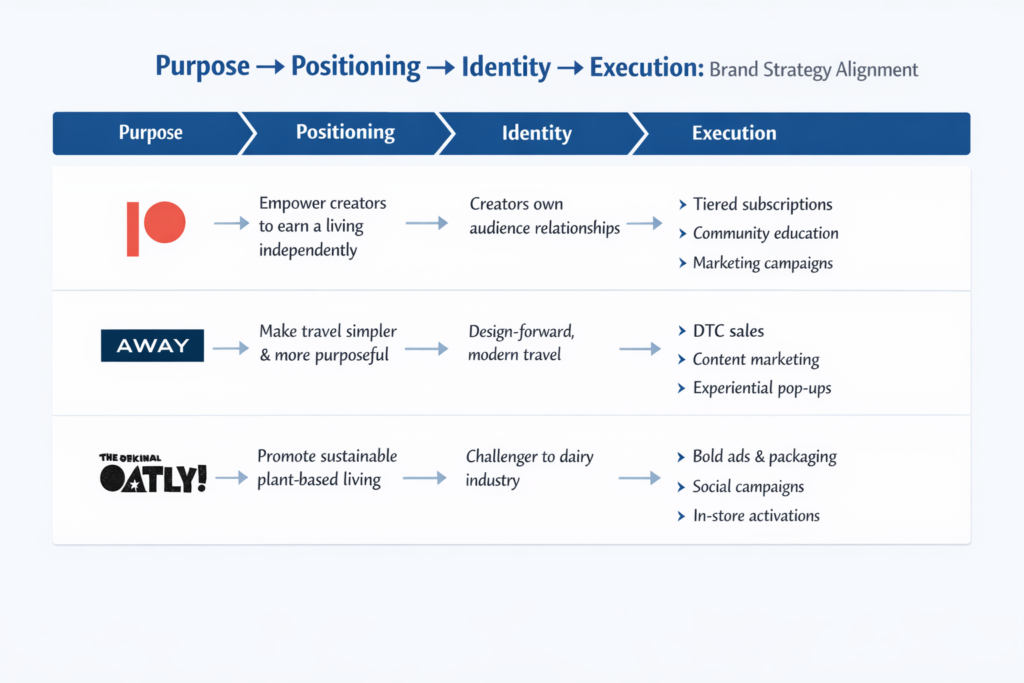
The strongest brands aren’t just memorable—they’re consistent. From purpose to positioning, identity, and execution, every decision reinforces the same narrative. The following examples illustrate how deliberate choices create cohesion and competitive advantage.
Patreon: Enabling Creative Independence
Purpose
Patreon exists to help creators earn a living doing what they love. Its mission goes beyond crowdfunding—it’s about empowering creative independence in a way traditional media cannot.
Positioning
Patreon positioned itself as the platform where creators own the relationship with their audience, rather than giving that power to distributors or social platforms. This differentiates it from traditional content platforms and donation tools.
Identity
The brand’s visual and verbal identity communicates empowerment and inclusivity: approachable typography, friendly tone, and community-centric language. Every touchpoint signals creator-first thinking.
Execution
From product features (tiered subscriptions, analytics dashboards) to educational content and marketing campaigns, everything reinforces Patreon’s mission. The narrative of creative independence is visible, consistent, and actionable for both creators and audiences.
Away: Travel Made Intentional
Purpose
Away exists to make travel simpler, more purposeful, and enjoyable. The brand frames travel not as a commodity, but as a personal and aspirational experience.
Positioning
Away positioned itself in a crowded luggage market as the thoughtful, design-forward alternative to traditional brands. Beyond features, it emphasizes storytelling, lifestyle integration, and emotional resonance.
Identity
The visual identity is minimal and modern, with clean lines, soft typography, and photography that evokes travel as experience. The tone is confident but approachable, consistent across product, social, and retail spaces.
Execution
Execution extends beyond products: direct-to-consumer channels, content marketing, influencer storytelling, and experiential pop-ups all reinforce the same brand story. Even customer service and packaging reflect care and attention, making the strategy tangible.
Oatly: Provocative, Values-Driven Differentiation
Purpose
Oatly exists to make plant-based food mainstream and environmentally responsible. Its purpose is both product-driven and ideological: to inspire sustainable consumption.
Positioning
Oatly positioned itself not just as an oat milk brand, but as a challenger to the dairy industry, embracing irreverence and cultural critique to stand out in a commoditized category.
Identity
Its identity is unmistakable: hand-drawn typography, bold packaging copy, and witty, provocative messaging. Tone and voice consistently reinforce the brand’s challenger personality.
Execution
From packaging to social media campaigns, ads, and in-store activations, Oatly’s communication reinforces both its product benefits and cultural positioning. Every interaction feels intentional and coherent.
The Pattern Across These Brands
Patreon, Away, and Oatly all show the same principle: clarity and alignment win. Purpose gives direction. Positioning defines differentiation. Identity expresses meaning. Execution reinforces both consistently over time.
Strong brand strategy isn’t about doing more; it’s about doing the right things consistently. That discipline creates trust, recognition, and competitive advantage that endures beyond any single campaign or product launch.
Measuring Brand Strategy Effectiveness
A brand strategy is only as strong as the outcomes it produces. Without measurement, even the clearest purpose and positioning risk becoming aspirational statements rather than actionable advantage. Measuring effectiveness isn’t about checking vanity metrics—it’s about understanding whether your brand is building equity, preference, and consistency in ways that matter to growth.
Brand Equity and Market Perception
Brand equity is the cumulative value of how the market perceives your brand. It’s more than awareness; it’s the strength of associations, differentiation, and loyalty your brand earns over time. Effective measurement looks at:
- Awareness: Do your target audiences recognize your brand in the right context?
- Preference: Do they choose your brand over competitors when making decisions?
These indicators show whether your strategic choices—positioning, narrative, and identity—are resonating with the market.
Consistency Audits
Even a brilliant strategy can falter if execution is inconsistent. Consistency audits review touchpoints—website, campaigns, sales materials, product experiences—to ensure messaging, visuals, and tone align with the documented brand strategy. Gaps often reveal where teams need clearer guidance or governance, preventing fragmentation before it erodes trust.
Brand Health Dashboards
For ongoing management, many brands build dashboards that combine qualitative and quantitative data. Metrics may include:
- Share of voice and sentiment tracking
- Brand recall and recognition surveys
- Customer experience feedback
- Engagement trends across marketing channels
A well-structured dashboard turns abstract concepts into actionable insights, showing how strategy translates into market performance and internal alignment.
Strong brands treat measurement not as an afterthought, but as a feedback loop. Awareness, preference, consistency, and equity data inform decisions—from refining messaging to prioritizing investments—ensuring the brand evolves while remaining true to its strategic foundation.
In short, you can’t manage what you don’t measure. Tracking effectiveness is how strategy moves from theory to competitive advantage.
When to Update or Rebuild Your Brand Strategy
A brand strategy isn’t static. Markets evolve, customer expectations shift, and internal priorities change. The question isn’t if you’ll need to revisit your strategy—it’s when, and how to recognize the signs early.
Signs Your Strategy Is Outdated
A strategy that isn’t working shows itself in clear ways:
- Messaging confusion: Teams argue over what the brand stands for, or campaigns feel inconsistent across channels.
- Weak differentiation: Competitors are copying your positioning, or your value proposition no longer stands out.
- Audience drift: Your actual customers no longer match the profile your strategy targets.
- Internal friction: Product, marketing, or sales teams make conflicting decisions because the brand rules aren’t clear.
- Performance gaps: CAC, retention, or engagement trends suggest your strategy isn’t resonating with the market.
These are not abstract problems—they are symptoms that strategy has fallen behind reality. Recognizing them early prevents misaligned execution and wasted resources.
A refreshed brand strategy is not a failure—it’s a deliberate adaptation. The best brands treat strategy as a living asset, revisited whenever the market, business objectives, or customer realities change.
Common Brand Strategy Mistakes (and How to Avoid Them)
Even experienced teams stumble when building brand strategy. Here are the most frequent pitfalls and how to address them:
1. Treating Strategy as Phrases, Not Decisions
Simply crafting a tagline, value statement, or mission phrase isn’t enough. Strategy must guide choices: what to pursue, what to ignore, and how to compete.
Avoid it: Translate statements into actionable rules for messaging, product design, and go-to-market decisions.
2. Lack of Differentiation
A strategy that reads like every other brand fails to create an advantage. If your positioning could describe multiple competitors, it’s not strategic.
Avoid it: Define clear trade-offs—what you do exceptionally well and what you intentionally leave out.
3. Vague or Generic Values
“Integrity” or “innovation” on their own don’t move teams or customers. Values must be specific and observable in behavior.
Avoid it: Articulate values in operational terms, e.g., “We ship weekly updates to customers to stay transparent and accountable.”
4. Misalignment with Product or CX
A brilliant positioning loses power if product experience, features, or customer interactions contradict it.
Avoid it: Map strategy to all touchpoints—marketing, product design, support—before finalizing.
5. Infrequent or No Updates
Markets change, audiences evolve, and businesses grow. A static strategy becomes irrelevant over time.
Avoid it: Treat strategy as a living asset. Schedule audits and update when reality shifts.
6. Overly Complex or Jargon-Filled Language
Complicated language confuses teams and customers alike. If people can’t explain your brand in simple terms, adoption suffers.
Avoid it: Use clear, concise language that anyone in your organization can repeat and act on.
7. Ignoring Measurement
Without tracking performance, you can’t know if your strategy works.
Avoid it: Establish metrics for awareness, preference, and consistency, and tie them to strategic goals.
Final Thoughts: Brand Strategy as a Living System
A brand strategy isn’t a one-and-done exercise. The market changes, competitors move, and audiences evolve—and your strategy has to keep up. Treat it as a living system: something you revisit, test, and refine regularly.
Continuous evaluation doesn’t just prevent misalignment—it uncovers new opportunities. It ensures your positioning stays sharp, your messaging consistent, and your teams aligned around the choices that actually matter.
The brands that last aren’t the ones that set a strategy once and forget it—they’re the ones that keep it in motion, letting it guide decisions without constraining action.
To make this practical, you can download the full Brand Strategy Template, a ready-to-use framework for documenting, measuring, and iterating your strategy over time.
