
In a crowded marketplace, companies struggle to communicate value. Without clear, consistent, strategic messaging, even great products can go unnoticed. A Go-to-Market (GTM) messaging framework provides a blueprint for all communications across marketing, sales, product, and customer success. It ensures everyone in the company speaks with one voice, consistently conveying value to the target audience.
In this comprehensive guide, we’ll show you how to build a GTM messaging framework that aligns teams, resonates with customers, and drives growth.
What Is a GTM Messaging Framework?
A GTM messaging framework is a structured approach to communicating your brand’s value in a way that resonates with your audience. It is essentially a guide that defines what your brand should say, how it should say it, and to whom it should speak.
A strong messaging framework addresses four key questions:
- Who is our target audience?
- What problems are we solving for them?
- How are we different from competitors?
- Why should the audience care?
By answering these questions, companies ensure clarity, consistency, and alignment. Without a messaging framework, organizations risk inconsistency, confusion, and diluted brand identity.
Why Your Business Needs a GTM Messaging Framework
Every marketing and sales activity is more effective with a messaging framework. Without one, organizations face challenges:
- Inconsistent Messaging: Different teams may communicate differently, creating confusion for potential customers.
- Reduced Engagement: Messages that do not resonate with the audience fail to generate interest or conversions.
- Brand Confusion: A lack of consistent messaging weakens brand recognition and trust over time.
A GTM messaging framework ensures that all stakeholders—marketing, sales, product, and customer success teams—speak the same language. It strengthens brand positioning, improves customer engagement, and makes campaigns more impactful.
Step 1: Understand Your Audience
Building a messaging framework starts with understanding your audience. Knowing your customers helps you craft messages that motivate action.
Create Detailed Buyer Personas
A buyer persona is a semi-fictional ideal customer based on research and real insights. Creating personas clarifies who you’re addressing, what matters to them, and how to tailor your messaging.
When creating personas, consider:
- Demographics: Age, gender, location, occupation, income level.
- Behavior Patterns: How they make purchasing decisions, content they consume, and channels they frequent.
- Pain Points: Challenges or problems they are trying to solve.
- Goals and Motivations: What drives them, their ambitions, and desired outcomes.
For example, if you are marketing a SaaS productivity tool, your persona might be a 35-year-old project manager in a mid-sized tech company who struggles with team coordination and workflow inefficiencies. This level of detail ensures your messaging speaks directly to their specific pain points.
Map the Customer Journey
Once you define personas, map their journey. Identify touchpoints from awareness to decision. Understand their questions and objections. This mapping enables messaging for every stage.
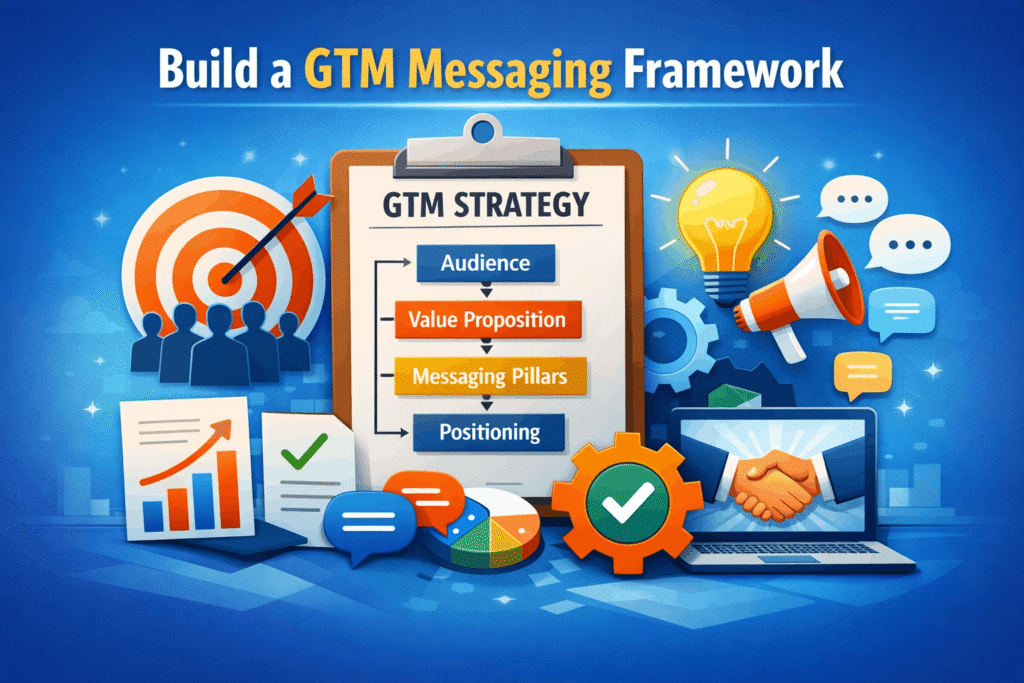
Step 2: Define Your Value Proposition
A value proposition is a clear statement explaining your product’s benefits, uniqueness, and why customers should care. It forms your messaging framework’s foundation.
Components of a Strong Value Proposition
- Customer-Centric: Focus on what your product does for the customer, not just features.
- Unique and Differentiated: Highlight what sets your solution apart from competitors.
- Clear and Concise: Avoid jargon or complex statements; aim for simplicity.
- Evidence-Based: Support your claims with data, testimonials, or case studies.
For instance, instead of saying:
“We provide marketing automation software.”
You could say:
“Our platform automates repetitive marketing tasks, helping mid-sized businesses save 20 hours per week and increase lead conversion by 30%.”
A clear value proposition anchors all messaging. It guides marketing, sales, and customer success communications.
Step 3: Develop Messaging Pillars
Messaging pillars are core themes supporting your value proposition. They guide all communications and ensure consistency. Most companies use 3–5 pillars.
How to Build Messaging Pillars
- Each pillar should highlight a benefit or solution your product provides.
- Ensure pillars are relevant to your audience and match their pain points.
- Add supporting proof such as statistics, testimonials, or case studies.
Example for a Project Management Tool:
- Efficiency: Streamline workflows and eliminate redundant tasks.
- Collaboration: Improve team communication across departments.
- Insights: Provide actionable analytics to improve decision-making.
Messaging pillars are the backbone of all campaigns. They ensure alignment across all content, from social media to sales decks to websites.
Step 4: Craft Your Positioning Statement
A positioning statement defines your market position and helps your audience see how you differ from competitors.
Positioning Statement Formula
“For [target audience], [brand] is the [category] that [unique benefit] because [proof].”
Example:
“For small e-commerce businesses, BrandQuarterly is the marketing analytics platform that simplifies data-driven decisions because it integrates multiple data sources into one intuitive dashboard.”
Positioning statements anchor all messaging. They ensure your GTM strategy delivers consistent value across all channels.
Step 5: Establish Tone of Voice and Brand Personality
Messaging is about what you say and how you say it. Tone of voice reflects brand personality and must resonate with your audience.
Key Considerations
- Professional vs. Casual: Is your communication formal, approachable, or playful?
- Conversational Style: Should content be detailed and technical or light and easy to digest?
- Emotional Appeal: How should your audience feel when interacting with your brand?
Documenting tone of voice ensures blog posts, social updates, and emails reflect your brand consistently.
Step 6: Align Internal Teams
A GTM messaging framework is effective only if all teams understand and use it. Marketing, sales, product, and customer success must align.
Alignment Strategies
- Internal Workshops: Educate teams on the framework and its application.
- Accessible Playbooks: Create a messaging guide with value propositions, pillars, positioning statements, and sample copy.
- Regular Updates: Keep messaging current with market shifts, competitors, or product changes.
Alignment ensures customers receive consistent, persuasive messaging from both content and sales interactions.
Step 7: Test and Refine Messaging
No messaging framework is perfect at first. Testing and refinement are essential.
Metrics to Monitor
- Engagement: Track clicks, shares, and interactions with your content.
- Conversion Rates: Measure lead generation and sales effectiveness.
- Customer Feedback: Gather feedback to check message clarity.
Use the insights to continuously refine your messaging. Iterative testing ensures your GTM messaging framework evolves with the market and audience needs.
Common Mistakes to Avoid
Even with a clear framework, companies often make mistakes that reduce its impact.
- Overcomplicating Messaging: Too many pillars or complex language confuse your audience.
- Ignoring Buyer Personas: Messages must reflect the needs and language of real customers.
- Lack of Proof Points: Claims without evidence fail to build trust.
- Inconsistent Application: Teams must consistently apply the framework across all channels.
- Neglecting Updates: Messaging must evolve with market trends and customer expectations.
Avoiding these mistakes ensures your GTM messaging framework drives results and strengthens your brand.
SEO Best Practices for GTM Messaging Content
Optimizing your GTM messaging content for search engines ensures that your efforts reach the right audience.
- Include primary keywords naturally: “GTM messaging framework,” “go-to-market messaging,” “messaging pillars.”
- Use LSI keywords: “value proposition examples,” “buyer persona development,” “brand messaging strategy.”
- Include internal links to relevant content on your site.
- Structure your article with H2/H3 headings for readability and SEO.
- Add a meta description: Summarize your article in 155–160 characters using primary keywords.
Following these SEO practices ensures that your content is discoverable while remaining natural and human-friendly.
Conclusion
Building a GTM messaging framework is not just a marketing exercise; it is a strategic necessity for any business aiming for growth and impact. By defining your audience, crafting a strong value proposition, developing messaging pillars, creating a positioning statement, defining tone of voice, aligning internal teams, and continuously testing, your company can communicate with clarity and consistency.
A well-executed GTM messaging framework strengthens brand identity, drives engagement, and improves conversion rates. For businesses serious about growth, this framework is the foundation of a successful go-to-market strategy.
By investing time and effort in building a robust GTM messaging framework, you ensure your brand not only stands out in the market but also delivers messages that resonate deeply with your audience, every time.
