
A rebranding project plan template provides the clarity, structure, and accountability necessary for a successful transformation. Whether updating a visual identity or executing a full strategic overhaul, effective planning distinguishes a rebrand that engages the market from one that causes confusion. This article outlines each phase of a rebranding project plan, details the key components of every stage, and offers a downloadable template for your organization. By the end, you will understand both the required actions and the importance of their sequence.
What Is a Rebranding Project Plan Template?
A rebranding project plan template is a structured document that organizes tasks, responsibilities, timelines, and milestones for evolving a brand. It serves as a master roadmap that aligns stakeholders, grounds creative work in strategy, and prevents scope creep. Unlike a general marketing plan, a rebranding template focuses on the sequential steps needed to change brand perception internally and externally.
The template typically progresses through discovery, strategy, identity development, internal alignment, and launch phases. Each phase builds on the previous one, so skipping steps, even under budget or time constraints, often leads to costly issues. Starting creative work before completing research can result in rework and diminished stakeholder confidence. A well-structured template ensures the correct sequence is clear from the outset.
Understanding the difference between a rebrand and a brand refresh is also essential before you build your plan. The scope of your template will look very different depending on whether you are changing your core positioning or simply modernizing your visual system. Both are legitimate strategies, but they require different timelines, budgets, and levels of organizational commitment.
A well-designed rebranding project plan template also doubles as a communication tool. When leadership, marketing, design, and product teams all reference the same document, alignment becomes easier to maintain — and easier to rebuild when it inevitably gets tested.
When Do You Need a Rebranding Project Plan?
Not every brand evolution requires the same level of planning rigor, but most organizations benefit from a formal project plan when a rebrand involves more than one department, a significant budget, or a public-facing change. Common triggers include mergers and acquisitions, a strategic pivot, an outdated visual identity, expansion into new markets, or a reputation problem that requires a deliberate reset. In each of these cases, improvisation is expensive.
The decision to rebrand should always begin with a thorough brand audit that documents what your brand currently communicates, where it performs well, and where it creates friction. Without that foundation, a rebrand risks discarding equity you did not know you had. Many organizations spend significant resources on new identities only to discover that audiences valued certain brand elements that were quietly eliminated in the redesign.
Timing matters too. A rebranding project launched in the middle of a product release cycle, a major hiring push, or a market downturn faces compounded risk. The project plan should include a readiness assessment that looks at organizational bandwidth, budget stability, and external market conditions before committing to a start date.
If you are unsure whether a full rebrand is warranted, this strategic framework for when and how to rebrand can help you make that call with confidence rather than guesswork.
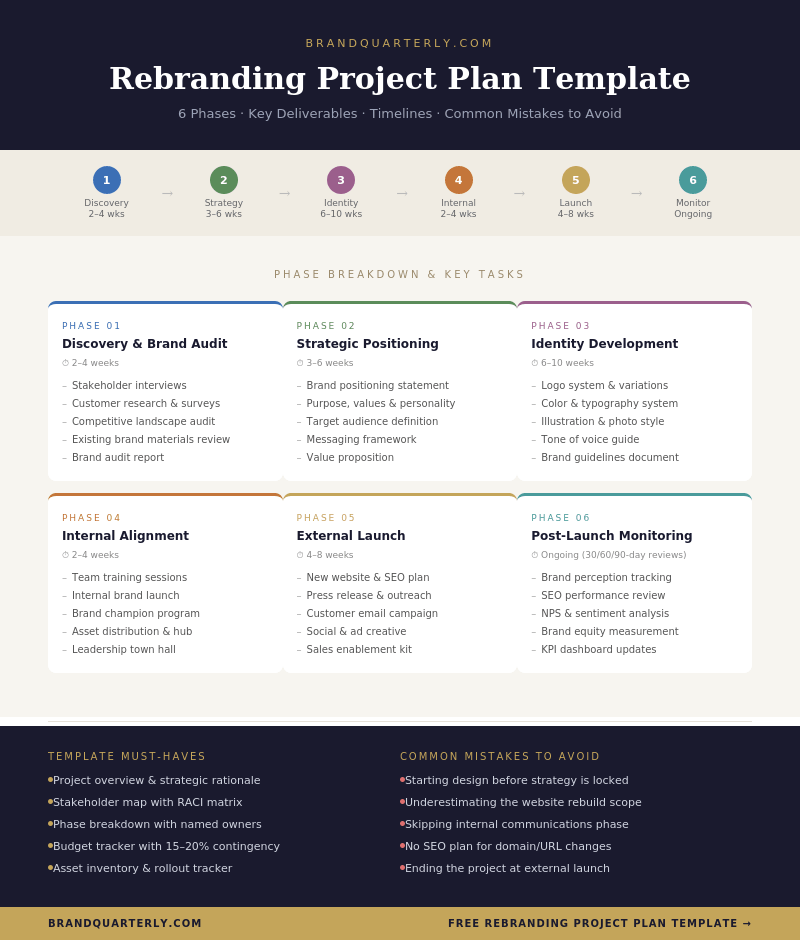
Phase 1: Discovery and Brand Audit
Every rebranding project plan begins with discovery — a structured effort to understand the current state of your brand before deciding what to change. This phase typically takes two to four weeks and involves a combination of internal interviews, customer research, competitive analysis, and a review of existing brand materials. The goal is not to justify a rebrand but to understand what is actually driving the need for one.
Discovery tasks to include in your template:
- Internal stakeholder interviews (leadership, sales, customer success, product)
- Customer and prospect surveys or focus groups
- Analysis of brand perception data, NPS scores, and support themes
- Review of all existing brand materials (website, sales collateral, social profiles, packaging)
- Competitive landscape mapping
Your competitive analysis during discovery should go beyond surface aesthetics. You want to understand how competitors position themselves, what emotional territory they occupy, and where genuine white space exists that your brand could own. Brands that skip this step frequently rebrand into a position that is already crowded, which defeats the purpose of the exercise.
The discovery phase should conclude with a “brand audit report” that documents findings, identifies gaps, and frames the strategic questions that the rest of the project needs to answer. This report becomes the factual foundation for every decision that follows. Without it, creative and strategic debates tend to become battles of opinion rather than conversations grounded in evidence.
Phase 2: Strategic Positioning and Messaging
Once discovery is complete, the next phase in your rebranding project plan focuses on strategy. This is where you define — or redefine — the foundational elements that will shape everything from your visual identity to your sales pitch. Strategic work done well in this phase saves enormous time and money in every subsequent phase, because designers and writers have a clear direction rather than an open-ended brief.
The core strategic outputs for this phase include:
Brand positioning: A clear articulation of who you serve, what you offer, and why that matters more than any alternative. A strong brand positioning statement is specific enough to be useful and differentiated enough to be meaningful. Vague positioning creates vague identities.
Brand purpose and values: These are the internal beliefs that guide behavior and the external commitments that build trust over time. Documenting brand purpose and brand values during the rebrand ensures that the new identity reflects something real rather than aspirational fiction.
Target audience definition: A rebrand is an opportunity to get more precise about who you are serving — and who you are not. Detailed target audience and customer segmentation work during this phase ensures that the new brand resonates with the people who matter most to your business.
Messaging framework: Before any creative work begins, the team needs a messaging framework that defines key messages, proof points, and the language that will carry the new brand across every channel.
This phase typically takes three to six weeks, depending on the amount of research required and the number of stakeholders involved in approvals. Rushing it to get to the “exciting” creative work is one of the most common — and most costly — mistakes brands make during a rebrand.
Phase 3: Brand Identity Development
With strategy locked, the creative phase of your rebranding project plan can begin in earnest. Brand identity development covers the visual and verbal systems that express the repositioned brand in tangible form. This is where logos, color palettes, typography, photography styles, tone of voice guidelines, and nomenclature all get defined and documented.
The identity development process should follow a structured briefing and review cycle. Designers need a creative brief that is rooted in the strategic positioning work from Phase 2 — not a vague instruction to “make it look more modern.” Each round of design review should be evaluated against strategic criteria, not just aesthetic preference. Teams that skip this discipline end up with identities that look interesting but fail to communicate the right things.
Key deliverables in this phase include:
- Logo system (primary, secondary, icon/mark variations)
- Color palette (primary, secondary, and neutral tones with accessibility specs)
- Typography system (display, body, and UI typefaces)
- Illustration or iconography style
- Photography and video art direction guidelines
- Tone of voice and editorial style guide
- Brand tagline or verbal signature
These elements should all be compiled into a comprehensive set of brand guidelines that explain not just what the brand looks like, but why each decision was made. This context helps the guidelines hold up over time — when new team members join, or agencies change, the rationale prevents arbitrary drift from the intended identity.
Identity development typically takes six to ten weeks. Allocating too little time here produces work that needs to be revised after launch, which is far more expensive than getting it right before rollout.
Phase 4: Internal Alignment and Team Activation
One of the most frequently skipped phases in a rebranding project plan is internal alignment. Organizations invest heavily in the strategy and identity work, then launch externally before anyone internally understands the new brand — or worse, before they have bought into it. The result is inconsistent execution, confused customer-facing staff, and a brand that reads differently depending on who is communicating it.
Internal activation should precede external launch, typically by two to four weeks. This phase involves training sessions, internal announcements, brand champion programs, and the distribution of all new brand assets to everyone who creates or approves content. Sales teams need to understand the new messaging. Customer success teams need to speak the same language. HR teams need to align job postings and employer brand materials with the new identity.
A strong internal launch also creates cultural momentum. When employees feel informed and included in a rebrand rather than blindsided by it, they become advocates rather than skeptics. That internal energy translates into more consistent and enthusiastic external expression of the brand.
Your rebranding project plan template should include a dedicated internal communications calendar for this phase — covering announcement emails, town hall presentations, team training workshops, and a resource hub where all new brand materials live. Skipping this infrastructure forces individuals to rely on outdated assets simply because the new ones are not easy to find.
Phase 5: Launch Planning and Execution
The external launch is the most visible moment in any rebrand, and it deserves its own detailed plan within your broader rebranding project plan template. A well-executed launch creates momentum, earns media coverage, and signals change to your market in a way that builds rather than erodes trust.
Launch planning should address three distinct audiences: existing customers, prospective customers, and the broader industry or press. Each group needs a tailored communication strategy. Existing customers need context — why the brand is changing, what stays the same, and what it means for them. Prospects need a compelling first impression of the new brand. Industry audiences need a story that positions the rebrand as a sign of strategic strength, not instability.
Before going public, protecting your SEO during the rebrand is critical. Domain changes, URL restructuring, and content overhauls can significantly disrupt organic search performance if not managed carefully. Your launch plan should include a technical SEO checklist, redirect mapping, and a monitoring plan for the first 90 days post-launch.
Launch phase deliverables typically include:
- New website (or major website overhaul)
- Press release and media outreach
- Email announcement to existing customers and subscribers
- Updated social media profiles and launch content
- Sales enablement materials reflecting new positioning
- Updated advertising creative
- Event or activation plan (if applicable)
Rebranding without losing your existing audience requires deliberate continuity signals — elements that remind people what they already trust about your brand, even as the visual and verbal expression evolves. Maintaining audience trust through a rebrand is as much a strategic challenge as it is a communication one.
Phase 6: Post-Launch Monitoring and Optimization
A rebranding project plan that ends at launch is incomplete. The weeks and months following a rebrand reveal how well the new positioning and identity are landing — and where adjustments are needed. Building a post-launch monitoring phase into your template signals organizational maturity and prevents small issues from becoming large problems.
Monitoring should cover brand perception, website performance, lead quality, sales cycle metrics, and social sentiment. If the rebrand included a repositioning, you should also be tracking whether your brand equity is building in the intended direction — measuring aided and unaided brand awareness, net promoter score, and share of voice among target segments.
Set a formal 30-day, 60-day, and 90-day review cadence. Each review should assess performance against the goals defined in your brand strategy — not vanity metrics like social likes or press mentions, but indicators that connect brand health to business outcomes. A brand KPI dashboard built specifically for the post-rebrand period makes these reviews faster and more actionable.
Optimization after launch is not a sign that the rebrand failed. It is a sign that the team is responsive and committed to making the investment work. The brands that get the most out of a rebranding effort are those that treat launch as a beginning rather than an endpoint.
Rebranding Project Plan Template: Key Sections to Include
Your completed rebranding project plan template should consolidate all components into a single, accessible document. The following are essential sections for a comprehensive template.
1. Project Overview: Outline the strategic rationale, scope of work, budget range, and desired outcomes. This section provides context for the project’s purpose and success criteria.
2. Stakeholder Map and RACI: Identify all participants and their roles (Responsible, Accountable, Consulted, Informed). Clear ownership prevents decision-making delays and ensures timely approvals.
3. Phase Breakdown with Milestones: List each phase with specific deliverables, timelines, and assigned owners. Use a Gantt chart or project management tool to visualize sequence and dependencies.
4. Budget Tracker: Organize costs by phase, including discovery, strategy, design, development, launch, and monitoring. Include a 15–20% contingency to accommodate scope adjustments.
5. Brand Strategy Brief: Embed or link strategic outputs from Phase 2 in the template to ensure creative teams have access to positioning, audience, and messaging guidance.
6. Asset Inventory and Rollout Tracker: Create a master list of all assets requiring updates, such as website pages, social profiles, email templates, sales decks, and packaging. Track each asset’s status from needs updating to live.
7. Internal Communications Plan: Document the schedule of internal announcements, training sessions, and resource releases to prepare the team for external launch.
8. Launch Checklist: Provide a detailed task list for the 72 hours before and after launch to ensure a smooth rollout and avoid last-minute issues.
9. Post-Launch Review Framework: Define metrics, review cadence, and the process for post-launch optimizations. This section transforms the template into an ongoing performance tool.
Common Mistakes to Avoid in Your Rebranding Project Plan
Even well-resourced teams fall into predictable traps when managing a rebrand. Knowing these pitfalls in advance lets you design your project plan to avoid them rather than recover from them.
Starting creative work before the strategy is locked. Design teams are eager to get into visual exploration, and clients are eager to see something tangible. However, identity work built on unresolved strategic questions almost always requires rework. Protect the sequence in your template even when internal pressure pushes against it.
Underestimating the website rebuild. For most brands, the website is the most complex and time-consuming rebrand deliverable — involving content strategy, UX design, visual design, development, SEO, and content migration. Teams that treat the website as a straightforward “step” rather than its own project-within-the-project routinely blow timelines and budgets.
Treating internal communications as optional. As noted in Phase 4, skipping the internal activation phase produces inconsistent brand expression and erodes trust with employees. Build it in from the start — it is not an add-on.
Ignoring the go-to-market strategy implications of a repositioned brand. A rebrand that involves a genuine shift in positioning has implications for how you sell, how you price, and which channels you prioritize. Aligning your GTM approach with the new brand is not a marketing afterthought; it is a commercial necessity.
Failing to document the new brand thoroughly. The effort invested in creating a great brand identity dissipates quickly if it is not captured in detailed guidelines that real teams can follow. Documentation is not glamorous work, but it is what makes a rebrand durable.
How to Use This Template on Your Team
Download the rebranding project plan template below and adapt it to your organization’s size, industry, and scope of rebrand. Smaller organizations can compress phases and simplify the stakeholder map; larger enterprises may need to expand each phase into its own sub-project with dedicated owners. The template is a starting point — intelligent customization is expected and encouraged.
Share the template with all stakeholders at the project kickoff. Walk through each phase, clarify roles, and establish the decision-making process before any work begins. This conversation alone prevents a significant percentage of the coordination failures that derail rebranding projects.
Review and update the template weekly during active phases. A project plan that is not maintained becomes a museum artifact rather than a working tool. Assign one team member to own template hygiene — updating statuses, flagging risks, and keeping the document accurate as the project evolves.
Finally, use the template as the basis for stakeholder reporting. Leadership teams and boards do not need granular task-level detail, but they do need to see that the project is on track, on budget, and on strategy. A well-maintained template makes those reports fast to produce and credible to read.

Final Thoughts
A rebranding project plan template is not just a scheduling tool. It is the infrastructure that turns a complex, multi-month transformation into a manageable, measurable process. The organizations that execute rebrands most successfully are not always those with the biggest budgets or the most experienced agencies — they are the ones with the clearest plan and the discipline to follow it.
Every section of this template exists for a reason rooted in how successful rebrands actually work. Discovery creates the evidence base. Strategy creates the direction. Identity development creates the expression. Internal alignment creates consistency. Launch planning creates the moment. Post-launch monitoring creates the compound value. Miss any of these, and the ones that remain are weaker for it.
If you are ready to start planning your rebrand with full strategic clarity, the template below gives you a proven structure to build from. Adapt it, pressure-test it with your team, and use it as the foundation for a brand transformation that delivers lasting results.
Download the Rebranding Project Plan Template here https://brandquarterly.com/templates/
