
Tracking digital brand awareness used to rely more on intuition than data. Not long ago, brand awareness was something you felt more than measured. You ran a campaign, watched the sales figures nudge upward, and hoped the two were connected. Today, that gut-feel approach is a liability. Digital channels generate vast amounts of data at every touchpoint. The brands winning market share know how to read that data and act on it quickly.
It Goes Beyond Follower Counts
Tracking digital brand awareness is not simply about counting followers or watching impressions tick upward. It is about understanding how your audience perceives you. You need to know where they encounter you and what they say when you are not in the room. You also need to know whether that conversation pulls people closer to your brand or pushes them away. These are strategic questions, and answering them requires a structured, repeatable measurement system.
The Tools Are More Accessible Than Ever
The good news is that the tools available today make this more accessible than ever before. Whether you run a lean startup or manage a global enterprise, there are methods that fit your budget and team size. What matters is building the habit of measurement. Consistently turning insight into action is where the real competitive advantage lies.
This guide covers everything you need to know to track digital brand awareness meaningfully. From foundational metrics to the tools that surface real insight, you will leave with a clear picture of where to start and how to grow.
What Tracking Digital Brand Awareness Actually Means
Brand awareness is one of those terms that gets used constantly but rarely gets defined with precision. At its core, brand awareness refers to how well your target audience recognizes and recalls your brand when a relevant need arises. It is the difference between someone typing your company name into a search bar and someone typing a generic product category because no specific brand comes to mind.
Awareness Across Digital Channels
Digital brand awareness extends this idea into online channels. It covers how visible your brand is across search engines, social media, review sites, industry publications, podcasts, and video platforms. Existing in these spaces is not enough. What matters is whether your presence is meaningful, consistent, and tied to the right ideas and emotions in your audience’s minds.
Aided vs. Unaided Awareness
Two distinct types of brand awareness warrant a clear distinction. Aided awareness refers to recognition, where someone identifies your brand when prompted with your logo or company name. Unaided awareness, also called brand recall, refers to whether someone names your brand without prompting when thinking about your product category. Both matter, but unaided awareness is the stronger indicator of brand health because it shows your brand has secured real mental real estate.
Reputation Is Part of the Picture
In the digital context, brand awareness also carries a reputational dimension. Your brand is not only what you say about yourself. It is the sum of what others say, share, link to, and associate with your name online. A company can invest heavily in advertising and still suffer from low effective awareness if the online conversation around its name is negative, fragmented, or simply quiet.
Understanding the difference between visibility and perception is essential before you build any tracking system. Metrics that only measure reach or impressions tell you half the story. A complete picture requires combining quantitative data with qualitative signals. You need to understand not just how many people see you, but what they think when they do.
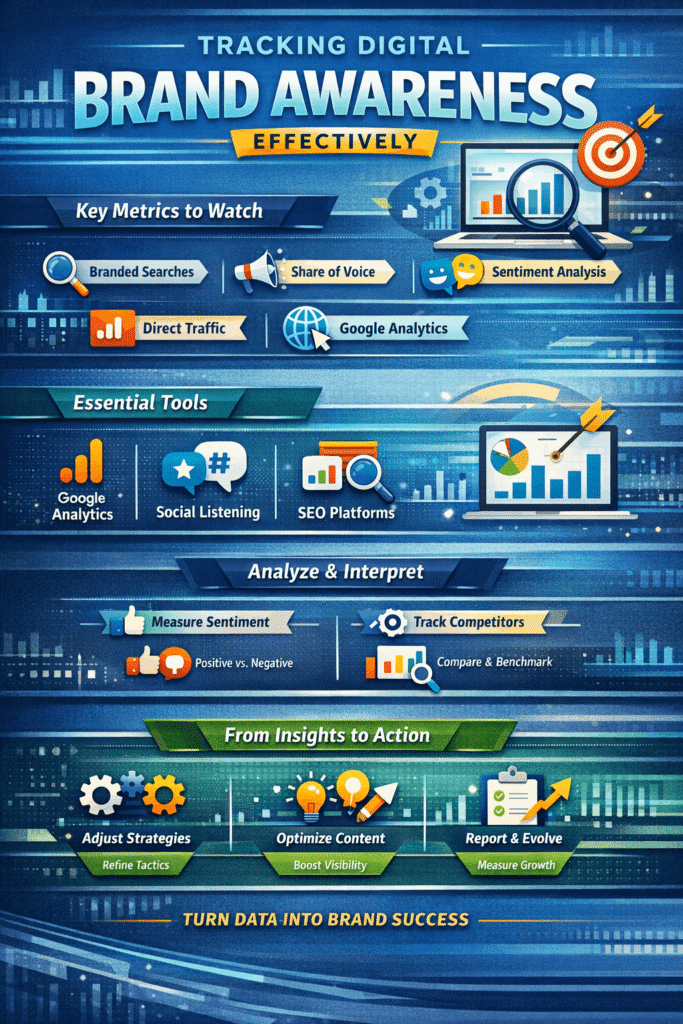
Core Metrics for Tracking Digital Brand Awareness
When marketers first approach brand awareness tracking, they often gravitate toward the easiest metrics to pull from a dashboard. Follower counts, page views, and ad impressions are familiar and visible. The problem is that familiarity does not equal relevance. Several of the most important brand awareness metrics require a little more effort to find and interpret correctly.
Branded Keyword Search Volume
One of the clearest signals of growing brand awareness is an increase in direct searches for your brand name. When someone searches for your company or branded terms on Google, they already know you exist. They are not discovering you through an ad or a recommendation. This makes branded search volume a direct measure of unprompted recall. Tools like Google Search Console and Google Trends make it straightforward to monitor this over time.
Share of Voice
Share of voice measures how much of the total conversation in your category belongs to your brand compared to competitors. To understand exactly how your competitors stack up, our competitor mapping guide walks you through the full process. In the traditional advertising world, this was calculated based on media spend. In the digital world, it is calculated based on mentions, content volume, social engagement, and search visibility across your competitive landscape. A growing share of voice typically precedes growth in market share. This makes it one of the more forward-looking metrics available.
Social Mentions and Sentiment
The volume of times your brand gets mentioned across social platforms is a useful proxy for awareness. Volume alone, however, is incomplete without sentiment analysis. Two brands can have identical mention volumes and wildly different brand health if one is being praised while the other faces complaints. Monitoring the ratio of positive to neutral to negative mentions gives you a richer and more honest picture of where your brand stands.
Direct Traffic
When someone navigates to your website by typing your URL directly into a browser, it is a strong signal that they know your brand and actively sought you out. Direct traffic in your analytics platform is one of the cleaner indicators of brand recall because it reflects intentional behavior rather than passive exposure. Track this metric over time, particularly in the weeks following major campaigns or press coverage, to understand whether awareness-building efforts are landing.
Branded Backlinks and Press Mentions
When reputable websites, publications, and journalists reference your brand by name, they expand your reach to new audiences. They also reinforce your credibility with existing ones. Tracking the quantity and quality of branded mentions across the web, using tools like Ahrefs, Semrush, or Moz, gives you a view of your earned media footprint. A healthy backlink profile filled with genuine brand mentions is both an SEO asset and a reliable indicator that your brand is generating meaningful conversation.
Platforms for Tracking Digital Brand Awareness
Brand awareness does not live in one place. It is distributed across a wide ecosystem of channels, each with its own audience behavior, content format, and measurement logic. Understanding where your brand awareness actually exists is a prerequisite for tracking it effectively.
Search Engines
Search engines remain the most commercially significant channel for brand awareness. Google processes billions of queries every day. The brands that consistently appear in results for relevant searches accumulate a significant awareness advantage over time. This is not only about paid ads. Organic search visibility for informational and category-level queries builds awareness that compounds over months and years. When someone reads your content because it answered their question, they carry that experience forward.
Social Media Platforms
Social media platforms are the most conversational environments for brand awareness, which makes them both valuable and complex to track. Platforms like Instagram, LinkedIn, TikTok, Facebook, and X all generate brand data in different formats. Some brands thrive on one platform and remain invisible on others. Understanding where your audience actually engages and where your competitors have built presence helps you prioritize your tracking and content investments more intelligently.
Review and Community Sites
Review and community platforms deserve more attention than they typically receive in brand awareness discussions. Google Business Profile reviews, Trustpilot, G2, Reddit threads, and niche industry forums all shape brand perception in ways that advertising cannot fully control. People trust peer voices more than brand voices. A strong presence in these spaces can accelerate awareness-building in ways that owned media cannot replicate.
Video and Audio Channels
Video and audio channels, including YouTube, podcasts, and streaming platforms, represent a fast-growing frontier for brand awareness. Video content, in particular, has extraordinary reach potential. Brands that build a recognizable presence in these formats reach audiences during moments of high attention and engagement. Tracking brand mentions in video descriptions, podcast transcripts, and channel analytics gives you additional signal points beyond text-based media.
Email and Newsletter Ecosystems
Email and newsletter ecosystems are often overlooked in brand awareness tracking because they sit behind closed doors. However, when industry newsletters or thought leaders mention your brand in their publications, they reach highly engaged and often influential audiences. Monitoring your brand’s appearance in email content, through webmention tools or direct relationships with key newsletter publishers, adds another dimension to your awareness picture.
Tools for Tracking Digital Brand Awareness
The market for brand monitoring and analytics tools has matured significantly in recent years. Solutions now exist for solopreneurs working with tight budgets and for enterprise teams managing brand presence across dozens of markets. Knowing which tools are worth your investment depends on the metrics you prioritize and the sophistication of your current tracking infrastructure.
Google Search Console and Google Analytics 4
For most businesses, these two free tools from Google form the foundation of any digital brand awareness tracking effort. Search Console shows you exactly which branded queries drive clicks to your website, how often your brand appears in search results, and how your click-through rates trend over time. Google Analytics 4 gives you visibility into direct traffic, referral sources, and user behavior across channels and campaigns. Together, they give you a reliable baseline at no additional cost.
Google Trends
Google Trends allows you to track search interest in your brand name over time, compare it against competitors, and identify geographic concentrations of interest. It is particularly useful for understanding whether a campaign or PR moment genuinely moved branded search behavior. Because it shows relative interest rather than absolute volume, it works well for competitive benchmarking even when you lack access to competitors’ actual search data.
Social Listening Platforms
Social listening platforms give you real-time and historical data on brand mentions across social media, news sites, blogs, and forums. Brandwatch is a powerful enterprise option with deep sentiment analysis and competitive tracking capabilities. Mention is a more accessible option for smaller teams that still want robust monitoring. Sprout Social combines social listening with publishing and engagement tools, making it a practical all-in-one platform. All three allow you to set up brand keyword alerts that surface new mentions as they happen.
SEO Platforms
Semrush and Ahrefs are both essential for tracking branded search visibility, backlink acquisition, and share of voice in organic search. Both platforms allow you to monitor which websites link to you and which branded keywords generate traffic. Ahrefs is particularly strong for backlink analysis, while Semrush has broader coverage of advertising data and content performance metrics. Either platform gives you a comprehensive view of your brand’s search footprint that free tools cannot match.
Brand Surveys
Periodic brand awareness surveys, conducted via tools like SurveyMonkey or Typeform, let you ask your audience directly whether they recognize your brand and how they would describe it. Running these surveys quarterly or biannually gives you a longitudinal view of how brand perception evolves over time. No analytics dashboard can replicate this kind of direct audience insight.
Building a Tracking Digital Brand Awareness Framework
Having access to the right metrics and tools is only useful if you bring them together consistently. Without structure, brand tracking becomes a collection of disconnected data points that different team members interpret differently. A well-designed tracking framework creates alignment around what matters, how you measure it, and what the results mean for decisions.
Step One: Define Awareness for Your Business
Start by defining what brand awareness means for your specific business in your specific market. A local service business defines and measures awareness differently than a direct-to-consumer e-commerce brand or a B2B software company. Pin down your audience, your geographic market, your key competitors, and your primary channels before building your measurement system. This ensures the data you collect stays relevant to your actual situation.
Step Two: Select Your Key Performance Indicators
Select your key performance indicators and organize them into a dashboard you can review regularly. Separate your metrics into two categories. Leading indicators signal that awareness is growing before revenue is affected, including branded search volume, social mentions, and share of voice. Lagging indicators confirm that awareness has translated into behavior, as evidenced by direct traffic and organic branded conversions. Keeping both types visible prevents premature conclusions based on incomplete signals.
Step Three: Establish a Baseline
You cannot measure growth without knowing where you started. Before launching any major awareness campaign, document your current branded search volume, direct traffic levels, mention frequency, and share of voice. Store these baseline numbers with clear timestamps and contextual notes so that future measurements can be compared accurately. This historical record becomes more valuable with every passing month.
Step Four: Set a Consistent Review Rhythm
Brand awareness metrics rarely move in dramatic overnight jumps. They tend to shift gradually over weeks and months. Build a weekly review of fast-moving metrics like social mentions and sentiment. Add a monthly review of search visibility and traffic trends. Then schedule a quarterly review of share of voice and survey data. This cadence catches meaningful signals without triggering reactions to normal fluctuations in the data.
Step Five: Document Your Definitions
Create clear internal documentation that explains what each metric means, how you calculate it, and the threshold that would trigger a strategy change. This documentation matters most for teams where multiple people contribute to brand tracking. When everyone agrees on definitions and benchmarks upfront, performance conversations stay focused on solutions rather than disagreements about interpretation.
How Content Marketing Supports Brand Awareness Tracking
Content marketing and brand awareness tracking are not separate disciplines. They are deeply intertwined, and understanding their relationship makes both more effective. Content marketing is one of the most powerful long-term drivers of brand awareness. Tracking gives you the feedback loop you need to keep improving it consistently.
Content as an Awareness Engine
Every piece of content your brand publishes creates an opportunity to build awareness among a new audience segment. If your messaging isn’t landing yet, start with our guide on messaging pillars that influence decisions. When someone discovers your blog post through a search query, reads a thoughtful article in an industry publication, or watches a video that helps them solve a real problem, they form an impression of your brand. That impression is the raw material of awareness. Without tracking, you have no way of knowing which content is building the kind of awareness that eventually translates into trust and purchase intent.
Non-Branded Traffic as an Awareness Signal
Tracking which content pieces generate the most organic traffic from non-branded queries gives you insight into which topics expand your reach to new audiences. These are readers who had never heard of you before your content appeared in front of them. These pieces are your awareness-building content, and they deserve more investment than the conversion-focused content that dominates many editorial calendars. Understanding this distinction lets you build a content strategy that addresses different stages of the awareness journey.
Backlink Acquisition and Content Strategy
Backlinks earned through content represent another dimension worth monitoring closely. When your content earns links from reputable websites, it increases your authority in search engines while simultaneously reaching new audiences through the linking site’s readership. Tracking which content types and topics drive the most natural link acquisition over time helps you refine your editorial strategy to align with what the market finds genuinely valuable.
Content and Share of Voice
Content performance data feeds directly into your share-of-voice calculations. If your content appears in search results for category-level queries at a rate higher than 6 months ago, that signals meaningful growth in organic brand awareness. Connecting your content metrics to your broader brand tracking framework ensures you measure content by its actual strategic impact, not just by vanity metrics like page views or time on site.
Competitive Brand Awareness Analysis
Understanding your own brand awareness in isolation gives you only part of the picture. Brand awareness is fundamentally relative. You compete for attention, recognition, and preference in a market where other brands also invest in visibility. Incorporating competitive analysis into your tracking practice transforms it from an internal measurement exercise into a genuine strategic intelligence function. Our guide to competitive analysis for brands gives you a practical framework to get started.
Tracking Competitors Alongside Your Own Brand
Start by identifying your two to four primary competitors and tracking the same core metrics for them that you track for yourself. Branded search volume comparisons, share of voice in social media, backlink acquisition rates, and content publishing frequency all become more meaningful when you see how your numbers move relative to the competition. Tools like Semrush, Ahrefs, and Brandwatch all support competitive tracking at varying levels of depth and sophistication.
Share of Search as a Predictive Signal
Share of search measures what percentage of total branded and category-level searches in your market go to your brand versus competitors. Research has consistently shown that the share of search predicts market share, often leading it by several months. If your share of search grows while a competitor’s declines, the market’s awareness dynamics are likely shifting in your favor. This makes it one of the most forward-looking signals available to brand marketers.
Identifying Content Gaps Through Competitor Analysis
Analyzing competitors’ content strategies can reveal market gaps where your brand can build awareness that competitors have neglected. If a major competitor produces no content on a set of high-relevance topics your audience cares about, entering that space with high-quality, consistent publishing can rapidly build awareness in areas where your competitors are invisible. This kind of gap analysis turns competitive intelligence into a direct editorial advantage.
Competitive Social Listening
Monitoring what people say about your competitors, including complaints, praise, and frequently asked questions, surfaces insight about what the market values and where existing brand experiences fall short. These conversations reveal real audience needs that your brand can address. This turns competitive intelligence into a direct input for your awareness-building strategy and helps you position your brand around unmet market expectations.
Measuring Earned Media and PR for Brand Awareness
Earned media represents one of the most credible and scalable forms of brand awareness. When a journalist writes about your company, when a creator recommends your product, or when a podcast host interviews your CEO, your brand reaches a new audience through a trusted third-party voice. Tracking this kind of coverage is an important but often underdeveloped part of brand awareness measurement.
Setting Up Media Monitoring
Start your earned media tracking with a robust media monitoring setup. Tools like Mention, Google Alerts, Meltwater, and Cision all send notifications whenever your brand name appears in new content across the web. Set up alerts for your brand name, key product names, executive names, and important branded phrases. This ensures you capture coverage as it happens rather than discovering it weeks later when the moment has already passed.
Evaluating Source Quality
Beyond raw coverage volume, the quality and authority of the sources covering your brand matter enormously. A single feature in a top-tier industry publication reaching a million monthly readers delivers more brand awareness value than fifty mentions on low-traffic blogs. Tracking the domain authority, audience size, and editorial quality of the outlets that cover you helps you assess the real reach and credibility impact of your earned media.
Connecting PR to Downstream Metrics
Measuring the downstream effect of earned media on your other brand metrics is possible with careful tracking. When a major press piece runs, expect to see a spike in direct traffic, branded search volume, and social mentions in the following days. Document these correlations over time. You then build a clearer model of how earned media translates into measurable awareness movement. This model helps justify continued investment in PR and thought leadership activities.
Tracking Influencer and Creator Impact
Influencer and creator partnerships sit in a gray area between earned and paid media. They deserve specific tracking attention because of their potential reach and targeting precision. Monitor how creator-driven content affects your brand mention volume, sentiment, and direct traffic. This provides data that helps you evaluate the actual return on investment from influencer investments. You move beyond surface-level metrics of reach and engagement that creators typically report.
Turning Brand Awareness Data Into Strategic Decisions
Collecting brand awareness data without acting on it is a waste of time and resources. The real value of tracking lies in its ability to surface insights that improve your strategy, reallocate your resources, and help you respond faster to changes in the market or your competitive landscape.
Informing Budget Allocation
One of the most valuable ways to use brand awareness data is in budget allocation decisions. If your tracking shows that organic search accounts for a disproportionate share of your branded discovery while paid social delivers impressions with little evidence of behavior change, that is a clear signal to rebalance your investment. Brand awareness data makes these conversations objective rather than political. Resource decisions rest on evidence rather than internal advocacy.
Shaping Creative Strategy
Awareness data also informs creative strategy. If sentiment tracking reveals that the attributes your audience most frequently associates with your brand are not the ones your strategy tries to build, your creative messaging is not landing as intended. Align your content and campaign creative with the perception you want to build. Then track whether that perception actually shifts over subsequent months to close the loop between creative intent and real-world impact.
Identifying Geographic and Demographic Gaps
Identifying geographic or demographic gaps in your brand awareness is another high-value application of tracking data. If your brand has strong awareness in one region but is virtually unknown in another, that represents a significant market opportunity; that insight drives a targeted awareness campaign with a clear objective and measurable outcome. The same logic applies to audience segments. Understanding which demographics recognize your brand helps you prioritize acquisition efforts more precisely.
Early Warning Signals
Tracking also gives you an early warning when something goes wrong. A sudden spike in negative sentiment, an unexpected decline in branded search volume, or a competitor rapidly gaining share of voice are all signals that warrant attention. Brands that monitor these signals in real time have a meaningful response advantage over those who only review performance quarterly. Early detection often makes the difference between a manageable issue and a full-blown brand crisis.
Common Mistakes in Tracking Digital Brand Awareness
Even marketers who take brand awareness measurement seriously often fall into recurring traps that undermine the quality of their data and the decisions it informs. Understanding these mistakes is a useful shortcut to building a more reliable tracking practice from the start.
Tracking Too Many Metrics
The most common mistake is tracking too many metrics without prioritizing the ones linked to business outcomes. When a dashboard contains 30 different brand metrics with no clear hierarchy, every review meeting becomes a negotiation over which numbers to focus on. Narrow your core tracking set to five to eight meaningful metrics. Review the rest only when specific questions arise. This keeps measurements efficient and decisions clear.
Ignoring External Context
Another frequent mistake is failing to account for external factors when interpreting brand awareness data. A spike in branded searches might appear to be evidence that a campaign worked, when news coverage actually drove it. A competitor’s major product recall might temporarily boost your share of voice with no effort on your part. Build the habit of contextualizing data by noting what was happening in the business and the market during each measurement period. This prevents costly misinterpretations.
Treating It as a One-Time Project
Many teams treat brand awareness tracking as a one-time project rather than an ongoing practice. They measure awareness before a major campaign launch, use the data to inform the campaign, and then move on. Without continuous measurement, you lose the ability to see how awareness trends over time. Brand awareness data becomes genuinely powerful only when it accumulates into a longitudinal dataset that reveals patterns invisible in any single snapshot.
Underinvesting in Qualitative Research
Many brands underinvest in qualitative data collection. Surveys, customer interviews, and focus groups seem slow and expensive compared to the clean dashboards generated by analytics platforms. However, quantitative metrics can tell you that sentiment declined, but not why. Qualitative research fills that explanatory gap. It is often the difference between understanding a problem well enough to solve it and chasing numbers without real insight to guide your decisions.
Conclusion
Tracking digital brand awareness is not a single activity or a one-time project. It is a discipline that grows more valuable the longer you practice it consistently. The brands that build the strongest market positions are rarely the ones that spend the most on advertising. They are the ones that paid attention, measured what mattered, learned from the data, and improved with every cycle.
Start With Clarity
The key to building a tracking practice that lasts is starting with clarity about what you are trying to understand and why. Define awareness in terms specific to your business. Choose a manageable set of metrics that reflect both visibility and perception. Build a dashboard that you and your team will actually review on a consistent schedule. Document your baselines, your benchmarks, and your interpretive criteria so the practice does not depend on any one person’s institutional knowledge.
Brand Tracking Influences the Whole Business
As your practice matures, brand awareness data starts to inform decisions across functions far beyond marketing. To connect brand activity to commercial outcomes more formally, see our branding ROI guide. Product teams gain insight from what the market says about your category. Sales teams learn which channels and content types produce the highest-awareness leads. Leadership gains confidence in brand investment because evidence connects brand activity to measurable business outcomes. Tracking transforms a brand from a soft concept into a strategic business asset.
Stay Flexible as the Landscape Evolves
The digital landscape will continue to evolve. New platforms will emerge. Search behavior will shift. Measurement tools will improve, and the metrics that matter most will keep changing. The brands best positioned to adapt are the ones that build a flexible, curious, and evidence-based approach to tracking digital brand awareness. No methodology stays perfect forever, and the willingness to update your approach is itself a competitive advantage.
Start small if you need to. Pick three metrics, build a monthly review habit, and let the practice develop from there. The most important step is the one that gets you measuring at all, because even imperfect data collected consistently outperforms perfect data that never gets collected. Tracking digital brand awareness is not a one-time task but an ongoing discipline. The brands that succeed are those that measure consistently, adapt quickly, and turn insights into action.
