
Your brand is being talked about right now. ChatGPT, Gemini, Perplexity, and Claude are answering questions about your category every single day. They recommend brands, compare products, and build consumer opinions — all without a single click to your website. An LLM monitoring strategy is the only way to know what those AI systems are saying about you. Without it, you are completely blind to one of the fastest-growing discovery channels in 2026.
Most brand teams still focus on social media listening, SEO rankings, and review management. Those channels matter. However, a massive new layer of brand discovery now happens inside AI chat interfaces. Consumers ask things like “What is the best project management tool?” or “Which brand has the most ethical supply chain?” They get a confident AI-generated answer — and they often act on it. Because of this, your LLM monitoring strategy directly affects your brand growth.
This guide explains what an LLM monitoring strategy is. It also covers why it matters, what risks you face without one, and how to build a framework that works in 2026.
What Is an LLM Monitoring Strategy?
An LLM monitoring strategy is a structured process for tracking how large language models represent your brand. It covers what AI systems say when users ask about your company, products, competitors, and category. Think of it as brand monitoring — but built specifically for the AI layer of the internet.
Traditional brand monitoring watches social media, news articles, and review platforms. In contrast, LLM monitoring watches something entirely different. It tracks the AI-generated answers that now sit at the top of millions of discovery journeys. These answers shape perception fast. Furthermore, they operate outside your usual analytics tools completely.
So what does an LLM monitoring strategy include? At its core, it covers four activities:
- Query tracking: Running a library of prompts across major AI platforms on a regular schedule
- Output documentation: Recording how AI systems describe, position, and compare your brand
- Gap analysis: Identifying where your messaging is missing, distorted, or inaccurate
- Response planning: Taking action to close the content and coverage gaps that affect your AI visibility
Without all four of these activities, you do not have a real strategy. You just have occasional curiosity.
Why Every Brand Needs an LLM Monitoring Strategy in 2026
The scale of AI-assisted discovery has shifted dramatically. In 2026, AI chat platforms will handle billions of queries every month. A large share of those queries is brand- and category-related. Therefore, your AI representation is not a niche technical concern — it is a core brand visibility issue.
A critical issue is that AI-generated answers about your category may not accurately reflect your brand. They may be outdated, highlight competitors more prominently, or reduce your positioning to a generic statement. These issues are not visible in your traffic data, lead reports, or social listening dashboards.
Additionally, these AI systems do not pull content directly from your website. They reflect what the open web has published about you, weighted by source authority, content consistency, and information depth. Brands with thin or inconsistent digital footprints are underrepresented. As a result, they lose ground to competitors who are better covered in third-party publications.
This is why your LLM monitoring strategy connects directly to your digital brand management practice. If you already manage your brand across search, social, and web — it is time to extend that discipline into the AI layer.
How AI Systems Learn About Your Brand
To build an effective LLM monitoring strategy, you need to understand how AI systems form their view of your brand. Large language models train on enormous volumes of internet text. Articles, reviews, forums, press releases, comparison pages — all of it feeds the model’s understanding of the world.
What the model “knows” about your brand reflects that training data directly. Because of this, the quality and consistency of your digital content shape your AI representation. Furthermore, that representation can become outdated quickly, since most models have training cutoffs.
Your brand positioning is no longer just a messaging exercise. Every press mention, every review, and every comparison article contributes to the portrait an AI paints of your brand. Inconsistent messaging fragments that portray. Weak third-party coverage means thinner AI representation.
Importantly, the sources that carry the most weight in AI training are authoritative third-party publications — not your own website. Therefore, your earned media strategy, your PR coverage, and your presence in industry roundups all directly feed your LLM monitoring outcomes.
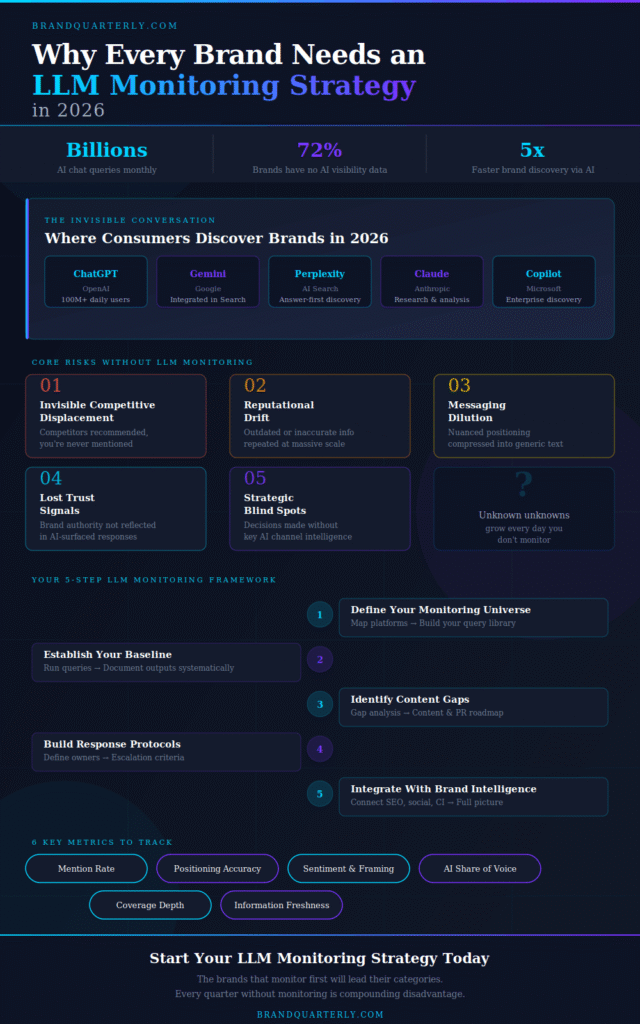
The 5 Core Risks of Having No LLM Monitoring Strategy
Risk 1: Invisible Competitive Displacement
When someone asks an AI to recommend brands in your category and your name does not appear, that is a real loss. Your competitor gets recommended to a prospect who may never visit your website or see your ads. This type of displacement is completely invisible to standard analytics. You will not find it in your traffic data. It simply shows up as slow brand awareness growth with no obvious cause.
Brands that invest in competitive intelligence need to expand their scope. Traditional competitive tracking does not capture what AI systems say about your category. Only an LLM monitoring strategy can surface this intelligence.
Risk 2: Reputational Drift
AI systems can confidently state things about your brand that are inaccurate or outdated. These statements repeat across millions of conversations. A single problematic AI description, surfaced at scale, compounds into real reputational damage over time. Without monitoring, you have no early warning system at all.
Your online reputation monitoring checklist needs a dedicated AI section. What users read in an AI-generated answer often carries more credibility than a random social post. Therefore, detecting AI-sourced misinformation requires active monitoring — not passive hope.
Risk 3: Messaging Dilution
You may have invested significant effort in building a precise brand messaging framework. Unfortunately, LLMs compress and paraphrase everything. What enters the model as sophisticated, differentiated positioning often exits as a generic one-sentence category description.
As a result, your brand’s unique story gets flattened into language that could describe any competitor equally well. Monitoring helps you understand how your messaging survives — or fails — translation into the AI layer.
Risk 4: Lost Trust Signals
AI systems pull trust signals from reviews, citations, expert endorsements, and comparison content. If your brand is missing from the sources that LLMs weigh most heavily, you start every AI-mediated brand interaction at a trust deficit. Therefore, brands that have invested in brand trust through customer experience need to ensure those trust signals appear in the digital content that feeds AI training.
Risk 5: Strategic Blind Spots
Without LLM monitoring data, your brand strategy is built on incomplete intelligence. You make decisions about positioning, messaging, and investment without knowing how the fastest-growing discovery channel represents you. A thorough competitive analysis for brands in 2026 must include AI visibility data. Otherwise, your picture of the competitive landscape has a major blind spot.
The 5-Step LLM Monitoring Strategy Framework
Step 1: Define Your Monitoring Universe
Start by identifying the AI platforms most relevant to your audience. ChatGPT, Gemini, Claude, Perplexity, Copilot, and Meta AI each work differently. Your monitoring universe should reflect where your target customers most often ask category-related questions.
Next, build your query library. These are the specific prompts you run regularly to probe your AI brand presence. A strong query library includes:
- Brand queries: “Tell me about [Brand Name].”
- Category queries: “What are the best [category] tools or brands?”
- Problem queries: “How do I solve [pain point]? What do you recommend?”
- Comparison queries: “How does [Brand] compare to [Competitor]?”
Treat this library as a living document. Update it regularly as your category and consumer language evolve.
Step 2: Establish Your Baseline
Before you can track improvement, you need your starting position. Run your full query library across every platform in your monitoring universe. Document all outputs carefully. Note where your brand appears, how it is described, which competitors are mentioned, and what framing surrounds your name.
This baseline is your foundation. Teams already running brand audits will recognize this as a natural extension into AI channels. Pay close attention to the language used. Does it reflect your messaging pillars? Timestamp everything — AI outputs change as models update.
Step 3: Identify Your Content Gaps
LLMs reflect the web. So if your brand is underrepresented or misrepresented, the root cause is almost always a gap in your digital content footprint. LLM monitoring makes those gaps visible and actionable. Common gaps include:
- Thin coverage in authoritative third-party publications
- Absence from category-defining comparison articles and roundups
- Insufficient coverage of your brand purpose, values, and proof points
- Outdated press coverage that pre-dates a rebrand or product pivot
This analysis feeds directly into your content and PR strategy. Consequently, your monitoring data transforms content planning from a guess into a precision operation driven by real intelligence.
Step 4: Build Your Response Protocols
Monitoring without response protocols is just surveillance. You need a clear playbook for what happens when you find a problem. Assign specific owners. Define escalation thresholds. Determine which content and PR actions address which types of gaps.
Not every finding requires the same urgency. A slight compression of your messaging is a medium-term content strategy issue. In contrast, active misinformation about your product is a crisis requiring immediate attention. Brands with established brand monitoring automation workflows will find it easier to integrate LLM monitoring into their existing response infrastructure.
Step 5: Integrate With Your Brand Intelligence Stack
LLM monitoring delivers its greatest value when connected to your wider intelligence systems. Social listening, review monitoring, SEO tracking, and competitive research all become richer with AI visibility data added. Therefore, a finding from LLM monitoring might explain trends you already see elsewhere — a dip in branded search traffic or a shift in language prospects use during sales calls.
This integration is what scaling digital brand management looks like in practice for mature brand teams. Define your monitoring cadence clearly: weekly query sweeps, monthly strategic reviews, and quarterly approach adjustments.
6 Key Metrics to Track in Your LLM Monitoring Strategy
A strong LLM monitoring strategy measures the right things consistently. Here are the six metrics that give you a complete picture of your AI brand performance.
1. Mention Rate: How often does your brand appear across your full query library? This is your foundational visibility metric. A low mention rate on high-volume query types is a clear strategic priority to address.
2. Positioning Accuracy When your brand is mentioned, how accurately does the AI describe it? Does it align with your brand positioning statement? Score this qualitatively across your key differentiators and product attributes each month.
3. Sentiment and Framing: Is your brand framed positively, neutrally, or negatively in AI outputs? What language surrounds your brand name? How does this framing compare to how competitors appear in the same responses?
4. Competitive Share of AI Voice Across your full query library, what proportion of relevant brand mentions go to you versus your competitors? This is the AI equivalent of share of voice. It is a critical metric for tracking digital brand awareness in 2026.
5. Coverage Depth When your brand appears, does it receive a passing mention or substantive, differentiated coverage? Depth of coverage reflects how strongly your brand is anchored in the model’s understanding of your category.
6. Information Freshness: Is the information being surfaced current and accurate? Or is the AI drawing from older content that no longer reflects your brand, your products, or your current positioning?
LLM Monitoring and Your Go-to-Market Strategy
The connection between LLM monitoring and your go-to-market strategy is more direct than most teams realize. When you enter a new market or launch a product, your AI visibility in that category can accelerate or undermine your efforts. A strong AI presence signals credibility to prospects. An absence signals the opposite.
Monitoring from day one of a new GTM motion gives you early data on how quickly the AI layer incorporates your new positioning. This also applies to rebrands and repositioning efforts. If you have shifted your audience or refined your competitive angle, LLM monitoring helps you track how quickly the new narrative takes hold. Teams working through rebranding without losing their audience will find this intelligence invaluable throughout the process.
The Content Strategy Behind Strong LLM Monitoring Results
If LLMs reflect the web, then content is your primary lever for shaping what they reflect. The types of content that carry the most weight in AI training include long-form authoritative articles, third-party reviews from credible sources, and expert-authored thought leadership. Besides these, structured comparison content that clearly explains your differentiators also carries significant weight.
Because of this, your content strategy needs a new dimension: LLM optimization. This is not about keyword stuffing or gaming algorithms. Instead, it is about ensuring that the full picture of your brand exists in the digital ecosystem in sufficient depth and breadth. Your brand storytelling must be calibrated not just for human readers, but also for the AI systems that mediate so much of the discovery experience today.
Furthermore, your brand values and purpose need consistent representation across multiple source types. Earned media, analyst coverage, expert mentions, and comparison content from credible third parties all contribute to the AI footprint that your LLM monitoring strategy is designed to measure and improve.
Common Mistakes Brands Make Without an LLM Monitoring Strategy
Assuming the problem does not exist. Brand teams that have never run queries through major AI platforms have no basis for confidence about their AI representation. The first step is always to look. Until you do that, you are guessing.
Treating it as a one-time audit. AI outputs change as models update and as the content landscape shifts. Therefore, a snapshot from six months ago tells you very little about your current AI brand presence. Effective LLM monitoring is an ongoing practice — not a project with a finish date.
Keeping monitoring data siloed. When LLM findings are not shared across marketing, communications, product, and leadership teams, they generate insights with no clear owner. Effective monitoring is cross-functional by design. Besides that, the findings require action from content creators, PR professionals, and brand stewards working together.
Underestimating what competitors are doing. The brands treating LLM monitoring as a leading indicator of market position are already building advantages. Every quarter without a strategy is a quarter of compounding disadvantage. Consequently, the window for early-mover advantage is narrowing fast.
Your First 30 Days: A Practical Start
Starting an LLM monitoring program does not require advanced technology or a large budget. It requires systematic effort and clear documentation. Here is a simple four-week plan to get started.
Week 1: Define your query library across five to eight priority query types. Cover brand queries, category queries, problem-based queries, and competitor comparisons.
Week 2: Run those queries across three to five major AI platforms. Document all outputs with timestamps. Note the exact language, framing, competitor mentions, and anything unexpected.
Week 3: Conduct a gap analysis. Compare your AI representation to your intended brand strategy. Identify your top three to five priority gaps to address first.
Week 4: Build your initial response roadmap. Define which content and PR actions address which gaps. Assign owners, set your ongoing monitoring cadence, and establish your baseline metrics.
This 30-day foundation gives you the data, the gap analysis, and the initial roadmap you need. Moreover, it gives you the internal credibility to make the case for ongoing investment in LLM monitoring as a strategic function.
Conclusion: The Gap Widens Every Day You Wait
In the next five years, leading brands will not only offer superior products but will also have intelligence systems that encompass every channel where customers form opinions, including the AI layer that now drives many discovery journeys.
Your brand is being described, compared, recommended, and sometimes dismissed in conversations that are not directly visible. This reality requires a proactive response. An LLM monitoring strategy enables you to bring these conversations into focus, measure them systematically, and influence outcomes with precision.
Brands that act now will establish data, baselines, and refined approaches before LLM monitoring becomes standard practice. Those that delay will be forced to catch up, and in a rapidly evolving AI landscape, this gap will widen quickly.
Begin monitoring, measuring, and shaping your AI brand presence with the same rigor applied to other aspects of your brand strategy. Your LLM monitoring strategy starts with the decision to take action.
