
Every brand that has ever been blindsided by a competitor’s product launch, a sudden price shift, or a new market entrant knows the sting of operating without good information. Competitive intelligence research is the structured discipline of gathering, analyzing, and applying knowledge about your competitive landscape so that surprise becomes strategy. It is not corporate espionage, and it is not obsessively watching what rivals post on LinkedIn. It is a repeatable, ethical, and systematic process that gives you the clarity to make faster, smarter decisions. When done well, it becomes one of the most powerful inputs into your brand strategy and positioning work.
This guide walks you through the entire process from first principles to operational execution. Whether you are building your first competitive intelligence program from scratch or tightening up a patchy, informal process, you will find a clear sequence of steps, practical tools, and frameworks that actually work in the real world.
What Is Competitive Intelligence Research (and Why It Matters)
Competitive intelligence research is the ongoing practice of collecting information about competitors, the broader market, and industry trends, then turning that raw information into actionable insight. The distinction between information and intelligence is critical: information is a data point, while intelligence is an interpreted, contextualized insight that informs a decision. Anyone can collect information; the discipline lies in transforming it into something useful.
The reason this matters for brand builders is direct. Your competitive analysis for brand work only produces value when it is grounded in current, accurate knowledge of what rivals are actually doing in the market. Without that grounding, brand strategy risks being built on assumptions rather than evidence. The brands that grow fastest are rarely the ones that move first; they are the ones that move most intelligently.
It is also worth drawing a clear line between competitive intelligence and competitive analysis, since many practitioners conflate the two. Competitive intelligence vs competitive analysis is a meaningful distinction: analysis is a snapshot activity you perform at a point in time, while intelligence is an ongoing program. A one-time competitor teardown is competitive analysis. A living system that continuously monitors, interprets, and distributes rival insights across your organization is competitive intelligence. Both have value, but only the latter compounds over time.
Step 1: Define the Intelligence Questions You Actually Need Answered
The single most common mistake in competitive intelligence is starting with data collection before clarifying the questions you are trying to answer. Gathering everything available about your competitors without a guiding framework produces noise, not intelligence. Before you open a single browser tab or spin up a monitoring tool, spend time defining your key intelligence questions.
These questions should be tied directly to decisions your organization needs to make. Are you evaluating whether to enter a new market segment? Then your questions center on which competitors are already there, how they are positioned, and what gaps exist. Are you refining your messaging? Then your questions are about how rivals communicate value and where their messaging is weakest. Are you preparing for a pricing conversation with prospects? Then you need to understand competitive pricing architectures and how they are justified.
Good intelligence questions have three properties. They are decision-relevant, meaning an answer will change or confirm a course of action. They are answerable with available sources, meaning you are not chasing information that does not exist. And they are specific enough to bound your research effort so you do not spiral into an endless data collection exercise. Vague questions like “what are competitors doing?” generate endless work. Specific questions like “how do our top three rivals structure their onboarding experience for enterprise customers?” generate focused, actionable output.
Once you have your questions, organize them into priority tiers. Tier one questions are critical to near-term decisions. Tier two questions are important but can be answered over a longer horizon. This prioritization prevents the all-too-common outcome where competitive intelligence becomes a never-ending project that never actually informs anything.
Step 2: Map Your Competitive Landscape
Before you can research competitors intelligently, you need to know who they actually are. Most brand teams default to a short list of well-known rivals, but a proper competitor map is considerably more layered. Competitor mapping involves identifying direct competitors, indirect competitors, adjacent players, and emerging disruptors, then placing them in relation to your own positioning.
Direct competitors are brands targeting the same customer with a similar solution. Indirect competitors solve the same underlying problem but through a different mechanism or delivery model. Adjacent players are not yet in your space but have the resources, audience, and strategic rationale to enter it. Emerging disruptors are early-stage players whose current footprint is small but whose trajectory is worth watching.
Start building your map by asking where your ideal customer profile actually looks when evaluating options in your category. Search the terms your customers use, look at the alternatives sections on G2 or Capterra, scan the “customers also viewed” patterns on Amazon or app stores, and review the competitive landscape slides in any available industry analyst reports. You will often find competitors you had never considered. This broader view is especially important because the threats that catch brands off guard are almost never the obvious ones.
Document your competitor map in a shared, accessible format. Include each competitor’s primary positioning, their main customer segment, their estimated size or market presence, and their perceived strengths and weaknesses. This becomes your living reference document. It will evolve as your intelligence program matures, and it serves as the foundation for all subsequent research steps.
Step 3: Build Your Source Architecture
The quality of competitive intelligence depends on its sources. Experienced practitioners focus on building a source architecture—a system that continuously delivers relevant intelligence. Effective programs draw from multiple categories of sources.
Public digital sources include competitor websites, pricing pages, blog content, social media profiles, press releases, job postings, patent filings, and regulatory disclosures. Job postings are particularly underrated: a wave of engineering hires signals product investment, a cluster of sales hires signals market expansion, and repeated posting for the same role signals operational friction. Competitor blog content reveals strategic priorities and SEO ambitions. Pricing page changes reveal commercial strategy in real time.
Earned and observed sources include customer conversations, win/loss interviews, sales team debriefs, and analyst conversations. These are qualitative but often carry the highest signal density of any source category. A prospect who just evaluated four alternatives and chose you can give you more competitive insight in thirty minutes than hours of desk research. Win/loss programs are among the most valuable and most underused intelligence inputs available to brand teams. You can get frameworks for this kind of qualitative vs quantitative intelligence methods work that help you structure both types of inputs effectively.
Aggregated and monitored sources use tools to track competitor content changes, media mentions, backlinks, social engagement, and review activity. Platforms such as Semrush, Similarweb, SpyFu, Crayon, Klue, and Brandwatch streamline large-scale monitoring. Refer to the guide on automating monitoring systems for more detail.
Third-party research sources include industry analyst reports (Gartner, Forrester, IDC), trade publications, academic research, earnings call transcripts for public companies, and investor presentations. These sources are especially useful for understanding macro trends and how well-resourced players are thinking about the category’s future.
Document your source architecture for reference. For each intelligence question, identify the most relevant sources. This targeted approach prevents unfocused data collection.
Step 4: Conduct Systematic Data Collection
Once your questions, competitor map, and source architecture are established, begin systematic data collection. Avoid ad hoc collection, which can bias results toward the most visible or active competitors and distort your understanding of the landscape.
Begin with a structured audit of each priority competitor’s digital presence. Document homepage positioning, key messaging, and value propositions. Review product or service pages for features and pricing. Analyze recent content to understand their narratives and target audiences. Examine social media for engagement patterns and community interaction.
Go deeper on the SEO layer. Understanding a competitor’s SEO competitive intelligence picture tells you which keywords they are investing in, which content is driving traffic, and where their organic search strategy is headed. Tools like Semrush’s organic research module or Ahrefs’ site explorer give you a detailed view of competitor keyword rankings, top pages, and backlink growth over time. This data is genuinely predictive of where competitors plan to build authority.
Document findings as you collect them. Use a standardized competitor profile template with consistent fields for accurate comparisons. Include screenshots and date each entry. This discipline enables effective tracking over time and supports leadership briefings.
Collect data on competitor presence in customer conversations. Review profiles on G2, Capterra, Trustpilot, or industry-specific platforms. Pay close attention to negative reviews, as they highlight persistent gaps and potential opportunities for your own positioning.
Step 5: Analyze Messaging and Positioning
Collecting data is only the first step. Next, analyze what competitors are communicating and the strategy behind it. This analysis transforms research into actionable brand strategy input.
Begin with a messaging audit for each competitor. Collect their tagline, homepage headline, primary value proposition, and key proof points. Assess how they frame their customer and promised outcomes, and identify both emotional and rational elements. This analysis informs your own messaging and highlights differentiation opportunities.
Map competitors on a positioning grid using two relevant axes, such as price versus sophistication or specialization versus breadth. Plot each competitor and identify clusters, which indicate crowded areas, and open spaces, which suggest differentiation opportunities. Ground this exercise in actual intelligence, not assumptions.
Pay close attention to the language competitors use to describe the problem they solve, not just the solution they offer. The problem framing is often where differentiation is created or lost. If all of your competitors describe the problem in the same way, there is an opportunity to reframe it in a way that makes your solution the natural answer. This is the essence of a sophisticated brand positioning strategy.
Assess whether competitor messaging aligns with customer experience by comparing marketing claims to reviews. Identify gaps between promises and delivery, distinguishing between structural and executional issues. Structural gaps can become lasting competitive advantages if you address them effectively.
Step 6: Analyze Competitive Moves and Strategic Intent
Beyond messaging, the most sophisticated dimension of competitive intelligence is reading strategic intent — understanding not just what rivals are doing now but where they are heading and why. This requires synthesis across multiple data points rather than analysis of any single source.
Job postings are one of the best leading indicators of strategic intent available publicly. A competitor hiring heavily in customer success signals a shift toward retention-focused growth. A cluster of hires in partnerships or channel sales signals a go-to-market strategy pivot. A sudden surge in engineering hires for a specific technology area signals a product roadmap investment. Cross-reference hiring patterns with content investments and press releases to triangulate where a competitor is placing their bets.
Funding and M&A activity are also significant signals. A funding announcement tells you a competitor has resources to deploy; what they say about their plans in the announcement gives you a preview of where those resources will go. Acquisitions reveal capability gaps the acquirer is trying to fill and often signal the category direction they are moving toward.
Review competitor behavior in the sales cycle. If your sales team hears consistent patterns — competitors lowering prices, competitors changing their pitch, competitors emphasizing new features — those patterns are intelligence. Formalizing this channel through regular win/loss debriefs turns your frontline into a highly tuned competitive listening post. These insights are especially powerful when layered against the signals you are collecting from monitoring tools, because they ground the abstract data in actual customer perception.
Combine your analysis of strategic moves with an evaluation of competitive signals versus noise. The guide on signals vs noise: what competitors are really telling you is essential reading for developing the judgment to distinguish between real directional shifts and tactical noise.
Step 7: Assess Your Own Competitive Position
Competitive intelligence is not just about understanding others — it is about understanding yourself in relation to others. This step turns the lens inward and asks where you actually stand. Without honest self-assessment, even the most comprehensive rival analysis produces strategically useless output.
Start with your own positioning clarity. Could your team articulate your brand positioning statement consistently and confidently to a prospect who has just evaluated three alternatives? If not, that is the first problem to solve. Vague internal positioning translates into vague market-facing messaging, and vague messaging loses to precise messaging in competitive situations.
Next, conduct a gap analysis. For each dimension you have studied in your competitors — messaging clarity, content quality, review sentiment, pricing transparency, customer experience consistency — honestly rate where you stand relative to the competitive field. This is not a comfortable exercise, but it is a necessary one. Knowing where you are genuinely strong and where you are genuinely weak is the foundation of a defensible strategy.
Look also at how you are perceived by customers relative to competitors. Review your own review profiles, conduct customer satisfaction research, and, if possible, commission win/loss interviews that include the competitive alternatives customers considered. The gap between how you think you are perceived and how you are actually perceived is often significant and almost always actionable.
Use this self-assessment to identify where you should compete on strength — doubling down on genuine advantages — and where you should work to neutralize competitive vulnerabilities. Not every weakness needs to be fixed; some can be positioned around. But you cannot make those strategic choices without first seeing your position clearly.
Step 8: Translate Intelligence Into Strategy
Intelligence is only valuable when it leads to action. High-performing programs translate findings into concrete strategic inputs through deliberate process design.
Establish a standard format for synthesizing intelligence, such as briefs, positioning updates, or messaging recommendations. Consistently produce and share these outputs with decision-makers. Regularly update your go-to-market strategy based on current intelligence to ensure decisions reflect the latest market realities.
Integrate intelligence into your positioning and messaging. If competitors converge on similar messaging, differentiate. If they overlook key customer pain points, amplify those in your messaging. Each intelligence finding should prompt a strategic action.
For teams working through a formal brand or positioning process, the Quarterly Clarity Method provides a rhythm for reviewing and refreshing strategic inputs, including competitive intelligence, on a cadence that keeps strategy current without creating endless planning cycles. This kind of operating rhythm is what separates brands that continuously sharpen their position from those that drift.
Distribute findings to relevant teams in appropriate formats. Marketing needs messaging inputs, sales needs battle cards, product needs feature gap insights, and leadership needs trend awareness. Tailor outputs to each audience to maximize usage.
Step 9: Build a Monitoring System for Continuous Intelligence
Competitive intelligence is not a project; it is a program. The most valuable competitive intelligence builds compound knowledge over time, tracking how competitors evolve, how the market shifts, and how your own position changes in response. This requires moving from ad hoc research to a continuous monitoring system.
Brand monitoring automation tools allow you to track competitor mentions, content changes, social activity, and review volume without manual effort. Set up Google Alerts for every priority competitor. Use a tool like Crayon or Klue to monitor competitor website changes. Track competitor social accounts through social listening platforms. Monitor competitor job postings through LinkedIn Talent Insights or manual LinkedIn searches. Subscribe to competitor email lists and newsletter content.
Build a monitoring cadence that matches your organizational tempo. Daily monitoring is appropriate for fast-moving categories. Weekly synthesis is appropriate for most teams. Monthly deep-dive reviews work well for strategic inputs into planning cycles. The key is establishing the rhythm and protecting the time, because monitoring programs that lack a regular cadence quickly lapse into inactivity.
Assign ownership for competitive intelligence explicitly. In many organizations, everyone vaguely feels responsible for competitive awareness, which means no one is actually accountable. A dedicated competitive intelligence owner — whether that is a full-time role in a large organization or a part-time responsibility in a smaller one — ensures continuity, quality, and organizational credibility for the program. The competitive intelligence function works best when it has a clear owner, a defined audience, and a regular delivery cadence.
Document your monitoring system as a living operational process. Include the tools used, the sources monitored, the synthesis schedule, the distribution list, and the output formats. This documentation ensures continuity when people change roles and makes it easier to onboard new team members or scale the program over time.
Step 10: Integrate CI Into Your Brand and Marketing Operations
The true measure of a competitive intelligence program is its impact on brand and marketing decisions. Integration ensures intelligence becomes a core part of operational processes, not a separate activity.
Begin by aligning your content strategy with competitive intelligence. Use insights to guide content topics, angles, and keyword investments. Decide whether to compete directly or target less crowded areas. Content decisions grounded in competitive context enhance brand management effectiveness.
Incorporate intelligence into your positioning reviews. Each time you update brand identity or messaging, use current intelligence as an input. Continuous monitoring ensures you detect market shifts before they become issues.
Incorporate competitive insights into customer experience design. Enhance journey mapping by understanding where competitors create friction or delight. Designing experiences with awareness of competitor shortcomings builds lasting competitive advantage.
Integrate competitive intelligence into performance measurement. Track your position over time using metrics such as share of voice, review sentiment, search visibility, and sales win rates. Use frameworks to connect brand investments to measurable outcomes and monitor shifts alongside brand equity metrics.
Common Mistakes to Avoid in Competitive Intelligence Research
Even experienced teams make avoidable mistakes in competitive intelligence. Understanding the most common failure modes is almost as valuable as understanding best practices, because these mistakes can quietly undermine an otherwise solid program.
Confirmation bias is the most pervasive problem. Teams collect and emphasize intelligence that confirms their existing beliefs about their competitors and downplay evidence that challenges those beliefs. The antidote is structured analytical processes that force engagement with disconfirming evidence. Before concluding that a competitor is struggling, actively seek evidence that they are strengthening. Before concluding that your position is strong, actively seek evidence that it is eroding.
Over-indexing on large, visible competitors while ignoring smaller or newer players leads to strategic blind spots. The competitive threats that cause the most damage are rarely the ones you were watching. Build your competitor map to explicitly include emerging and adjacent players, and give them regular monitoring attention even when they feel too small to matter.
Treating competitive intelligence as a periodic project rather than a continuous program means your intelligence is always stale by the time it reaches decision-makers. Markets move continuously. A competitor analysis completed in January may be significantly outdated by April. Build your program for continuity, not just comprehensiveness.
Collecting without synthesizing is an extremely common failure mode. Teams accumulate vast quantities of data — news alerts, social monitoring outputs, review aggregations — but never actually turn that data into interpreted insight. Every data collection activity should have a corresponding synthesis step, and synthesis should always be oriented toward answering the intelligence questions you defined in Step 1.
Tools for Competitive Intelligence Research
The right tool selection depends on your category, your budget, and the sophistication of your program. Here is a practical overview of the landscape, organized by function.
Digital monitoring and web intelligence tools: Semrush, Ahrefs, and Moz for SEO and content intelligence; Similarweb for traffic and engagement benchmarking; BuiltWith for technology stack analysis; WhoIsHostingThis for infrastructure intelligence.
Social and brand monitoring tools: Brandwatch, Mention, and Sprout Social for social listening and share-of-voice tracking; Crayon and Klue for comprehensive competitor monitoring across digital channels.
Sales and win/loss intelligence: Gong and Chorus for conversation intelligence that surfaces competitive patterns in sales calls; Klue’s battlecard functionality for distributing competitive intel to sales teams.
Research and synthesis tools: Notion, Airtable, or dedicated competitive intelligence platforms like Intelligence2day for organizing and distributing intelligence across teams.
Customer voice tools: G2, Capterra, Trustpilot, and sector-specific review platforms for structured customer perception data on both your brand and competitors.
Trend and macro intelligence tools: Exploding Topics, Google Trends, SparkToro for audience intelligence; trade publications and analyst reports for a structured industry perspective. Keeping your monitoring approach current also means watching how AI-powered research tools are changing the landscape, which the guide on LLM monitoring strategy addresses in detail.
How to Scale Your Competitive Intelligence Program
Starting a competitive intelligence program is easier than sustaining and scaling one. The practices that work when you have one researcher and ten competitors look different at the scale of a large team monitoring dozens of rivals across multiple categories. Building for scale from the beginning saves significant rework.
Standardize your templates and processes early. Consistent competitor profile templates, standard synthesis formats, and documented monitoring workflows are the infrastructure that makes scaling possible. When templates are inconsistent, intelligence is hard to compare across competitors or over time. Standardization is not bureaucracy; it is the foundation of institutional knowledge.
Invest in tools that reduce manual effort. The biggest scaling constraint in competitive intelligence is always human attention. Tools that automate monitoring, aggregate sources, and surface relevant signals dramatically extend what a small team can cover. The guide on scaling digital brand management includes frameworks for building automation into brand operations that apply directly to intelligence programs.
Build internal intelligence networks. Your sales team, customer success team, product team, and leadership are all interacting with market signals constantly. Building lightweight processes for surfacing those signals into your intelligence program — a Slack channel, a regular standup question, a monthly debrief — turns your entire organization into a distributed intelligence network. The most valuable intelligence often comes from within.
Review and evolve your intelligence questions regularly. As your business and market change, the questions that matter most change with them. Quarterly reviews of your core intelligence questions ensure that your program stays aligned with actual decision needs rather than drifting toward research for its own sake.
Conclusion
Competitive intelligence research is one of the highest-leverage disciplines available to brand builders, marketers, and strategists. It is not about paranoia, imitation, or obsession with rivals. It is about operating with clarity: knowing the landscape well enough that your strategic choices are grounded in evidence rather than assumption, and your brand positioning is built on real differentiation rather than guesswork.
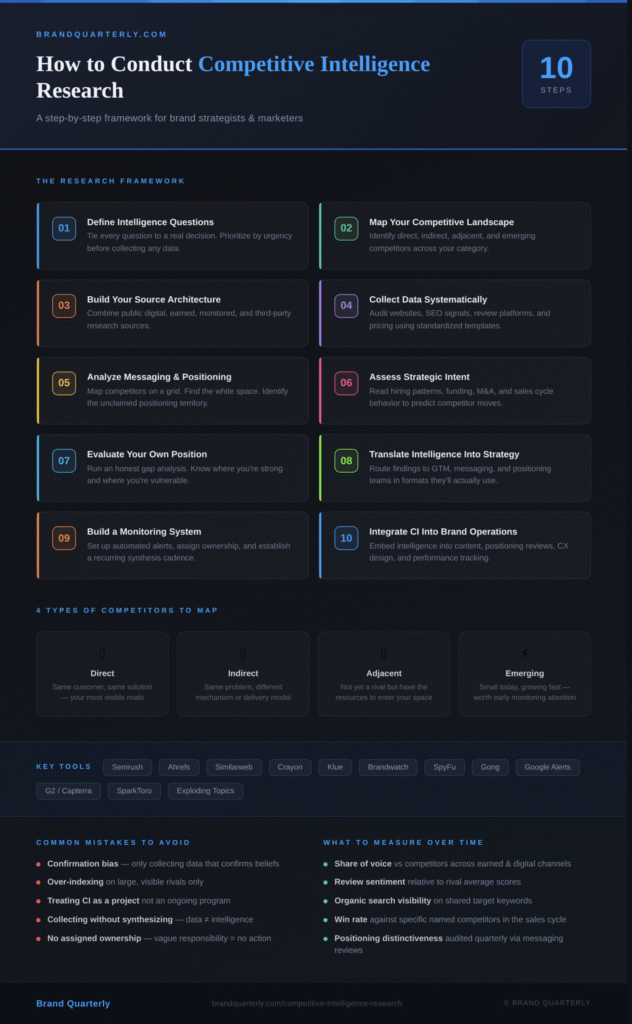
The ten-step process outlined here — from defining intelligence questions to building a continuous monitoring system and integrating intelligence into brand operations — provides a complete framework for building a competitive intelligence capability that actually delivers value. Like all strategic disciplines, it rewards consistency over intensity. A modest, well-maintained intelligence program that runs every week is worth far more than an exhaustive research project conducted once a year.
Start with the questions that matter most to the decisions you are making right now. Build the source architecture to answer them. Develop the analytical habits to turn data into insight. And create the operational rhythms to ensure that insight reaches the people who need it, when they need it. That is what serious competitive intelligence looks like — and it is one of the clearest advantages available to brands willing to do the work.
