
Understanding social media metrics is now a strategic necessity for brand performance. Every post, campaign, and interaction on social platforms generates data that can refine your strategy or highlight areas for improvement. However, many brand managers still focus on vanity metrics such as follower counts and likes, overlooking more meaningful insights. This article explains which metrics matter, how to interpret them, and how to leverage this intelligence to build a purposeful, high-performing brand.
Social platforms now serve as advanced indicators of brand health. When interpreted correctly, they are powerful tools for brand management. By the end of this guide, you will have a clear framework for measuring, monitoring, and improving your brand’s social media performance throughout the customer journey.
Why Social Media Metrics Matter for Brand Performance
Brand performance extends beyond sales and market share. It includes audience perception, engagement frequency, and public advocacy. Social media metrics provide real-time insights into these areas, offering immediate, detailed feedback unmatched by other channels.
Ignoring social media data leaves brands without direction. This can lead to investing in ineffective content or missing early signs of reputation issues. Tracking the right metrics links social activity to broader business outcomes, which is essential for demonstrating return on investment. Social metrics should be integrated into your measurement framework from the outset.
Social media platforms produce vast amounts of data, but not all metrics are meaningful. Prioritizing the right metrics and aligning them with brand goals distinguishes high-performing teams. This section provides the foundation to help you make faster, more informed decisions.
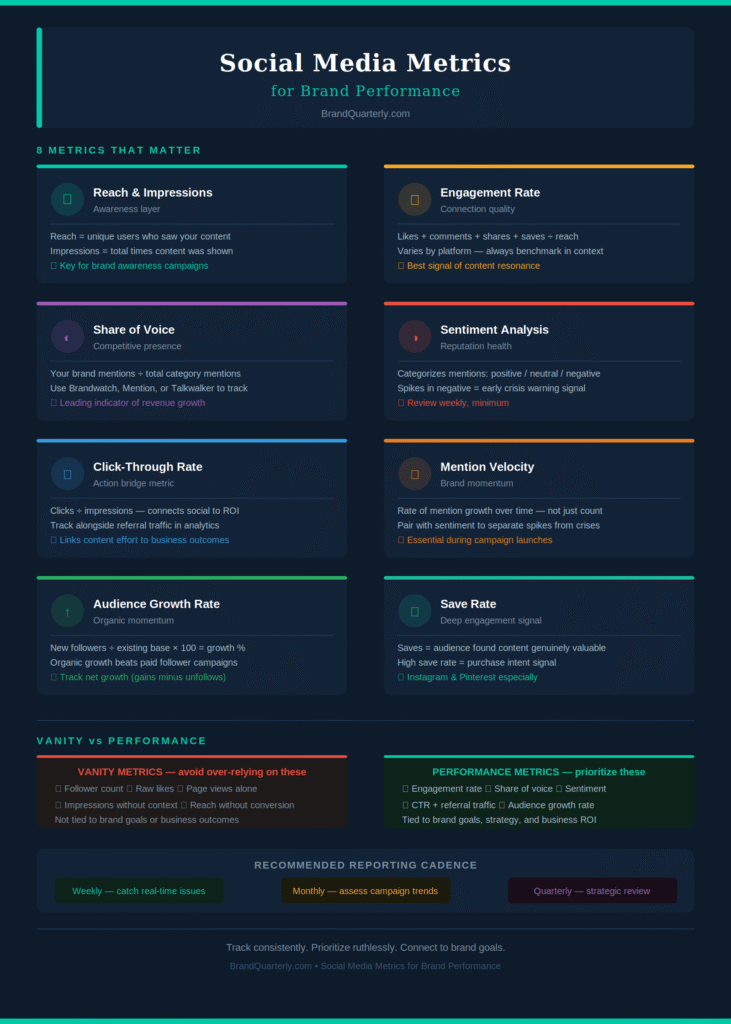
The Difference Between Vanity Metrics and Performance Metrics
Follower count is a classic vanity metric. While it may appear impressive, it provides little insight into brand resonance, conversion, or loyalty. A brand with fewer followers but higher engagement often outperforms one with a larger, less engaged audience. Metrics tied to behavior, sentiment, and business outcomes are far more valuable.
Performance metrics, on the other hand, are tightly aligned with your brand’s objectives. If you’re focused on awareness, you’ll prioritize reach, impressions, and share of voice. If loyalty is the goal, you’ll look at repeat engagement, shifts in sentiment, and how often your brand is mentioned over time. And if conversion is the priority, metrics like click-through rates, social referral traffic, and assisted conversions become key. Together, these metrics provide a more complete and meaningful picture of how your brand is performing.
This distinction is critical when reporting to leadership. Executives want to understand how social activity impacts revenue, customer acquisition, or brand equity. Relying on vanity metrics undermines credibility, while performance data demonstrates social media’s strategic value. When building your reporting process, always ask if each metric aligns with a specific brand objective.
Core Social Media Metrics Every Brand Should Track
Reach and Impressions
Reach is the number of unique users who see your content within a specific period. Impressions count every instance your content is displayed, including multiple views by the same user. Both metrics are important but serve different purposes: reach measures message breadth, while impressions measure exposure frequency.
For brand awareness campaigns, reach is valuable as it indicates whether your content is reaching new audiences. Consistently low reach suggests issues with your content strategy or platform alignment. Monitoring reach over time helps identify which formats and topics attract the broadest audiences.
Impressions help you understand how often your audience encounters your content. High impressions relative to reach may indicate over-saturation, leading to fatigue and lower engagement. Low impressions suggest limited distribution. Balancing reach and impressions is essential for sustainable brand visibility.
Engagement Rate
Engagement rate reliably indicates how well your content connects with your audience. It measures the percentage of viewers who interact with your content through likes, comments, shares, saves, or clicks. A high engagement rate shows your content is relevant and resonates with your target audience.
Engagement rate can be calculated in several ways, such as dividing total engagements by followers, reach, or impressions. Consistency in your chosen method is essential for accurate trend analysis and benchmarking. Apply the same calculation across all reporting periods and competitor comparisons.
Engagement rates vary by platform and industry, making context essential. For example, a 1% rate may be strong on LinkedIn but weak on Instagram. Benchmark against your historical data and industry averages to accurately assess performance. Understanding these nuances strengthens your brand identity across channels.
Share of Voice
Share of voice (SOV) measures your brand’s portion of online conversations within your category compared to competitors. It directly reflects competitive positioning and brand strength. An increasing SOV indicates your brand is capturing more audience attention in the market.
Monitoring share of voice requires social listening tools that track brand mentions, hashtags, and keywords across platforms in real time. Tools such as Brandwatch, Mention, Sprout Social, and Talkwalker enable this at scale. Comparing your SOV data to competitive benchmarks shows whether your content investments are driving real market presence.
An increasing share of voice often signals upcoming revenue growth, making it a key metric to track quarterly. If a competitor’s SOV rises while yours falls, investigate promptly. Quick responses to these shifts are a core benefit of disciplined social metrics tracking.
Sentiment Analysis
Raw mention counts are helpful, but understanding whether mentions are positive, negative, or neutral makes the data actionable. Sentiment analysis tools categorize the emotional tone of social content. Tracking sentiment trends over time reveals how your brand’s reputation is evolving in real time.
A sudden increase in negative sentiment is an early warning of a potential reputation issue. Early detection allows for a timely response before negative narratives take hold. Conversely, a steady rise in positive sentiment often reflects successful brand-building efforts or improved customer experiences.
Connecting sentiment data to your online reputation monitoring checklist is a powerful way to systematize your brand health tracking. Regular sentiment audits—weekly at minimum—should be part of every brand team’s operational rhythm. Over time, sentiment trend data becomes one of the richest sources of insight into what your audience actually thinks and feels about your brand on a day-to-day basis.
Click-Through Rate and Referral Traffic
Click-through rate (CTR) measures how often viewers click through to your website or landing page. It bridges social media performance and business outcomes. A strong CTR shows your content attracts attention and motivates action, which is the goal of brand-driven content marketing.
Referral traffic from social media, tracked via web analytics, shows which platforms and posts drive visitors to your digital properties. This data helps attribute social efforts to outcomes like lead generation or e-commerce transactions. Combined with on-site behavior data, it reveals both click volume and post-click actions.
Low CTR despite strong reach and engagement may indicate a disconnect between your social audience and website offering or a weak call to action. Regularly review top posts by CTR to identify effective messaging and formats. This analysis is essential for robust branding ROI measurement.
Advanced Social Media Metrics for Deeper Brand Intelligence
Brand Mention Volume and Velocity
Beyond mention counts, tracking the velocity of brand mentions—how quickly they rise or fall—provides insight into brand momentum. A steady increase suggests organic growth, while sudden spikes may indicate viral exposure, positive or negative. Combining mention volume with sentiment analysis clarifies these trends.
Mention velocity is particularly valuable during campaigns, when rapid response is crucial. Tracking mention growth after a campaign launch helps set expectations and optimize media support. Monitoring this metric allows brands to address declining momentum quickly and sustain reach.
Tracking mention volume over quarters or years measures the cumulative impact of brand-building. Consistent organic growth in mentions signals increasing cultural relevance. Comparing your mention velocity to competitors adds a valuable layer of competitive intelligence often overlooked by brand teams.
Audience Growth Rate
Total follower count is a vanity metric, but audience growth rate is a meaningful performance indicator. It measures how quickly your follower base expands as a percentage over time. A healthy brand should show positive audience growth across primary platforms.
It is also important to understand what drives audience growth. Organic growth, fueled by word-of-mouth and shareable content, is more valuable than growth from paid campaigns or giveaways. Organic followers are typically more engaged and aligned with your brand. Track follower sources to distinguish between organic and paid growth.
Analyze audience growth rate alongside churn, the rate of follower loss. Net audience growth, calculated as new followers minus unfollows, provides the most accurate view of audience momentum.
Save Rate and Content Value
On platforms like Instagram and Pinterest, save rate—how often users save your content—is an underappreciated metric. Saves indicate genuine value and deep engagement, often correlating with future purchase intent.
A high save rate on certain content types reveals what your audience currently values. Educational content, inspiration boards, how-to guides, and product comparisons often generate high save rates. Posts with above-average saves should be analyzed and replicated in future content.
Including save rate data in your content planning helps you create more content your audience wants to revisit. Over time, this builds a library of high-value assets that drive ongoing engagement. Understanding what your audience saves reveals their intentions, not just fleeting interest.
Building a Social Media Metrics Dashboard for Your Brand
Selecting the Right Tools
Building an effective brand performance dashboard begins with selecting tools that fit your needs and budget. Native platform analytics, such as Meta Business Suite, LinkedIn Analytics, and TikTok Analytics, offer foundational data at no cost. For cross-platform aggregation, advanced sentiment analysis, or competitor benchmarking, third-party tools are necessary.
Platforms such as Sprout Social, Hootsuite Analytics, and Brandwatch provide comprehensive dashboards for multi-platform data and benchmarking. For competitive share of voice and mention analysis, Talkwalker and Mention are leading options. Choose tools based on the metrics most critical to your brand goals, not just features or price.
Regardless of the tools you select, consistent data collection is essential for long-term trend analysis. Define metrics clearly, use consistent date ranges, and maintain regular reporting cycles to ensure comparability. Avoid frequent tool changes, as this disrupts historical comparisons and reduces data value.
Defining Your Reporting Cadence
The frequency of social media metric reviews should match your brand’s activity and decision cycles. Most teams benefit from weekly operational, monthly performance, and quarterly strategic reviews. Each cadence serves a distinct purpose and level of data analysis.
Weekly reviews help identify real-time issues, such as spikes in negative sentiment or underperforming posts. Monthly reviews clarify trends and assess campaign performance. Quarterly reviews evaluate whether your social media strategy is advancing key brand performance indicators.
Connecting your social media reporting to your broader brand measurement framework ensures that social data is never siloed from other brand health indicators. For example, linking social sentiment trends to your brand equity models and NPS data creates a richer, more integrated view of brand health. The brands that win consistently treat social metrics as one important input into a broader, systemic understanding of performance.
Connecting Social Media Metrics to Brand Strategy
Aligning Metrics with Brand Goals
A common mistake is tracking metrics without defining what success means for your brand. Before building dashboards or reports, align social media metrics with specific brand objectives. For example, prioritize impressions and reach for awareness goals, or sentiment recovery and positive mentions for rebuilding trust.
This alignment should involve the entire brand leadership team, not just marketing. When executives, product, and sales teams understand which social metrics are tracked and why, social data becomes a shared language for brand performance, not just a marketing metric.
Reviewing this alignment quarterly, in the context of your brand positioning evolution, ensures that your metrics remain aligned with your current strategic priorities. Brand goals shift over time as markets evolve, and your measurement framework needs to evolve alongside them. Metrics that were central eighteen months ago may be far less relevant today if your brand strategy has meaningfully pivoted.
Using Data to Refine Your Brand Messaging
Social media metrics provide a powerful feedback loop for brand strategists. Consistently high engagement, strong sentiment, and increased share of voice indicate what resonates with your audience. Incorporating these insights into your messaging framework sharpens your brand over time.
Analyzing top-performing content themes, tones, and formats reveals your brand’s strengths and audience priorities. For example, educational or user-generated content may outperform promotional posts. These patterns reflect actual audience behavior and are more valuable than focus group feedback.
Linking social metrics to your messaging pillars grounds your brand voice in evidence. Rather than chasing trends, refine your communication strategy based on what truly connects with your audience. This discipline creates a distinctive and resonant brand voice over time.
Common Mistakes in Tracking Social Media Metrics
Tracking Too Many Metrics at Once
More data is not always better. Tracking too many metrics often leads to comprehensive but non-actionable reports. Without prioritization, reporting fatigue sets in and few real decisions are made.
The solution is to prioritize metrics based on brand goals. For each objective, select two or three key metrics to track progress. Monitor other metrics in the background, but focus reporting on those that drive decision-making.
Review your metrics annually and remove those no longer aligned with active brand goals. This keeps your measurement framework focused and relevant. If a metric has not influenced decisions in six months, it should not be on your main dashboard.
Ignoring Context in Data Interpretation
Numbers without context can be misleading and lead to poor decisions. For example, a 30% drop in engagement may be due to reduced posting or external events. Context turns raw data into actionable insights.
Adding contextual notes to your reports is a valuable practice. Documenting campaign launches, holidays, algorithm changes, competitor actions, and major events alongside metrics improves trend analysis. Over time, this annotated history becomes a useful knowledge base for interpreting future data.
Context is also crucial when benchmarking competitors. A competitor’s engagement spike may result from a one-time event, not a sustainable trend. Distinguishing between lasting trends and anomalies is essential for strategic brand analysis.
Social Media Metrics and Long-Term Brand Performance
Building a Measurement Culture
The value of social media metrics increases as your dataset grows. One month of data reveals little, but tracking metrics over twelve to twenty-four months uncovers trends, seasonal patterns, and the long-term impact of brand investments.
Treating social data as a long-term organizational asset is essential for effective brand performance management. This requires commitment beyond marketing and consistent measurement practices, even through personnel changes, platform updates, and strategy shifts.
Documentation of metric definitions, data sources, and calculation methods ensures continuity even as team membership changes over time. A well-documented measurement practice is, in itself, a genuine competitive advantage that most organizations overlook. Long-term data also enables more sophisticated analysis, including correlation modeling of social metrics and business outcomes, which can inform digital brand management strategy at the highest level.
Integrating Social Metrics into Broader Brand Health Tracking
Social media metrics are most effective when integrated with other brand health data, such as surveys, website analytics, customer service, and sales intelligence. Combined, these sources provide a comprehensive view of brand health.
For example, combining social sentiment trends with Net Promoter Score data can show if online perception changes lead or follow shifts in customer loyalty. Linking referral traffic with conversion analytics reveals if social investment drives measurable growth. These integrations require cross-functional data sharing and organizational commitment.
An integrated view is increasingly important as brands operate in complex, multi-channel environments. Leading brands invest in sophisticated measurement systems. Social media metrics are most powerful when connected to the broader ecosystem of brand intelligence.
Conclusion
Social media metrics for brand performance are far more than operational scorecards for marketing teams. When deliberately chosen, consistently tracked, and interpreted with contextual intelligence, they become a strategic compass for sustained brand growth. They tell you what is working and what is not, what your audience values most, and how your brand is positioned relative to the competition in real time.
The brands that win on social media are not necessarily those with the largest budgets or the most followers in their category. They are the ones that listen most carefully to what their data is telling them—and act on those insights with discipline and speed. By building a focused metrics framework, connecting social data to brand strategy, and maintaining consistent measurement over time, you put your brand in a position to grow with clarity, confidence, and competitive advantage. Start by identifying your top three brand goals, align your core metrics to each one, and build your measurement infrastructure from there.
