
A customer experience strategy template gives your team a clear, repeatable system for turning every interaction into a loyalty-building moment. Without a structured approach, even well-intentioned CX efforts become fragmented and hard to measure. Brands that treat customer experience as a strategic discipline — not just a support function — consistently outperform competitors on retention, revenue, and referral rates. This guide walks you through a proven, six-phase customer experience strategy template you can adapt and apply straight away.
Customer experience sits at the heart of everything your brand communicates. Every touchpoint — from a paid ad to a post-purchase email — either reinforces or erodes the trust you have built. Understanding how to design those moments with intention is what separates brands that grow from brands that churn. By following the structure outlined here, you will be able to align your team, sharpen your messaging, and deliver experiences customers want to talk about.
What Is a Customer Experience Strategy?
A customer experience strategy is a deliberate, organization-wide plan for shaping how customers feel at every stage of their relationship with your brand. It goes beyond fixing complaints — it is about proactively engineering positive emotions. Consequently, brands that invest in CX strategy see measurable gains in Net Promoter Score, Customer Lifetime Value, and organic word-of-mouth growth. A well-built strategy connects your brand values directly to the moments customers encounter in the real world.
Many companies confuse customer service with customer experience. Customer service handles problems after they occur; customer experience design prevents those problems from arising in the first place. Furthermore, CX strategy encompasses the full arc of a customer relationship — from the first impression through to post-purchase advocacy. It is an ongoing discipline rather than a one-time project.
To build an effective strategy, you first need a shared definition of what a great experience means for your specific audience. That definition should draw on customer research, brand positioning, and competitive intelligence. In addition, it must be grounded in your brand’s unique personality and values so that the experience feels authentic rather than scripted. A brand strategy framework provides the foundation for your CX strategy.
Why a Customer Experience Strategy Template Saves Time and Reduces Errors
Starting from a blank page wastes time and introduces inconsistency. A customer experience strategy template gives your team a shared structure so everyone moves in the same direction from day one. Moreover, templates create an institutional memory — they capture best practices and let new team members get up to speed quickly. The consistency a template provides is itself a competitive advantage because it means your CX improves predictably over time.
Templates also make it easier to run reviews and audits. When your strategy lives inside a clear framework, gaps become obvious. Additionally, stakeholders — from marketing to product to customer success — can access the same document and understand their roles without lengthy briefings. This cross-functional alignment is one of the biggest drivers of CX improvement in high-growth brands.
Using a template does not mean being rigid. The best templates are built to be customized; therefore, you adapt the sections to your industry, audience, and growth stage. What stays constant is the thinking discipline: auditing before assuming, measuring before scaling, and iterating before declaring success.
Phase 1: Audit Your Current Customer Experience
Before you design anything new, you need an honest picture of where you stand today. A CX audit examines every touchpoint a customer encounters and evaluates the quality of that experience against your brand promise. Start by listing every channel and interaction: website, social media, sales calls, onboarding emails, support tickets, and packaging. Then rate each touchpoint on consistency, clarity, and emotional impact.
Quantitative data tells you what is happening. Collect your current NPS, CSAT (Customer Satisfaction Score), and CES (Customer Effort Score) benchmarks to establish a baseline. Equally important is qualitative data — customer interviews, review mining, and social listening reveal why customers feel the way they do. Together, these two lenses give you a full picture of your CX gaps and strengths.
Competitive benchmarking adds a third dimension to your audit. Understanding how your experience compares to rivals helps you identify where CX can become a genuine differentiator rather than just a catch-up exercise. BrandQuarterly’s competitive analysis for brands framework is a useful companion at this stage. Furthermore, it helps you frame CX investment conversations with leadership by showing exactly where you sit relative to the market.
Finally, document your findings in a structured format so they can inform every phase that follows. An audit that lives only in someone’s memory has no lasting value. Consequently, create a shared document or dashboard — ideally linked to your brand KPI system — so findings are visible, actionable, and revisitable. This documentation habit is what separates CX teams that improve year-on-year from those that keep re-diagnosing the same problems.
Phase 2: Define Your Customer Personas
Effective customer experience design starts with a precise understanding of who you are designing for. Customer personas are research-based profiles that represent the key segments of your audience — their goals, frustrations, behaviors, and decision-making patterns. Without clearly defined personas, CX improvements tend to be generic and fail to resonate with the people who matter most. Building three to five detailed personas gives your team a human face to design toward.
Each persona should include demographic context, but the most valuable information is psychographic and behavioral. What does this person value? What does a bad experience cost them emotionally? Additionally, how do they prefer to communicate, and at what stage of the journey are they most likely to disengage? These details turn a persona from a marketing exercise into a genuine design brief.
Your personas must connect directly to your customer segmentation strategy. Segmentation tells you who exists in your audience; personas tell you how to reach each group meaningfully. Furthermore, personas should be updated regularly as your audience evolves — a persona built from 2021 data may no longer reflect how your customers think in today’s market. Schedule a review at least once per year.
Share your personas widely across the organization. Sales, product, content, and support teams all benefit from knowing who the customer is and what matters to them. In fact, one of the most common causes of inconsistent CX is that different departments have different mental models of the customer. A shared persona set solves that problem and creates the alignment your CX strategy needs to function.
Phase 3: Map the Customer Journey
A customer journey map visualizes every step a customer takes — from first becoming aware of your brand through to becoming a loyal advocate. Journey mapping is one of the most powerful exercises in CX strategy because it makes invisible experiences visible. Once you can see the full arc of the customer relationship, you can identify exactly where delight is happening and where friction is causing drop-off. Without a map, your improvements will be reactive and patchy.
Build your journey map around the stages most relevant to your business model. Common stages include Awareness, Consideration, Purchase, Onboarding, Retention, and Advocacy. For each stage, document the touchpoints involved, the customer’s goal at that moment, their likely emotional state, and any barriers they face. This multidimensional view reveals patterns that raw data alone cannot.
BrandQuarterly’s deep-dive guide on what a customer journey map is provides a detailed framework for building your first map or refining an existing one. In addition, linking your journey map to your brand trust and customer experience strategy ensures that every improvement you make is grounded in building long-term emotional equity. These two frameworks are complementary — use them together.
Once your map is complete, prioritize the moments that carry the greatest leverage. Not every touchpoint is equal; some moments have an outsized influence on whether a customer stays or leaves. Therefore, focus your first round of improvements on the highest-impact interactions — typically the first meaningful use of your product and the first time something goes wrong. These are the moments that define whether a relationship deepens or ends.
Phase 4: Align Customer Experience With Your Brand Identity
Customer experience and brand identity are inseparable. The way a customer feels when they interact with you is, in practice, what your brand is to them. A brand that positions itself as innovative but delivers a confusing, slow-onboarding experience has a credibility problem—not a marketing problem. Consequently, your CX strategy must be built on the same foundations as your brand strategy.
Start by reviewing your brand positioning statement and asking whether your current experiences actually deliver on that promise. If your positioning centers on ease and simplicity, every touchpoint should reflect that. Similarly, if your brand values include transparency, your communications — from pricing pages to error messages — should feel open and honest. Brand-CX alignment is not aspirational; it is operational.
Your brand personality plays a similarly important role. The tone of your support communications, the language in your onboarding emails, and the visual feel of your digital interfaces all express personality. When these elements are inconsistent, customers sense it even if they cannot articulate why. Therefore, create a CX communication guide that translates your brand personality into practical guidance for every team that has customer contact.
Brand alignment also strengthens the business case for CX investment. When you can demonstrate that customer experience is a direct expression of brand value — not just a cost center — it becomes easier to secure budget and cross-functional buy-in. Moreover, it ties your CX metrics directly to brand equity metrics, giving leadership a clearer picture of what experience investment actually returns. This connection between CX and brand strategy is one of the most underused levers in growth marketing.
Phase 5: Set CX Goals and Define Your Key Metrics
A customer experience strategy without measurable goals is a wish list. Before you implement any changes, define exactly what success looks like and how you will measure it. Your goals should align with business outcomes — reduced churn, higher CLV, higher NPS, or improved conversion at a specific funnel stage. Furthermore, each goal should have an owner, a timeline, and a defined measurement cadence to build accountability from the start.
The most widely used CX metrics are NPS (Net Promoter Score), CSAT (Customer Satisfaction Score), CES (Customer Effort Score), and CLV (Customer Lifetime Value). Each measures a different dimension of experience quality. NPS captures overall loyalty and advocacy potential; CSAT measures satisfaction at a specific interaction; CES assesses how easy it was for a customer to accomplish a goal. Together, they provide a balanced view of experience health across the full journey.
In addition to these standard metrics, consider tracking qualitative signals — verbatim feedback, recurring themes in support tickets, and social sentiment. Numbers tell you whether your CX is improving; qualitative data tells you why and gives you the language to communicate improvements to customers. BrandQuarterly’s brand KPI dashboard template brings these metrics together in one place for easy reporting and review.
Set your goals at two levels: strategic (annual or quarterly targets tied to business outcomes) and tactical (sprint-level improvements to specific touchpoints). This dual structure keeps the big picture visible while ensuring day-to-day work moves the needle. Additionally, share your CX metrics openly with the whole organization — transparency drives engagement and makes it easier to course-correct quickly when something is not working.
Phase 6: Design and Implement CX Improvements
With your audit complete, personas defined, journey mapped, brand aligned, and goals set, you are ready to design and implement changes. Start with the highest-impact, lowest-effort improvements to build momentum and demonstrate early wins to stakeholders. Then move systematically through the higher-effort interventions that will drive sustained change over time. A phased approach prevents the overwhelm that kills many well-intentioned CX programs.
Good CX design is collaborative. Involve frontline teams — support agents, sales reps, account managers — because they understand the customer’s pain points better than anyone in a head office. Furthermore, involve customers directly through co-design sessions, usability tests, or beta groups. The improvements that land best are almost always built with customer input rather than only for customers from the outside in.
Your messaging pillars play a key role during implementation. Every new touchpoint or communication you introduce should reinforce your core messages — not just solve a functional problem. This is how CX improvements compound over time: each one reinforces brand perception and solves a practical issue. Without this discipline, improvements feel disconnected and fail to add up to a coherent brand experience.
Implementation also requires change management. CX improvements often involve changing how people work, not just what tools they use. Therefore, invest in training, clear process documentation, and regular check-ins to ensure changes are consistently applied. A rollout plan that accounts for human adoption — not just technical deployment — is far more likely to deliver lasting results than one that assumes people will simply adapt on their own.
Phase 7: Measure, Iterate, and Scale
No CX strategy delivers its full value on the first pass. The brands that build genuinely exceptional customer experiences do so through a disciplined cycle of measurement, learning, and iteration. After each improvement, measure the impact against your baseline metrics. If NPS improved at a specific touchpoint, understand why — and then ask whether that same principle can be applied elsewhere. This is how localized wins become systemic improvements.
Build a regular review rhythm into your strategy. A monthly tactical review catches issues early and keeps the team aligned on short-term priorities. A quarterly strategic review examines whether your CX goals are still relevant, whether new competitive pressures have emerged, and whether your personas need updating. Additionally, an annual deep audit — similar to the one that launched your strategy — ensures you are always working from current data rather than outdated assumptions.
Scaling successful CX improvements across a growing organization requires documentation and process clarity. What worked in one region, channel, or product line needs to be codified so it can be replicated without losing fidelity. BrandQuarterly’s scaling digital brand management guide addresses exactly this challenge and offers practical frameworks for maintaining consistency as your business grows. Furthermore, automation can play an important role — not in replacing human interaction, but in ensuring that consistent, personalized communications happen reliably at scale.
Iteration should be driven by data and customer feedback in equal measure. Data tells you what happened; feedback tells you what it meant to the customer. Use both to inform your next round of improvements and to maintain a genuine connection with the people you serve. Over time, this commitment to continuous improvement becomes a cultural asset — a shared belief that great customer experience is always possible and worth pursuing.
How Customer Experience Strategy Connects to Brand Differentiation
In crowded markets, product parity is the norm. Features get copied; prices get matched. Customer experience, however, is far harder to replicate because it lives in your organization’s culture, values, and operational habits. This is why CX has become the primary arena of brand differentiation for market-leading companies. If your experience is distinctly better than your competitors’, customers will choose you — and stay — even at a higher price point.
Your brand differentiation strategy should explicitly name customer experience as a differentiator and define what that means in practical terms. For example, if you differentiate on expertise, your CX should feature unusually knowledgeable support and content. If you differentiate on speed, every customer interaction should be faster and simpler than the industry norm. Differentiation only works when it is lived, not just stated.
Understanding what your competitors do well — and where they fall short — is essential context for your CX differentiation strategy. A thorough competitive intelligence program tells you where the experience bar currently sits, where gaps exist, and where you can claim ground that competitors are unlikely to contest. Furthermore, it helps you avoid investing heavily in areas where your competitors already have an insurmountable lead. Work smarter by differentiating where it matters most to your target audience.
Strong CX differentiation also accelerates the value of your brand messaging framework. When the experience you deliver actually matches the story you tell in your marketing, credibility compounds. Every customer who lives your brand promise becomes a validator for every prospect who encounters your advertising. This virtuous cycle — where CX feeds marketing credibility and marketing credibility attracts better-fit customers — is the growth engine that the best brands have quietly built over the years.
Integrating CX Strategy Into Your Go-To-Market Plan
Customer experience strategy is not a post-launch consideration — it should be built into your go-to-market plan from the beginning. The expectations you set in your GTM messaging create the CX bar you must clear once a customer commits. Therefore, the CX and GTM teams must work together, not in sequence. BrandQuarterly’s GTM strategy guide provides a strong framework for integrating CX thinking from the earliest stages of market planning.
Your ideal customer profile is another critical input. When you know exactly who you are building the experience for, you can make smarter trade-offs — investing heavily in the touchpoints your best customers value most and simplifying or automating the ones that are less important to them. This focus prevents the CX dilution that happens when teams try to optimize everything simultaneously and end up improving nothing meaningfully.
A GTM-integrated CX strategy also improves retention from day one. Many companies lose customers in the first 90 days because their onboarding experience fails to deliver on the acquisition promises they made. Additionally, the transition from marketing to onboarding is often the most jarring — the brand voice shifts, the experience becomes more functional and less aspirational, and the customer wonders whether they made the right choice. Deliberately designing this handoff into your GTM plan dramatically reduces early churn.
Finally, align your CX strategy with your value proposition. Your value proposition is what you promise; your customer experience is what you deliver. When the two are tightly aligned, customers receive exactly what they expected — and sometimes more. That consistency is the bedrock of trust, and trust is the foundation on which every high-value, long-term customer relationship is built.
Common Mistakes to Avoid in CX Strategy
The most common mistake brands make is treating CX as a reactive discipline — fixing problems as they emerge rather than designing positive experiences proactively. Reactive CX is expensive and demoralizing; proactive CX is efficient and inspiring. Accordingly, shift your team’s mindset from “how do we handle complaints better?” to “how do we design experiences so fewer complaints arise?” This is a cultural shift as much as a strategic one.
Another frequent error is measuring the wrong things. Tracking vanity metrics — page views, social followers, email open rates — tells you about reach but not experience quality. Instead, focus relentlessly on the metrics that capture how customers feel: NPS, CSAT, CES, and qualitative sentiment. Furthermore, make sure your metrics are tied to specific touchpoints so you know exactly where improvements are driving results and where work still needs to be done.
Siloed CX ownership is a third common problem. When customer experience is the responsibility of one team — usually support or customer success — other departments behave as though it has nothing to do with them. In reality, CX is created by product decisions, pricing structures, marketing messages, and operational processes as much as by support interactions. Therefore, CX strategy must be a cross-functional discipline with clear ownership and accountability distributed across the organization.
Finally, many brands underinvest in closing the loop with customers. When a customer takes the time to give feedback, they expect to see evidence that it was heard. Closing the loop — thanking customers, explaining what you changed, and demonstrating improvement — builds trust and converts detractors into advocates. Additionally, it gives your team a powerful source of ongoing insight that no survey or analytics tool can match.
Quick-Reference Customer Experience Strategy Template
Use this framework as your starting point. Adapt each section to your brand, industry, and current CX maturity.
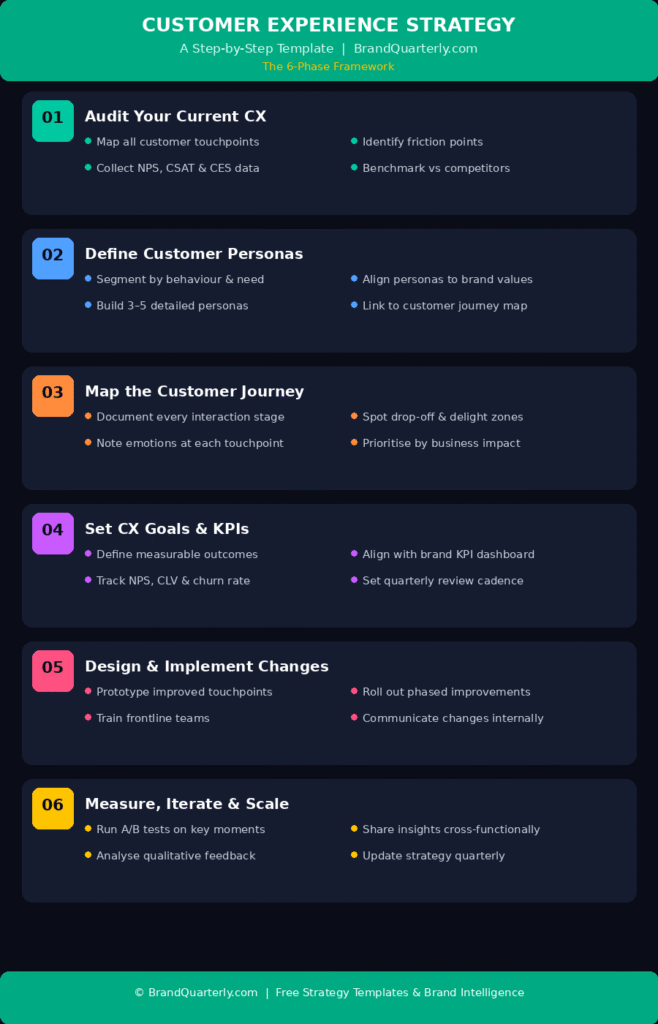
Phase 1 — Audit: Map all existing touchpoints. Collect NPS, CSAT, and CES baselines. Identify the top five friction points and the top five delight moments. Benchmark against two or three direct competitors.
Phase 2 — Personas: Build three to five research-based customer personas. Include goals, frustrations, preferred channels, and decision triggers. Link each persona to a customer segment.
Phase 3 — Journey Map: Document each stage of the customer journey from Awareness to Advocacy. For each stage, note the touchpoints, customer goal, emotional state, and current gaps.
Phase 4 — Brand Alignment Review your brand positioning, values, and personality. Audit whether existing touchpoints reflect those elements. Create a CX communication guide for frontline teams.
Phase 5 — Goals and Metrics: Define three to five measurable CX goals tied to business outcomes. Assign ownership and a review cadence to each. Set up a shared KPI dashboard.
Phase 6 — Implement and Iterate. Prioritize improvements by impact and effort. Involve frontline teams and customers in design. Implement in phases, measure after each phase, and iterate based on the results.
Conclusion
A customer experience strategy template turns an abstract ambition — delivering great experiences — into a structured, measurable program your whole organization can execute. The six-phase framework covered here gives you everything you need to audit, design, align, and continuously improve the experiences your brand creates. Moreover, it connects CX directly to the brand and commercial outcomes that matter most to your business.
The brands that win over the next decade will be the ones that treat customer experience as seriously as product development or go-to-market strategy. They will invest in understanding their customers deeply, design touchpoints with intention, measure rigorously, and iterate relentlessly. Starting with a solid template is not about taking shortcuts — it is about channeling your energy into the right work from day one rather than reinventing the wheel.
