
Every brand that wins in its market does so because it understands the terrain before charging into battle. A competitive landscape mapping template gives you a structured way to visualize where competitors stand, where gaps exist, and where your brand has the most room to grow. Without this kind of structured view, decisions about positioning, messaging, and strategy tend to rely on gut instinct rather than evidence. This article walks you through exactly how to use a competitive landscape mapping template, why it matters, and what to do with the insights you uncover.
What Is a Competitive Landscape Mapping Template?
A competitive landscape mapping template is a structured framework that helps you organize, visualize, and analyze the competitive environment around your brand. It goes beyond a simple list of competitors. Instead, it layers in positioning data, strengths and weaknesses, messaging themes, pricing tiers, audience focus, and perceived market value. The template becomes a living strategic document that informs decisions across brand, marketing, product, and sales. When used consistently, it transforms scattered competitor research into clear, actionable intelligence.
The template typically includes several core components: a competitor identification matrix, a two-axis positioning map, a strengths and weaknesses summary, a messaging and tone analysis, and a gap analysis grid. Each of these sections builds on the last to produce a full picture of the competitive landscape. You do not need to complete every section at once. Many teams start with the positioning map and add depth over time as they gather more data.
Why Competitive Landscape Mapping Matters for Brand Strategy
Understanding your competitors is not a one-time task. It is an ongoing discipline that shapes how you communicate your brand’s value, price your products, and differentiate in your market. A well-maintained competitive landscape mapping template keeps your entire team aligned around a shared view of the market. It also prevents one of the most common branding mistakes: assuming your positioning is unique when a competitor already owns that space in the customer’s mind.
Brand positioning is ultimately a relative concept. Customers do not evaluate your brand in isolation. They compare you to alternatives, consciously or not. When you understand how brand positioning actually works, you quickly realize that the space you occupy in the market is defined as much by who surrounds you as by what you say about yourself. Competitive landscape mapping makes those surroundings visible and manageable.
Teams that practice regular competitive mapping also tend to develop stronger brand differentiation strategies. They can see clearly which positioning territories are crowded, which are unclaimed, and which are occupied by vulnerable competitors. That visibility is what turns competitive research from a passive exercise into an active strategic advantage
.
Step 1 — Identify Your Competitive Set
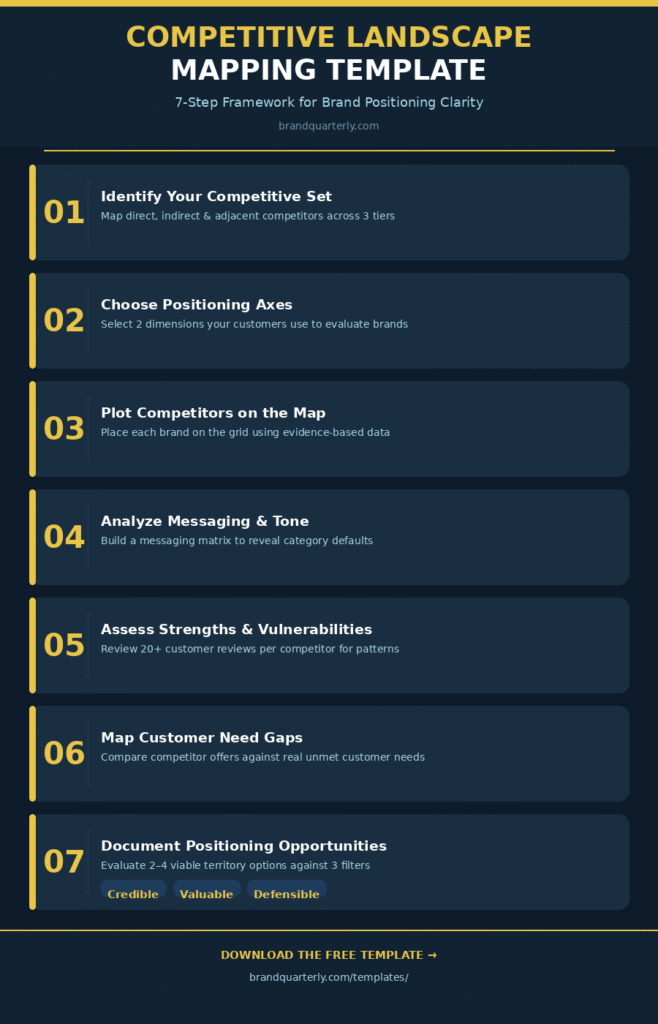
Before you can map the landscape, you need to know who belongs on the map. Most brands operate within at least three competitive layers: direct competitors, indirect competitors, and aspirational or adjacent competitors. Direct competitors offer products or services similar to those of a similar audience. Indirect competitors solve the same problem through a different mechanism. Adjacent competitors may not target your audience today, but could move into your space quickly.
Start by listing at least eight to twelve competitors across all three categories. Use customer interviews, search data, review platforms, and sales team feedback to inform this list. Do not rely solely on brands you already know. Many of the most dangerous competitive threats are brands your customers mention in conversations you are not yet having. Competitive intelligence research often reveals surprising names that never appeared in executive discussions.
Once your competitor list is built, group them into tiers based on how directly they compete with your core offer. Tier one competitors share your audience and price point. Tier two competitors overlap in some but not all dimensions. Tier three competitors are worth watching, but do not require deep weekly analysis. This tiering system helps you allocate your research effort efficiently. It also keeps your competitive landscape mapping template from becoming so broad that it loses focus.
Step 2 — Choose Your Positioning Axes
The positioning map is the visual centerpiece of most competitive landscape mapping templates. It places competitors on a two-axis grid so you can see how the market clusters and where white space exists. Choosing the right axes is the most critical decision in this entire process. Poorly chosen axes produce a map that looks interesting but tells you nothing useful.
Effective axes reflect the dimensions your customers actually use to evaluate options. Common examples include price versus quality, traditional versus innovative, niche versus broad audience, and product-led versus service-led. However, the most powerful axes are often category-specific. A software company might map automation depth against ease of use. A professional services firm might map speed of delivery against level of customization. Think carefully about how customers in your category actually make decisions, and let that thinking guide your axis choices.
You will likely test two or three axis combinations before finding the one that produces the most revealing map. That is normal and worthwhile. The goal is a map where competitor clusters become obvious, and at least one area of meaningful white space becomes visible. That white space is where your brand’s positioning statement will eventually live if you choose to pursue it.
Step 3 — Plot Competitors on the Map
With your axes chosen, it is time to place each competitor on the grid. This step requires honest, evidence-based judgment rather than wishful thinking. Gather data points for each competitor before placing them. Review their pricing pages, read their customer testimonials, analyze their website copy, and study their sales materials. Your goal is to understand how they position themselves — and more importantly, how the market perceives them.
Pay particular attention to the gap between a competitor’s stated positioning and their actual market perception. A brand may claim to be premium but attract predominantly mid-market customers. Another brand may describe itself as innovative but use conservative, risk-averse messaging throughout its content. These gaps are important because they reveal either an opportunity to claim better positioning or a cautionary example of misalignment to avoid. Signals from competitor behavior often tell a more accurate story than their official messaging ever will.
Once all competitors are plotted, step back and look at the map as a whole. Note where clusters form. Clusters indicate competitive intensity — lots of brands fighting for similar positioning. Note where the map is sparse or empty. Those sparse areas represent either untapped positioning opportunities or territories that competitors have abandoned because customers do not value them. Your competitive landscape mapping template should explicitly capture both findings.
Step 4 — Analyze Competitor Messaging and Tone
Positioning maps show where brands sit spatially, but they do not capture the language and tone they use to maintain their position. A messaging analysis layer is essential for any competitive landscape mapping template that will inform the brand communications strategy. Gather the homepage headline, primary value proposition, and three to five core messaging themes from each competitor. Then look for patterns.
Most competitive landscapes reveal a dominant messaging mode — a common vocabulary and emotional register that nearly every competitor defaults to. In B2B technology, this is often some combination of “efficiency,” “scalability,” and “results.” In consumer wellness, it tends to cluster around “natural,” “empowering,” and “science-backed.” When most competitors use similar language, the brand that speaks differently immediately stands out. Building messaging pillars that genuinely influence decisions means deliberately avoiding the default vocabulary of your category.
Document your findings in a simple messaging matrix within your template. Each row represents a competitor. Columns capture their primary benefit claim, emotional tone, audience language, and any distinctive phrases or concepts they own. Once your messaging matrix is complete, you will see which territory is open at a glance. That open territory is where you can create genuine separation — not just in positioning, but in voice and personality.
Step 5 — Assess Strengths, Weaknesses, and Vulnerabilities
A competitive landscape mapping template is incomplete without a clear-eyed assessment of each competitor’s strengths and vulnerabilities. This section is where most teams rush or cut corners, but it is often where the highest-value strategic insights live. For each tier-one competitor, document at minimum: their most defensible competitive advantage, their most commonly cited weakness in customer reviews, their pricing model, and any recent strategic shifts in their messaging, product, or positioning.
Customer reviews on platforms like G2, Capterra, Trustpilot, and Google are invaluable here. They give you direct access to the language customers use to describe both frustrations and praise. Read at least twenty reviews per competitor before drawing conclusions. Look for recurring themes rather than individual complaints. Qualitative intelligence methods like this often surface insights that quantitative data entirely misses.
Also assess each competitor’s momentum. Is the brand growing or contracting? Are they hiring aggressively or quietly reducing headcount? Have they launched new products or pivoted their messaging recently? Momentum matters because a strong competitor who is losing direction is more vulnerable than a weaker competitor who is growing with conviction. Your template should capture these momentum signals alongside static strength and weakness data.
Step 6 — Map the Gap Between Competitors and Customer Needs
The most powerful section of your competitive landscape mapping template is the gap analysis. This is where you compare what competitors offer against what customers actually need and value. Even in mature, crowded markets, gaps between customer needs and competitive offerings persist. Finding them requires combining your competitor data with direct customer insight.
Conduct at least five to ten customer or prospect interviews focused specifically on how they evaluate and choose between options in your category. Ask them what matters most in their decision, what frustrates them about current solutions, and what they wish existed that does not yet. Then compare their answers to what competitors are currently emphasizing. The space between what customers want and what competitors deliver is your strategic opportunity zone.
This gap analysis connects directly to your go-to-market strategy. When you know where the unmet needs live, you can build a GTM plan that leads with those needs rather than simply replicating what competitors already say. That kind of customer-first differentiation is far more durable than feature-based competitive claims. It also tends to produce stronger customer loyalty because you are solving something real rather than fighting on the same terms as everyone else.
Step 7 — Document Positioning Opportunities
With your competitive map, messaging analysis, strengths and weaknesses assessment, and gap analysis complete, you are ready to document specific positioning opportunities. This section of your competitive landscape mapping template captures two to four distinct territory options your brand could realistically pursue based on the evidence you have gathered. Each opportunity should include a description of the territory, the customer segment it serves best, the competitors it differentiates from, and the primary claim or promise it would require you to make.
Evaluate each opportunity against three filters. First, is it credible — does your brand have or can it develop the capability to own this position authentically? Second, is it valuable — do enough customers care enough about this dimension to make it a commercially meaningful differentiator? Third, is it defensible — can you hold this position over time without it being easily copied by a larger competitor? A brand strategy that survives market changes is almost always built on positioning that passes all three filters.
Document your evaluation for each opportunity directly in the template. This creates a decision trail your team can return to when priorities shift or new competitors emerge. It also makes it much easier to brief agencies, new team members, or leadership on why you chose one positioning direction over another.
How to Use the Template Regularly
A competitive landscape mapping template delivers its full value only when used consistently, rather than as a one-time exercise. Build a regular review cadence into your brand and marketing operations. Most teams find that a quarterly review works well for the full template, while a monthly scan for new messaging shifts and competitor launches keeps the most time-sensitive data up to date.
Assign clear ownership for maintaining the template. Without ownership, the document quietly becomes outdated and loses its authority as a strategic reference. The owner does not need to conduct all the research themselves. They do, however, need to coordinate input from sales, product, customer success, and marketing to ensure the template reflects the full picture of what the organization is seeing in the market. Automating parts of competitive monitoring can significantly reduce the manual burden of keeping the template up to date.
When major changes occur — a competitor raises a large funding round, a new entrant appears, a category leader rebrands — trigger an unscheduled review. These moments of market disruption often provide the clearest strategic signal of where the landscape is shifting. Teams that update their competitive landscape mapping template in response to these events are better positioned to act quickly. Those who wait for the next scheduled review often find themselves reacting rather than anticipating.
Common Mistakes to Avoid
Several predictable mistakes undermine the value of competitive landscape mapping for teams attempting it for the first time. The first and most common is mapping only direct competitors. When you focus exclusively on your most obvious rivals, you miss the peripheral brands that are quietly reshaping customer expectations in your category. Widen your view intentionally and update the competitive set every six to twelve months to avoid blind spots.
The second mistake is building a map based on how competitors describe themselves rather than how customers perceive them. Competitor websites and press releases represent aspirational positioning, not market reality. A brand that calls itself a market leader may actually have poor brand equity in practice. Use customer research, third-party reviews, and competitive analysis data to ground your mapping in perception rather than self-description.
A third frequent mistake is treating the competitive landscape map as a finished product rather than a working document. The moment you stop updating it, it starts misleading you. Markets shift, competitors pivot, customer priorities evolve. Your template needs to evolve alongside them. Build maintenance into your planning calendar from the start, and treat the template as infrastructure — not a deliverable you complete and file away.
Connecting Competitive Mapping to Brand Architecture and Audience Strategy
Competitive landscape mapping does not operate in isolation. Its insights inform your brand architecture decisions, audience segmentation strategy, and overall brand identity development. When you know which competitive territories are crowded and which are open, you can make sharper decisions about how to structure your brand portfolio, prioritize audience segments, and develop a brand personality that occupies distinct emotional territory.
Brand architecture decisions, for example, become significantly cleaner when you can see how competitors structure their own portfolios and where the structural gaps in the market exist. Target audience prioritization also benefits from competitive mapping, which reveals which segments are underserved by current competitive offers — and therefore more likely to respond strongly to a brand that speaks directly to their unmet needs.
Similarly, your brand messaging framework should reflect insights into the competitive landscape at every level. The claims you prioritize, the language you choose, and the emotional territory you attempt to own should all be informed by a clear understanding of what competitors are already saying. Without that understanding, even a beautifully written messaging framework risks echoing the competition rather than standing out.
Using AI and Data Tools to Enhance Your Competitive Mapping
Modern competitive landscape mapping can be significantly enhanced by technology. AI tools now make it possible to monitor competitor messaging changes, track share of voice across digital channels, and analyze large volumes of customer feedback at a scale that would be impossible manually. Using AI for competitive intelligence does not replace strategic thinking, but it dramatically accelerates data gathering and helps surface patterns that human analysts might miss.
Several tool categories are worth integrating into your competitive mapping workflow. Social listening platforms track brand mentions, sentiment, and share of voice across social channels. SEO tools like SEMrush and Ahrefs reveal competitor keyword strategies and content gaps. Review aggregation tools surface recurring customer feedback themes across platforms. Together, these tools can automatically populate large sections of your competitive landscape mapping template, freeing your team to focus on interpretation and strategy rather than manual research.
The key is to treat these tools as inputs to human judgment, not replacements for it. Data tells you what is happening. Strategy tells you what to do about it. Your competitive landscape mapping template should always culminate in clear strategic choices — not just a comprehensive database of competitor attributes.
Competitive Landscape Mapping and Go-to-Market Planning
One of the most direct applications of a completed competitive landscape mapping template is informing a go-to-market strategy. When launching a new product, entering a new market, or repositioning an existing brand, a current competitive map provides the foundation for a GTM plan grounded in market reality rather than internal assumptions.
Your GTM messaging, channel choices, and audience targeting should all reflect the competitive landscape. If the map shows that all competitors reach their audience through the same two or three channels, there may be an advantage to showing up elsewhere. If it reveals that competitors all speak in a similar register — formal, technical, or corporate — there may be an opportunity to differentiate through tone and voice alone. Types of go-to-market strategies often differ less in structure than in how well they reflect the actual competitive context their brand is entering.
The competitive landscape mapping template also helps teams avoid one of the most costly GTM mistakes: launching with positioning that replicates what a stronger competitor already owns. When you can see the map clearly, you can build a launch strategy that finds its own lane rather than fighting for territory already claimed by a more established brand.
Conclusion
A competitive landscape mapping template is one of the most practical strategic tools any brand team can maintain. It makes the invisible visible — turning a chaotic, complex market into a clear, navigable terrain. When built with real evidence and maintained with discipline, it becomes a source of ongoing strategic advantage. It sharpens your positioning, informs your messaging, improves your audience targeting, and grounds your go-to-market planning in market reality.
The template in this article is designed to be used immediately, iterated over time, and shared across the teams that need to understand your competitive context. Download it below, work through each section with your team, and revisit it every quarter. The brands that win over the long term are not always the ones with the most resources. They are the ones who understand their market most clearly and act on that understanding consistently and with discipline.
