
Managing a brand in 2026 is a fundamentally different challenge than it was even three years ago. Your brand exists simultaneously across dozens of digital touchpoints — your website, social channels, third-party review platforms, partner networks, marketplaces, and AI-generated content surfaces — and inconsistency at any one of them chips away at the trust and recognition you’ve worked to build.
Brand management tools have evolved to meet this complexity. What once meant a shared Dropbox folder of logo files and a style guide PDF now means integrated platforms that govern everything from asset distribution and campaign consistency to competitive monitoring and performance measurement.
But the market is crowded, and the differences between tools matter. Choosing the wrong platform — one that’s built for enterprise scale when you need SMB simplicity, or one that focuses on social listening when your real gap is digital asset management — wastes time, budget, and the organizational goodwill required to get a new tool adopted.
This guide compares the 10 best brand management tools available in 2026, with honest assessments of what each one does well, where it falls short, and which type of business it serves best.
Before diving in, if you haven’t yet taken stock of where your brand currently stands, our Digital Brand Audit Template gives you a structured, step-by-step framework for assessing every layer of your brand presence — a useful foundation before committing to any new toolset.
What to Look for in a Brand Management Tool
Not all brand management platforms solve the same problem. Before evaluating any tool, it helps to be clear on which of the following functions matter most to your business:
Digital Asset Management (DAM): Centralizing, organizing, and distributing brand assets — logos, photography, templates, video, copy — so everyone in your organization and your partner network is working from approved, current materials.
Brand Guidelines Management: Making your visual and verbal identity standards accessible and enforceable across teams, agencies, and vendors.
Brand Monitoring and Reputation Management: Tracking how your brand is being mentioned, represented, and perceived across the web, social platforms, and review sites.
Creative Production and Templating: Enabling non-designers to produce on-brand content at speed without violating brand standards.
Analytics and Brand Performance Measurement: Quantifying brand health through metrics like share of voice, sentiment, engagement, and visual consistency.
The best tool for your business is the one that addresses your highest-priority gap, integrates with tools you’re already running, and can be realistically adopted by your team. Keep that lens active as you read through the comparisons below.
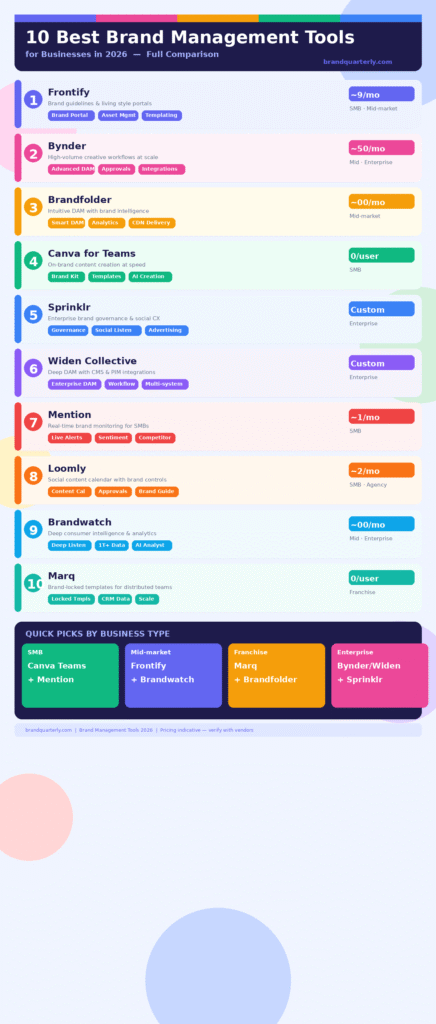
1. Frontify
Best for: Growing businesses and mid-market brands that need a single source of truth for brand identity
Frontify has established itself as one of the most complete brand management platforms available, and in 2026, it remains a top choice for businesses that have outgrown shared drives but aren’t ready for the complexity of enterprise DAM systems.
At its core, Frontify is a brand guidelines platform — but it’s expanded well beyond that. You get a living, interactive brand portal where your visual identity, tone of voice, logo usage rules, color palettes, typography, and iconography live in one accessible, shareable location. Unlike a static PDF style guide, a Frontify brand portal is searchable, linkable, and updateable in real time.
The platform’s asset management capabilities are solid for the mid-market: you can upload, tag, organize, and distribute assets directly through the portal, with version control that prevents outdated files from circulating. Its templating features allow marketing teams to create approved content formats that non-designers can adapt without breaking brand consistency.
Where Frontify earns particular praise is in its usability. Brand portals are genuinely beautiful and easy for both internal teams and external agencies to navigate. Onboarding friction is low compared to more complex enterprise systems.
Limitations: Frontify’s monitoring and analytics capabilities are lighter than dedicated listening tools. If competitive intelligence or sentiment tracking is a priority, you’ll need to supplement it with a separate tool.
Pricing: Starts around $79/month for small teams; scales with user count and feature set.
2. Bynder
Best for: Mid-to-large businesses with high-volume creative production and complex asset workflows
Bynder is a digital asset management platform built for scale. If your business produces a significant volume of creative assets — across campaigns, regions, markets, and channels — and distributes them to a broad network of internal teams, agencies, and channel partners, Bynder’s infrastructure is designed for exactly that.
Its core strength is workflow. Bynder’s creative workflow tools manage the full lifecycle of an asset from creative brief through review, approval, and distribution — with audit trails, version control, and permission layers throughout. For businesses where the cost of distributing an incorrect or outdated asset is high (retail, financial services, franchise networks), this workflow discipline is genuinely valuable.
Bynder’s AI-powered asset tagging has improved considerably. The platform automatically tags uploaded assets with descriptive metadata, making large libraries searchable without requiring manual tagging at scale. Its brand template studio allows marketing teams to produce localized, channel-specific variations of approved content formats within defined brand parameters.
The platform also integrates broadly with the marketing technology stack: Salesforce, HubSpot, Adobe Creative Cloud, Canva, Hootsuite, and dozens more.
Limitations: Bynder is priced for the mid-to-enterprise market and may be more system than small businesses need. Implementation requires meaningful investment; plan for a structured rollout rather than a quick setup.
Pricing: Custom pricing; typically starts in the $450–$600/month range for small deployments.
3. Brandfolder
Best for: Businesses prioritizing intuitive DAM with strong sharing and permissions capabilities
Brandfolder (acquired by Smartsheet) delivers one of the cleanest user experiences in the DAM category. Its interface is intentionally simple — assets are easy to upload, organize, find, and share — which drives adoption rates that more complex platforms often struggle to match.
What distinguishes Brandfolder in 2026 is its Brand Intelligence feature: AI-powered analytics that surface insights on how assets are being used across the organization. You can see which assets are being downloaded most frequently, which are being shared externally, and which are sitting unused — intelligence that helps brand teams make smarter decisions about what to create more of and what to retire.
Brandfolder’s CDN-powered asset delivery makes it particularly useful for businesses with distributed teams or global operations; assets load fast regardless of where team members are located. Its Guest Portal feature allows secure, controlled sharing of assets with external parties without requiring them to create accounts.
The permissions and sharing controls are among the best in class — granular enough to manage complex partner ecosystems where different parties should have access to different asset collections.
Limitations: Like most DAM-first tools, Brandfolder is lighter on brand guidelines and monitoring capabilities. It’s an asset management solution, not a full brand management platform.
Pricing: Starts around $300/month; scales with storage and users.
4. Canva for Teams (with Brand Kit)
Best for: Small to medium businesses that need consistent, on-brand content production at speed
Canva needs little introduction, but Canva for Teams with Brand Kit is a meaningfully different product from the free personal version — and one of the most practical brand management tools available for SMBs in 2026.
The Brand Kit functionality allows businesses to lock in brand colors, fonts, logos, and templates at the workspace level. When a team member creates new content in Canva, they’re working within a pre-defined brand system by default. This passive enforcement of brand consistency is extraordinarily effective for businesses where design resources are limited and content production is distributed across non-designer team members.
Canva’s template library has expanded dramatically. Businesses can create custom branded templates for social posts, presentations, proposals, email headers, reports, and more — templates that team members can edit within brand parameters but can’t break structurally. The Magic Resize tool adapts content across formats instantly, maintaining proportions and layouts.
The 2026 version of Canva for Teams also includes AI-powered copy and image generation tools that integrate directly into the design workflow, which meaningfully accelerates content production for lean marketing teams.
Limitations: Canva is primarily a content creation tool, not a brand management platform. It doesn’t offer monitoring, competitive intelligence, performance analytics, or robust asset management beyond what’s in the workspace. For businesses that need those capabilities, Canva works best as a production layer alongside a more comprehensive brand management system.
Pricing: Canva for Teams starts at $10/user/month (billed annually). Exceptional value for the production capabilities provided.
5. Sprinklr
Best for: Enterprise brands managing brand presence, social listening, and customer experience at scale
Sprinklr operates in a different weight class from most tools on this list — it’s a unified customer experience management platform that encompasses social media management, customer service, advertising, and brand monitoring under one roof.
What makes it relevant to a brand management context is its Brand Governance module, which allows enterprise organizations to enforce brand standards, approval workflows, and publishing controls across every social and digital channel globally. For a multinational brand managing dozens of regional teams, this kind of governance infrastructure is essential.
Sprinklr’s listening and intelligence capabilities are among the most advanced available. The platform monitors brand mentions across 30+ social networks, news outlets, review sites, and forums in real time, with sentiment analysis, trend detection, and competitive share-of-voice tracking. For brand teams whose job includes reputation management and competitive monitoring, this depth of intelligence is difficult to match.
Limitations: Sprinklr’s complexity and pricing make it appropriate for large enterprises, not SMBs or growing mid-market businesses. Implementation requires dedicated resources and typically involves an extended onboarding process. Budget conversations should start in the five-figure annual range.
Pricing: Custom enterprise pricing.
6. Widen Collective (Acquia DAM)
Best for: Enterprises requiring deep DAM capabilities with content operations integration
Widen Collective, now part of Acquia’s digital experience platform, is a robust enterprise DAM solution built for organizations with complex content operations — multiple product lines, global markets, regulatory requirements on asset use, and deep integration needs with CMS, e-commerce, and PIM (Product Information Management) systems.
Its Insights module provides analytics on asset performance across the distribution chain, including metrics on which assets are being used in external-facing content and how they’re performing against engagement benchmarks. For brand teams responsible for the quality and consistency of content across a large organization, this visibility is genuinely powerful.
Widen’s integration ecosystem is one of its strongest attributes. It connects natively with Salesforce, Adobe Experience Manager, Sitecore, Drupal, Shopify, and dozens of other enterprise platforms — meaning assets flow seamlessly into content workflows without manual transfer.
Limitations: Positioned firmly at the enterprise end of the market. Implementation and total cost of ownership are significant.
7. Mention
Best for: SMBs and growing businesses that need accessible brand monitoring and social listening
Mention fills an important gap in the market: it provides meaningful brand monitoring capabilities at a price point that’s accessible to small and medium businesses. While it lacks the depth of enterprise listening tools like Sprinklr or Brandwatch, it covers the fundamentals well enough that most SMBs will find it more than sufficient.
The platform monitors brand mentions across social networks, news sites, blogs, forums, and review platforms in real time. Alert thresholds allow you to be notified immediately when mention volume spikes — useful for catching potential reputation issues early. Sentiment analysis helps you quickly distinguish positive brand coverage from neutral references from potentially damaging mentions.
Mention’s competitive monitoring feature is particularly useful for smaller businesses: you can track not just your own brand but also competitor brand mentions, giving you a high-level view of share of voice trends and helping you understand how your brand narrative compares to the competition. If you want to go deeper on competitive positioning, our Competitive Landscape Mapping Template pairs well with Mention’s monitoring data to build a structured competitive view.
Limitations: Mention’s data depth and historical range are considerably lighter than enterprise listening platforms. For businesses in highly competitive or reputationally sensitive sectors, a more robust monitoring tool may be warranted.
Pricing: Solo plan starts at $41/month; business plans start at around $149/month.
8. Loomly
Best for: Small to mid-sized businesses and agencies managing consistent brand content across social channels
Loomly occupies a useful niche: it’s a social media management and content calendar tool with meaningful brand consistency features built in. For businesses whose primary brand management challenge is maintaining a consistent, on-brand social presence without a dedicated social media manager, Loomly offers an accessible and well-designed solution.
Its Brand Style Guide feature allows teams to document and reference brand colors, fonts, logo usage, and tone of voice guidelines directly within the platform — so the people creating and scheduling content always have brand standards in context. Content approval workflows route posts through review before publishing, enforcing quality and brand standards at the publication stage.
Loomly’s AI content assistant helps generate post ideas, caption variations, and hashtag suggestions informed by brand context and current trend data — useful for lean teams that struggle to maintain publishing consistency.
Limitations: Loomly is a social-first tool. If your brand management needs extend beyond social content — into asset management, competitive monitoring, or guidelines distribution — you’ll need additional tools alongside it.
Pricing: Starting at $32/month for the Base plan (up to 2 users and 10 social accounts).
9. Brandwatch
Best for: Data-driven brand teams requiring deep consumer intelligence and reputation analytics
Brandwatch is one of the most respected names in social intelligence and brand monitoring, and in 2026, its capabilities have expanded into full consumer intelligence territory — combining brand monitoring, audience analysis, trend detection, and competitive benchmarking into a single platform.
What distinguishes Brandwatch from lighter listening tools is the depth and historical range of its data. The platform claims access to over a trillion data points going back years, allowing brand teams to analyze sentiment trends over time rather than just in real time. This longitudinal perspective is valuable for understanding how brand perception has evolved across campaigns, crises, or market changes.
Its AI Analyst feature — which surfaces narrative summaries of what’s happening with your brand and why, rather than requiring manual interpretation of raw data — is one of the most practical implementations of AI in brand intelligence tools today. Brand teams without dedicated analysts can still extract meaningful insight from the platform’s data.
Brandwatch also provides strong competitive benchmarking: tracking share of voice, sentiment comparison, and content strategy analysis across your competitive set. This data pairs naturally with the kind of structured performance tracking you’d build in a Brand KPI Dashboard.
Limitations: Pricing and complexity make Brandwatch better suited to mid-market and enterprise brands than SMBs. The depth of the platform requires some analytical orientation to use effectively.
Pricing: Custom pricing; typically accessible to mid-market teams from around $800–$1,000/month.
10. Marq (formerly Lucidpress)
Best for: Businesses with distributed teams or franchise networks needing templated content at scale
Marq addresses a specific and common brand management problem: how do you enable a large number of non-designer team members, franchisees, or regional partners to produce localized, personalized content — while ensuring it stays on-brand?
The answer Marq provides is brand-locked templates. Designers create master templates in which certain elements (logo, brand colors, core typography, legal disclaimers) are locked and immutable, while other elements (local address, promotional offer, regional imagery) are editable within defined parameters. Distributed users log in, select the template they need, fill in the editable fields, and download or publish — without being able to inadvertently (or intentionally) violate brand standards.
For franchise businesses, multi-location retailers, real estate networks, and financial services firms with advisor networks, this model is extremely valuable. It solves the consistent brand execution problem at scale without requiring central design team involvement for every individual asset.
Marq integrates with CRM data sources, enabling auto-populated templates that pull in property details, client names, or location-specific information — useful for high-volume personalized content workflows.
Limitations: Marq’s strength is templated execution; it’s not a comprehensive brand management platform. Monitoring, analytics, and full DAM capabilities are outside its scope.
Pricing: Starts at $10/user/month for teams; enterprise pricing available for larger deployments.
Head-to-Head Comparison
| Frontify | Growing brands | ✅ | ✅✅ | ❌ | ✅ | ~$79/mo |
| Bynder | Mid-enterprise DAM | ✅✅ | ✅ | ❌ | ✅ | ~$450/mo |
| Brandfolder | Intuitive DAM | ✅✅ | ✅ | ❌ | ✅ | ~$300/mo |
| Canva for Teams | SMB content production | ✅ | ✅ | ❌ | ✅✅ | $10/user/mo |
| Sprinklr | Enterprise governance | ✅ | ✅✅ | ✅✅ | ✅ | Custom |
| Widen Collective | Enterprise DAM + ops | ✅✅ | ✅ | ❌ | ✅ | Custom |
| Mention | SMB monitoring | ❌ | ❌ | ✅✅ | ❌ | ~$41/mo |
| Loomly | Social brand consistency | ❌ | ✅ | ✅ | ✅ | ~$32/mo |
| Brandwatch | Consumer intelligence | ❌ | ❌ | ✅✅ | ❌ | ~$800/mo |
| Marq | Distributed templating | ❌ | ✅ | ❌ | ✅✅ | $10/user/mo |
How to Choose the Right Brand Management Tool
The comparison table above is useful, but the right choice isn’t simply the tool with the most checkmarks. A few questions to guide your decision:
What is your most expensive brand management problem right now?
If team members are regularly using outdated logos and off-brand imagery, you have a DAM problem. Tools like Bynder, Brandfolder, or Frontify address this directly. If you’re learning about brand mentions and reputation issues after the fact, you have a monitoring gap — Mention or Brandwatch would be the priority. If your content volume is outstripping your design team’s capacity, Canva for Teams or Marq solves that more directly than a comprehensive DAM system.
Start with your most acute pain point, not the most comprehensive tool.
How sophisticated is your current brand foundation?
If your brand guidelines don’t yet exist in a structured, documented form, investing in a sophisticated brand management platform before you’ve built that foundation is putting the cart before the horse. Our Digital Brand Audit Template can help you assess where gaps exist before committing to a technology solution.
What does your adoption reality look like?
A platform that your team doesn’t use is worse than no platform. Honestly assess how tech-comfortable your team is and how much change management capacity you have. For many SMBs, starting with Canva for Teams and Mention — simple, accessible, immediately useful — will generate better real-world brand consistency outcomes than an enterprise DAM deployment that stalls in onboarding.
Where is your brand going in the next 12–18 months?
If a rebrand or brand refresh is in your near-term plans, factor that into your tool selection. A platform that handles your current state well but can’t accommodate a new identity rollout will create friction at exactly the wrong moment. For businesses considering that kind of change, it’s worth reading our breakdown of Rebranding vs Brand Refresh before committing to any long-term tooling decisions.
Integrating Brand Management Tools into a Broader Strategy
The tools in this guide are components of a brand management system, not substitutes for one. Technology enforces and scales a brand strategy; it doesn’t create one.
The businesses that get the most out of these platforms are the ones that have done the strategic groundwork first: clear brand positioning, documented identity standards, defined audience understanding, and agreed-upon performance metrics. With that foundation in place, brand management tools become powerful multipliers.
If you’re building that foundation, our resources on AI-Powered Digital Marketing and the Customer Experience Strategy Template offer practical frameworks for connecting brand management to broader business performance.
The question of which metrics to track — and how to build a reporting system that makes brand performance visible to stakeholders — is covered in depth in our Brand KPI Dashboard Template, which complements any of the monitoring and analytics tools covered in this guide.
Final Verdict
There’s no single “best” brand management tool in 2026, because the category covers meaningfully different functions. But here are clear recommendations based on business type:
Best for SMBs on a budget: Canva for Teams + Mention. Together, they cover content production consistency and brand monitoring for under $200/month — a highly practical starting point.
Best for growing mid-market brands: Frontify for brand guidelines and DAM, supplemented with Brandwatch or Mention for monitoring. This combination covers the most common mid-market brand management gaps without requiring enterprise-scale investment.
Best for distributed or franchise businesses: Marq is the clear leader for templated content execution at scale. Pair it with Brandfolder for broader asset management.
Best for enterprises: Bynder or Widen Collective for DAM, Sprinklr or Brandwatch for intelligence and governance. These are serious platforms that require serious implementation investment — but for brands at that scale, the ROI is clear.
Brand consistency isn’t just an aesthetic preference. It’s a commercial asset: the accumulated recognition, trust, and preference that makes customers choose you over a cheaper or more convenient alternative. The right brand management tool protects and compounds that asset systematically.
Choose the tool that solves your real problem, implement it with intention, and use it consistently. That’s the work.
Looking for more frameworks and intelligence on brand strategy? Browse the full BrandQuarterly Intelligence library for guides, templates, and strategic resources built for ambitious brands.
