
When building a go-to-market strategy, understanding brand positioning vs product positioning is one of the most important decisions you’ll make. These two concepts are often confused, but they play very different roles in shaping how your company is perceived and how your offerings compete. Treating them as interchangeable can lead to costly strategic missteps. The real advantage comes from knowing the difference—and more importantly, how they work together to create a lasting impact in the market.
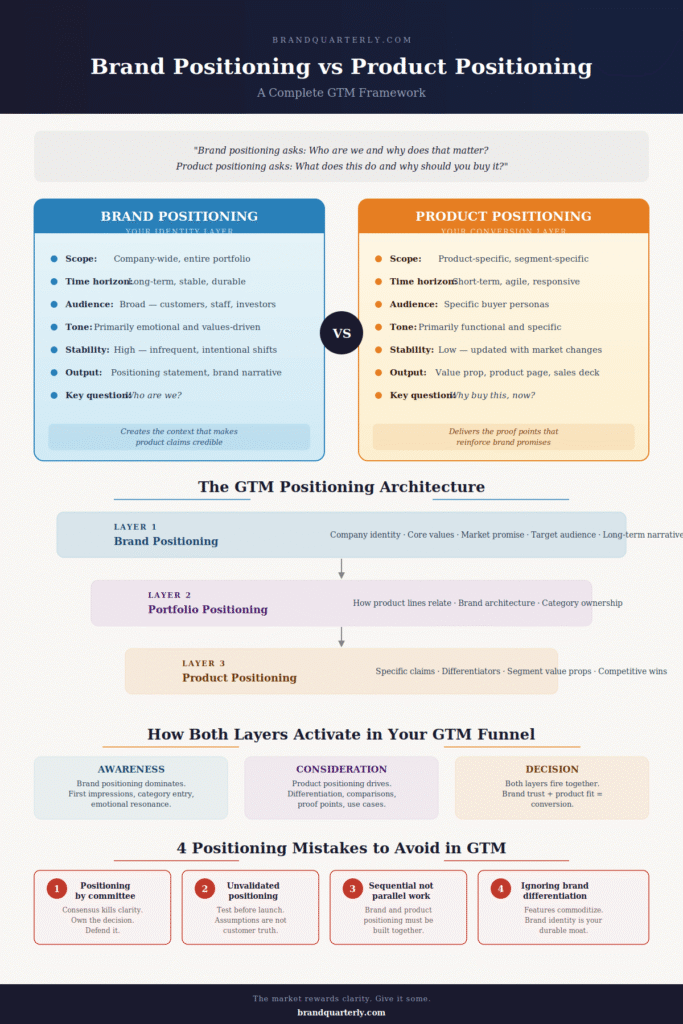
Brand positioning answers the question: Who are we, and why does that matter? Product positioning answers the question: What does this do, and why should you buy it? Both questions are essential, but they live at different altitudes in your strategy. One is your foundation; the other is your proof. Together, they form the complete positioning architecture that powers your GTM motion.
This article breaks down both concepts in full, explains where they diverge, where they converge, and how to build a GTM strategy that uses both intelligently. Whether you’re launching a new product, entering a new market, or rethinking your current go-to-market approach, understanding this distinction will clarify your messaging, sharpen your differentiation, and ultimately help you win.
What Is Brand Positioning?
Brand positioning is the strategic foundation that defines how your company is perceived in the minds of your target audience relative to your competitors. It is not a tagline, a logo, or a campaign—it is a deliberate decision about the emotional and conceptual territory your brand intends to own. Done well, brand positioning persists across every product you launch, every market you enter, and every customer interaction you create.
Brand positioning centers on identity and trust. It communicates your values, philosophy, and the promise you offer to all stakeholders. It is why customers choose your brand over similar alternatives, shaping perceptions before a sale and fostering loyalty afterward.
A strong brand positioning statement accomplishes three things simultaneously: it defines your target audience, articulates your unique space in the market, and grounds that claim in something authentic and defensible. Without this foundation, every product launch, campaign, and sales conversation starts from zero. With it, every new initiative benefits from accumulated brand equity that makes the market more receptive from day one.
Brand positioning also directly influences how customers perceive your products—before they ever experience them. A customer who trusts your brand will give your new product the benefit of the doubt. A customer who has no connection to your brand needs to be convinced from scratch, at much higher cost. That is why investing in brand positioning is not a soft, optional exercise—it is a hard-nosed business decision with measurable returns.
What Is Product Positioning?
Product positioning is the specific, tactical articulation of where a particular product fits in the market, who it is for, what it does, and why it is the best option for a defined audience facing a defined problem. While brand positioning operates at the company level, product positioning operates at the SKU level—it is scoped, specific, and optimized for conversion.
Good product positioning starts with deep customer understanding. You must know your ideal customer profile in granular detail: their role, their pain points, their decision-making criteria, and the alternatives they are considering. From there, you craft a positioning that makes your product the obvious choice for that specific person in that specific context. Vague product positioning is a conversion killer because it leaves the buyer doing the work you should have done.
Product positioning lives in the intersection of three forces: customer needs, your product’s capabilities, and the competitive landscape. The moment any of these changes—a new competitor enters, a feature ships, customer needs evolve—your product positioning needs to be revisited. Unlike brand positioning, which should be relatively stable over time, product positioning is a living document that must respond to market dynamics.
The output of product positioning shows up in your product pages, sales decks, onboarding flows, and feature announcements. It informs the specific language your sales team uses in discovery calls and the claims your performance marketing team tests in ads. When product positioning is clear and well-researched, every function of your commercial team moves faster and closes more. When it is vague or inconsistent, you get friction at every stage of the funnel.
The Core Differences: Brand vs Product Positioning
Understanding the structural differences between brand and product positioning is essential before you try to use both in a GTM strategy. Here is how they differ across several key dimensions.
Scope and Altitude
Brand positioning operates at the company level and spans your entire portfolio, regardless of how many products you have or how many markets you serve. It is the lens through which everything else is interpreted. Product positioning, by contrast, is product-specific and market-specific. A company can have one brand position and twenty distinct product positions, each calibrated for a different segment, use case, or geography.
Time Horizon
Brand positioning is built to last. While it should evolve as your company grows, a strong brand position is not something you rebuild with every product cycle or campaign. The goal is to create something durable—an identity that compounds in value over time. Product positioning, on the other hand, has a shorter shelf life. It should be reviewed with every major product update, every new competitor entry, and every significant shift in buyer behavior.
Audience
Brand positioning speaks to your broadest possible audience: existing customers, prospective customers, employees, investors, partners, and the media. It is your public identity. Product positioning speaks to a much more defined segment—the specific buyer persona most likely to purchase a specific product. The precision of product positioning is one of its greatest strengths. You are not trying to appeal to everyone; you are trying to be undeniably relevant to someone.
Emotional vs Functional
Brand positioning is primarily emotional. It creates a feeling, a set of associations, and a sense of what your company stands for. Product positioning is primarily functional, though not exclusively. It answers the question of what the product does and why it does it better—often in specific, measurable terms. The best product positioning, however, blends functional claims with emotional resonance, which is where the brand foundation proves its worth.
Stability vs Agility
Your brand strategy should be a stabilizing force in your business. Frequent changes to brand positioning erode trust and confuse both customers and internal teams. Product positioning, by contrast, needs agility. Markets shift, competitors move, and customer needs evolve. A product positioning that was accurate eighteen months ago may be dangerously outdated today.
Why Both Matter in a GTM Strategy
A go-to-market strategy without brand positioning is just a launch plan. A GTM strategy without product positioning is just a mission statement. You need both—functioning as distinct layers of a unified strategic architecture—to build a market entry that creates lasting commercial momentum.
Your GTM strategy is the operational plan for how you bring a product or service to market. It includes your target segments, pricing, distribution channels, messaging, sales motion, and success metrics. Brand positioning informs the “why us” narrative that runs through every component of that plan. Product positioning informs the specific “why this” claims that make individual segments act.
Consider what happens when you have strong brand positioning but weak product positioning: you build awareness and goodwill, but struggle to convert at the bottom of the funnel. Prospects understand what you stand for, but not why they should buy this specific product today. Alternatively, when you have strong product positioning but weak brand positioning, you can win individual deals but struggle to build durable category authority. You win on features, but you lose on trust and loyalty.
The most powerful GTM strategies integrate both. The brand creates the context that makes product claims credible. The product delivers the proof points that reinforce brand promises. Every touchpoint—from a cold outreach email to a product demo to a renewal conversation—benefits from both layers firing simultaneously.
How Brand Positioning Shapes GTM Messaging
The relationship between brand positioning and GTM messaging is one of the most underappreciated leverage points in marketing. Your GTM messaging framework should be a direct expression of your brand position, filtered through the specific context of a product launch or market entry.
Brand positioning gives your messaging its voice, its values, and its overarching narrative. It is the reason your copy sounds a certain way, uses certain words, and avoids others. When your brand position is clearly defined, messaging decisions become faster and more consistent across your entire team. Writers, designers, salespeople, and executives can all orient around the same north star.
Without a strong brand position underpinning your GTM messaging, you end up with campaigns that feel disconnected from one another, sales conversations that contradict marketing materials, and a brand that looks inconsistent across channels. These are not aesthetic problems—they are commercial problems. Inconsistency erodes trust, and trust is the single most valuable asset in any customer relationship.
Your messaging pillars that influence decisions are the structural backbone of your communications. They should derive from your brand position and inform your product messaging, not the other way around. When you build your messaging hierarchy from the brand down, every product campaign inherits brand equity rather than spending its budget building from zero.
Product Positioning in the GTM Funnel
Product positioning does its heaviest lifting in the middle and bottom of the GTM funnel—where abstract interest turns into specific purchase intent. Understanding how product positioning activates at each stage of the funnel is essential for GTM leaders who want to optimize conversion without losing brand coherence.
At the awareness stage, product positioning should be visible but restrained. You are planting the seeds of relevance, not delivering the full sales pitch. Your product’s category, primary use case, and key differentiator should be communicated in terms that resonate with the pain your audience is experiencing. The goal is recognition, not conversion.
At the consideration stage, product positioning does its most intensive work. This is where detailed comparisons, use cases, proof points, and differentiation claims need to be sharp, specific, and tailored to the segment. Your competitive analysis for brand work becomes critical here—you need to know exactly what alternatives your prospect is considering and why your product wins that comparison.
At the decision stage, product positioning reinforces the emotional and rational reasons to act now. Pricing, terms, guarantees, and social proof all play supporting roles, but the underlying product position—the specific, credible reason this product is the right choice—is what converts a serious prospect into a signed contract. When product positioning is vague at this stage, the default buyer response is hesitation.
The Competitive Dimension: Positioning Against the Market
Neither brand positioning nor product positioning exists in a vacuum. Both are fundamentally competitive—they define your place in the market relative to alternatives, not just in absolute terms. Building your positioning strategy without a rigorous understanding of the competitive landscape is like navigating without a map.
Competitor mapping is the analytical foundation for competitive positioning. By systematically charting where your competitors have staked their brand and product positions, you can identify genuine white space—territory that is both valuable to your target audience and unclaimed by established players. White space is where strong positioning lives.
Competitive positioning also helps you understand the conversations already happening in your category. Your prospects are not coming to you with blank minds—they have been shaped by every competitor ad they have seen, every review they have read, and every conversation they have had with colleagues. Your brand and product positioning must enter that conversation with a point of view that is both distinct and relevant.
One of the most common positioning mistakes is positioning against a competitor’s weakness rather than a customer’s desire. Winning on a competitor’s weakness is temporary—they can fix the weakness. Winning on a customer desire you uniquely fulfill is durable. Use your competitive intelligence to understand the competitive landscape, but anchor your positioning in what your best customers value most.
Building a Positioning Architecture for GTM
The most effective way to manage both brand and product positioning in a GTM context is to build what practitioners call a positioning architecture: a hierarchical framework that defines how company-level brand claims connect to product-level proof points. This architecture ensures coherence without sacrificing the specificity that product positioning requires.
Your positioning architecture typically has three layers. The first is your brand positioning layer—your company-wide identity, values, and promise. The second is your portfolio positioning layer—how your product lines or service categories relate to one another and to the brand. The third is your product positioning layer—the specific claims, differentiators, and value propositions for each individual product targeting each specific segment.
This framework prevents two common pathologies. The first is brand fragmentation, where different product teams create positioning that contradicts the brand identity. The second is brand irrelevance, where product teams create positioning so narrowly functional that it never contributes to brand equity. A clear architecture solves both by giving every product team a clear lane.
Brand architecture decisions—whether you operate a branded house, house of brands, or hybrid model—have major implications for how you structure your positioning architecture. A branded house concentrates equity and simplifies positioning. A house of brands maximizes flexibility but requires more investment in each individual brand’s positioning. Your GTM model should inform this decision before you finalize your positioning structure.
How to Write a Brand Positioning Statement That Drives GTM
A brand positioning statement is the internal compass document that encodes your brand position in a concise, actionable form. It is not a tagline—it is a strategic document used by leadership, marketing, product, and sales to align on what the brand stands for and who it serves. Getting it right is foundational to every downstream GTM decision.
The classic structure of a positioning statement includes: target audience, frame of reference (the category or context in which you compete), key differentiator (what makes you uniquely valuable), and the reason to believe (the proof behind the claim). Each element serves a specific function, and weakness in any one of them creates a positioning statement that is either too generic or too narrow to drive decisions.
The most common failure mode in brand positioning statements is the frame of reference problem. Companies either define their category too broadly (we make software) or too narrowly (we make B2B SaaS project management tools for remote-first engineering teams in Series B startups). Both extremes create problems. Too broad, and your differentiation gets lost. Too narrow, and your total addressable market shrinks artificially.
The best positioning statements are simultaneously aspirational and credible. They describe a position you can genuinely occupy today while pointing toward where the brand is headed. They are written in plain language, free of jargon, and clear enough that a new employee reading them on day one would immediately understand what the company stands for and who it serves.
Value Proposition vs Positioning: Understanding the Difference
While closely related, a value proposition and a positioning statement serve distinct functions and should not be conflated. This is a common point of confusion that, left unresolved, creates strategic drift in both your brand and product positioning work.
A value proposition is customer-facing and conversion-oriented. It answers the question: “What will I get if I choose you?” It is often expressed in headlines, product pages, and sales materials. It is specific, benefits-focused, and designed to drive action. Your value proposition can and should vary across customer segments and products.
A positioning statement is internal and strategy-oriented. It answers the question: “Where do we play and how do we win?” It is not written for customers—it is written for your team. It defines the strategic territory you intend to own and the logic behind that choice. Your positioning statement should remain stable across customer segments; your value proposition adapts.
Understanding this distinction matters enormously for GTM execution. When teams confuse positioning with value propositions, they either produce positioning that is too execution-specific to guide strategy or value propositions that are too abstract to drive conversion. The two documents should inform each other—your positioning defines the territory, your value proposition activates it in specific customer contexts.
Common Positioning Mistakes in GTM Launches
GTM launches are high-stakes moments where positioning errors have outsized consequences. Understanding the most common mistakes allows you to avoid them proactively rather than diagnosing them post-launch when the cost of correction is much higher.
The first and most damaging mistake is positioning-by-committee. When brand and product positioning decisions are made by consensus across too many stakeholders, the result is inevitably a watered-down position that tries to speak to everyone and resonates with no one. Strong positioning is the result of clear strategic choices, and clear strategic choices require someone with authority to make them and defend them.
The second mistake is launching with unvalidated positioning. Too many teams develop positioning in a conference room and deploy it directly into the market without testing their core assumptions with real customers. Before you commit to a GTM position, validate it through customer interviews, win/loss analysis, and, if possible, A/B testing of core messages. The Quarterly Clarity Method offers a structured approach to continuously validate and refine your strategic positioning over time.
The third mistake is treating brand and product positioning as sequential rather than parallel workstreams. Some teams believe they must finalize brand positioning before doing product positioning. Others build product positioning in isolation and bolt on brand narrative later. Neither approach works. Brand and product positioning need to be developed in dialogue with each other, with clear ownership for each layer and deliberate integration points.
The fourth mistake is ignoring brand differentiation as a strategic lever. Many GTM strategies focus exclusively on product features and pricing as differentiators, ignoring the powerful and durable differentiation that brand values, personality, and purpose can provide. In commoditizing markets, brand differentiation is often the only sustainable competitive advantage available.
Positioning and the Customer Journey
Your positioning does not exist only in your marketing materials—it lives in the customer’s mind, shaped by every interaction they have with your brand across the entire customer journey. Aligning your brand and product positioning with the customer journey is one of the most sophisticated and impactful things a GTM leader can do.
At the earliest stages of the customer journey map, customers are forming initial impressions based on brand signals: your website design, your social presence, your PR coverage, and what they hear from peers. Your brand positioning should be clearly legible at this stage—prospects should walk away from their first encounter with a clear sense of what you stand for.
As customers move through evaluation, your product positioning takes the lead. They are comparing options, reading reviews, requesting demos, and asking hard questions. Your product positioning needs to be precise, defensible, and consistent across every evaluation touchpoint. Inconsistency between your marketing materials and your sales team’s pitches is a positioning execution failure that kills deals.
Post-purchase, your brand positioning reasserts its importance. Customer retention, expansion, and advocacy are driven far more by brand experience than by product feature sets. Customers who feel a genuine affinity for your brand—who believe in what you stand for—are more forgiving of product friction, more open to upsell conversations, and more likely to refer others. Brand positioning is not just a top-of-funnel asset; it is a retention and growth asset throughout the entire relationship.
Measuring the Impact of Your Positioning
One of the most common objections to investing in brand positioning work is that it is difficult to measure. This objection, while understandable, reflects a narrow view of what measurement means in a brand context. Both brand and product positioning are measurable—they just require different measurement frameworks and different time horizons.
Brand positioning impact shows up in brand awareness studies, net promoter scores, share of voice, brand preference surveys, and qualitative customer feedback. It also shows up indirectly in sales velocity, win rates, and pricing power—companies with strong brand positions close deals faster, win more often, and command premium pricing compared to equivalent competitors with weaker brand positions. Tracking digital brand awareness gives you a data-driven window into how your brand position is landing in the market.
Product positioning impact is more directly measurable. You can track conversion rates at each funnel stage, win/loss ratios by competitive scenario, deal velocity by segment, and message resonance through A/B testing. If your product positioning is working, these metrics improve. If they are stagnating or declining, your positioning may need to be revisited.
GTM KPIs and how to measure market entry success should be defined before you launch, not after. By establishing baseline metrics and clear success benchmarks tied to your positioning strategy, you create the accountability structure that ensures your positioning work is driving real commercial outcomes rather than just producing polished documents.
When to Evolve Your Positioning
One of the most nuanced judgment calls in brand and GTM strategy is knowing when your positioning needs to evolve. Change too frequently, and you undermine the brand equity you have built. Change too slowly, and your positioning becomes stale and disconnected from market reality.
Brand positioning should evolve when there is a fundamental shift in your market, your customer base, your competitive landscape, or your own company’s capabilities and ambitions. It should also evolve when you have clear evidence that your current position is no longer resonating—declining brand metrics, increasing competitive pressure in your core segment, or customer feedback that suggests your brand promise is not being delivered. Rebranding without losing your audience requires a thoughtful, staged approach that preserves trust while signaling strategic evolution.
Product positioning should evolve more frequently. A good rule of thumb is to review your product positioning at least annually, and additionally, any time a significant competitor moves, a meaningful feature ships, or a new customer segment emerges as a material opportunity. The goal is not change for its own sake—it is staying calibrated to the real competitive and customer landscape.
Evolution in positioning should always be grounded in evidence. Customer research, competitive analysis, win/loss data, and brand audit findings should all inform positioning decisions. Intuition has a role, but it should be a secondary input to the real-world signal. A brand audit is one of the most reliable tools for identifying the gap between your intended positioning and how your brand is actually perceived.
Integrating Brand and Product Positioning for GTM Success
The final and most important piece is integration. Brand positioning and product positioning are not parallel tracks—they are interdependent layers of a single strategic system. When they are aligned, they create a compounding effect where every product campaign builds brand equity and every brand investment makes product campaigns more effective.
Integration starts with shared language. Your brand positioning vocabulary—the specific words, phrases, and claims that define your brand identity—should flow directly into your product messaging. This does not mean your product copy sounds like your brand manifesto. It means the values and voice of your brand are recognizable in the way your product is described, marketed, and sold.
Integration also requires clear ownership and process. Define who owns brand positioning (typically marketing or brand leadership) and who owns product positioning (typically product marketing). Create a regular rhythm for these teams to align, share customer insights, review competitive intelligence, and ensure that individual product positions are reinforcing rather than contradicting the brand position.
Finally, integration requires discipline at the execution level. Every piece of content, every sales deck, every product page, and every campaign should pass a positioning check: Does this reflect our brand position? Does this deliver our product position for the target segment? When both questions answer yes, you have positioning integration working at full strength.
Conclusion
Brand positioning and product positioning are two of the most powerful tools in a GTM leader’s arsenal—and two of the most frequently misused. Brand positioning is your identity, your promise, and your long-term competitive moat. Product positioning is your proof, your specificity, and your conversion engine. Neither works as well alone as they do together.
The companies that win in competitive markets are not just the ones with the best products—they are the ones with the clearest, most coherent positioning across both dimensions. They know who they are at the brand level, and they know exactly who each product serves and why it wins at the product level. That clarity flows through every marketing message, every sales conversation, every customer experience, and every GTM decision.
Building this clarity takes time, discipline, and genuine strategic investment. But the returns—in conversion rates, win rates, pricing power, customer retention, and market authority—are compounding and durable. Start with your brand position. Build your product positions from that foundation. Integrate both into every GTM motion. And revisit, refine, and evolve as your market demands.
