
Brands face pressure to create louder, flashier ads in a crowded marketplace. Every campaign battles for attention and engagement. Even with rising budgets, many companies struggle to stand out or grow because they don’t understand that good positioning beats good ads. Exceptional ads alone can’t overcome weak positioning, which defines how your brand exists in the customer’s mind.
Good positioning beats good ads because it defines how your brand exists in the customer’s mind. Advertising amplifies what already exists. If your strategic foundation lacks clarity or differentiation, even award-winning campaigns will struggle to convert attention into loyalty. Positioning shapes perception, and perception ultimately drives purchasing behavior more reliably than creativity alone.
To understand why effective marketing endures, it’s important to look more deeply at the relationship between strategy and execution. This article explores why strategic positioning consistently outperforms tactical advertising, how positioning compounds over time, and how brands can build lasting authority without depending solely on ad spend.
The Core Difference Between Positioning and Advertising
Advertising is execution. Positioning is a strategy. Advertising distributes messages outward, while positioning defines meaning inward.
A well-produced advertisement can generate awareness spikes, increase traffic, or even create viral momentum. However, if the strategic positioning behind that campaign lacks clarity, those gains often disappear quickly. Without a clear foundation, advertising becomes a disconnected activity rather than cumulative brand building.
Positioning works at a cognitive level. It creates mental shortcuts that simplify decisions. When positioning is strong, customers quickly and confidently understand your brand. That clarity reduces friction, strengthens recall, and builds preference over time.
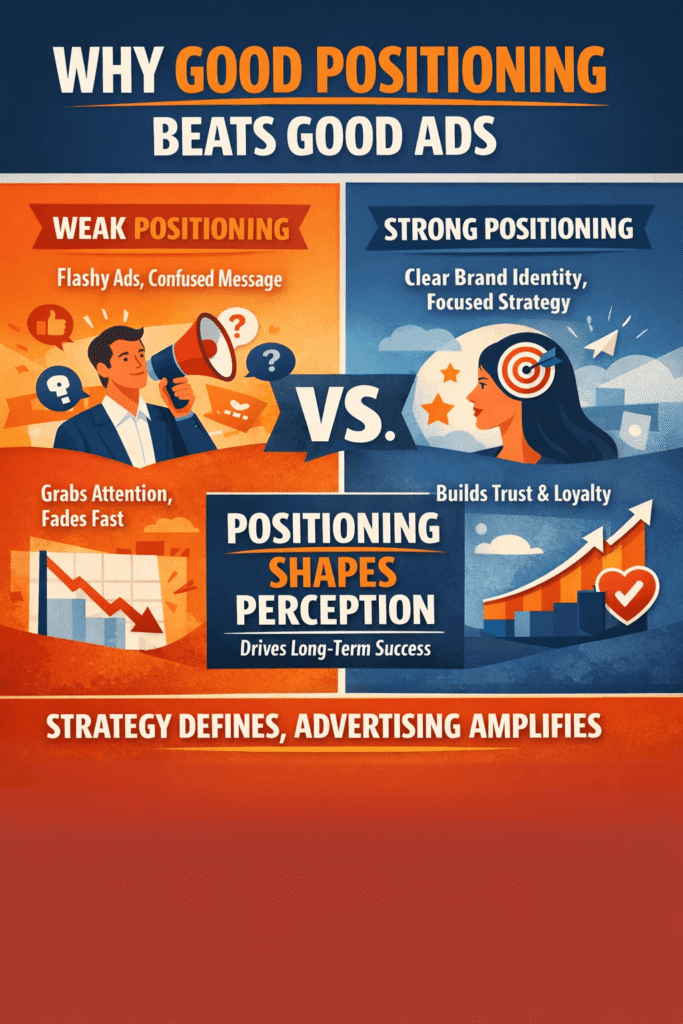
Why Good Positioning Outperforms Good Ads
1. Positioning Creates Long-Term Brand Equity
Advertising campaigns are temporary. Budgets change, platforms shift, creative rotates. Positioning gains strength over time.
When your brand consistently occupies a defined space in the market, customers begin associating you with a particular benefit or category. This mental association builds familiarity and trust. Over time, your brand becomes the default choice within that defined space.
The compounding effect of clear positioning means every marketing activity reinforces the same idea. Instead of restarting the narrative, you build equity that advertising alone cannot replicate.
2. Strong Positioning Improves Marketing Efficiency
Brands with weak positioning often compensate with increased ad spend. They assume that more exposure will solve awareness issues. However, if the message is unclear, additional reach simply spreads confusion further.
With strong positioning, advertising performs better because it reinforces an idea customers already understand. Conversion rates improve because the brand’s promise is clear. Sales cycles shorten without long explanations.
Over time, strong positioning lowers acquisition costs by attracting customers through clarity and distinctiveness.
3. Positioning Supports Premium Pricing
Good ads may generate demand, but positioning justifies price. Customers pay more when they perceive a brand as unique, specialized, or authoritative.
If your positioning communicates unique value, customers make fewer direct comparisons. They see you in your own frame, not as a commodity. This shift reduces price sensitivity and protects margins.
Brands lacking clear positioning often rely on promotions and discounts to compete. This erodes long-term profitability. Strong positioning protects pricing power by reinforcing differentiated value.
4. Positioning Builds Trust Through Consistency
Trust is built through repetition and reliability. When positioning is clear, every brand touchpoint communicates a cohesive message.
Customers feel confident when they understand what a brand stands for. That clarity reduces perceived risk, which increases loyalty. Over time, consistent positioning strengthens emotional connection and retention.
Advertising may capture attention briefly, but consistent positioning sustains credibility and grows loyalty as customers experience alignment between promise and delivery.
5. Advertising Cannot Repair Strategic Confusion
When growth slows, companies often redesign campaigns or try new channels. But if the foundation stays unclear, creative changes rarely fix the core issue.
Strategic confusion often manifests as inconsistent messaging or shifting target audiences. Customers sense this inconsistency immediately, even if they cannot articulate it directly.
Strong positioning aligns internal teams around a shared narrative. That alignment creates coherence externally, making all marketing efforts more persuasive and efficient.
Why Positioning Compounds Over Time
Positioning strengthens memory structures gradually. Each interaction reinforces the same core idea, making your brand easier to recall in future decision moments.
Repeated reinforcement creates familiarity over time. Familiar brands feel safer, influencing buyers. The clearer your positioning, the faster customers connect your brand to their needs.
Advertising may spark short-term awareness, but positioning builds durable recognition that drives sustained growth.
The Psychological Advantage of Clear Positioning
Human decision-making depends heavily on mental shortcuts. Consumers simplify choices by relying on brand associations rather than analyzing every option in detail.
Strong positioning embeds your brand in decision shortcuts. When a need arises, your brand surfaces because it holds a clear place in memory. That access boosts selection chances.
Advertising alone may trigger curiosity, but positioning embeds identity. Identity influences repeat behavior far more than momentary creative impact.
How to Build Positioning That Beats Advertising
1. Define a Clear Competitive Frame
Customers must understand where you fit in the market. Ambiguity weakens recall and slows decision-making.
Identify the main problem you solve and clarify its context. Avoid broad definitions that weaken authority. Specificity boosts perceived expertise.
A clear competitive frame strengthens messaging and sharpens focus across all marketing channels.
2. Focus on One Dominant Strength
Brands often attempt to communicate multiple advantages simultaneously. This approach weakens memorability because customers struggle to retain scattered claims.
Find your strongest differentiator and emphasize it. Repeating one idea builds recognition faster than listing many small benefits.
When advertising reinforces one powerful position repeatedly, the brand becomes easier to remember and easier to choose.
3. Align Messaging Across Departments
Positioning must extend beyond marketing. Sales teams, customer support, product development, and leadership must reinforce the same narrative.
If internal teams describe the brand differently, customers get mixed signals. This inconsistency erodes trust and impact.
Strong alignment ensures that positioning becomes embedded within the organization’s culture rather than confined to marketing materials.
4. Maintain Strategic Stability
Creative campaigns can evolve, but core positioning should remain stable. Frequent strategic shifts reset customer progress.
Stability does not mean stagnation. It means reinforcing the same foundational idea through varied creative executions.
Brands that change positioning frequently struggle to build cumulative memory strength. Consistency builds lasting impact.
When Good Ads Actually Work
Good ads are powerful when built upon strong positioning. Creative storytelling, humor, emotional appeal, and design excellence become significantly more effective when anchored in clarity.
Advertising should express, not define, positioning. A solid foundation gives creative teams a framework for innovation.
In this scenario, advertising accelerates growth rather than compensating for a strategic weakness.
The Financial Case for Positioning First
Positioning brings compounding returns. It supports premium pricing, lowers acquisition costs, boosts retention, and strengthens brand equity.
Advertising often delivers immediate but temporary metrics. Positioning builds a sustainable competitive advantage that persists beyond campaign cycles.
Investing in positioning may feel less dramatic, but it builds durable growth that advertising alone cannot secure.
Common Strategic Mistakes
- Confusing visual branding with strategic positioning.
- Chasing viral trends instead of reinforcing core identity.
- Expanding target audiences too broadly to avoid exclusion.
- Changing positioning prematurely due to short-term performance pressure.
Each mistake weakens clarity. Strong positioning needs focus, discipline, and patience.
Conclusion: Strategy Before Tactics
Good positioning beats good ads because it shapes perception at a deeper level. It clarifies identity, strengthens differentiation, and builds durable brand equity. Advertising without positioning becomes noise. Positioning without heavy advertising can still grow through clarity and word of mouth.
The most successful brands prioritize positioning first and use advertising as a multiplier. When strategy leads, tactics perform better.
If sustainable growth, stronger margins, and loyal customers are your goal, start with positioning. The ads will work better because of it.
FAQ
1. Why does good positioning beat good ads?
Good positioning beats good ads because it shapes how customers perceive your brand before any advertisement appears. Advertising amplifies what already exists in the customer’s mind, but positioning defines that mental space. Without clear positioning, even creative or high-budget campaigns struggle to convert attention into loyalty and long-term growth.
2. Can strong advertising fix weak brand positioning?
Strong advertising may generate short-term awareness, but it cannot repair unclear strategy. If customers do not understand what makes your brand different or valuable, increased exposure only spreads confusion. Sustainable growth requires strategic clarity first, then advertising to reinforce it.
3. How does positioning improve marketing ROI?
Clear positioning improves marketing ROI by increasing conversion rates and reducing customer acquisition costs. When customers quickly understand your value, they require less persuasion and fewer touchpoints. This efficiency lowers wasted ad spend and strengthens long-term profitability.
4. Does positioning help with premium pricing?
Yes, strong positioning supports premium pricing by differentiating your brand from competitors. When customers perceive you as unique or authoritative, they make fewer direct price comparisons. This perceived value reduces price sensitivity and protects profit margins.
5. When do good ads actually work best?
Good ads work best when they reinforce an already clear positioning strategy. Creative execution becomes more powerful when anchored in a strong strategic foundation. In this case, advertising accelerates growth instead of compensating for a lack of clarity.
