
AI in digital brand management is no longer a futuristic concept — it is a present-day competitive advantage that brand teams cannot afford to ignore. The way brands build, protect, and scale their presence has fundamentally shifted because of artificial intelligence. Marketers who once spent days pulling reports and drafting strategies now move faster, make smarter decisions, and produce more consistent work. Therefore, understanding how AI integrates into every layer of digital brand management has become essential for anyone serious about building a durable, distinctive brand.
This article explores how AI is reshaping brand strategy, content, monitoring, positioning, and competitive intelligence. Each section breaks down real applications, practical workflows, and the mindset shifts that high-performing brand teams are making right now. Whether you are managing a growing startup or a global enterprise, the principles here apply directly to the challenges you face every day.
What AI in Digital Brand Management Actually Means
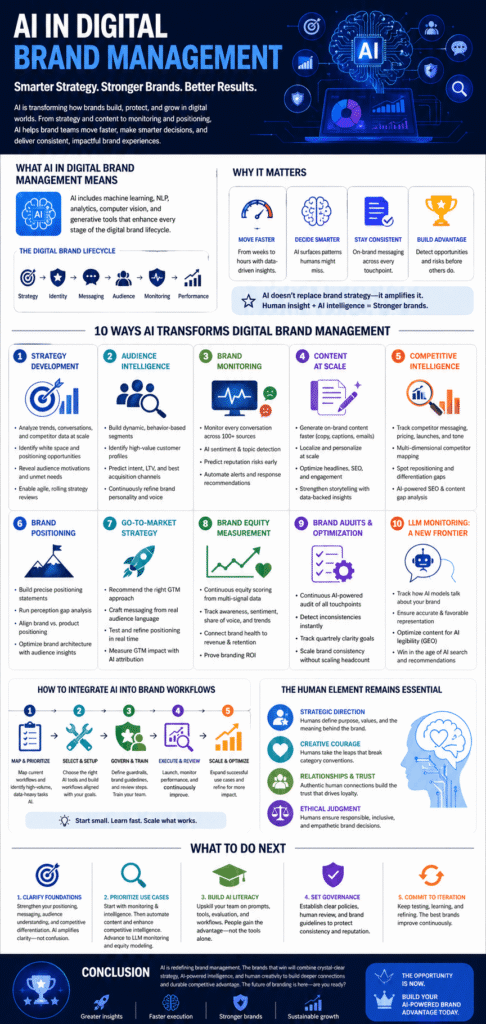
Before exploring specific applications, it is worth defining what AI in digital brand management actually means in practice. Many brand professionals still associate AI with chatbots or automated email sequences — but the scope is far broader. AI encompasses machine learning models, natural language processing, predictive analytics, computer vision, and generative tools, all of which now have direct applications in how brands present themselves and engage audiences.
Digital brand management refers to the full lifecycle of how a brand operates in online environments. This includes brand strategy, visual identity, messaging consistency, audience targeting, competitive positioning, reputation management, and performance measurement. Consequently, when AI intersects with this lifecycle, it creates opportunities to automate repetitive tasks, surface hidden insights, personalize at scale, and respond to market signals in near real-time.
The brands that are winning today are not simply using AI to write faster copy. They are using it to make smarter strategic decisions, detect reputation risks before they escalate, and align every brand touchpoint with a coherent identity. Understanding this fuller picture is the first step toward building an AI-powered brand operation that actually delivers results.
How AI Is Transforming Brand Strategy Development
Brand strategy has traditionally been a slow, research-heavy process driven by workshops, surveys, and periodic reviews. AI changes this dynamic significantly. Modern AI tools can analyze vast datasets — including social conversations, search trends, competitor activity, and customer sentiment — and surface strategic insights in hours rather than weeks. As a result, brand teams can move from observation to decision-making far more quickly.
One of the most powerful applications is using AI to sharpen brand positioning. AI tools can scan thousands of competitor communications, customer reviews, and industry conversations to identify white space in the market — areas where no brand is clearly owning a perception. This kind of positioning intelligence used to require expensive research firms and months of analysis. Today, a well-configured AI workflow can surface the same insights in a fraction of the time.
AI also plays a strong role in refining brand purpose and brand values. By analyzing audience conversations at scale, AI can reveal the underlying motivations, fears, and aspirations that drive your target customers. This means brand strategy documents no longer need to be built purely on intuition and focus groups — they can be grounded in real, continuously updated behavioral data.
Furthermore, AI supports more agile strategy cycles. Traditional brand strategy operated on annual reviews with quarterly check-ins. AI-powered brand teams can now run rolling strategy reviews, adjusting positioning, messaging, and tone based on live market signals. This agility does not mean abandoning long-term thinking; instead, it means that long-term brand vision stays relevant as the market evolves.
AI-Powered Audience Intelligence and Segmentation
Understanding your audience deeply is the foundation of effective brand management. AI dramatically improves the quality and depth of audience intelligence available to brand teams. Rather than relying on static demographic profiles, AI enables dynamic, behavior-based audience understanding that updates continuously as new data flows in.
Customer segmentation is one area where AI delivers immediate, measurable value. Traditional segmentation divides audiences by age, location, or income. AI-powered segmentation goes far deeper, grouping customers by psychographic profiles, purchase intent signals, content consumption patterns, and predicted lifetime value. This level of nuance allows brand teams to craft messaging that resonates with each segment’s specific worldview — not just their demographic category.
Building an accurate ideal customer profile has also become far more sophisticated with AI. Machine learning models can identify the characteristics shared by your highest-value customers, compare them to the broader market, and predict which acquisition channels are most likely to bring in similar profiles. Additionally, AI can flag when your ideal customer profile is drifting — for example, when you are attracting a different type of customer than you originally intended — giving brand teams the early warning needed to course-correct.
Audience intelligence gathered through AI also feeds directly into brand personality decisions. When you understand how your audience communicates, what language they use, what emotional triggers drive their decisions, and how they talk about brands like yours, you can refine your brand’s voice and character to match those expectations. This creates a feedback loop where audience data continuously sharpens brand expression.
AI and Brand Monitoring: Staying Ahead of Perception Shifts
Brand monitoring has always been important, but AI has made it both more comprehensive and more actionable. The volume of online conversations about any given brand now exceeds what any human team could manually track. Social media, review platforms, news sites, forums, podcasts, and video platforms all generate signals that matter to brand health. AI tools aggregate and analyze these signals continuously, turning raw noise into structured intelligence.
The most sophisticated brand teams are now using AI for reputation management that goes well beyond setting up keyword alerts. They use sentiment analysis models that distinguish between sarcastic positivity and genuine praise, topic clustering that identifies emerging narrative themes, and trend detection that flags rising risks before they reach mainstream visibility. In other words, the shift is from reactive monitoring to predictive brand intelligence.
An online reputation monitoring checklist powered by AI looks very different from a manual one. Instead of checking platforms one by one, AI-driven systems centralize data from dozens of sources, apply natural language processing to classify tone and topic, and surface only the signals that require human attention. This frees brand managers to focus on strategic response rather than data collection.
AI also enables brand monitoring automation at a scale that simply was not feasible before. Automated systems can now send alerts when sentiment scores drop below a threshold, flag mentions from high-authority accounts, identify coordinated negative campaigns, and even draft initial response recommendations for brand managers to review. Consequently, brand teams operate with a level of responsiveness that would previously have required a much larger staff.
Generative AI and Content at Scale
Content creation is one of the most visible applications of AI in digital brand management. Generative AI tools now play a key role in producing, personalizing, and optimizing content across channels. Effective brand teams use AI to enhance, not replace, human creativity.
AI excels at high-volume, repetitive content tasks such as product descriptions, social media variants, email subject lines, meta descriptions, localized copy, and content briefs. Automating these tasks allows brand writers to focus on conceptual and emotional work that differentiates the brand. AI elevates, rather than diminishes, the role of human brand builders.
A strong brand messaging framework is essential to ensure AI-generated content remains on-brand. Without clear messaging pillars, tone guidelines, and positioning rules, AI may produce technically correct but inconsistent content. Investing in clear frameworks upfront makes AI output more strategically valuable.
Brand guidelines are evolving to include explicit instructions for AI tools, covering not only visual and verbal standards but also approved vocabulary, banned phrases, tone examples, and context-specific messaging rules. As generative AI becomes integral to content workflows, these guidelines are increasingly important.
Brand storytelling remains fundamentally human — but AI can support it meaningfully. AI tools can analyze which story structures resonate most with your audience, identify the emotional beats that drive engagement, and suggest narrative frameworks grounded in what actually works in your category. The human brand strategist still makes the creative call; AI simply provides a more informed foundation for that decision.
AI in Competitive Intelligence and Market Positioning
AI has transformed competitive analysis more than any other brand management function. While traditional methods like reviewing competitor websites and press releases still have value, they capture only a fraction of the intelligence that AI-powered systems can now provide continuously and systematically.
AI-powered competitive intelligence tools monitor competitor messaging, pricing, product launches, social media tone, SEO changes, and customer sentiment in real time. This provides brand teams with a dynamic view of the competitive landscape and enables early detection of subtle repositioning by competitors.
Competitor mapping is also more powerful with AI support. Rather than plotting competitors on a simple two-by-two matrix based on two variables, AI enables multi-dimensional mapping that factors in brand perception, content strategy, audience overlap, share of voice, and positioning language all at once. This richer picture gives brand strategists a far more accurate view of where genuine differentiation opportunities exist.
Brand differentiation is more effective when based on continuous competitive intelligence. AI systems identify competitors’ language, emotional benefits, and target segments, allowing precise identification of open positioning opportunities. They also alert teams when competitors move toward your positioning, enabling proactive responses.
SEO competitive intelligence is another area where AI provides significant leverage. AI tools can analyze competitor keyword strategies, content gaps, backlink profiles, and SERP positioning at scale, surfacing actionable recommendations for how your brand can gain search visibility. When this is combined with a broader brand strategy, it creates a coherent approach where brand-building and search performance reinforce each other.
AI and Brand Positioning: Precision at Every Level
Positioning is arguably the most strategically consequential dimension of brand management, and AI is making it more precise. A well-defined brand positioning statement reflects a deep understanding of the audience, the competitive landscape, and the brand’s authentic strengths. AI helps brand teams build all three dimensions of that understanding more rigorously and keep them current as market conditions evolve.
One of the subtler but important applications of AI in positioning is in perception gap analysis. AI tools can compare what a brand says about itself with what audiences actually perceive — surfacing the gaps between intended positioning and lived brand experience. This kind of analysis used to require expensive research studies; AI makes it continuous and cost-effective. Consequently, brand teams can close perception gaps faster and ensure their positioning efforts are actually moving the needle.
Brand positioning versus product positioning in go-to-market strategies is a distinction that AI is helping brand teams navigate more clearly. AI can analyze where brand-level messaging and product-level claims are creating confusion in the market, and recommend how to layer them effectively. This is especially valuable in multi-product companies where brand architecture and individual product positioning need to coexist without creating mixed signals.
Brand architecture decisions — how a parent brand relates to sub-brands, product lines, and market segments — are also increasingly informed by AI. By analyzing how audiences perceive different parts of a brand portfolio, AI can surface which relationships are adding clarity and which are creating confusion. This intelligence allows brand leaders to make architecture decisions that are grounded in market reality rather than internal logic alone.
AI in Go-to-Market Strategy and Execution
AI has become a core enabler of faster, smarter go-to-market execution. The traditional GTM strategy development process often relied on historical analogs and market assumptions that aged quickly once a product hit the market. AI changes this by enabling real-time market sensing, rapid hypothesis testing, and continuous optimization across every GTM lever.
In the context of types of go-to-market strategies, AI helps brand teams evaluate which approach fits the market context most precisely. By analyzing how similar products have been launched, how target audiences have responded to different entry strategies, and where competitive resistance is strongest, AI produces a more objective GTM strategy recommendation than intuition alone can deliver.
GTM messaging frameworks benefit enormously from AI-driven audience research. Understanding exactly how your target audience describes their problem, what language they use to evaluate solutions, and what emotional concerns they carry into purchase decisions allows you to craft GTM messaging that lands with precision. AI can process thousands of customer reviews, support transcripts, and community conversations to surface this language at scale.
Measuring GTM success has also become more sophisticated. GTM KPIs now benefit from AI-powered attribution modeling that connects brand-level investments to downstream commercial outcomes more accurately than last-click or channel-siloed models. This allows brand teams to demonstrate the ROI of their work and make smarter resource allocation decisions as campaigns progress.
AI and Brand Equity: Measuring What Matters
Brand equity has long been one of the most difficult brand metrics to measure reliably. Traditional approaches relied on periodic surveys, awareness tracking studies, and Net Promoter Score data — all of which are valuable but inherently backward-looking. AI is changing the measurement paradigm by enabling continuous, multi-signal brand equity tracking.
Modern AI-powered brand equity measurement combines sentiment analysis, share of voice data, search trend analysis, social listening, and customer behavior signals into composite equity scores that update in near real-time. This does not replace the depth of a well-designed brand tracking study, but it provides a continuous signal between those studies that helps brand teams stay informed. Furthermore, it connects brand equity movement to specific campaigns, competitor actions, or market events — giving brand leaders the context they need to understand what is driving changes.
Tracking digital brand awareness is one component of this broader equity measurement. AI tools can measure branded search volume, social share of voice, content engagement patterns, and direct traffic trends simultaneously, providing a richer, more multidimensional view of awareness than any single metric can deliver. When combined with sentiment data, this creates an awareness-plus-perception picture that is far more actionable.
Branding ROI is another area where AI is improving analytical rigor. By building models that connect brand health metrics to revenue performance, customer retention, and pricing power, AI helps brand teams make the business case for brand investment more compelling. This is increasingly important as brand teams compete for budget against performance marketing channels, where attribution is more direct.
AI, Brand Audits, and Continuous Optimization
Brand audits have traditionally been annual or biannual exercises — comprehensive but infrequent. AI is enabling a shift toward continuous brand auditing, where consistency gaps, perception drifts, and messaging deviations are surfaced and addressed on an ongoing basis rather than in occasional deep dives.
AI-powered audit tools can scan all brand touchpoints — website copy, social media profiles, advertising creative, email templates, sales collateral, support communications — and evaluate them against defined brand standards automatically. When inconsistencies are detected, the system flags them for human review rather than waiting for the next scheduled audit. As a result, brand consistency improves steadily rather than in the periodic improvement cycles of the past.
The Quarterly Clarity Method is one structured approach that pairs well with AI-powered continuous auditing. By setting clear brand clarity goals at the start of each quarter and using AI to track progress against those goals throughout the period, brand teams can operate with both strategic discipline and operational agility. This rhythm creates accountability while leaving room to adapt as market conditions evolve.
Scaling digital brand management becomes more achievable when AI handles the monitoring and consistency-checking work that would otherwise require a large team. Small brand teams at fast-growing companies can punch well above their weight when they have AI systems doing the heavy lifting of audit, monitoring, and reporting. This changes the economics of brand management significantly for companies that are growing quickly but do not yet have the headcount of a large organization.
LLM Monitoring: A New Frontier in Brand Intelligence
One of the most important emerging applications of AI in digital brand management is monitoring how large language models represent your brand. As consumers increasingly turn to AI assistants and chatbots for product recommendations, research, and purchasing guidance, the way LLMs talk about your brand matters enormously. This is a new and rapidly growing dimension of brand management.
An LLM monitoring strategy involves systematically tracking how AI tools like ChatGPT, Gemini, Claude, and others describe your brand, recommend your products, compare you to competitors, and frame your value proposition. Just as brands track their search rankings and social sentiment, they will increasingly need to track their AI representation. This is sometimes called “generative engine optimization” — the practice of ensuring your brand is accurately and favorably represented in AI-generated responses.
The implications for brand strategy are significant. If an LLM consistently describes a competitor as the category leader, or misrepresents your brand’s key differentiators, this shapes how millions of users perceive your options. Furthermore, because LLMs are trained on web content, the brand content you publish today directly influences how AI systems will represent you in the future. This means brand content strategy must now account for AI legibility alongside human readability.
Brand teams that begin building LLM monitoring capabilities now will have a meaningful first-mover advantage. The tools and methodologies for this type of monitoring are still maturing, but the strategic imperative is already clear. Understanding and influencing your AI brand footprint is becoming as important as managing your social media presence or search visibility.
Practical AI Workflow Integration for Brand Teams
Understanding the strategic potential of AI in digital brand management is important — but so is knowing how to actually integrate these capabilities into day-to-day brand operations. Many brand teams struggle not because they lack access to AI tools, but because they have not built the workflows and governance structures to use them effectively.
The most successful AI-powered brand teams start by mapping their existing workflows and identifying which tasks are highest-volume, most repetitive, and most dependent on data analysis. These are the best candidates for AI automation or augmentation. Conversely, tasks that require deep creative judgment, stakeholder relationships, or qualitative cultural sensitivity are better kept as human-led with AI support rather than AI-primary processes.
Governance is critical. Brand teams need clear policies about what AI can and cannot do on behalf of the brand, how human review is built into AI-assisted workflows, and how brand guidelines are communicated to AI tools. Without these guardrails, AI can drift from brand standards quickly — particularly in high-volume content production environments. Therefore, investing in AI governance is not a bureaucratic exercise; it is a brand protection measure.
Training is another important dimension. The most effective AI-powered brand professionals are not those who simply know how to use individual tools — they are those who understand how to construct effective prompts, evaluate AI output critically, and iterate on AI workflows to improve output quality over time. Building this capability across a brand team requires deliberate investment and an ongoing learning culture.
The Human Element in an AI-Powered Brand
Despite the enormous potential of AI in digital brand management, the human element remains irreplaceable at the highest levels of brand strategy. AI can surface insights, automate processes, generate content, and monitor performance — but it cannot replace the empathy, cultural sensitivity, creative vision, and ethical judgment that great brand leaders bring to their work.
The most important human contribution in an AI-augmented brand team is strategic direction-setting. AI tools are optimizers — they can tell you what is working, what the data suggests, and what similar brands have done. However, they cannot define what your brand stands for at a level of human meaning and purpose. That work remains fundamentally human. Brand purpose, values, and identity are still expressions of human intention.
Creative courage is another distinctly human contribution. The best brand decisions are often the ones that break from category conventions, take a risk on an unconventional positioning, or commit to a story that logic alone would not recommend. AI, by its nature, is trained on what has already existed — making it inherently better at optimizing within existing paradigms than at breaking them. Human brand builders who understand this distinction will use AI to work smarter within known patterns while reserving their creative courage for the leaps that AI cannot take.
Finally, relationships and trust-building remain human at their core. Brand is ultimately about how people feel about your organization. That feeling is shaped by every interaction, every promise kept or broken, and every moment of genuine human connection. AI can help brands identify where trust is being built or eroded, but it cannot replace the authentic human relationships that make a brand truly meaningful to the people it serves.
What to Do Next: Building Your AI Brand Management Capability
If you are at the beginning of your AI brand management journey, the most important first step is clarity on your current brand foundations. AI amplifies what already exists — so if your positioning is unclear, your messaging is inconsistent, or your audience understanding is shallow, AI will simply produce more of that ambiguity faster. Before investing in AI tools, invest in brand clarity.
Start with a structured brand strategy review. Evaluate your positioning, messaging pillars, audience definition, and competitive differentiation for clarity and consistency. Identify the strategic gaps that are limiting your brand performance. Once those foundations are strong, AI tools can be layered in to accelerate execution and sharpen intelligence.
Next, prioritize the AI applications that address your biggest operational pain points. For most brand teams, that means starting with monitoring and intelligence — getting a clearer, faster picture of what is happening in the market. From there, content automation and competitive intelligence are typically the next highest-leverage investments. Advanced applications like LLM monitoring and predictive brand equity modeling can follow once core capabilities are in place.
Finally, commit to building AI literacy across your brand team. The competitive advantage of AI in brand management does not come from the tools themselves — it comes from the quality of the people using them. Brand professionals who combine deep strategic understanding with strong AI fluency will be the most valuable contributors to any brand team in the years ahead. Investing in that human capability is the most important investment of all.
Conclusion
AI in digital brand management is reshaping every dimension of how brands are built, protected, and grown. From strategy development and audience intelligence to content creation, competitive monitoring, and equity measurement, AI is providing brand teams with capabilities that were previously available only to the largest organizations with the biggest budgets. Today, those capabilities are accessible to any brand team willing to invest in learning and adapting.
The brands that succeed in this new environment will treat AI as a strategic partner, not just a quick fix. They’ll focus on brand clarity before technology, set up governance to keep AI output on-brand, and build human skills that work with AI, not against it. They’ll also keep a long-term view, knowing that brands are built over years and that AI speeds up the process but doesn’t replace it.
The opportunity is clear. The tools are available. The strategic case is compelling. Now is the time to build the AI-powered brand management capability that will define the next generation of great brands.
