
When your brand starts to feel misaligned with your business, two options often come up: a full rebranding or a brand refresh. Understanding the difference between rebranding vs brand refresh is one of the most important decisions brand strategists and business leaders face. Both approaches can reinvigorate a company’s identity, but they operate at very different depths and carry very different risks. Choosing the wrong path can cost you years of brand equity, loyal customers, and market positioning. This guide breaks down exactly what separates the two, when each approach makes sense, and how to make the right call for your organization.
What Is a Brand Refresh?
A brand refresh updates the visual and surface-level elements of your brand while preserving its core identity, mission, and values. It is similar to modernizing packaging without altering the product. Companies choose a refresh when their visual identity appears outdated, their tone of voice is inconsistent, or their design system does not adapt well to digital platforms. The aim is to evolve, not overhaul, the brand.
A refresh often includes updating your logo, refining typography, adjusting colors, or simplifying the mark for scalability, while maintaining the original design language. It may also involve updating brand photography, revising brand guidelines, or refining messaging to reflect the company’s current position. Customers should still recognize the brand; the change should feel natural and timely. A well-executed refresh demonstrates maturity and strategic intent, not a reaction to crisis.
One useful way to think about a brand refresh is to compare it to renovating a house. You replace the flooring, repaint the walls, and modernize the kitchen — but the foundation, structure, and address stay exactly the same. Your brand identity fundamentals remain intact; only the aesthetic expression evolves. This is precisely why a refresh carries significantly less risk than a full rebrand. Because the brand’s strategic core stays constant, customer trust and recognition are preserved throughout the process.
What Is a Full Rebrand?
A full rebrand, by contrast, involves reconsidering and reconstructing the strategic foundation of your brand — not just its look and feel. This means revisiting your brand purpose, repositioning your offering in the market, redefining your brand values, and often targeting an entirely different audience or communicating a fundamentally different value proposition. A rebrand signals a significant change in what your company stands for, who it serves, or how it competes.
Full rebrands are usually prompted by major business events such as mergers, acquisitions, market expansions, business model pivots, or reputational challenges. They require extensive strategic work, significant investment, and careful change management. The visual overhaul is only one aspect; the underlying strategy, including positioning, messaging, and audience definition, must be rebuilt before any design work begins.
A rebrand is not just about creating a new logo. Treating it solely as a design project often leads to ineffective results, as visuals without strategic backing lack impact. A successful rebrand begins by addressing core questions: Why do we exist? Who do we serve? How are we different from competitors? Design should follow strategy. Without this foundation, even the best visuals will not resonate.
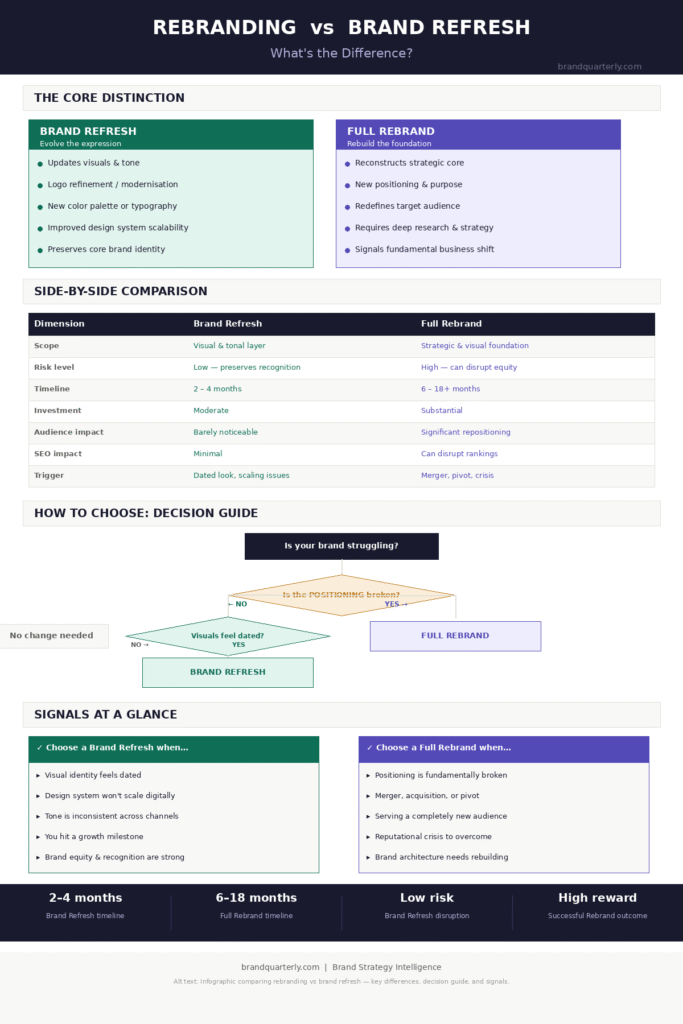
Rebranding vs Brand Refresh: The Core Differences
Understanding the practical differences between these options enables clear decision-making. The following table highlights the key areas where rebranding and brand refresh differ.
Scope and Depth
A brand refresh updates the visual and tonal aspects of your brand without altering its core meaning. In contrast, a rebrand changes the brand’s strategic intent, market positioning, and often its target audience. As a result, a rebrand requires more preparation, stakeholder alignment, and post-launch communication.
The scope difference also means the two approaches involve very different teams and processes. A refresh is primarily a design and marketing exercise that can often be managed in-house with a focused agency partner. A rebrand, however, typically demands involvement from senior leadership, brand strategy consultants, market research teams, and sometimes external advisors who specialize in organizational change. Furthermore, a rebrand almost always requires a brand audit to establish a clear baseline before any strategic decisions are made.
Risk and Disruption
Brand refreshes carry low risk because they maintain recognition. Customers often appreciate the updates without confusion. A rebrand, however, can alienate existing customers if not managed carefully. Abrupt changes without a clear narrative can lead to customer loss, negative media coverage, and reduced brand equity. Many high-profile rebrands have failed due to underestimating customers’ emotional connection to the original brand.
A rebrand also has significant SEO implications that a refresh usually does not. Changes to your domain, product names, or core messaging can disrupt years of search authority. Before proceeding, consult a rebranding SEO checklist to protect your digital presence during the transition.
Investment and Timeline
A brand refresh is typically completed in two to four months with a moderate budget, depending on the scope. It is focused and efficient. In contrast, a full rebrand often takes six months to over a year and requires a much larger investment in design, research, strategy, internal alignment, and post-launch brand building.
The timeline reflects the complexity of alignment required. A refresh moves quickly because it does not demand consensus on core strategy. A rebrand, however, requires alignment among all key stakeholders on the brand’s new direction. Without this, even the best visual identity will not deliver a consistent customer experience.
How to Know Which One You Need
Choosing between a rebrand and a refresh begins with an honest assessment of your situation. Conduct a thorough brand audit to evaluate equity, recognition, and strategic alignment. This will reveal whether your brand’s challenges are cosmetic or structural, which is essential for making the right decision.
Signs You Need a Brand Refresh
A refresh is appropriate if your visual identity appears outdated compared to competitors but your core positioning is strong. It is also suitable if your tone of voice is inconsistent or your design system does not scale well digitally. Significant growth milestones, such as entering new markets or launching new products, may also justify a refresh without changing the brand’s core meaning.
If customers still recognize and trust your brand but its presentation feels outdated, a refresh is usually the most effective and least risky option. Modernizing your brand while preserving equity shows your organization is evolving without losing its core strengths. Leading brands like Coca-Cola and Apple have used periodic refreshes to stay current while maintaining recognition.
Signs You Need a Full Rebrand
A full rebrand is needed when your brand identity no longer aligns with your current business reality. This may occur if you serve a new audience, your positioning no longer differentiates you, or your brand has negative associations that hinder growth. In these cases, a refresh will not address the core issues.
Significant structural changes, such as mergers, acquisitions, or major pivots, often require a rebrand to reflect the new organization. If your brand architecture has expanded with sub-brands or new product lines, a rebrand may be needed for coherence. Ask: Does our current brand accurately represent who we are and where we are headed?
The Strategic Process Behind Each Approach
Running a Brand Refresh Effectively
An effective brand refresh begins with a clear brief that defines the scope of updates. Without this, projects can expand beyond their original intent, known as “refresh creep.” The brief should specify what will change, what will remain, and the reasons for each decision, keeping the project focused and efficient.
Next, conduct a visual audit of current brand assets, review competitors, and explore design options. The chosen direction is applied across all touchpoints and documented in updated brand guidelines. A phased rollout is often preferable, allowing teams to update assets gradually and avoid inconsistencies.
An internal communication plan is essential. Employees, partners, and stakeholders should understand the reasons for the refresh before it is public. Clear usage guidelines should accompany new brand assets to ensure all teams apply the updated identity consistently from the start.
Running a Rebrand Effectively
A successful rebrand starts with a structured strategic process well before design begins. The first phase includes in-depth research: customer interviews, competitive analysis, stakeholder workshops, and a thorough brand audit to assess strengths and weaknesses. This research is essential for informed decision-making.
The strategy phase follows, during which the team defines the new brand’s positioning, purpose, and personality. This includes developing a clear brand positioning statement, articulating the brand’s messaging pillars, and ensuring that the new brand is meaningfully differentiated from competitors. Only after this strategic work is complete does the creative development phase begin. Design teams work within a clear strategic framework, which leads to identities that are not just beautiful but genuinely meaningful.
The final phase — launch and transition — demands as much attention as any other. How you communicate the rebrand to customers, employees, media, and partners will largely determine how it is received. Companies that reposition successfully almost always tell a clear, honest story about why the change was necessary and where the brand is headed. This narrative transforms what might otherwise feel like disruption into a compelling statement of intent and ambition. Rebranding without losing your audience is entirely achievable — but it requires deliberate, transparent communication at every stage.
Common Mistakes to Avoid
Treating a Rebrand as a Design Project
The most common and costly rebranding mistake is treating it as a visual project only. Rebranding due to an outdated logo, without addressing strategic issues, often results in an attractive but ineffective identity. Problems with positioning, messaging, or product-market fit require strategic—not just design—solutions.
Before investing in a rebrand, conduct a thorough competitive analysis to understand your market position and opportunities for differentiation. This may reveal that your strategic foundations are strong and only a refresh is needed, or it may confirm the need for a full rebrand.
Underestimating the Impact on SEO and Digital Presence
A brand change impacts more than visual assets. Domain names, URLs, content, backlinks, and search rankings can all be affected if not managed carefully. Many companies overlook this, resulting in lost organic traffic. With proper planning, including redirects, content migration, and outreach, these risks can be minimized.
A rebrand also affects your digital brand management infrastructure. Social media handles, business profiles, app listings, and email templates all need updating, which requires coordination. Develop a detailed asset migration plan before launch to ensure a smooth transition.
Moving Too Fast or Too Slow
Timing mistakes are common. Rushing a rebrand by shortening strategy and research often results in a shallow identity. Moving too slowly can cause loss of momentum, diluted focus, or obsolescence. The ideal process is disciplined, thorough, and maintains momentum.
Real-World Examples That Illustrate the Difference
Brand Refresh in Practice
Many major consumer brands have updated their logos over time without a full rebrand. These subtle changes, such as refined letterforms or simplified colors, are typical of brand refreshes. The brand’s meaning, audience, and positioning remain unchanged; only the visuals are modernized. Successful refreshes often go unnoticed, making the change feel natural rather than disruptive.
A common refresh scenario is when a company expands its product line or enters a new category. Instead of starting over, the team updates the visual system to support the broader portfolio while preserving existing brand equity. The refreshed system is more flexible and scalable, reflecting the business’s current state without requiring customers to adapt to a new brand.
Full Rebrand in Practice
A full rebrand is usually required when a company undergoes a fundamental transformation that its current identity cannot represent. For example, if a B2B software company shifts from serving small businesses to targeting enterprise clients, a rebrand signals the new positioning and credibility. The original brand may hinder success in the new market if it does not align with the expectations of enterprise customers.
Companies recovering from reputational crises or major failures may also require a full rebrand to signal real change in direction and leadership. In these cases, the rebrand serves as both a cultural and organizational statement, demonstrating to all stakeholders that the company has addressed its issues and is prepared to move forward. When done with integrity, this type of rebrand can be transformative.
Measuring Success After a Refresh or Rebrand
What to Track After a Refresh
After a brand refresh, the primary success metrics are recognition and reception. You want to confirm that existing customers still recognize and connect with the updated brand, and that the refreshed presentation is resonating positively with new audiences. Brand tracking surveys, social listening, and qualitative customer feedback are all valuable tools for assessing this in the weeks and months after launch. Additionally, tracking changes in brand awareness and engagement metrics across digital channels provides a data-driven view of how the refresh is performing.
It is also worth monitoring how well internal teams have adopted the new visual system. Inconsistent application of the refreshed identity — particularly in customer-facing materials — can undermine the entire exercise. Scheduling a post-launch brand compliance review at the thirty- and ninety-day marks helps catch and correct inconsistencies before they become entrenched. Using data analytics for brand decision-making throughout the post-launch period ensures that strategic decisions are grounded in evidence rather than assumptions.
What to Track After a Rebrand
Measuring rebrand success is complex and long-term. In the short term, use sentiment analysis and media coverage to gauge reception. In the medium term, track sales pipeline quality, acquisition costs, and deal size to assess audience alignment. Over time, brand equity research on awareness, associations, quality, and loyalty offers a comprehensive view of success.
Branding ROI is difficult to measure, but setting clear baseline metrics before launching a rebrand makes post-launch evaluation more meaningful. Without baselines, it is hard to demonstrate impact. Measurement discipline should begin at the start of the strategic process, not after launch.
The Role of Brand Positioning in Both Approaches
Whether you are refreshing or rebranding, brand positioning is the strategic anchor that everything else connects to. A refresh assumes your positioning is sound and simply updates how that positioning is expressed. A rebrand, by contrast, often involves repositioning — changing where the brand sits in the competitive landscape and how it is perceived relative to alternatives. Both decisions should be made with a clear-eyed view of what your target audience actually values and how they currently perceive your brand.
Clear positioning determines whether a brand change builds or erodes equity. When customers understand a brand’s purpose, even major visual changes feel coherent. Unclear positioning makes even small updates confusing. Every brand evolution should start with a positioning review, not a design brief.

Conclusion
The difference between rebranding and a brand refresh is one of depth. A refresh updates your brand’s expression; a rebrand rebuilds its foundation. Both are valuable when used appropriately. The key is to honestly assess whether your brand’s challenges are cosmetic or structural before choosing a path.
If your positioning is strong but your presentation is outdated, a focused brand refresh is the smart, efficient option. If your brand’s foundations are misaligned with your business, a rebrand is the more effective solution. In both cases, base your work on research, strategy, and respect for your customers and communities. When executed well, either approach can move your brand forward without losing its core value.
Ready to assess where your brand stands? Start with the Quarterly Clarity Method — a structured framework for diagnosing your brand’s strengths, gaps, and opportunities before you decide on the right path forward.
