
Data analytics for brand decision-making has moved from a competitive advantage to an operational necessity. Brands that rely on instinct alone are increasingly outpaced by those that pair creative vision with hard evidence. In fact, the way a brand positions itself, speaks to its audience, and competes in the market can all be sharpened dramatically when analytics sits at the center of the strategy. This article walks through how to build a data-informed brand operation—from the foundations of brand measurement to the specific tools and frameworks that turn raw numbers into confident decisions.
Why Data Analytics Belongs at the Heart of Brand Strategy
Brand strategy was once seen primarily as a creative discipline shaped by intuition and experience. This perspective is changing rapidly. Today, brand leaders who integrate analytics into their decision-making consistently outperform those who do not, as they can test assumptions, validate positioning, and adjust course before issues escalate.
This shift is significant because brand decisions often involve substantial costs and risks. Decisions such as adopting a new positioning statement, entering a new market segment, or updating visual identity benefit from data on audience behavior, competitive signals, and sentiment trends, which reduce risk. Additionally, data fosters a shared language within organizations, enabling teams to align around objective insights rather than subjective opinions.
Data analytics enables brands to be proactive rather than reactive. Analytics can identify early warning signs, such as changes in share of voice, search intent, or sentiment, allowing timely action. This foresight is possible only when measurement is integrated into daily operations, not treated as an afterthought.
If your brand lacks a structured measurement approach, brand equity models and the metrics behind them offer a strong starting point for understanding which numbers actually matter.
The Data Landscape: What Brands Are Actually Measuring
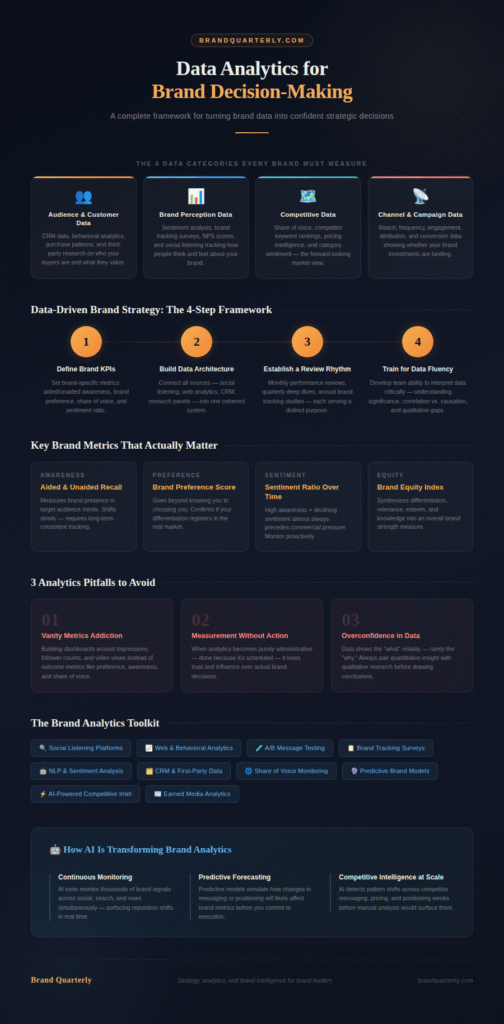
Before exploring frameworks, it is important to understand the types of data available to brand teams. Not all data is equally valuable, so prioritizing the right signals is essential.
Audience and customer data covers who your buyers are, how they behave, what they value, and how their needs are shifting. This includes first-party data from CRM systems, behavioral data from your website and app, and third-party research that maps the broader market. Understanding your ideal customer profile through a data lens gives you far more precision than demographic assumptions alone.
Brand perception data tracks how people think and feel about your brand over time. Sentiment analysis, brand tracking surveys, Net Promoter Scores, and social listening all contribute to this category. This data is particularly valuable because perception often moves ahead of financial performance—a brand with declining perception today will typically see revenue consequences months later.
Competitive data maps how rivals are positioning, messaging, spending, and performing. Share of voice, competitive keyword rankings, pricing intelligence, and category sentiment analysis all fall here. Competitive intelligence done well gives brands a forward-looking view of the landscape rather than just a rearview mirror.
Channel and campaign data measure the effectiveness of brand-building efforts across touchpoints. Metrics such as reach, frequency, engagement, attribution, and conversion indicate the impact of brand investments. Collectively, these four data categories give brand teams a comprehensive view of their market position.
Building a Data-Driven Brand Strategy Framework
A data-driven brand strategy is more than just having a dashboard. It is a framework where every major decision—positioning, messaging, targeting, investment—undergoes analytical review before execution. Building this framework requires intentional design.
Step one is defining your brand’s key performance indicators (KPIs). Generic marketing metrics like impressions or clicks rarely tell you much about brand health. Instead, brand-specific KPIs—aided awareness, unaided recall, brand preference, share of voice, sentiment ratio, and category entry points—give you a direct read on the brand’s health. Establishing these upfront ensures your analytics infrastructure measures what actually matters to brand growth. A structured brand audit can help identify which KPIs are most relevant to your specific situation.
Step two is to build a data collection architecture by connecting all data sources—such as social listening platforms, web analytics, CRM systems, research panels, and competitor monitoring—into a unified system. Without integration, teams only see fragmented data. Establishing a central analytics hub, even a basic one, allows for collective review of core metrics.
Step three is to establish a regular analytics review cycle. Data informs decisions only when reviewed consistently and tied to action. Monthly reviews, quarterly analyses, and annual tracking studies each serve distinct purposes. With this rhythm, analytics becomes integral to brand operations rather than an occasional project.
Step four is training your team to interpret data critically. Numbers are only as useful as the judgment applied to them. Brand teams benefit enormously from developing fluency in reading data—understanding statistical significance, recognizing correlation versus causation, and knowing when qualitative insight is needed to explain what quantitative data can only describe. Qualitative versus quantitative intelligence methods is a topic worth exploring if your team currently leans too heavily in one direction.
Using Analytics to Sharpen Brand Positioning
Positioning is arguably the most consequential decision a brand makes, and it is also one of the most data-rich opportunities in brand management. Analytics can inform positioning at every stage—discovery, validation, refinement, and monitoring.
During discovery, data surfaces white space in the competitive landscape. By analyzing how competitors are positioning, the language customers use to describe category needs, and which associations are currently ownerless, brands can identify positioning territories with real differentiation potential. Competitor mapping becomes far more powerful when it incorporates sentiment data, search intent trends, and share-of-voice analysis, rather than relying solely on manual observation.
During validation, quantitative testing such as concept surveys, A/B message tests, and conjoint studies enables brands to evaluate positioning options before committing. This approach allows brands to test multiple positions with target audiences, measure preference and distinctiveness, and choose the option supported by the strongest evidence.
During refinement, ongoing perception tracking reveals whether the positioning is resonating as intended. Gaps between intended and perceived positioning are common, and analytics is essential for early detection. For example, if your brand aims for “reliability” but sentiment data shows an association with “affordability,” this gap should be addressed promptly.
For a deeper look at how positioning decisions translate into market outcomes, why good positioning beats good ads is worth reading alongside your analytics work.
Audience Analytics: Knowing Your Customer More Deeply Than Ever
Audience analytics is often the most data-rich area for brands. Digital behavior, purchase patterns, survey responses, and engagement data together provide a detailed understanding of customer preferences and decision-making. Successful brands leverage this data to achieve precise targeting and messaging.
Customer segmentation powered by analytics goes far beyond basic demographics. Behavioral segmentation—grouping customers by how they interact with your brand, what content they engage with, and at what point in the journey they convert—allows for much more precise messaging strategies. Attitudinal segmentation, based on survey data, reveals which customer groups are most emotionally aligned with your brand values and therefore most likely to become advocates.
Audience analytics helps identify segments with the highest lifetime value, not just the largest volume. Large groups of price-sensitive buyers may underperform in retention and advocacy, while smaller, values-aligned segments can generate greater long-term revenue and referrals. Recognizing these distinctions guides effective resource allocation.
Additionally, audience data helps brands track how customer profiles are shifting over time. Markets evolve. New competitors attract segments your brand previously owned. Cultural shifts change what customers value. Regular audience analytics ensures that your target audience definition reflects the current reality rather than assumptions made two years ago.
Competitive Analytics: Turning Market Intelligence Into Brand Decisions
Competitive analytics is a high-impact use of data in brand management. It addresses key questions such as whether the brand is gaining or losing ground, where competitors are investing, what messages they are using, and future market directions.
Share of voice analysis, which measures your brand’s presence in online conversations compared to competitors, is a direct indicator of brand momentum. An increasing share of voice often signals future market share growth, while a decline can indicate waning relevance. Monitoring this metric monthly across channels provides a reliable view of competitive position.
Message analysis is equally revealing. By systematically monitoring competitor messaging—website copy, ad campaigns, press releases, social content—brands can identify the themes competitors are doubling down on and the gaps they are leaving open. Signals versus noise in competitive monitoring is a critical skill here, because not every competitor move deserves a response.
Furthermore, using AI for competitive intelligence is rapidly changing the speed and scale at which brands can process competitive data. AI-powered tools can now monitor thousands of competitor signals simultaneously, flag material changes, and surface pattern shifts that would take human analysts weeks to detect. Brands that integrate AI into their competitive analytics workflow gain a meaningful speed advantage in a fast-moving market.
Messaging Analytics: Measuring What Actually Resonates
Every brand message is a hypothesis until validated by the market. Analytics turns messaging into a testable, iterative process, enabling brands to learn which language, tone, and claims resonate with their audience.
Digital channels have made message testing more accessible than ever. A/B testing ad copy, landing page headlines, email subject lines, and social captions gives brands real-world feedback at scale and speed. When these tests are designed around specific brand messages rather than just conversion variables, they generate insights that feed directly back into the broader brand strategy. Your messaging pillars should be regularly pressure-tested against engagement and response data to confirm they still hold up.
Natural language processing (NLP) tools add another dimension to messaging analytics by analyzing how customers describe your brand in their own words. Customer reviews, social media comments, support conversations, and survey open-ends all contain rich language data that reveals which brand attributes are registering, which claims are being questioned, and which emotional associations are forming spontaneously. When that language closely mirrors your intended brand voice, you know the messaging is working. When it diverges, you have a clear signal that something needs attention.
Finally, message analytics should extend to earned and owned media. Tracking which thought leadership content generates the most engagement, which brand narratives earn the most press coverage, and which stories prompt the highest-quality social sharing gives brand teams a continuously updated picture of what their audience finds genuinely compelling.
Brand Performance Metrics That Actually Matter
A common analytics mistake is focusing on activity metrics rather than outcome metrics. Metrics like page views and follower counts are easy to track but offer limited insight into brand health. Effective analytics prioritizes metrics that directly reflect brand strength and business value.
Brand awareness metrics—aided awareness, unaided awareness, and top-of-mind awareness—measure how prominently your brand is in your target audience’s minds. These metrics change slowly, so they require consistent long-term tracking rather than point-in-time snapshots. Tracking digital brand awareness over time is one of the most reliable ways to assess whether brand-building investments are compounding.
Brand preference metrics assess not only brand awareness but also whether customers would choose your brand over competitors. Combined with positioning research, preference data reveals if your differentiation is recognized in the market or exists only internally.
Brand sentiment metrics track the emotional valence of brand mentions over time. A brand can have high awareness but declining sentiment—a combination that almost always foreshadows commercial pressure. Regular sentiment monitoring, combined with a clear process for acting on what the data reveals, enables brands to proactively protect and strengthen their reputations. Online reputation management for brands is an increasingly important extension of brand sentiment analytics.
Brand equity metrics synthesize multiple data points into an overall measure of brand strength. Models such as the Brand Asset Valuator and Millward Brown’s BrandDynamics pyramid provide structured frameworks for interpreting equity data along dimensions of differentiation, relevance, esteem, and knowledge.
Integrating Analytics Into Go-to-Market Decisions
Data analytics supports brand decision-making not only in ongoing management but also during critical strategic moments, such as go-to-market launches. When entering new markets, launching products, or repositioning, analytics should inform every stage.
Pre-launch, analytics informs segmentation and targeting decisions, helping brands identify which audience segments represent the highest opportunity and what messaging will resonate most strongly with each. Go-to-market strategy development benefits significantly from competitive positioning data that maps the territory before entry rather than after.
During launch, real-time analytics enables rapid optimization. Immediate data on channel performance, message conversion, and funnel issues allows teams to reinforce successful tactics and address problems while momentum is high.
Post-launch, analytics enables an honest assessment of whether the brand achieved what it set out to do. Comparing pre- and post-launch brand metrics—awareness, perception, preference, share of voice—against the objectives set at the outset gives brand leaders a clear picture of impact and a data-informed foundation for the next decision. Measuring your efforts against defined go-to-market KPIs ensures accountability and continuous improvement across every launch.
Common Pitfalls in Brand Analytics (and How to Avoid Them)
Even well-resourced brand teams fall into predictable analytics traps. Knowing what those traps look like is the first step toward avoiding them.
Vanity metrics addiction is perhaps the most widespread problem. When brand dashboards are dominated by easy-to-move numbers—impressions, follower growth, video views—they create a false sense of progress while the metrics that truly matter are going unmeasured. The solution is to build brand dashboards anchored to outcome metrics first, with activity metrics serving as supporting roles.
Measurement without action is another major pitfall. Data that does not inform decisions adds cost without value. Each analytics review should result in a decision or a documented question to address in the next review. Analytics must remain actionable to retain trust and relevance.
Overconfidence in data is another risk. Analytics often explains what happened, but not why. Without qualitative research, explanations may be inaccurate. Effective analytics combines quantitative rigor with qualitative insights for a complete understanding.
Siloed data is a structural problem that undermines even well-designed analytics programs. When brand data, campaign data, CRM data, and competitive data live in separate systems and are reviewed by separate teams, the connections between them go unseen. Digital brand management at scale requires connected data systems that allow teams to see the full picture together.
The Role of AI and Automation in Brand Analytics
Artificial intelligence is not just changing the tools available to brand teams—it is changing the pace at which brand analytics can operate. Processes that once required weeks of manual analysis can now run continuously in the background, surfacing insights in real time and at a scale no human team could match alone.
AI in digital brand management enables brands to monitor their reputation across thousands of online sources simultaneously, detect emerging narrative shifts before they become crises, and personalize brand experiences at the individual level. Natural language generation is also accelerating the analysis-to-insight pipeline, automatically summarizing complex data sets into actionable brand intelligence.
Predictive analytics is an emerging area with major implications for brand decisions. By analyzing historical data, predictive models forecast the impact of changes in messaging, positioning, or investment, enabling teams to simulate outcomes before acting. This shifts analytics from explanation to foresight.
As AI-powered analytics tools become more prevalent, the competitive advantage will increasingly belong to brands that know how to ask the right questions of their data, not simply to those with the most data. Human judgment, strategic framing, and ethical data use remain essential complements to automation. Automating competitive monitoring systems offers a practical lens for building AI-augmented brand intelligence without losing the human insight that gives it meaning.
Turning Analytics Into a Brand Culture
The most enduring competitive advantage in brand analytics is a data-driven culture. Organizations that foster data curiosity, value analytical and creative thinking equally, and routinely test decisions based on evidence consistently outperform those that treat analytics as a specialized function.
Building a data-driven culture begins with leadership. When senior leaders use data in decision-making, ask analytical questions, and reward teams for surfacing challenging insights, this behavior spreads throughout the organization. Using data only to support predetermined conclusions undermines the analytics process.
Training is the second lever. Brand teams do not need to become data scientists, but they do need enough analytical literacy to engage meaningfully with data, ask intelligent questions, and avoid being misled by poorly designed analyses. Regular training, exposure to analytics tools, and cross-functional collaboration with data teams all build that literacy over time.
Finally, building a culture of analytics means accepting uncertainty gracefully. Data reduces uncertainty; it rarely eliminates it. Brands that can make confident decisions despite residual uncertainty—treating analytics as a guide rather than a guarantee—are far better equipped for the pace and complexity of modern markets than those who wait for certainty that never fully arrives.
Conclusion
Data analytics is now the operational backbone for brands aiming to compete seriously. From positioning and messaging to strategy and targeting, analytics transforms intuition into intelligence. Successful brands embed analytics into their culture, processes, and decision-making, using it as a foundation for confident, creative decisions.
Begin by defining key brand metrics, connecting data sources, and establishing a regular review process. The gap between data-informed brands and those relying on instinct is widening, but closing it is achievable.
