
Many brand leaders confuse go-to-market strategy vs marketing strategy vs business strategy. These three terms appear everywhere in strategy meetings, pitch decks, and leadership reviews. However, each one answers a different question and operates at a different level of the organization. Mixing them up leads to misaligned teams, wasted budgets, and campaigns that fail to drive real results. In this article, you will learn exactly what separates these three strategy types — and how to align them so they work together.
What Is a Business Strategy?
A business strategy is the highest-level plan in your organization. It defines where the company is going, how it will compete, and what it will prioritize over the next three to ten years. Essentially, it answers one core question: how will this company win? Without a clear business strategy, every team below it ends up optimizing for different outcomes.
Business strategy covers decisions such as which markets to enter or exit, how to allocate resources across business units, and which financial targets to pursue. It also defines the competitive advantages the company will protect and build over time. Consequently, it sets the constraints for every other strategy in the organization. Your brand strategy must align with it. Your marketing strategy must serve it. And your go-to-market strategy must execute within it.
Notably, business strategy includes decisions about brand positioning — how the company wants to sit in its best customers’ minds relative to competitors. Positioning is not purely a marketing function. Instead, it starts as a strategic decision at the business level, before it cascades into messaging, campaigns, and content. Therefore, getting it right at the top matters enormously for everything that follows downstream.
One critical point worth emphasizing: business strategy is set by the CEO and board-level leadership. It changes rarely — only when the fundamental dynamics of the market shift materially. Moreover, it must be documented and shared across the leadership team before any meaningful marketing or go-to-market work can begin. Without that foundation, every strategy built on top of it will eventually drift.
What Is a Go-To-Market Strategy?
A go-to-market strategy — often called a GTM strategy — is the operational plan for bringing a specific product or service to market. It is narrower in scope than a business strategy and more focused than a marketing strategy. While business strategy asks “how will we win overall?”, a go-to-market strategy asks “how will we launch and sell this specific offering to this specific audience?”
A strong GTM strategy typically includes a well-defined ideal customer profile, a clear value proposition, a pricing and packaging model, and a defined sales motion. It also specifies the primary channels for customer acquisition and the messaging to use at each stage of the buying journey. Furthermore, it names the metrics that will measure success. Because of this specificity, you can track GTM performance with precision using GTM KPIs that measure market entry success.
The GTM strategy is most visible during a product launch, a market expansion, or a rebranding initiative. However, it is not exclusively a launch tool. Companies also build GTM strategies when entering new verticals, targeting new geographies, or repositioning an existing product for a different segment. Additionally, if your organization has explored the types of go-to-market strategies available, you already know that the right model depends on the complexity of the sale, the market’s maturity, and buyer behavior.
What makes a GTM strategy unique is its specificity and time-bound nature. It applies to a specific launch window or fiscal year—and that is actually a strength. As a result, every stakeholder — product, sales, marketing, customer success — shares one plan with shared definitions of success. Course-correction is therefore far easier than evaluating a vague, long-horizon plan that lacks defined endpoints.
What Is a Marketing Strategy?
A marketing strategy is the ongoing plan for how a company communicates with its target audience, builds brand awareness, generates demand, and supports revenue growth over time. It sits between the business strategy and individual campaigns. While business strategy sets the destination and GTM strategy handles specific launches, the marketing strategy governs the sustained relationship between a brand and its market.
A well-built marketing strategy includes decisions about target audience definition and customer segmentation, channel selection, brand voice, messaging hierarchy, and the metrics used to evaluate both brand and demand performance. It also defines the competitive position the brand wants to occupy. Consistency is, in fact, one of the defining qualities of a strong marketing strategy. Without it, brands look fragmented — and fragmented brands lose trust faster than almost anything else.
Unlike a GTM strategy, a marketing strategy is not tied to a single product or launch window. Instead, it evolves gradually because the underlying assets it builds accumulate over time. Brand equity, audience relationships, SEO authority, and category credibility all compound slowly over time. Therefore, cutting marketing investment during downturns is far more costly than most leadership teams realize. A strong brand equity model helps organizations understand exactly what is at stake when they interrupt that compounding process.
A well-developed marketing strategy also defines the messaging pillars that guide all communications across the business. These pillars ensure that whether a customer reads a blog post, watches an ad, or speaks with a sales rep, the same core truths about the brand come through clearly. Building that kind of coherence requires deliberate strategic work — not just a style guide and a content calendar, but a genuine framework for how the brand thinks about its audience.
Go-To-Market Strategy vs Marketing Strategy: Key Differences
These two strategy types are often confused because they share many of the same tools — messaging, channels, audience targeting, and content. However, the purpose, scope, and output of each are meaningfully different. Understanding where they diverge is essential for building a team structure and a planning process that actually works.
Scope and duration differ significantly. A go-to-market strategy is bounded — it applies to a specific product, launch, or market entry and has a clear beginning and end. A marketing strategy, on the other hand, is ongoing. It governs how the brand shows up across all products, all channels, and all moments of the customer relationship. Moreover, a GTM strategy can exist within a marketing strategy, borrowing its audience definitions and messaging frameworks while applying them to a specific commercial objective.
The primary question each strategy answers is different. GTM strategies answer: how do we get this specific offering in front of the right buyers and convert them? Marketing strategies answer: how do we build and maintain the brand relationships that make future GTM efforts easier and more effective? In other words, one focuses on activation, and the other focuses on accumulation. Both matter—but conflating them leads organizations to treat every launch as if it existed in isolation.
Audience specificity varies between the two. A go-to-market strategy operates with a tightly defined ideal customer profile — often down to firmographic, psychographic, and behavioral detail. A marketing strategy, however, works with broader audience segments and typically includes multiple personas across the full funnel. Consequently, using GTM-level specificity for all marketing activity leads to under-investing in brand building. Similarly, using marketing-level breadth for a product launch leads to vague messaging that struggles to convert.
Metrics are fundamentally different as well. GTM performance is typically measured through pipeline generation, conversion rates, sales cycle length, and market penetration within a defined period. Marketing strategy performance, by contrast, is measured through longer-horizon metrics: brand awareness, share of voice, net promoter score, customer lifetime value, and organic demand growth. Both measurement frameworks are important — and organizations that track only one tend to make poor investment decisions about the other.
Go-To-Market Strategy vs Business Strategy: Key Differences
While go-to-market and marketing strategies are easy to confuse because they share tools, go-to-market and business strategies are easy to confuse because they both involve competitive positioning and growth planning. Nevertheless, the differences between them are just as important to understand.
Time horizon separates them clearly. Business strategy operates on a three- to ten-year horizon. Go-to-market strategy, however, operates on a twelve-to-eighteen-month horizon — sometimes shorter. Business strategy governs the organization’s long-term trajectory. GTM strategy, therefore, focuses on executing a specific commercial objective within that trajectory. You might update your GTM strategy every year or every product cycle, but your business strategy should change far less frequently.
The level of decision-making differs as well. Business strategy is set at the executive and board level. It involves resource allocation across business units, major market entry or exit decisions, and fundamental competitive choices. Go-to-market strategy, by contrast, is typically owned by the head of marketing, the head of growth, or a cross-functional launch team. This distinction matters for governance — the people accountable for GTM execution should not be the same people who set the organization’s long-term direction.
Competitive context looks different at each level. Business strategy requires a deep understanding of the competitive landscape at a structural level — industry dynamics, competitor capabilities, and long-term market forces. A competitive intelligence function supports business strategy by surfacing signals about where the market is heading. GTM strategy, however, focuses more narrowly on the competitive context at the point of purchase — the alternatives buyers are evaluating right now and the objections that must be addressed. Your competitor mapping process will therefore look quite different depending on which strategic layer you are informing.
Marketing Strategy vs Business Strategy: Key Differences
Of the three pairings, marketing strategy and business strategy are perhaps the most commonly misaligned in practice. Marketing leaders sometimes develop strategies that reflect their own functional priorities rather than the organization’s strategic intent. Business leaders, on the other hand, sometimes set strategies that marketing has no practical way to execute. Closing this gap requires a shared language and mutual respect for each layer’s responsibilities.
Purpose differs between the two. Business strategy exists to guide organizational decisions about how the company competes and grows over the long term. Marketing strategy, by contrast, exists to build the brand relationships and demand generation infrastructure that support those long-term ambitions. Marketing strategy is fundamentally a function of business strategy—not a parallel track. When the two are misaligned, marketing teams execute campaigns that feel disconnected from the company’s actual competitive priorities.
Ownership and accountability are different, too. Business strategy belongs to the CEO and the senior leadership team. Marketing strategy, however, falls under the Chief Marketing Officer, in close collaboration with product and sales. Neither can be developed in isolation — the marketing strategy must be informed by the business strategy’s choices about which markets and segments to prioritize. Conversely, a well-articulated marketing strategy can — and should — inform business strategy decisions about where brand equity is strongest.
Brand serves as the critical bridge between the two. Brand purpose, brand values, and brand personality are not just marketing constructs. Rather, they are strategic assets that create a durable competitive advantage. A brand that occupies a distinctive position in its market makes every subsequent strategic move easier — new product launches to a receptive audience, new markets opening with existing credibility, and price premiums holding even when competitors undercut on features. That is precisely why good positioning beats good ads — it is a strategic advantage, not just a creative one.
How All Three Strategies Work Together
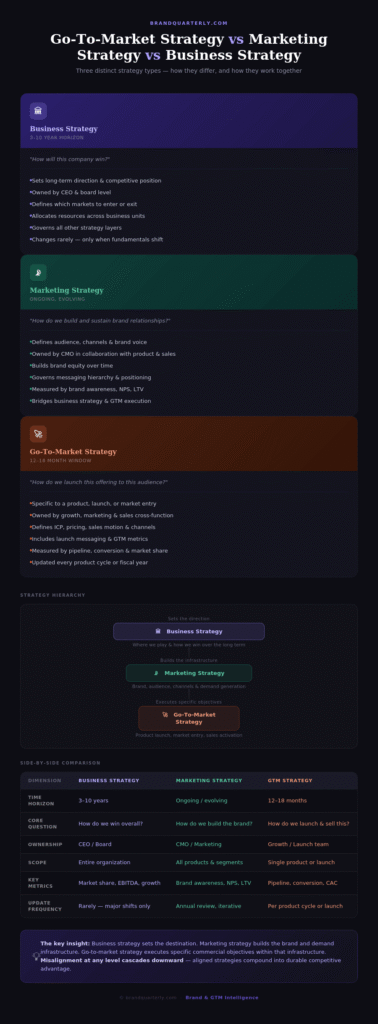
The most effective organizations do not treat these three strategies as separate documents or as the purview of separate departments. Instead, they understand the hierarchy: business strategy sets direction, marketing strategy builds the brand and demand infrastructure, and go-to-market strategy executes specific commercial objectives within that infrastructure. Each layer must be coherent with the others — and misalignment at any one level creates problems that cascade downward.
Consider a company that sets a business strategy to move upmarket and serve enterprise customers. Because of that decision, their marketing strategy must shift to build credibility with enterprise buyers — through thought leadership, case studies, executive-level content, and brand positioning that signals trust and scale. Their go-to-market strategy for the next product release must then reflect that shift as well: the sales motion changes from self-serve to enterprise, the messaging emphasizes security and compliance, and the channels shift from paid social to account-based marketing. Each layer informs and constrains the next. Therefore, when business strategy changes, marketing and GTM strategies must adapt accordingly.
The Quarterly Clarity Method offers a useful framework for aligning these three layers on a rolling basis. Rather than waiting for an annual planning cycle to surface misalignments, it reviews strategic alignment at regular quarterly intervals. This structured cadence prevents the drift that occurs when teams operate in silos for too long. Furthermore, building a cohesive brand messaging framework ensures that all three strategic layers speak the same language when they reach the customer.
A useful diagnostic for any organization is to ask: Does our GTM strategy reflect our marketing strategy? Does our marketing strategy reflect our business strategy? If the answer to either question is “not really,” then the strategies are not aligned — they are merely coexisting. Coexisting strategies produce average results. Aligned strategies, however, compound into a durable competitive advantage.
Common Mistakes When Confusing These Strategies
Confusing these three strategy types is extremely common — and the consequences are real. Below are the most frequent mistakes organizations make when they fail to clearly distinguish between them.
Treating every launch as a business strategy decision. Some leadership teams elevate every product launch to board-level review for decisions that clearly belong at the GTM level. This approach slows execution, creates bottlenecks, and demoralizes go-to-market teams. Not every decision is a business strategy decision — learning to distinguish between levels is a foundational leadership skill.
Building a marketing strategy that ignores business strategy. Marketing teams sometimes build strategies that reflect what is familiar or achievable — rather than what the business strategy actually requires. For instance, a company aiming to become the category leader in a new vertical needs a marketing strategy that aggressively builds awareness and credibility in that vertical. A strategy focused only on retention and loyalty in the existing customer base is not wrong — it is simply misaligned. A brand audit can help surface these misalignments before they become costly.
Deploying GTM tactics without a marketing strategy. Many growth-stage companies have a go-to-market strategy for each launch, but no coherent marketing strategy that connects those launches. As a result, each GTM effort starts from scratch — new messaging, new positioning, new audience definitions. As a result, the brand never builds equity. Over time, the company must spend more with each launch to achieve the same level of awareness that a well-maintained brand would carry forward automatically.
Skipping competitive analysis at the right level. Business strategy requires structural competitive intelligence — understanding industry forces over five to ten years. GTM strategy, however, requires point-in-time competitive analysis — understanding what alternatives buyers are evaluating right now. Consequently, using the wrong type of analysis at the wrong strategic level leads to poor decisions. Learn how competitive intelligence differs from competitive analysis to apply the right tool at the right level.
How to Build and Align Your Strategic Stack
For brand leaders who want to ensure their three strategies are properly constructed and aligned, the following practical framework provides a solid starting point.
Step 1: Establish Business Strategy Clarity First
Before developing a marketing or GTM strategy, confirm that your business strategy is clear, documented, and shared with the leadership team. Specifically, this means having explicit answers to the question: What markets are we competing in? What is our source of competitive advantage? What does winning look like over the next three to five years? If those questions lack clear, agreed-upon answers, then any marketing or GTM work built on top will be structurally unstable from the start.
Step 2: Build a Marketing Strategy That Serves the Business
With business strategy clarity established, develop a marketing strategy that directly serves those strategic priorities. Define your audience architecture, brand positioning, messaging hierarchy, and channel strategy. Build your value proposition in direct response to the competitive position your business strategy has identified. Moreover, use your brand differentiation work to ensure your marketing strategy rests on a foundation that competitors cannot easily replicate.
Step 3: Build GTM Strategies Within the Marketing Framework
For each product launch, market entry, or major commercial initiative, build a GTM strategy that borrows its audience definitions, messaging frameworks, and channel preferences from the marketing strategy — while adding the specificity required for execution. Define the ideal customer profile, sales motion, launch timeline, and success metrics. Ensure the GTM messaging aligns with the broader GTM messaging framework your marketing team has established. Doing this prevents each launch from reinventing the wheel and ensures brand consistency across all commercial moments.
Step 4: Schedule Regular Alignment Reviews
Strategies drift over time. Markets shift. Teams grow and bring new interpretations of existing priorities. Therefore, schedule strategic alignment reviews at least quarterly — to ensure all three strategies remain coherent with each other and with the current competitive landscape. Use tools like competitive analysis for brands to monitor whether your positioning assumptions still hold, and adjust accordingly when they do not.
Why This Distinction Matters for Brand Leaders
For CMOs, brand directors, and growth leaders, understanding the differences between go-to-market, marketing, and business strategies is not an academic exercise — it is a practical competitive advantage. Specifically, it changes how you structure your team, how you prioritize your time, how you present recommendations to the board, and how you evaluate whether your work is actually moving the business forward.
Brand leaders who confuse marketing strategy with GTM strategy tend to oscillate between being too tactical and too vague. Those who confuse marketing strategy with business strategy either overstep their remit or underdeliver on their mandate. The most effective brand leaders know exactly which layer they are operating in at any given moment. This kind of clarity is also what makes scaling digital brand management possible: when strategy is well-structured, growth does not require proportional increases in overhead and complexity.
Furthermore, this distinction matters enormously for measurement. Each strategy type has different metrics, different time horizons, and different definitions of success. Presenting GTM conversion metrics as evidence of marketing strategy success creates a false sense of confidence. Presenting marketing strategy metrics as evidence of progress in business strategy does the same. Therefore, build measurement frameworks that align with the strategic layer being evaluated and present them to each stakeholder group.
Conclusion
A go-to-market strategy, a marketing strategy, and a business strategy each serve a distinct and irreplaceable purpose in how a company grows. Business strategy sets the long-term direction. Marketing strategy builds the brand and demand infrastructure that sustains growth. A go-to-market strategy executes specific commercial objectives within that infrastructure. Each layer depends on the others — and misalignment between them is one of the most common and costly strategic failures a growing organization can make.
The good news is that alignment is achievable. Moreover, it does not require more documentation — it requires deliberate strategic thinking, cross-functional communication, and regular review. When all three strategies point in the same direction, brand building compounds, launches become more efficient, and competitive advantage becomes self-reinforcing. That result is not accidental. It follows from treating strategy as a coherent system rather than a collection of independent plans.
If you are working to bring greater clarity and alignment to your organization’s strategic stack, start by asking a simple question: Do our go-to-market efforts, our marketing investments, and our business priorities all tell the same story? If not, that gap is worth closing — and the sooner you close it, the better your results will be.
