
A digital brand audit template gives your team a structured, repeatable way to assess how your brand performs across every channel and touchpoint. Without one, brand reviews become ad hoc conversations — useful in the moment but hard to act on consistently. With a clear template, you capture the full picture: what is working, what is inconsistent, and where the biggest opportunities for improvement sit. This guide walks through each section of a practical digital brand audit template you can use right away.
Brand leaders and in-house managers alike benefit from conducting audits regularly. Quarterly light audits and annual deep reviews together provide you with both early-warning signals and the strategic clarity your brand needs to stay sharp. A solid brand audit process starts with knowing exactly what to measure — and this template gives you that foundation.
What a Digital Brand Audit Covers
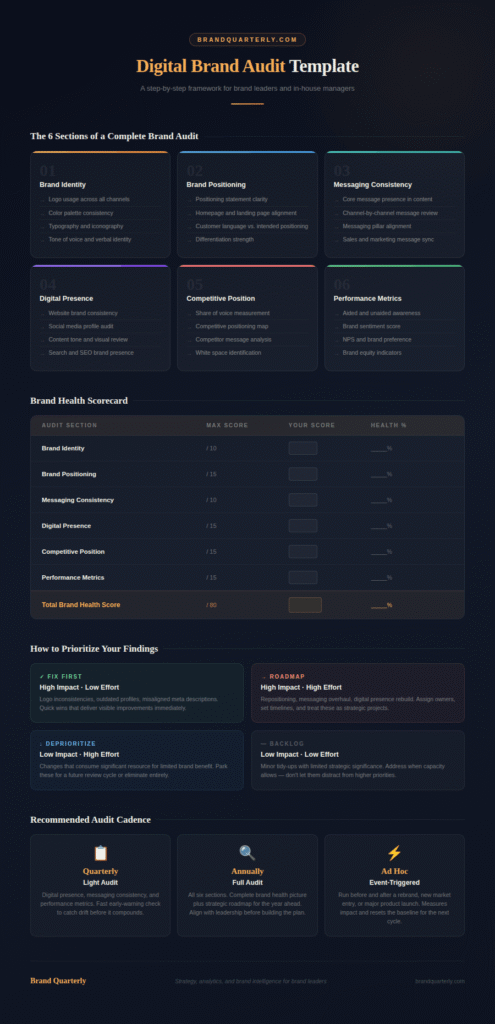
A digital brand audit covers six core areas: brand identity, brand positioning, messaging consistency, digital presence, competitive standing, and brand performance metrics. Each area connects to the others. Weakness in one tends to show up across all of them. Working through each section in order gives you a complete, connected view of your brand’s current health.
Section 1: Brand Identity Audit
The brand identity audit section evaluates whether your visual and verbal identity is consistent across all touchpoints. This is where most brands discover their first major inconsistencies. Logos appear in outdated versions. Colors shift between channels. Typography varies across platforms. These gaps seem small in isolation, but they compound into a perception problem at scale.
Visual Identity Checklist
Work through each visual identity element systematically. Check your logo usage across your website, social media profiles, email templates, presentations, and any external partner materials. Confirm that every instance uses the approved version, correct proportions, and the right clear space. Next, audit your color palette. Open five to ten pieces of recent content and check whether the hex codes and RGB values match your approved palette exactly. A single rogue shade repeated across dozens of assets creates visible inconsistency.
Review your typography across all digital channels. Confirm that heading fonts, body fonts, and any accent typefaces match your brand guidelines precisely. Check your iconography and illustration style for consistency. Then review your photography and imagery for tonal alignment — do all images feel like they come from the same brand world, or do they look assembled from different stock libraries?
Verbal Identity Checklist
Verbal identity encompasses your brand name usage, tagline application, and tone-of-voice consistency. Check whether your brand name appears correctly formatted across all channels — capitalization, spacing, and trademark symbols where required. Audit five to ten pieces of copy from different channels and assess whether the tone feels consistent. Rate each piece against your approved tone of voice description. Flag any that feel significantly off. Your brand personality should come through clearly in every piece of communication your brand produces.
Identity audit score: Rate each element as Consistent / Partially Consistent / Inconsistent. Total the ratings to generate an overall identity health score.
Section 2: Brand Positioning Audit
The positioning audit assesses whether your brand occupies a clear, differentiated, and credible space in your market. This section goes deeper than visual consistency. It asks whether the market actually understands and believes what your brand stands for.
Positioning Clarity Check
Start by documenting your current positioning statement. Then compare it against three sources of evidence. First, review your website homepage and key landing pages. Does the copy communicate your positioning clearly within the first few seconds? Second, read through your most recent ten social media posts. Do they reinforce your positioning, or do they drift into generic category messaging? Third, review any recent customer feedback, survey responses, or review site comments. Check whether customers describe your brand in language that matches your intended positioning.
Gaps between your intended positioning and how customers actually describe you are common — and important. They reveal whether your positioning is landing as designed or remaining an internal document that never quite reaches the market. Brand positioning only creates value when it shows up consistently in how customers think and talk about you, not just in how you describe yourself internally.
Differentiation Check
Assess your differentiation by listing the three to five things your brand claims to do or be better than alternatives. For each claim, ask two questions. First, is this claim genuinely distinctive — or do most competitors make the same claim? Second, do you have evidence that customers actually believe and value this distinction? Claims that fail either test need revision. Strong brand differentiation requires specificity and credibility, not just confident language.
Positioning audit score: Rate positioning clarity, differentiation strength, and customer alignment each on a scale of 1–5. Total for an overall positioning health score out of 15.
Section 3: Messaging Consistency Audit
The messaging audit reviews whether your brand communicates the same core ideas across every channel and format. Inconsistent messaging is one of the most common and damaging brand problems. It confuses prospects, weakens trust, and dilutes the cumulative impact of your marketing investment.
Core Message Audit
Start with your core message — the single most important idea your brand communicates. Write it down precisely. Then pull a sample of ten to fifteen pieces of content from across your channels: website copy, email sequences, social posts, sales decks, and any paid advertising. Read each piece and ask whether your core message is present, implied, or absent. Mark each as Present / Implied / Absent.
If your core message appears as absent or only implied in more than a third of your content sample, you have a messaging consistency problem. Your messaging pillars should anchor every significant piece of content your brand produces. When they do, cumulative message exposure builds the strong, clear associations that drive brand preference over time.
Channel-by-Channel Message Review
Review each major channel individually. For each one, record the primary message it communicates, the tone it uses, and whether it links back to your core positioning. Then compare across channels. Look for channels that have drifted into their own messaging territory, disconnected from your brand’s central narrative. This drift often happens gradually — a social media team develops its own voice, an email program evolves independently, a sales team creates its own deck language. A brand messaging framework keeps all channels aligned.
Messaging audit score: Rate message consistency across channels on a scale of 1–5. Rate core message presence in content on a scale of 1–5. Total for an overall messaging health score out of 10.
Section 4: Digital Presence Audit
The digital presence audit evaluates how your brand appears across all owned and earned digital channels. This section covers your website, social media profiles, search visibility, and content performance. It tells you whether your digital footprint is working hard for your brand or quietly undermining it.
Website Brand Audit
Your website is your most important owned brand channel. Audit it across four dimensions. First, check brand consistency — do all pages reflect the same visual identity, tone, and messaging? Pay particular attention to interior pages, blog posts, and conversion-focused landing pages. These are the pages most likely to drift from brand standards. Second, assess the brand experience — does the site feel premium, accessible, and aligned with your brand’s intended personality? Load speed, navigation clarity, and visual hierarchy all contribute to this perception.
Third, review your key brand pages — the About page, the homepage, and any brand story content — for clarity in positioning. Does a first-time visitor understand exactly what your brand does, who it serves, and why it is different within thirty seconds? Fourth, check whether your brand values and brand purpose come through authentically in your content. Visitors form strong impressions quickly. Make sure those impressions align with your intentions.
Social Media Brand Audit
Audit each active social channel separately. For each platform, check profile completeness and visual consistency — bio, profile image, cover image, and link. Review the most recent twenty posts for tone consistency, visual consistency, and message alignment. Note the engagement rate pattern — are certain content types consistently outperforming others? High-performing content types reveal what your audience most values from your brand on that channel.
Also, check for channel-specific brand drift. A brand that sounds sharp and confident on LinkedIn but casual and scattered on Instagram has a consistency problem. Each channel naturally has its own format conventions, but the underlying brand voice should remain recognizable across all of them. Systematic social media metrics for brand performance tracking give you the data to act on these findings, not just observe them.
Search and SEO Brand Audit
Search is a significant brand touchpoint that many teams overlook in brand audits. Run a branded search for your company name and review the first page of results. Check whether the listings, meta descriptions, and page titles reflect your current brand positioning and messaging. Look at your Google Business Profile if you have one— is it complete, up to date, and visually consistent?
Review your top organic landing pages from a brand experience perspective. Do they deliver on the brand promise that attracted the click? Check whether your brand positioning vs product positioning comes through clearly in how your pages present your offer to organic visitors.
Digital presence audit score: Rate your website, social media, and search presence each on a scale of 1–5. Total for an overall digital presence health score out of 15.
Section 5: Competitive Position Audit
The competitive position audit places your brand in its market context. A brand cannot assess its own strength accurately without understanding where it stands relative to competitors. This section maps the competitive landscape and identifies where your brand leads, matches, and trails.
Share of Voice Analysis
Start by measuring your brand’s share of voice—the percentage of relevant online conversation your brand generates relative to competitors. Use social listening tools to track brand mentions, relevant hashtags, and category keywords over the past ninety days. Compare your share of voice to your three to five closest competitors. A growing share of voice typically signals brand momentum. A declining share, even with stable revenue, often signals an early-stage relevance problem worth addressing before it compounds.
Competitive Positioning Map
Build a simple two-by-two positioning map. Choose two dimensions that matter most in your category—for example, premium versus accessible and specialist versus generalist. Plot your brand and your key competitors on this map based on how the market perceives each of them, not how they describe themselves. Competitor mapping done this way reveals the white space your brand could own and the crowded territory you should avoid.
Look at your competitors’ messaging, visual identity, and content strategy as part of this section. Identify the claims and associations that competitors own strongly. Then identify what they are leaving unaddressed. The strongest positioning opportunities often live in the gaps between what competitors are saying, not in trying to out-compete them on the same ground. Competitive analysis for brands provides a deeper methodology for this part of the audit.
Competitive position audit score: Rate your share of voice trend, positioning distinctiveness, and competitive gap clarity each on a scale of 1–5. Total for a competitive health score out of 15.
Section 6: Brand Performance Metrics Audit
The brand performance metrics audit reviews the quantitative data that reflects brand health over time. This section pulls together the numbers that tell you whether your brand-building efforts are delivering measurable results.
Awareness and Recall Metrics
Document your current brand awareness metrics. These include aided awareness — the percentage of your target audience who recognize your brand when prompted — and unaided awareness — the percentage who recall your brand without prompting. If you run regular brand-tracking studies, pull the most recent data and compare it with the previous period. Rising awareness in your target segment confirms that your brand-building investment is reaching the right people. Tracking digital brand awareness over time is one of the most reliable ways to measure whether brand investment is compounding.
Brand Sentiment Metrics
Review your net sentiment score — the ratio of positive to negative brand mentions across social media, review platforms, and customer feedback channels. Calculate your current score and compare it to the previous quarter. A declining sentiment score almost always precedes commercial pressure, so catching it early matters. Document the top three positive themes and the top three negative themes in customer feedback. These themes directly inform your next round of messaging and product decisions.
Brand Equity Indicators
Review your brand equity indicators — brand preference score, Net Promoter Score, customer lifetime value trends, and repeat purchase rate. Each of these metrics reflects a different dimension of the brand’s market strength. Together, they give you a multi-dimensional view of whether your brand is gaining or losing competitive power. Your brand equity models and metrics framework provides the structure for interpreting these numbers in the context of your specific brand goals.
Performance metrics audit score: Rate awareness trend, sentiment trend, and equity indicators each on a scale of 1–5. Total for a performance health score out of 15.
How to Score and Interpret Your Digital Brand Audit
Once you complete all six sections, compile your scores into a single brand health scorecard. Each section generates a score out of 10 or 15, and the total gives you a composite brand health score. Use the following ranges as a guide.
A score above 80% indicates a strong brand with minor gaps. Scores between 60% and 80% suggest a functional brand with notable improvement opportunities, usually in specific sections. Scores below 60% point to systemic challenges that require a fundamental strategic review before further investment.
Prioritize Your Audit Findings
Not all audit findings carry equal weight. Prioritize them across two dimensions: impact and effort. High-impact, low-effort fixes — a logo version inconsistency, an outdated social profile, a misaligned meta description — address first. They deliver quick, visible improvements. High-impact, high-effort improvements — repositioning work, messaging overhaul, digital presence rebuild — are included in your strategic roadmap, with clear owners and timelines. Low-impact findings go to the bottom of the list or get parked for a future review cycle.
Set a Review Cadence
A digital brand audit template delivers its full value only when you use it regularly. Run a light version of this audit every quarter, focusing on digital presence, messaging consistency, and performance metrics. Run the full audit once a year, covering all six sections. This cadence gives your brand both the early-warning system and the annual strategic reset it needs to stay coherent and competitive. If your brand undergoes significant changes — a rebrand, a new market entry, a major product launch — run a full audit before and after the change to clearly measure its impact.
Your Digital Brand Audit Action Plan
Completing the audit is only the first step. Findings without action plans add no value. Use the following structure to convert your audit results into a clear, owned, time-bound improvement plan.
Create Your Brand Improvement Backlog
List every finding from your audit in a single document. Group findings by section and by priority tier. Assign a clear owner to each finding — the person or team responsible for addressing it. Set a target completion date. Review this backlog at every brand team meeting until your team resolves every high-priority finding. Findings without owners and dates rarely get addressed.
Align Stakeholders Around the Findings
Share your audit findings with senior stakeholders before building the improvement plan. Audit data is one of the most effective tools for securing internal alignment on brand investments. When you show leadership exactly where the gaps are — with scores, examples, and competitive context — the case for brand investment becomes concrete rather than abstract. Your brand equity model data is particularly useful here, as it connects brand health directly to business value.
Track Progress Between Audits
Set up a lightweight tracking system to monitor progress on your audit action plan between formal review cycles. A simple shared document with status updates — Not Started / In Progress / Complete — is enough. The goal is to keep the findings visible and the improvements moving. Brands that treat the audit as an annual exercise but ignore the findings for the rest of the year waste most of the value the process creates.
Conclusion
A digital brand audit template transforms brand evaluation from a vague, occasional concern into a structured, repeatable discipline. Working through each section — identity, positioning, messaging, digital presence, competitive standing, and performance metrics — gives you a complete, honest picture of where your brand stands. More importantly, it gives you a prioritized action plan for making it stronger.
Run this template on a regular cycle. Assign clear owners to every finding. Share the results with your leadership team. The brands that improve most consistently are not those with the biggest budgets — they are the ones that look honestly at where they are, decide clearly where they want to go, and act on that knowledge with discipline and persistence.
